Florida DUI Checkpoint Legality: Know Your Rights 2026
Jason Goldsmith, Esq
DUI checkpoints are legal in Florida, but only if police follow strict constitutional rules that limit officer discretion and keep the stop brief. National guidance also notes that, as of June 2020, 37 states plus the District of Columbia conducted sobriety checkpoints, which tells you two things at once: checkpoints are common, and their legality depends on how your state allows them to be run.
If you're reading this after seeing flashing lights ahead on a South Florida road, or after an arrest in Broward, Miami-Dade, or Palm Beach County, start with this: a checkpoint case is never just about whether police had lights, cones, and uniforms. It's about whether they followed the rules before they stopped you, during the stop, and after the stop.
That matters more than is commonly perceived. I look at these cases the way a former prosecutor does. I know how the State tries to package a checkpoint arrest into a clean DUI file. I also know how those cases come apart when the paperwork is weak, the plan wasn't followed, or the officer pushed the stop further than the law allowed.
Table of Contents
What to Know When You See a DUI Checkpoint Ahead
You see brake lights bunching up. Then cones. Then patrol cars. Then the officer with a flashlight motioning traffic into a single lane. Your pulse jumps because you haven't done this before, or worse, because you already know how quickly a routine contact can turn into a DUI investigation.
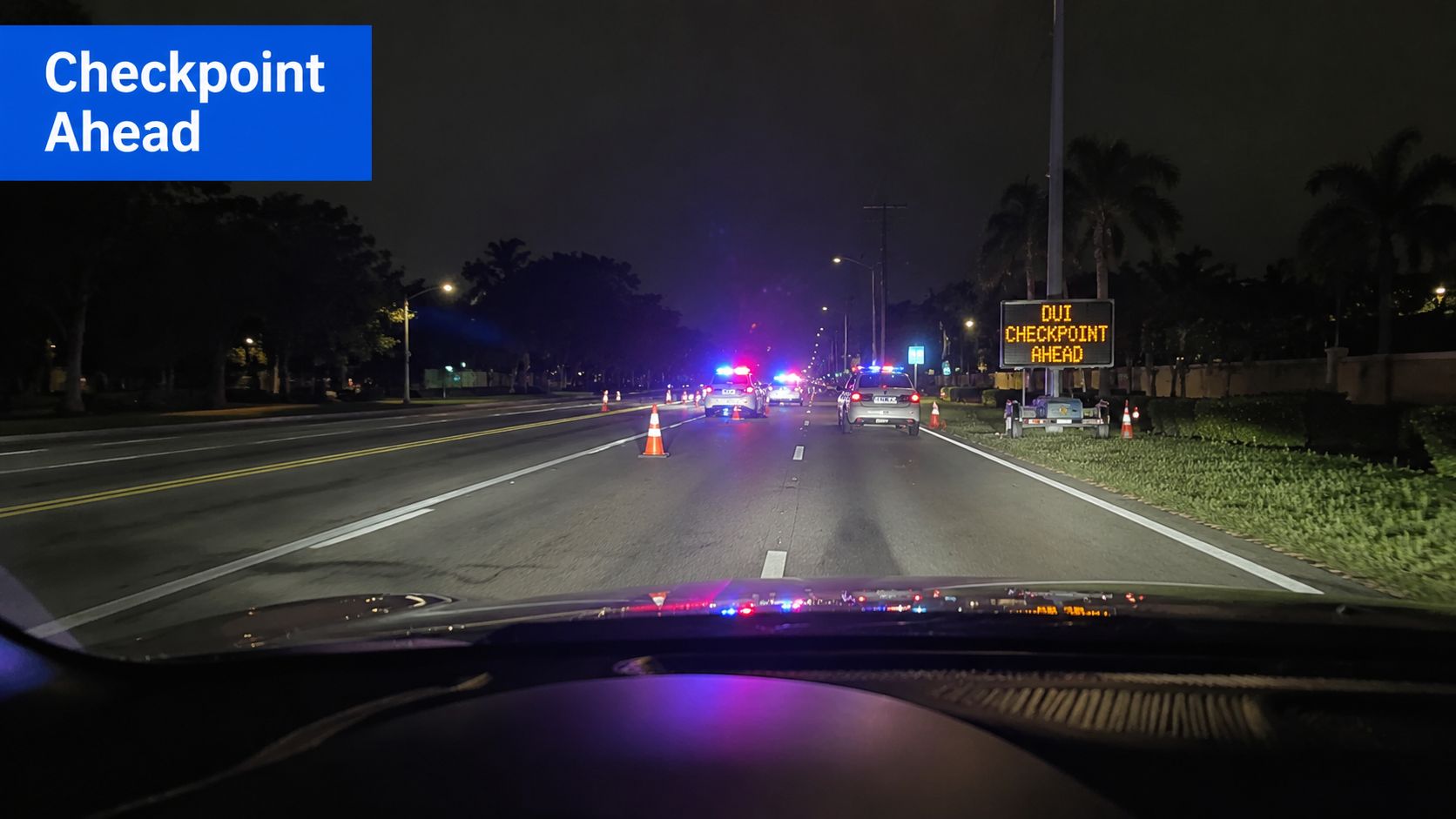
In that moment, most drivers make one of two mistakes. They either talk too much because they're nervous, or they act offended and make the stop harder than it needs to be. Both can hurt you.
What matters in the first minute
At a checkpoint, police are looking for quick indicators they can use to justify pulling you out of the line and into a full DUI investigation. They watch your hands, your face, your speech, your documents, and every casual answer you give.
A simple exchange can become evidence fast:
Where are you coming from
Have you had anything to drink tonight
Why are your eyes red
Why are you so nervous
Those aren't harmless conversation starters. They're evidence gathering.
Practical rule: Be polite, keep your movements calm, hand over required documents, and don't volunteer information.
The right mindset
You don't beat a checkpoint by arguing on the roadside. You protect yourself by giving police less to work with.
That means:
Stay calm: Sudden movements and sarcasm get remembered and written down.
Keep it simple: Produce what you're required to provide.
Don't perform roadside innocence: People often think explaining everything will help. Usually it adds statements the prosecution can use later.
Think defense early: What you do in the first two minutes can shape the entire case.
If you've already been stopped or charged, review how Florida DUI enforcement has changed under recent Florida DUI law updates. Timing, procedure, and officer conduct still matter, especially in checkpoint cases.
The Constitutional Basis for Sobriety Checkpoints
Most traffic stops require individualized suspicion. DUI checkpoints are different. That's why people are often shocked to learn they can be legal even when the officer had no reason to suspect that specific driver before the stop.
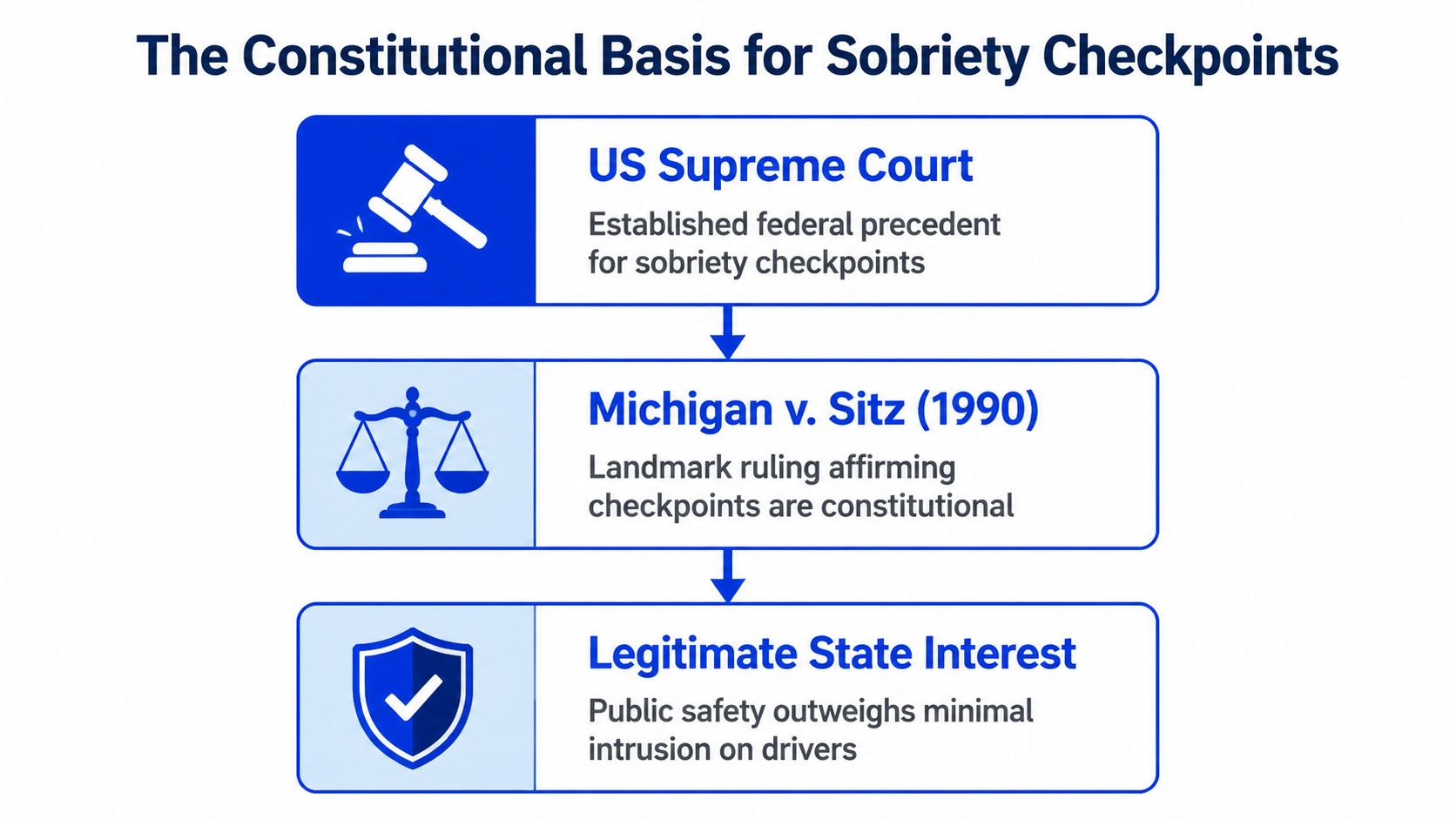
The federal starting point is Michigan Department of State Police v. Sitz, decided in 1990, where the U.S. Supreme Court upheld sobriety checkpoints as constitutional. Federal guidance later summarized the practical result: as of June 2020, 37 states plus the District of Columbia conducted sobriety checkpoints, while some states prohibit them and others allow them but rarely use them, as explained in the CDC checkpoint overview summarizing federal guidance.
Why the Supreme Court allowed it
The Court used a balancing approach. In plain English, the question was whether the government's interest in stopping impaired driving outweighed the limited intrusion on drivers who are briefly stopped.
Here's how to understand it: A normal stop is aimed at you personally. A checkpoint is supposed to be aimed at a roadway safety problem, not at picking individual targets. That distinction is the whole game.
For a checkpoint to pass that constitutional test, the stop has to stay narrow. It can't become an excuse for random fishing.
What a lawful checkpoint is supposed to look like
Federal guidance describes checkpoints as operations that are typically:
Highly visible
Publicly announced
Regularly conducted
Run with neutral stopping rules, such as every car or every third car
That structure matters because it limits arbitrary decisions by officers in the field. The law tolerates brief suspicionless stops only when the program is tightly controlled.
The constitutional argument usually isn't "checkpoints are always illegal." The real argument is often "this checkpoint didn't follow the rules that make one legal."
That's where many Florida DUI defenses begin. The Supreme Court gave states room to use checkpoints. It did not give police unlimited freedom to improvise them.
Florida's Strict Rules for Lawful DUI Checkpoints
Florida doesn't get a free pass just because checkpoints are allowed in principle. DUI checkpoint legality turns on control, planning, and restraint. If officers or supervisors don't set those limits in advance, the stop becomes vulnerable.
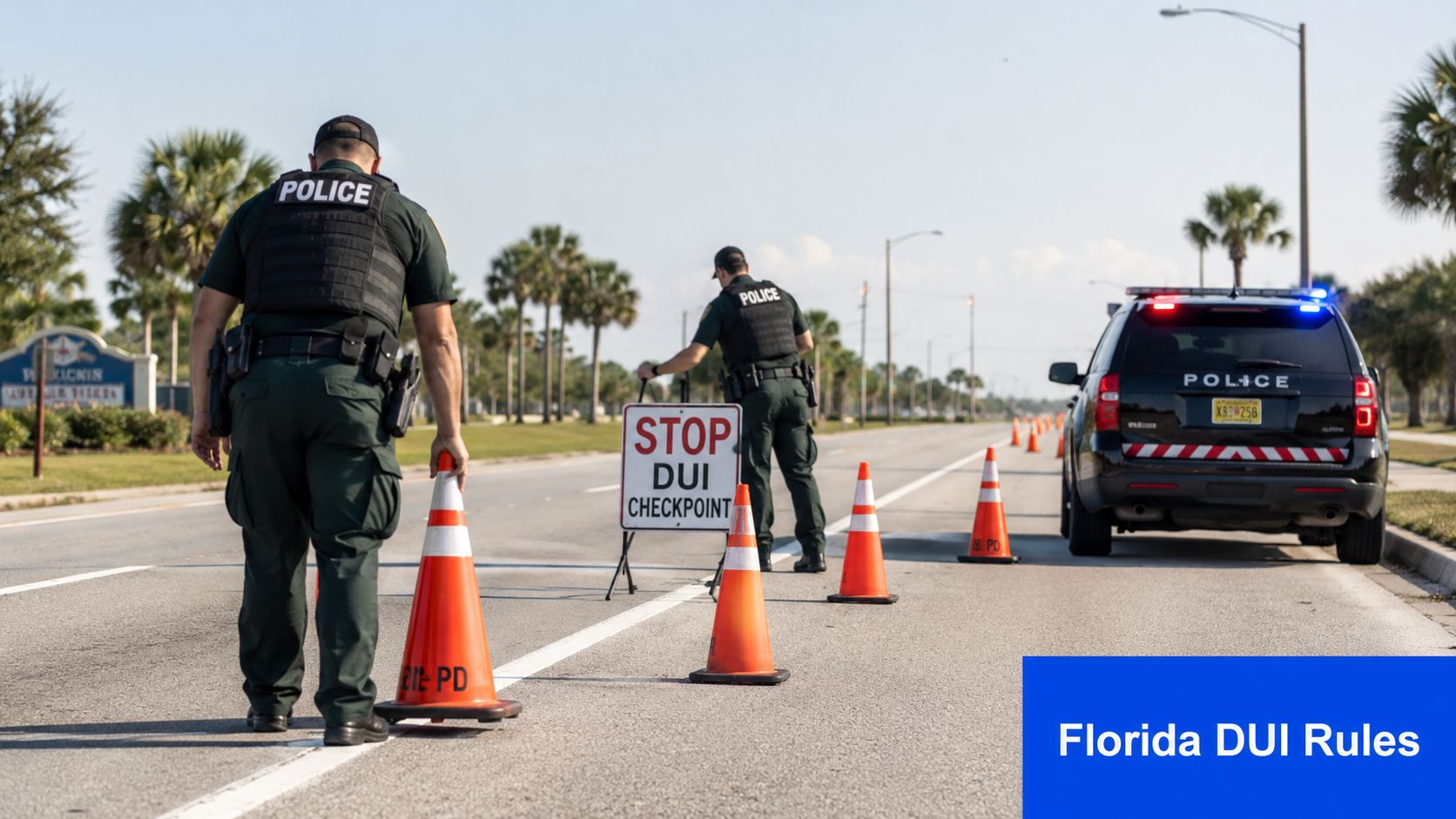
A useful legal summary appears in Justia's sobriety checkpoint explanation, which states that checkpoint legality is driven by a two-part constitutional test. The checkpoint must serve a roadway-safety purpose and be executed with objective, non-discriminatory limits on officer discretion. Courts commonly look for advance supervisory planning, public notice, neutral vehicle-selection rules, and reasonable time and place limits.
What I look for in a Florida checkpoint case
When I review a DUI arrest from Fort Lauderdale, Hollywood, Miami, Hialeah, West Palm Beach, or anywhere else in South Florida, I want the checkpoint records immediately. I don't accept "the officers were doing a DUI operation" as a legal answer.
I want to know whether law enforcement had:
Advance supervisory approval: The checkpoint should not be a spur-of-the-moment field decision.
A written operational plan or clear pre-set structure: The details should exist before the first car is stopped.
A neutral stopping formula: Every vehicle, every third vehicle, or another preset pattern. Not officer whim.
Reasonable location and duration limits: Time and place matter because courts examine intrusiveness.
Visible official markers: Cones, lights, patrol presence, and signs all help show the operation was official rather than arbitrary.
Public notice: Advance notice often matters because it reduces the surprise and coercive feel of the stop.
Where police often create problems for the State
The weak point in many checkpoint cases isn't the concept. It's execution.
Common issues include:
Problem | Why it matters |
|---|---|
Officers stop cars outside the neutral pattern | That suggests discretion replaced the plan |
The checkpoint plan is vague or missing | The State may struggle to prove lawful structure |
The stop lasts too long without reason | A brief screening can become an unlawful detention |
Officers use the checkpoint as a search shortcut | The stop's limited purpose gets distorted |
If you're facing a checkpoint arrest, you need someone who handles these cases from the defense side and understands how the State tries to justify them. One resource for that is the firm's Florida DUI defense hub, which covers common DUI evidence issues and defense strategy.
Your Rights How to Handle a Checkpoint Stop
At a checkpoint, your job is simple. Comply with lawful basics. Don't help build the case against yourself.
That sounds obvious, but stressed drivers often do the opposite. They answer every question, agree to unnecessary searches, and try to talk their way out of suspicion. By the time they call a lawyer, they've handed the State statements, observations, and consent it didn't have a minute earlier.
Here's the clean approach.
What you must do
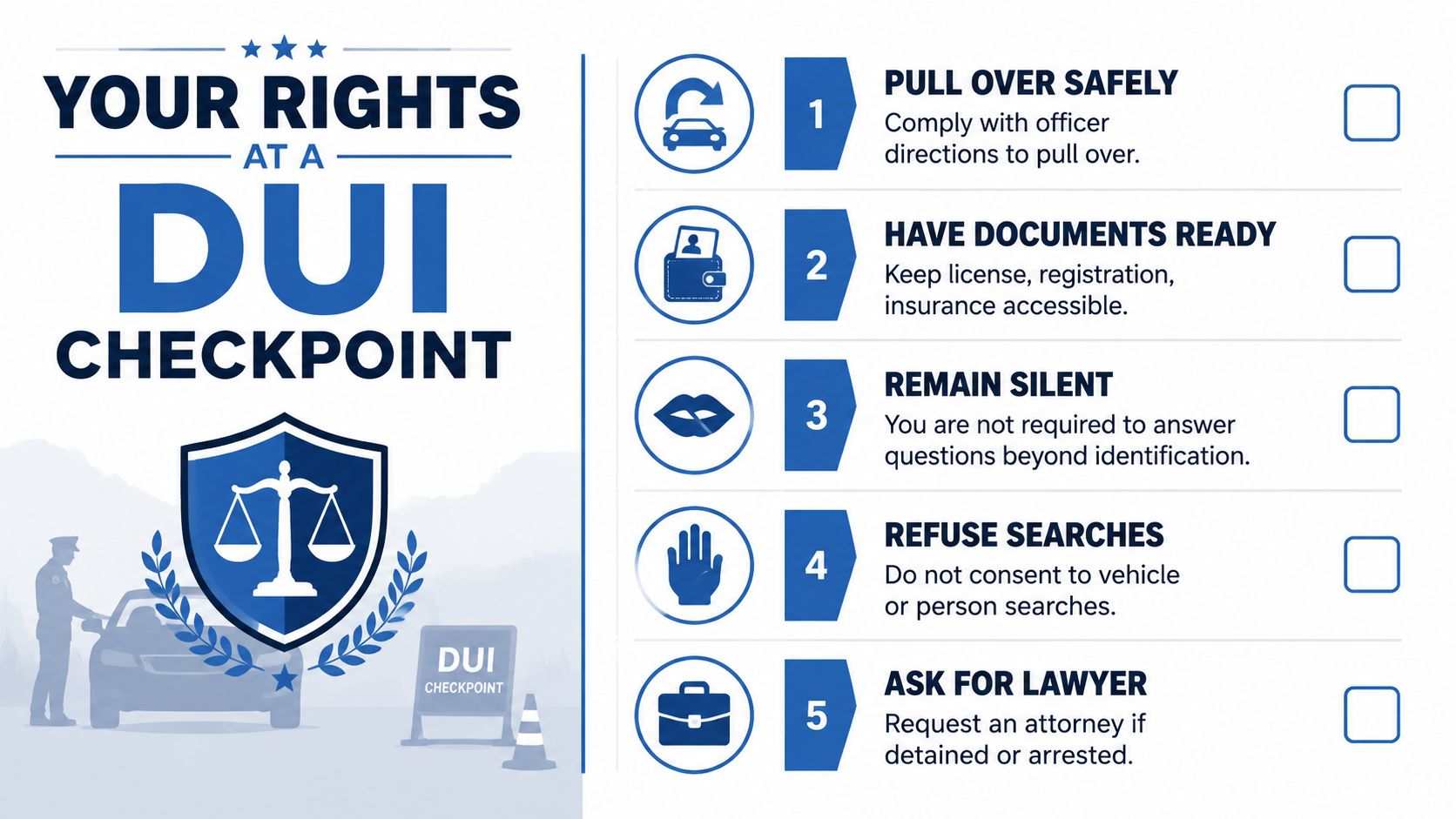
A recent consumer guidance summary states that drivers must provide license, registration, and insurance, but they do not have to answer incriminating questions and may refuse vehicle searches absent probable cause, a warrant, or consent, as noted in this discussion of checkpoint rights and refusals.
So at minimum, do this:
Pull over safely: Follow traffic direction and officer commands.
Provide identification documents: License, registration, and insurance.
Keep your hands visible: Don't create unnecessary tension.
Follow basic safety instructions: If an officer tells you where to stop, stop there.
What you usually should not do
Most checkpoint cases get stronger because the driver starts filling silence with explanations.
Don't do that.
Don't answer drinking questions: "Only two beers" is still an admission.
Don't guess or joke: Humor reads badly in a police report.
Don't consent to a vehicle search: If the officer has legal grounds, they'll act on them. Don't supply consent.
Don't volunteer medical, travel, or personal details unless needed for safety: Extra facts often become "indicators."
If an officer asks questions designed to get you to admit drinking, your safest answer is a calm refusal to discuss it.
A short response works better than an argument. You can be respectful without being helpful to the prosecution.
Field tests and breath issues
Drivers frequently get confused. There is a difference between roadside requests and later evidentiary testing. The source above also notes that refusing a breath test or field sobriety tests may have consequences under state implied-consent laws.
In practice, the critical point is this: you need to understand that some refusals can carry consequences, and those consequences depend on the type of test and the stage of the stop. That's why roadside decision-making matters so much.
If you're trying to understand how officers use balancing tests, divided attention tasks, and observations against you, read more about the Florida field sobriety test process.
A short explainer can help you visualize the encounter:
The script I recommend
Use plain, calm language.
Hand over the required documents
Stay polite
Decline to answer incriminating questions
Do not consent to a search
If detained or arrested, ask for a lawyer
Defense view: The roadside is not where you win. It's where you avoid making the case harder to defend later.
How to Challenge Evidence from a DUI Checkpoint
A checkpoint arrest is not a conviction. It is a file. And files can be attacked.
One of the biggest mistakes people make is assuming that if the checkpoint itself looked official, all the evidence will come in. That's wrong. A checkpoint can be lawful in theory and still produce suppressible evidence if police strayed from the plan or unlawfully expanded the stop.
That point is often missed in consumer articles, but it's central to defense work. A legal review discussing checkpoint challenges makes the same distinction: the primary issue is often whether the state permits checkpoints at all and whether the checkpoint complied with required planning rules, and a checkpoint may be lawful in principle while still creating suppressible evidence if officers deviated from the plan or expanded the stop unlawfully, as summarized in this analysis of checkpoint compliance and suppression issues.
How we take these cases apart
From a former prosecutor's standpoint, checkpoint prosecutions rely on a chain. If one link breaks, the State can lose key evidence.
I look at questions like these:
Was there a real plan, and can the State produce it
Did officers follow the neutral stopping sequence
Did the officer lawfully extend the encounter beyond the initial screening
Did the driver consent to something that police otherwise couldn't justify
Do the reports match the video and body camera footage
The motion that matters
In many checkpoint cases, the core pretrial fight is a motion to suppress. That motion asks the judge to exclude evidence because the stop, detention, search, or expansion of the encounter violated constitutional limits.
Here are common suppression angles:
Defense issue | What it targets |
|---|---|
Faulty checkpoint setup | The legality of the initial stop |
Deviation from stopping formula | Officer discretion and arbitrary enforcement |
Extended detention without new basis | The second stage of the encounter |
Unlawful search or coerced consent | Physical evidence or statements |
The strongest checkpoint defenses usually come from records, video, and officer inconsistencies. Not from speeches about fairness.
If the State claims an officer saw clues that justified moving you into roadside exercises, I also examine the technical basis for those observations, including tests like horizontal gaze nystagmus, because those details often decide whether an extended DUI investigation was justified.
Can You Legally Avoid a DUI Checkpoint
Yes, sometimes. But only if you do it legally.
A lot of drivers have heard the same bad advice for years: just turn around. That's incomplete and risky. You can generally avoid a checkpoint by making a safe, lawful turn before entering it. But if you make an illegal U-turn, cut across lanes, ignore traffic control devices, or drive in a way that looks evasive and unsafe, police may stop you based on that conduct.
The safe answer
If you see a checkpoint ahead and there is a lawful, ordinary route change available, taking it may be legal. The key is that your driving can't create a separate reason for a stop.
That means:
Use legal turns only
Signal properly
Don't brake hard or swerve
Don't violate any traffic law
Don't treat avoidance like a panic move
What gets people pulled over
Checkpoint avoidance becomes a problem when the driver turns a legal choice into suspicious driving. The issue usually isn't the decision to go another way. The issue is how they do it.
Bad examples include:
Abrupt lane changes near the checkpoint
Rolling through a prohibited turn
Stopping in the roadway
Driving onto a shoulder or private property in a strange way
A lawful turn is one thing. An unsafe or illegal maneuver gives police a fresh basis to stop you.
If you've already been stopped after trying to avoid a checkpoint, the exact location, timing, traffic pattern, and video footage matter. Those details can determine whether the officer had a valid reason to initiate the stop.
Frequently Asked Questions About Florida DUI Stops
Why are checkpoints legal if police usually need probable cause or suspicion to stop a car
Because courts treat checkpoints as a narrow exception when the operation serves roadway safety and uses structured limits on officer discretion. Policymakers keep supporting them in part because the public-safety data is measurable. NHTSA reports that CDC-reviewed evidence found sobriety checkpoints reduce alcohol-related fatal crashes by 9%, and a separate meta-analysis found 17% reductions in alcohol-related crashes, as explained in NHTSA's review of publicized checkpoint enforcement.
Do passengers have to show ID at a checkpoint
Not automatically in every situation. The answer can depend on what the officer is investigating and whether the passenger is being lawfully required to identify themselves under the circumstances. In most checkpoint situations, the initial focus is on the driver.
Can I film the police during a checkpoint stop
In many situations, yes, as long as you don't interfere with the officers or create a safety issue. Keep your phone movement calm and obvious. Don't reach suddenly into hidden areas while an officer is approaching your vehicle.
What is the difference between refusing roadside testing and later official testing
The difference can be serious. Roadside requests and later official evidentiary testing are not always treated the same way, and refusal consequences can depend on state implied-consent rules and the stage of the case. If refusal is an issue in your case, get legal advice immediately because that decision can affect both the criminal file and your license situation.
If the checkpoint looked professional, is my case hopeless
No. Professional appearance doesn't prove legal compliance. In checkpoint cases, we often learn more from planning records, body camera footage, stop timing, and officer testimony than from what the scene looked like to drivers.
What should I do after a checkpoint arrest in South Florida
Do three things immediately:
Write down everything: Location, time, officer statements, what you were asked, and what you said.
Preserve documents and notices: Especially anything involving your license.
Call a defense lawyer early: Checkpoint challenges are fact-specific, and early review matters.
If you were arrested after a checkpoint in Fort Lauderdale, Broward County, Miami-Dade, Palm Beach, or anywhere in South Florida, contact Ticket Shield, PLLC for a confidential consultation. A checkpoint case can rise or fall on planning records, officer conduct, and what happened in the first few minutes of the stop. Early defense work gives you the best chance to challenge the evidence, protect your license, and control the case before the State locks in its version of events.
Florida DUI checkpoints must follow strict legal requirements. Learn what officers can and can't do — and your rights when stopped.