DUI Probation Florida: Rules, Conditions, and Defenses
Jason Goldsmith, Esq
You've just been convicted of DUI in Florida, and the relief you felt about avoiding substantial jail time is starting to fade. Your probation officer has given you reporting instructions, your court order lists classes and community service, and you're worried that one missed appointment, incomplete log, or unexpected ignition-interlock reading could put your freedom at risk.
That concern is justified. Florida DUI probation is structured, mandatory, and technical. The safest approach is to treat every condition as a deadline backed by evidence. Keep records, ask questions before acting, and get legal advice immediately if you believe something has gone wrong.
Table of Contents
Understanding DUI Probation in Florida
A first DUI conviction can leave you working, caring for family, and living at home while the court still controls important parts of your routine. Florida law requires a DUI conviction to include monthly reporting probation, and a first conviction carries a probation term of no more than 1 year under Florida Statute 316.193. You remain in the community, but your compliance is monitored.
A common South Florida problem starts with an ordinary month. Your probation officer sets a report date, the DUI program requests completion records, and the court order requires vehicle immobilization or impoundment. You keep your job and meet your family obligations, yet a missing receipt, incomplete community-service log, or late report can become a new court issue.
Practical rule: Treat the probation order as the judge's checklist. Document every required step before the deadline.
Your exact conditions control. They may require in-person reporting, DUI education or treatment, community service, driving restrictions, and compliance with all laws. The sentence, written court order, and applicable Florida law determine what applies to you. Another person's probation terms are not a safe guide.
The hidden risk is technical compliance. Community service hours need accurate logs and authorized verification. Vehicle restrictions and ignition-interlock requirements can create separate problems if you use the wrong vehicle, miss a service appointment, or ignore a device warning. Keep copies of every receipt, appointment confirmation, completion certificate, and message with your probation officer.
Probation also affects transportation, money, work schedules, and communication with the court long after the arrest. If an officer or program says you failed a condition, act before the issue becomes a formal violation. For background on the underlying rules and defense issues, review this Florida DUI law resource. Local procedures in Broward County, Fort Lauderdale, Miami-Dade, Palm Beach, and other South Florida jurisdictions can affect how quickly a compliance concern reaches a judge.
Comparing Standard Probation and Diversion Programs
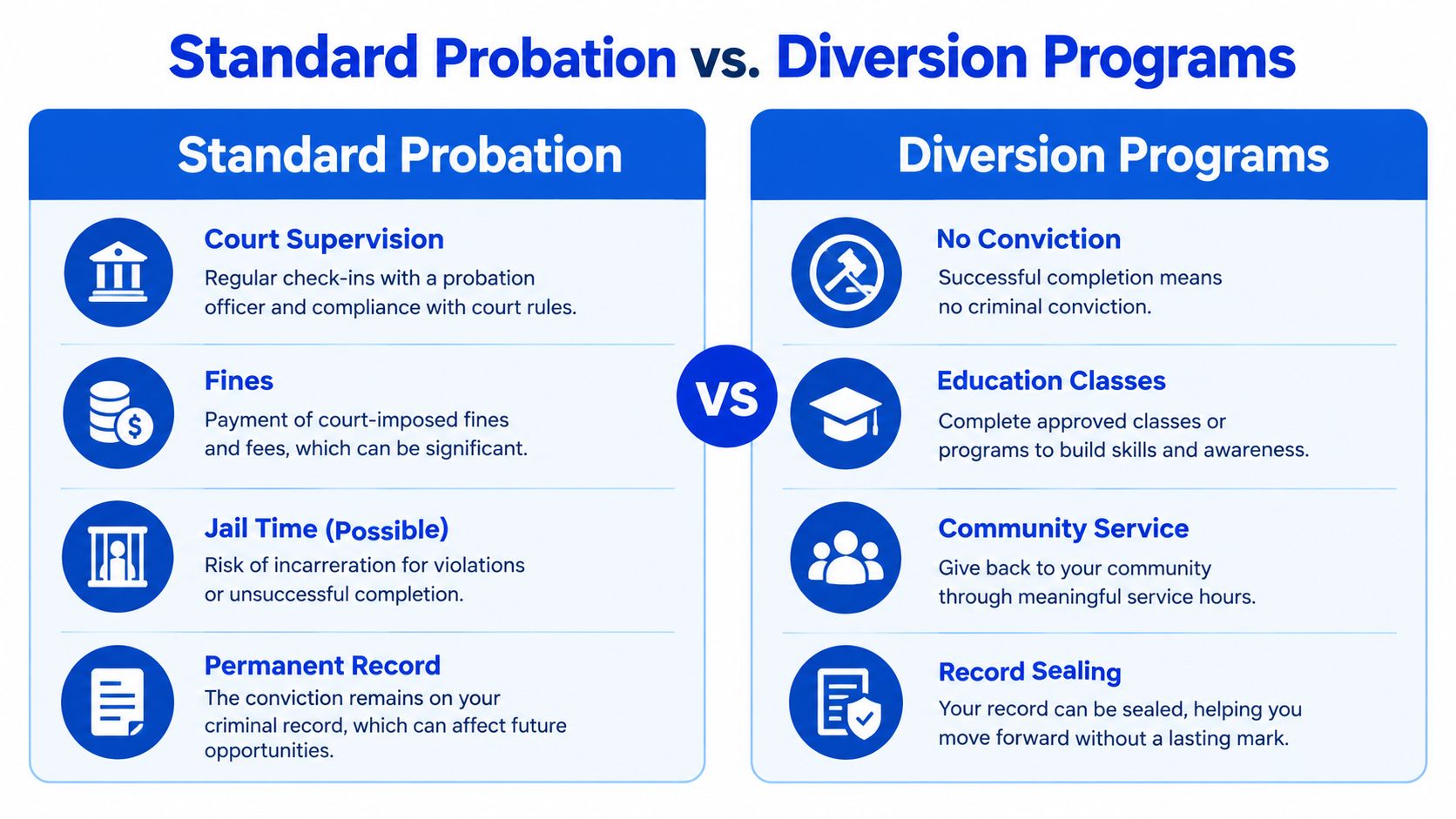
Standard probation and diversion are not interchangeable. Standard probation generally follows a conviction or plea resolution, while diversion is designed to resolve eligible cases before a conviction is entered. That difference can affect your record, your obligations, and the consequences of a mistake.
Standard probation places you under court supervision after the case has been adjudicated or otherwise resolved through a sentence. You must follow the written conditions, report as directed, complete required programs, and satisfy financial or service obligations listed in the order. A violation can expose you to sanctions, including possible incarceration.
Diversion operates as a negotiated alternative for qualifying defendants. Programs may emphasize education, treatment, evaluation, and accountability. Successful completion may allow the case to end without a formal conviction, depending on the program and negotiated agreement. Eligibility isn't automatic, and DUI cases can involve strict prosecutorial policies, so early legal review matters.
The strategic difference before a plea
Once you accept a resolution that includes a conviction and probation, you've usually given up the opportunity to use diversion as a pretrial negotiating tool. That's why a Fort Lauderdale DUI lawyer should examine diversion eligibility, evidentiary weaknesses, and charge-resolution options before you enter a plea.
A defense lawyer may evaluate:
The traffic stop: Whether the officer had a lawful basis to stop your vehicle.
Field sobriety evidence: Whether instructions, conditions, medical issues, or recording gaps affect the observations.
Chemical testing: Whether collection, maintenance, administration, and interpretation raise admissibility questions.
Prior record: Whether the prosecutor's position changes based on your history.
Collateral consequences: How a conviction could affect your license, employment, insurance, and immigration status.
Diversion isn't a guaranteed escape from consequences. It can require prompt enrollment, strict attendance, and complete compliance. But it may offer a better strategic path than accepting a permanent conviction without first examining alternatives. You can learn more about the process through this guide to Florida pretrial diversion programs.
Mandatory Conditions and Timelines for First Offenders
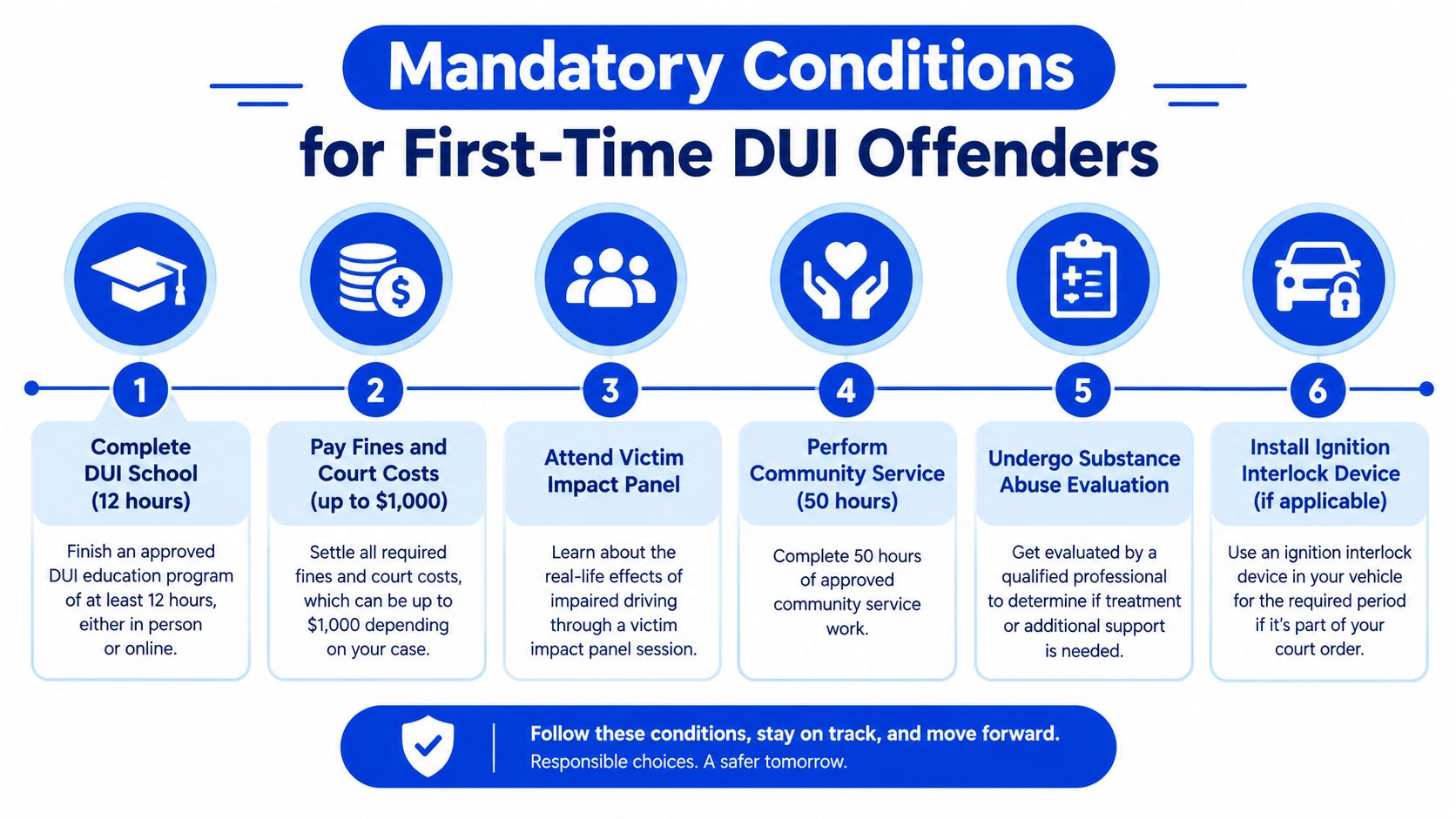
A first-offense sentence becomes a compliance project the moment the judge signs it. Build a written checklist before your first probation appointment. Florida requires monthly reporting probation and at least 50 hours of public service or community work for a first DUI conviction. The combined probation and incarceration period cannot exceed 1 year, and the court must order vehicle impoundment or immobilization for 10 days, subject to the lease or rental-agreement rule in the statute.
Build a compliance file
Use a physical folder and a digital backup. Store the signed probation order, probation officer instructions, class enrollment records, attendance confirmations, community-service logs, payment receipts, vehicle documents, and every compliance-related email or text.
Your checklist should cover:
Reporting: Confirm the date, location, and method for every monthly probation appointment. Record each appointment immediately.
Community work: Log the organization, service date, hours, supervisor, and written verification for every shift. The legal minimum is 50 hours, and the court may require more when justified, as reflected in Florida DUI guidance. Missing documentation can create a violation problem even when you performed the work.
Programs and evaluations: Complete every DUI education course, substance-abuse evaluation, treatment requirement, and other program listed in the order. Confirm enrollment and completion in writing.
Financial obligations: Track fines, costs, and payment deadlines. If payment is difficult, communicate before the deadline and ask counsel about requesting a modification.
Vehicle restrictions: Confirm whether the vehicle must be impounded or immobilized. Identify who must arrange compliance and retain the supporting records.
Proof of completion: Do not assume a provider reports completion automatically. Obtain written confirmation and submit it through the channel your probation officer accepts.
Technical details often trigger violations. A supervisor's memory, a phone call with a clerk, or an informal promise that a deadline is flexible may not protect you at a hearing. Get every instruction in writing, preserve delivery proof, and report problems before they become missed conditions.
Ignition Interlock Devices and License Impacts
An ignition-interlock device, or IID, adds a hardware-based compliance layer to DUI probation. It requires a breath sample before the vehicle starts and can record attempts, alerts, service events, and other information. Florida law allows a court to require an approved interlock for at least 6 continuous months when a DUI offender is permitted to drive. In certain aggravated first-offense cases, the requirement is mandatory for at least 6 months, and a qualifying second offense carries at least 2 continuous years, according to Florida's ignition-interlock statute.
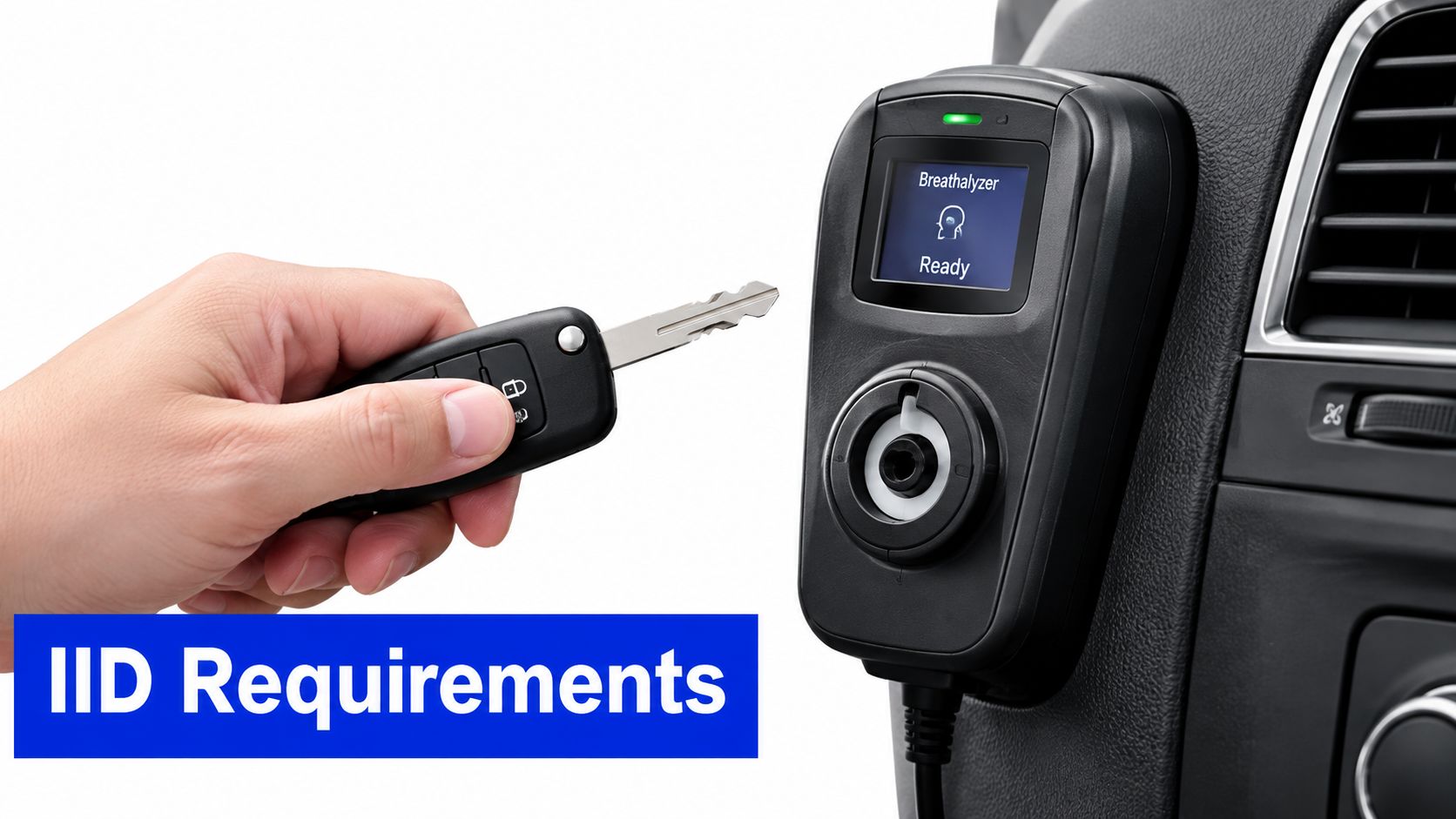
The device is calibrated to prevent the vehicle from starting when the breath-alcohol reading exceeds 0.025%, so an unexpected reading can become a compliance issue even when you believe you haven't consumed alcohol. Florida guidance explains that an IID generally isn't required for most first offenses, but it may be ordered in other situations, and it becomes mandatory for an aggravated first offense involving a BAC of 0.15% or more or a passenger under 18 years old, with a minimum interlock period of 6 months, as described in Florida first-offense DUI guidance.
Manage the device like evidence
Never allow another person to provide a breath sample for your vehicle. Don't tamper with the device, ignore a service appointment, or assume a warning is harmless. Keep every calibration receipt and service report. If the device reports a failed test or lockout, write down what happened immediately, preserve receipts and medical or product information, and contact your lawyer.
Follow the provider's instructions about food, beverages, personal-care products, and retesting. If an error appears, ask the provider for a written explanation and preserve the data. Don't argue with the machine at the roadside or attempt repeated starts without understanding the instructions.
The IID requirement can also affect your license status and the vehicles you're permitted to operate. Before driving, confirm that your license is valid for that vehicle and that every restriction has been satisfied. For questions about restoring driving privileges, consult this guide to license reinstatement after a Florida DUI.
Navigating Technical Violations and Defenses
A probation violation isn't automatically proof that you intended to disobey the court. A missed appointment may result from a medical emergency. A community-service provider may record hours incorrectly. An IID may produce a disputed reading. Those facts don't make the allegation disappear, but they can shape the defense and the outcome.
The first step is to stop treating the problem as a private misunderstanding. Contact your defense lawyer, preserve documents, and avoid making casual admissions before you understand the allegation. Read the violation affidavit carefully and compare it with your sentence, reporting records, provider documents, and communications.
Common technical traps
Missed reporting: Save medical records, work schedules, transportation records, and proof of any notice you gave the probation officer.
Incomplete service logs: Ask the organization to correct errors and provide a signed verification rather than relying on your own estimate.
Program deadlines: Obtain enrollment and attendance records immediately. A completed class may not help if the provider never transmitted proof.
Disputed testing: Preserve prescriptions, product information, test paperwork, and any request for confirmation testing.
Payment problems: Document income, expenses, attempted payments, and communications about hardship. Silence looks worse than a documented effort to comply.
Driving restrictions: Don't drive until counsel confirms your license status and the specific conditions governing your vehicle.
A technical allegation is still serious, but it is not the same as a new criminal case. The facts and your response matter.
At a violation hearing, the court can examine whether the violation occurred and whether the conduct was willful. The government's burden is lower than the burden required for a criminal conviction, which makes preparation essential. Counsel may challenge unreliable records, expose notice failures, present proof of impossibility or hardship, dispute the underlying event, or negotiate a reinstatement plan.
Possible resolutions can include dismissal of the allegation, reinstatement of probation, additional conditions, or another court-approved modification. Jail is not the only possible result, but waiting until an arrest occurs can narrow your options. A detailed discussion of these issues appears in this resource on technical probation violations.
How Ticket Shield PLLC Protects Your Rights
DUI probation defense starts before the alleged violation becomes a crisis. Attorney Jason S. Goldsmith is a former prosecutor, and that experience can help identify how the State may evaluate a disputed report, incomplete record, or technical compliance issue in Broward County and surrounding South Florida courts.
The defense process should be practical. Your lawyer should compare the allegation with the actual sentence, contact the relevant provider or probation office, collect records, and identify whether the issue involves a misunderstanding, inaccurate documentation, inability to comply, or intentional conduct. The goal is to present the judge with facts and a workable compliance plan, not excuses.
Ticket Shield, PLLC handles DUI defense and probation matters, including challenges involving:
The original stop: Whether the traffic stop complied with constitutional requirements.
Field sobriety testing: Whether the officer's instructions and observations are reliable.
Search and seizure: Whether police obtained evidence lawfully.
Charge negotiations: Whether a reduction or alternative resolution is legally available.
Probation violations: Whether the alleged breach can be challenged or resolved without revocation.
The firm serves clients in Fort Lauderdale, Broward County, Miami-Dade, Palm Beach, and other Florida jurisdictions. Direct communication by phone, text, or email can make a difference when an appointment is missed, a device reports an unexpected result, or a probation officer contacts you about noncompliance.
You can review the firm's Florida DUI defense services and request a confidential consultation. Don't wait for a warrant or hearing date if you already know there's a problem. Early documentation gives your lawyer more ways to protect your license, record, and freedom.
Frequently Asked Questions About Florida DUI Probation
Can I travel outside Florida while on DUI probation?
Maybe, but don't assume permission. Review your written conditions and ask your probation officer or lawyer before making plans. Provide the destination, purpose, dates, transportation details, and contact information, and obtain approval in writing when required.
Can probation end early?
Early termination depends on the sentence, the court's authority, your compliance history, and the prosecutor's position. A lawyer can review whether you've completed required conditions, maintained a clean record, and developed a legitimate basis for requesting relief. The judge makes the final decision.
What should I do if I miss a probation appointment?
Contact your probation officer promptly, explain the reason, request a new appointment, and preserve proof of the circumstances. Then speak with a defense lawyer before the issue escalates. Don't ignore calls, letters, or an affidavit of violation.
What happens after an affidavit of violation?
The court may schedule a violation hearing and may issue process requiring you to appear or be taken into custody. Your lawyer can review the allegation, gather records, address release concerns, and prepare defenses or negotiations. Don't discuss the facts casually with anyone before receiving legal advice.
Is a technical violation less serious than a new offense?
It can be treated differently, but it remains serious. A missed class or reporting appointment may be defensible when the failure wasn't willful, while a new criminal allegation can create separate exposure. Your response should address the exact condition and include proof of your effort to comply.
Ticket Shield, PLLC offers confidential Florida DUI defense and probation-violation guidance, including help with technical allegations, travel requests, license concerns, and court strategy. Visit Ticket Shield, PLLC to request a consultation before a probation problem becomes a warrant, revocation, or jail issue.