
Aggravated Battery Florida: Penalties, Defenses, and Legal
Jason Goldsmith, Esq
You're at work when your phone rings. A family member has been arrested after a bar fight, a domestic dispute, or a confrontation that initially sounded minor. Then you see the booking charge: aggravated battery. The words are intimidating, and the family often doesn't know whether the case involves a serious injury, a weapon allegation, or a misunderstanding that grew during the arrest.
Florida treats this charge as a serious violent felony. The accusation can affect custody, employment, professional licensing, immigration status, firearm rights, and your ability to contact the alleged victim. If you're searching for information about aggravated battery in Florida, focus on the facts that control exposure: what the State must prove, how the charge was documented, whether a protected victim or prior record changes the case, and how local courtroom practices affect negotiations.
Table of Contents
What Aggravated Battery Charges Mean for Your Future
An arrest after a bar fight, domestic dispute, or chaotic confrontation can change your future before the facts are fully understood. The booking charge may depend on an alleged serious injury, a weapon, or the claim that the other person was pregnant. In Florida, aggravated battery is generally a second-degree felony under Florida Statute 784.045.
The general sentencing framework permits up to 15 years in prison, 15 years of probation, and a $10,000 fine for a second-degree felony. That is the ceiling, not an automatic sentence. Your actual exposure can shift sharply based on the injury evidence, prior record, alleged victim category, weapon allegation, and the county handling the case. A judge and prosecutor in one venue may approach bond and plea negotiations differently from those in another.
The arrest report is only an early version of events. Witnesses may have been drinking, security footage may be incomplete, and a medical record may describe an injury differently from the initial police report. The State can still pursue a felony charge in Florida using an officer's description, witness statements, photographs, or medical information collected after the arrest.
Why the first days matter
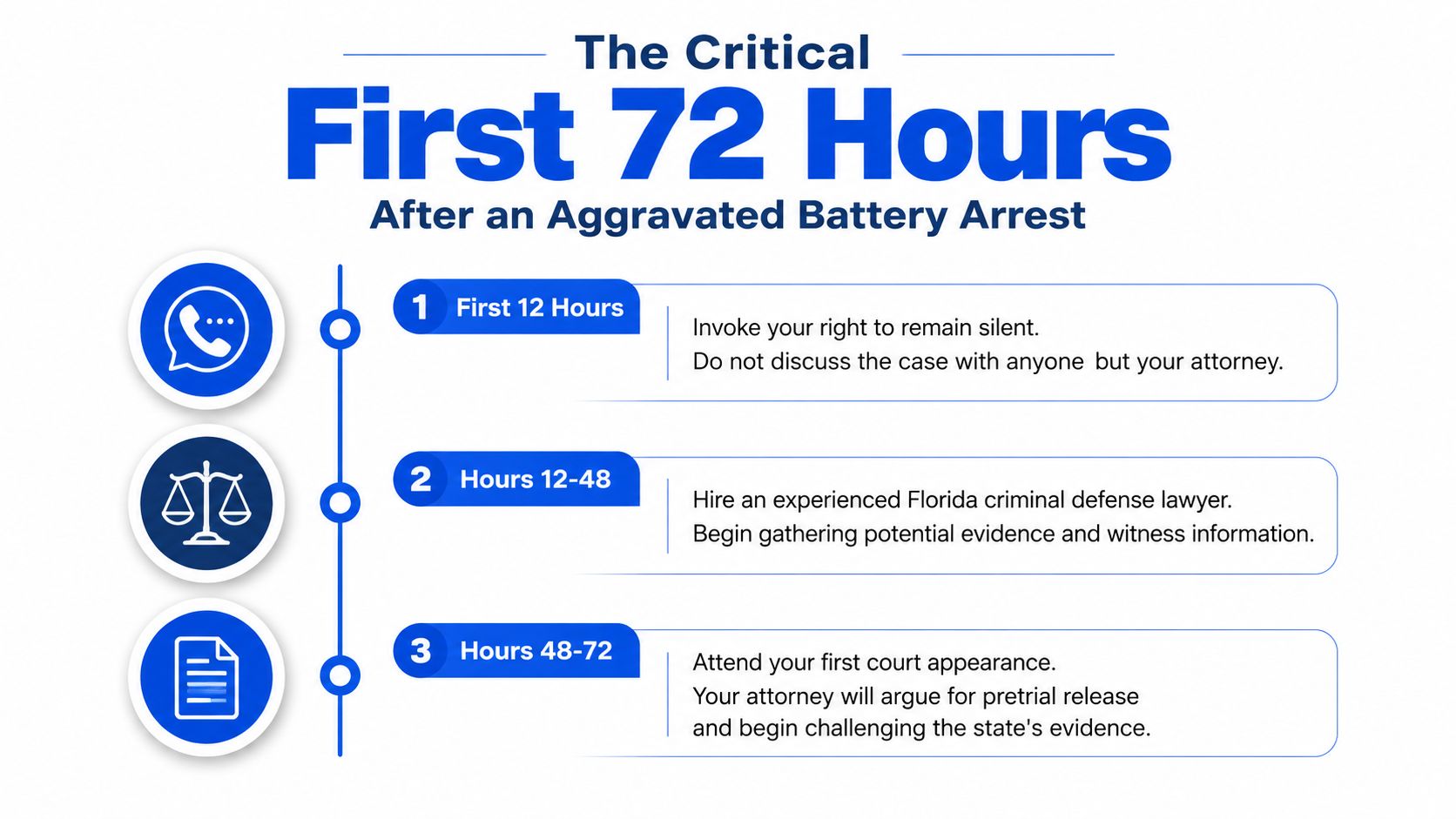
The first 72 hours can shape the defense. At the initial hearing, a judge may impose bond conditions, including no-contact restrictions. Prosecutors may keep the booked charge, file a different charge, or review additional evidence before formal filing.
Do not contact the alleged victim. An apology, explanation, request to retrieve belongings, or attempt to correct a statement can become evidence or create a separate allegation that you violated a court order.
Practical rule: Treat every call, text, social-media post, and conversation about the incident as potential evidence. Discuss the facts with your lawyer, not with the alleged victim, witnesses, or online contacts.
Your lawyer should examine the injury classification, alleged weapon, intent, identification, witness reliability, and evidence collection. Preserve messages and video, avoid public explanations, and get advice before making statements or accepting a plea.
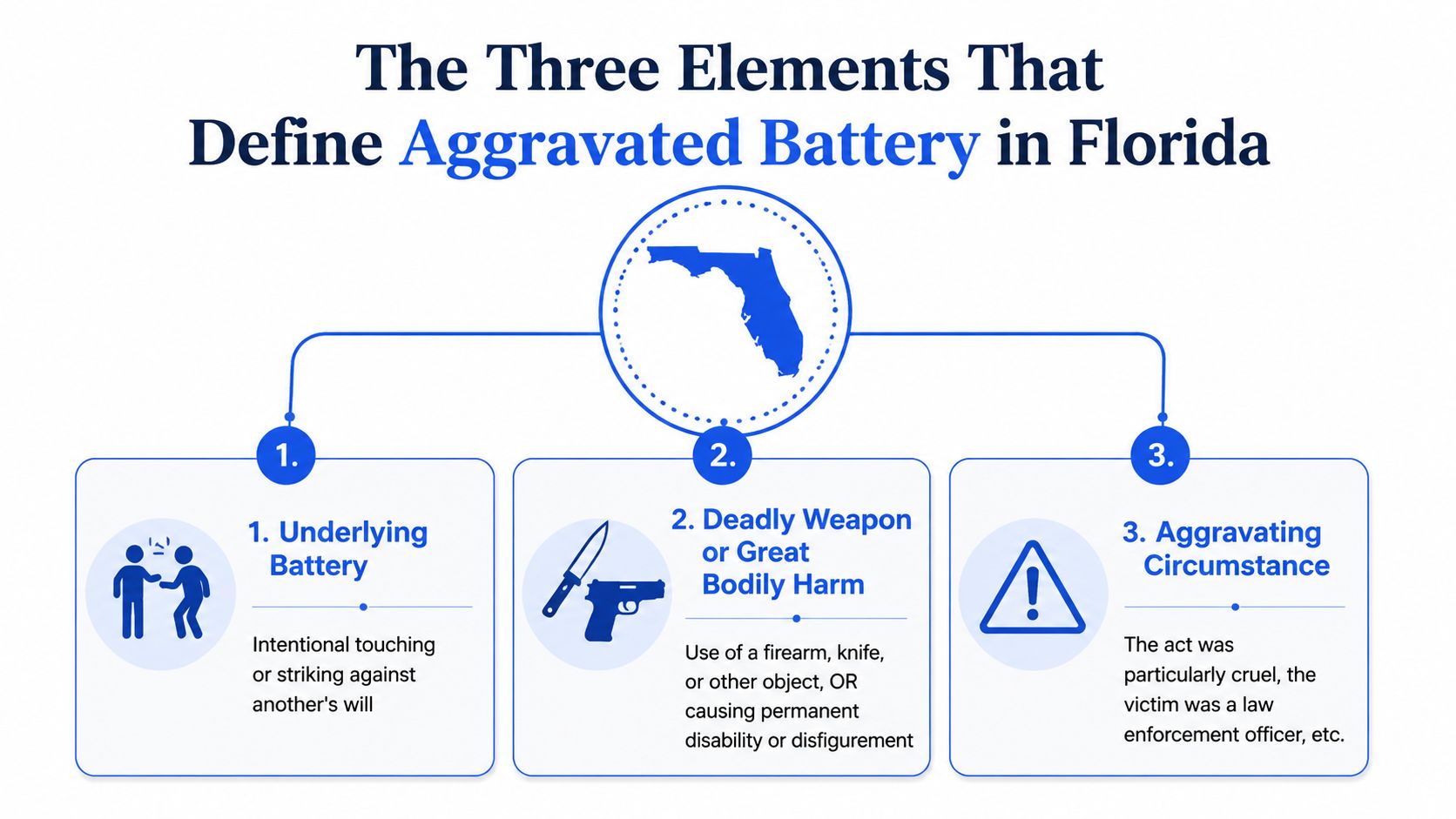
The Three Elements That Define Aggravated Battery in Florida
The State must prove the charged offense beyond a reasonable doubt. In practical terms, the prosecution must establish the underlying battery and the specific aggravating basis alleged in the charging document. If the evidence fails on a required part, the aggravated charge can't stand.
The underlying battery
Florida battery generally involves intentionally touching or striking another person against that person's will, or intentionally causing bodily harm. The contact doesn't have to look dramatic. A shove, slap, grab, or strike can supply the battery allegation if the State can prove the contact was intentional and unwanted.
That makes the surrounding evidence important. A collision in a crowded bar, an accidental movement during a struggle, or contact while separating two people may support a lack-of-intent defense. Video, witness positioning, lighting, and the sequence of events can matter more than a short description in an arrest affidavit.
The aggravating basis
The statute identifies distinct ways the battery becomes aggravated:
Great bodily harm, permanent disability, or permanent disfigurement: The State must connect the defendant's intentional or knowing conduct to the alleged serious harm. Medical records, photographs, treatment decisions, and expert testimony may become central.
Deadly weapon: A firearm or knife can qualify, but prosecutors may also argue that a bottle, vehicle, flashlight, or another ordinary object became deadly because of the way it was used or threatened.
Pregnant victim: The State must address whether the victim was pregnant and whether the defendant knew or should have known that fact.
A thrown beer bottle may be treated as a deadly weapon if the State claims it was used in a manner likely to cause serious harm. A broken nose may or may not satisfy the legal threshold for great bodily harm. The precise injury, treatment, lasting effect, and proof connecting the injury to the incident all matter.
Intent and circumstantial proof
Intent rarely appears in a written confession. Prosecutors may rely on statements before the confrontation, conduct during the incident, actions afterward, text messages, witness descriptions, and the alleged force used. Text messages sent before a meeting may be offered to argue that the defendant planned a confrontation, while later conduct may support either side's interpretation of what happened.
The defense doesn't need to prove that nothing happened. It can focus on whether the State can prove every required element, including the correct aggravating theory. A charge based on a weapon requires a careful examination of the object and its use. A charge based on injury requires a careful examination of the medical proof. For a broader explanation of the underlying offense, see battery charges in Florida.
Simple Battery Versus Aggravated Battery Explained
The same physical encounter can produce very different charges. A shove that leaves no meaningful injury may be treated differently from a shove that causes a fall and a serious wrist injury. A slap and a strike with a heavy flashlight may involve similar allegations of intentional contact, yet the claimed object can change the prosecution's theory.
Factor | Simple Battery, 784.03 | Aggravated Battery, 784.045 |
|---|---|---|
General classification | First-degree misdemeanor | Second-degree felony |
Maximum exposure | Up to 1 year in jail | Up to 15 years in prison |
Core conduct | Intentional unwanted touching, striking, or intentional bodily harm | Battery plus a statutory aggravating basis |
Injury trigger | No aggravated injury requirement | Great bodily harm, permanent disability, or permanent disfigurement |
Weapon trigger | No deadly-weapon allegation required | Use of a deadly weapon |
Victim-status trigger | Ordinary battery allegation | Victim known or reasonably expected to be known to be pregnant |
Practical consequence | Misdemeanor case | Felony case with broader long-term consequences |
The simple-battery maximum and classification are described in Florida battery law materials. The aggravated-battery classification and statutory triggers come from Florida's aggravated-battery statute linked above.
Why the charging paperwork matters
Police reports often summarize injuries and witness accounts quickly. An officer may describe a weapon as “used” without explaining how it allegedly created a risk of serious harm. The report may characterize an injury before complete medical records are available. Those descriptions can influence the initial charge, but they aren't the final word on what the State can prove.
A defense lawyer should compare the arrest affidavit with photographs, body-camera footage, 911 audio, surveillance video, medical records, text messages, and independent witness accounts. The central question is whether the evidence supports aggravated battery, a lesser offense, or no provable battery at all.
A felony conviction can also create consequences beyond incarceration. Firearm possession may be restricted, civil rights may be affected, and immigration consequences may be possible for noncitizens. Those consequences make an early review of the charge more important than just asking whether the alleged victim wants to continue.
Penalties and Sentencing Ranges You Need to Understand
A booking label does not tell you the full exposure. A second-degree aggravated-battery charge can carry up to 15 years in prison, 15 years of probation, and a $10,000 fine under Florida's general felony framework. The Florida aggravated-battery statute sets out the offense and its aggravating circumstances. The likely result depends on the charge, available proof, prior record, victim category, alleged weapon, injury, and county.
Florida courts use a Criminal Punishment Code scoresheet. Prior convictions and offense-related factors can affect the recommended range. The prosecutor and judge also weigh release conditions, mitigation, plea terms, and the strength of the evidence. A clean record helps, but it does not erase a weapon allegation or persuasive injury evidence.
The penalty escalators
Several facts can raise the stakes quickly:
Victim category: Florida has separate enhancement provisions for older adults and other protected victims. Those provisions may support reclassification or mandatory sentencing beyond the base offense.
Prior violent history: A qualifying conviction can change how the State charges the case and what plea terms it will consider. Counsel must verify the record, disposition, and legal relevance of every prior case.
Weapon allegation: A deadly-weapon allegation can change the felony analysis. Firearm-related rules may create separate mandatory consequences, so the defense must identify exactly what the State claims the defendant did with the firearm.
Older adult victim: Florida provides a special enhancement for aggravated battery involving a victim 65 or older. A conviction carries a mandatory minimum of 3 years in prison, a fine of up to $10,000, restitution, and up to 500 hours of community service, according to the Florida statutory provision.
Florida's 2026 statutory updates also include a prior conviction for resisting an officer with violence among reclassification factors in the relevant battery framework. Protected-victim allegations involving an older adult, code inspector, or law-enforcement officer can produce more serious exposure. The charging document and statutory subsection matter more than the booking label.
Why local venue matters for sentencing
Public-record data compiled across Florida counties shows state-prison outcomes for section 784.045 ranging from the teens to nearly 70%, with Duval at 68.7%, Pinellas at 56.5%, and Palm Beach at 47.6%. These figures appear in the Florida Senate materials concerning section 784.045.
Those figures do not predict an individual result. They do show why county matters. Charging habits, plea policies, judicial expectations, diversion options, and the treatment of injury and criminal history can affect negotiations in Broward County, Miami-Dade, Palm Beach, and other Florida jurisdictions. A lawyer should assess the local courtroom before advising you about a plea.
Scenario | Felony degree | Maximum prison | Mandatory minimum | Key trigger |
|---|---|---|---|---|
Base aggravated battery | Second-degree felony | Up to 15 years | Not stated by the base statute | Serious harm, deadly weapon, or pregnant victim allegation |
Aggravated battery involving an older adult | Enhanced exposure under separate statutory provisions | Depends on the applicable provision | 3 years | Victim is 65 or older |
Reclassified aggravated battery | First-degree felony may apply in certain circumstances | Depends on the applicable provision | May apply in some contexts | Protected victim, weapon, or prior-record pathway |
Do not judge a plea offer only by the sentence printed on the page. Ask about probation, restitution, no-contact terms, firearm restrictions, immigration consequences, professional licensing, and the lasting effect of a felony record. The Florida second-degree felony law provides further explanation of the classification.
Common Defenses That Can Reduce or Dismiss Your Charges
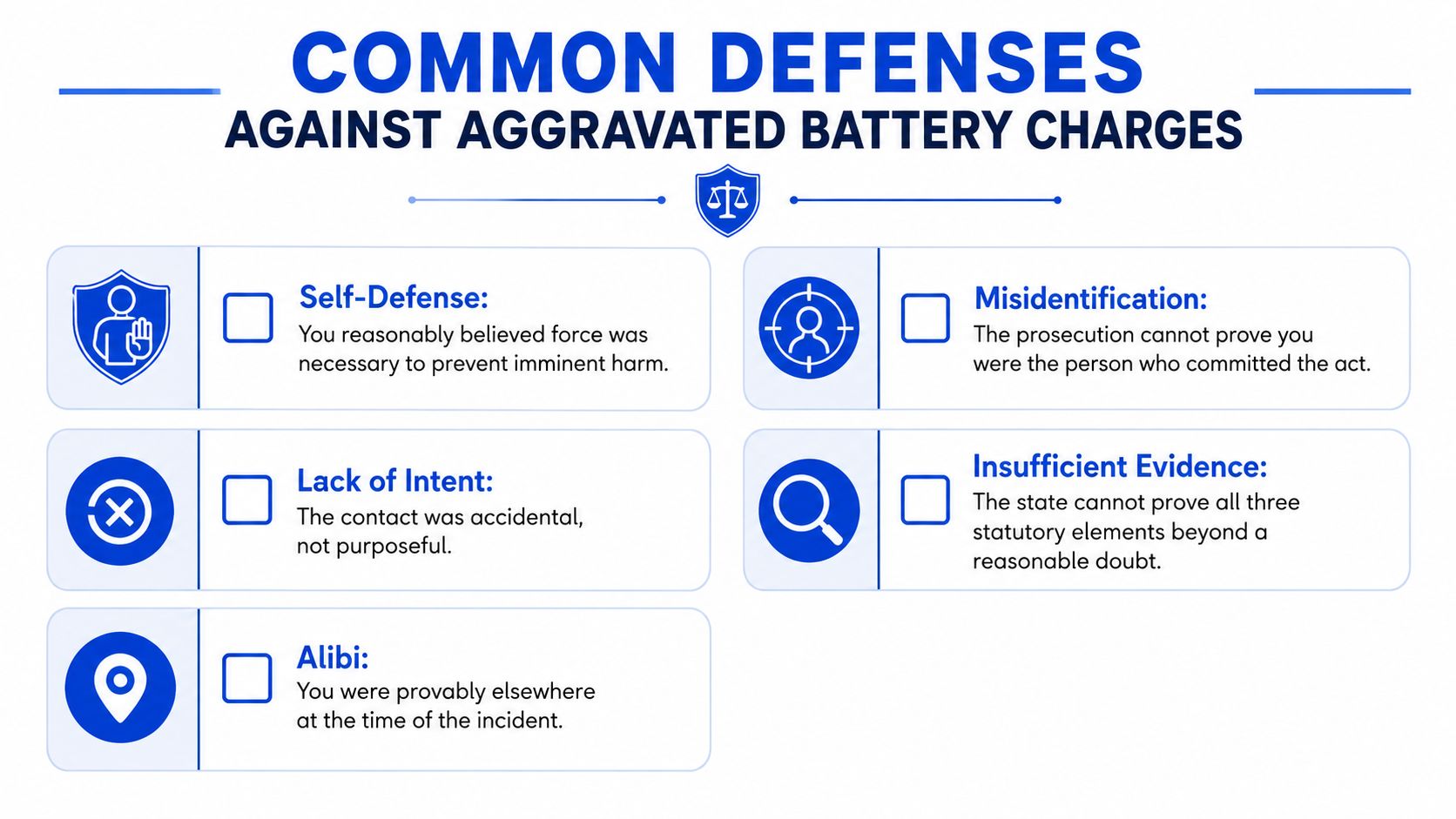
A strong defense starts with the State's exact theory. A lawyer shouldn't choose a defense because it sounds familiar. The evidence must determine whether the case is best attacked through self-defense, lack of intent, identity, injury classification, weapon classification, witness credibility, or a combination of those issues.
Self-defense and defense of others
Florida's Stand Your Ground framework may support a pretrial immunity motion when the evidence shows the defendant reasonably believed force was necessary to prevent imminent harm. The defense attorney examines who initiated the physical encounter, threats, injuries on both sides, video, witness accounts, and whether the force used matched the perceived danger.
A successful immunity ruling can end the prosecution before trial. Even when immunity isn't granted, self-defense evidence can shape bond arguments, negotiations, and the presentation to a jury.
Intent, identity, and consent
Aggravated battery requires more than proof that bodies touched. The State must prove the required intentional or knowing conduct and the aggravating circumstance it charged. An accidental collision, involuntary movement, or contact during an effort to escape may undermine the intent element.
Identity problems arise when a fight involves poor lighting, multiple people, alcohol, masks, or rapidly changing positions. In a bar case, one witness may identify the wrong person while surveillance footage shows that another participant held the object or caused the injury.
Consent or mutual combat may matter in limited circumstances, especially where both participants voluntarily engaged in physical conduct. It doesn't excuse every act, and it must be tested against the actual evidence rather than assumed from the setting.
Evidence challenges
A defense investigation should look for contradictions that affect the charged elements:
Body-camera footage: Video may contradict the officer's narrative, reveal who started the encounter, or show that the alleged weapon was never used as claimed.
Medical records: Treatment notes may not support the alleged severity, permanence, or causal connection of an injury.
Witness statements: Accounts can change after conversations with friends, family, officers, or the alleged victim.
Digital evidence: Messages and social posts may establish context, but they can also be misleading when presented without the full conversation.
Prior aggression or motive: Evidence of hostility, custody disputes, financial conflict, or inconsistent accusations may create reasonable doubt, subject to the court's evidence rules.
A defense is not a story chosen after the fact. It is a method for testing whether the State can prove every element with admissible evidence.
Timing affects the usefulness of each approach. Self-defense may be raised in a pretrial immunity motion. Contradictory footage may support a motion, negotiation, or trial cross-examination. Medical evidence can support a charge reduction when it defeats the aggravated injury theory. For additional context, review these types of criminal defenses.
What to Do Immediately After an Aggravated Battery Arrest
Your first priority is to stop creating evidence. Don't explain the incident to police after invoking your right to remain silent, and don't discuss the case with cellmates, friends, witnesses, or the alleged victim. Ask for a lawyer and follow counsel's advice before signing statements or agreeing to interviews.
The first hours
During booking and first appearance, remain respectful and concise. The judge may address probable cause, release conditions, and restrictions designed to protect the alleged victim and the court process. Your lawyer should present useful information about residence, employment, family responsibilities, court attendance, and weaknesses in the State's initial account.
Bond isn't a final judgment. It's a release decision, and counsel should address both public-safety concerns and flight-risk arguments with verifiable information. If a no-contact condition is imposed, obey it exactly. Don't use a family member, friend, coworker, or social-media account to send a message indirectly.
Preserve evidence before it disappears
Write down your memory privately for your lawyer, including the people present, where everyone stood, what was said, and what happened before and after the contact. Save original videos, messages, photographs, location records, receipts, and clothing. Don't edit, delete, forward, or post them.
Ask counsel to preserve surveillance footage quickly. Businesses may overwrite recordings, witnesses may become difficult to locate, and injuries may change as they heal. Early evidence collection can determine whether the case becomes a credibility contest or a documented defense.
Choosing counsel
Look for a Florida criminal defense lawyer who handles violent-felony cases, understands local court procedure, and can review evidence before the State's theory hardens. Former prosecutorial experience can help counsel anticipate charging decisions, discovery problems, witness preparation, and negotiation positions, but you should still ask how the lawyer will analyze your specific facts.
If a loved one is detained, use a practical guide to bailing someone out, then arrange a confidential legal consultation. The earlier counsel can review the arrest affidavit, bond conditions, medical claims, and available video, the more options may remain.
How Ticket Shield Builds Your Defense Strategy
Ticket Shield, PLLC handles Florida criminal defense matters, including aggravated battery and other violent-crime allegations. Attorney Jason S. Goldsmith's former-prosecutor background provides a practical perspective on how the State may evaluate police reports, witness accounts, injury evidence, and charging decisions.
The defense process should begin with a case audit, not a generic promise. That review may include body-camera footage, 911 recordings, surveillance video, witness statements, photographs, medical records, messages, and the defendant's prior record. The purpose is to identify whether the State can prove the charged aggravating factor and whether an early reduction, dismissal request, or focused trial defense is realistic.
Local knowledge also matters. A case in Broward County or Fort Lauderdale may develop differently from one in Miami-Dade or Palm Beach because courtroom practices, prosecutors, judges, and available resolutions differ. A defense lawyer should explain those local realities without guaranteeing a result.
The right early question isn't “Can someone make this disappear?” It's “What evidence supports each element, what escalators apply, and what can we challenge before the case gets harder to defend?”
If you or a family member faces aggravated battery charges in Florida, contact Ticket Shield, PLLC for a confidential consultation. The firm can review the arrest, bond conditions, alleged injury, weapon claim, victim category, prior record, and available evidence, then explain concrete defense options before your first court appearance.