
Withheld Adjudication Florida: What It Really Means
Jason Goldsmith, Esq
A withheld adjudication in Florida means the court accepted your plea or found you guilty but declined to formally adjudicate you guilty. For felony cases, the law bars withholding for capital, life, and first-degree felonies, while second-degree and third-degree felony cases face additional statutory limits.
You may be hearing those words after a stressful hearing in Broward County, Fort Lauderdale, Miami-Dade, Palm Beach, or another Florida courtroom. Your lawyer may have negotiated a “withhold,” the judge may have imposed probation, and yet nobody clearly explained whether you were convicted. That uncertainty is understandable.
A withhold can be a valuable outcome because it avoids a formal conviction, but it isn't a dismissal or a clean slate. The arrest, plea or finding of guilt, probation obligations, and possible record consequences still matter. The decision points come in order: whether the law permits a withhold, whether the judge is willing to grant one, whether you can complete probation, and whether the record may later qualify for sealing.
Table of Contents
What Withheld Adjudication Means in Florida
A nervous client sits in a Broward County courtroom and hears the judge say, “Adjudication is withheld.” The hearing ends, but the client still doesn't know whether the case was won, lost, or left unresolved. That reaction is common because the phrase sounds technical while carrying consequences that affect daily life.
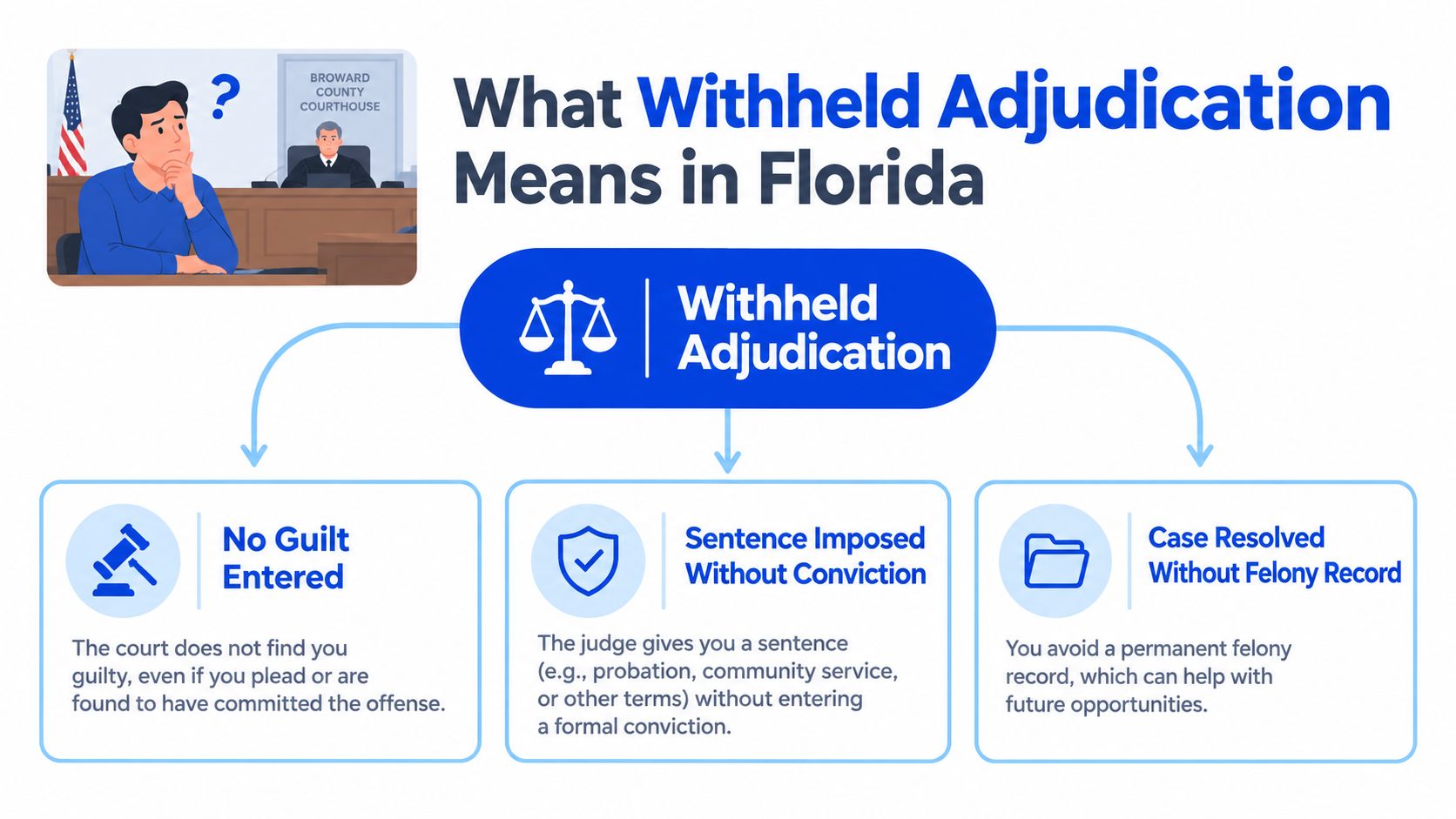
In plain English, a withheld adjudication means the court accepted a guilty or no-contest plea, or made a finding of guilt, but declined to enter a formal conviction. The court treats the case as resolved without adjudicating the person guilty. Florida's Supreme Court has described a withhold as a judicial finding that the person isn't likely to reoffend and that justice and the public welfare don't require a formal conviction. That description reflects why judges have this option, but it doesn't make the result automatic. Florida's statutory explanation of withholding adjudication shows that the judge still has to decide whether the outcome is appropriate.
The easiest way to understand the position is to place it between two more familiar outcomes:
Dismissal: The charge is ended without a conviction and without the same type of guilty disposition.
Withhold: The court accepts guilt or a plea, imposes the required sentence or supervision, and does not formally convict you.
Conviction: The court adjudicates you guilty and enters a formal conviction.
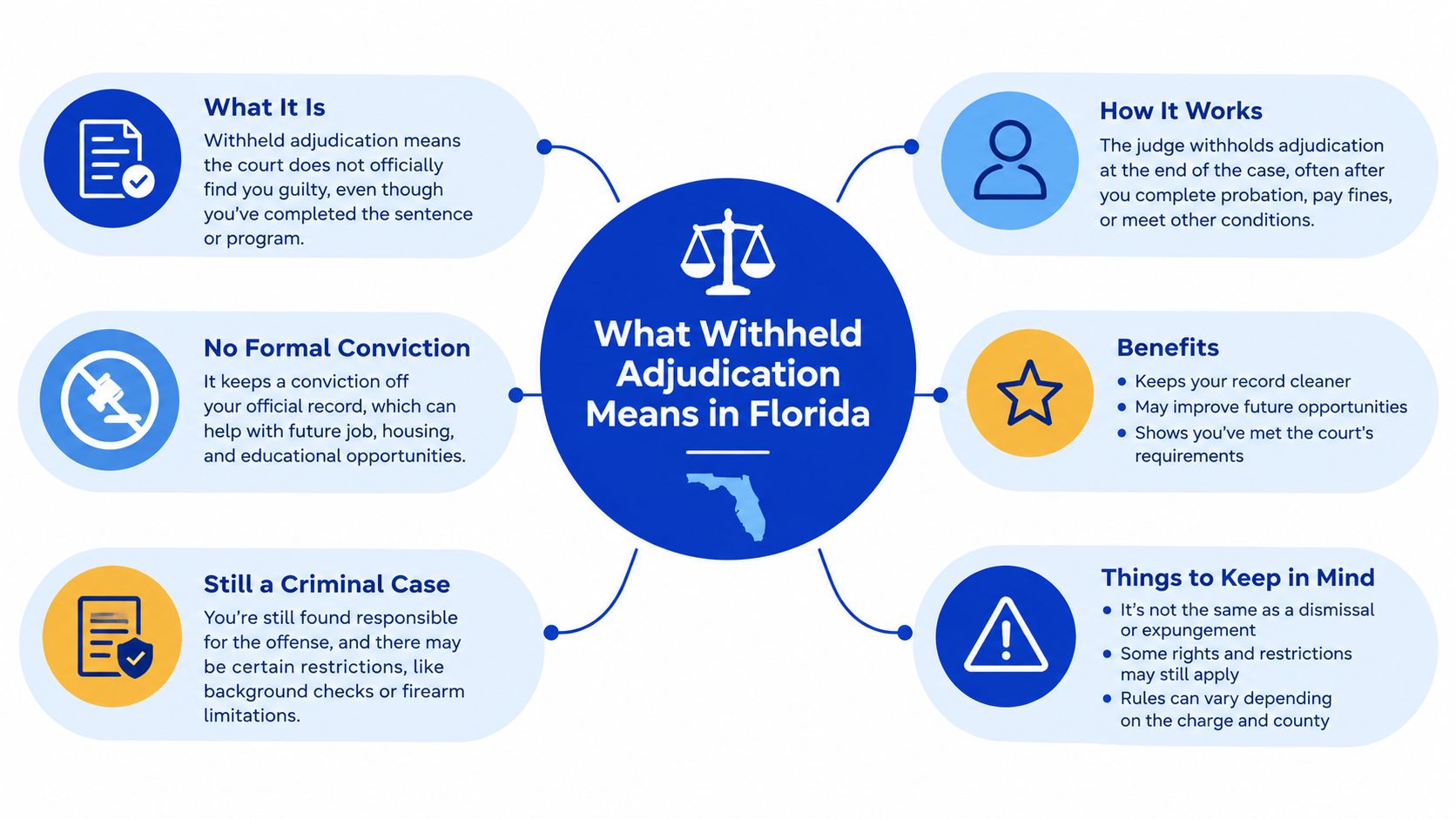
A withhold is therefore a structured sentencing outcome, not a legal trick. Florida law gives judges discretion in qualifying cases, but the defendant still has to comply with the sentence. For a felony, probation is the usual legal vehicle because Florida law requires the court to place the defendant on probation when it withholds adjudication. The Florida statutory framework for probation and withheld adjudication explains why the outcome can avoid a formal conviction while still placing substantial obligations on the person.
Consider a hypothetical client who accepts a negotiated plea with a withhold. The client hasn't been formally convicted, but the case hasn't vanished. The client may have to report to probation, follow court conditions, and deal with an arrest record unless the record later qualifies for sealing. That is why a lawyer should explain not only whether a withhold is available, but also what the disposition will require after court.
Withhold of Adjudication Versus a Conviction
The practical difference is the formal judgment. With a conviction, the court adjudicates the defendant guilty. With a withhold, the court declines to enter that formal adjudication even though the defendant may have pleaded guilty, pleaded no contest, or been found guilty.
That distinction can affect future applications and legal decisions, but it doesn't answer every question by itself. An employer, licensing agency, landlord, immigration authority, or court may ask about an arrest, a plea, a finding of guilt, or a conviction. Those are different questions, and a person must read the wording carefully rather than assume that “not convicted” means “nothing has to be disclosed.”
Issue | Withheld Adjudication | Formal Conviction |
|---|---|---|
Court's action | The court accepts guilt or a plea but withholds formal adjudication. | The court adjudicates the defendant guilty. |
Supervision | The court may impose probation and other conditions. For a felony withhold, probation is required under Florida law. | The court may impose probation, incarceration, or other authorized penalties. |
Conviction status | It isn't a formal Florida adjudication of guilt, although other legal systems or specific laws may analyze it differently. | It is a formal conviction for the offense. |
Record | The arrest and case remain part of the record unless the record later qualifies for sealing or another lawful remedy. | The conviction and case remain part of the record, subject to any remedy allowed by law. |
Applications | A truthful answer depends on whether the question asks about convictions, pleas, arrests, or findings of guilt. | A conviction question generally requires disclosure of the conviction unless a specific legal exception applies. |
Future legal review | The underlying case may still matter to courts, agencies, and licensing bodies. | The conviction may carry direct and additional consequences under applicable law. |
Firearm and licensing questions | A withhold doesn't automatically resolve firearm, professional licensing, immigration, or other specialized issues. | A conviction can create serious consequences, but the exact result depends on the offense and governing law. |
A withhold isn't an acquittal. The arrest doesn't disappear, and the case isn't treated as though no plea or finding of guilt ever occurred. That is why a person considering a plea should examine the written agreement, the proposed probation conditions, and the future questions they may need to answer.
The phrase “adjudication of guilt” has a specific meaning in Florida criminal procedure. A plain-English explanation of what adjudication of guilt means can help, but it can't replace case-specific advice. The charge level, plea language, prior record, and exact court order can change the analysis.
Practical rule: Never accept a withhold based only on the words “you won't have a conviction.” Ask what you must do, what remains visible, and what could happen if you violate the sentence.
Who Qualifies Under Florida Statute 775.08435
Eligibility starts with the offense level and the defendant's prior felony withholds. Florida's modern statutory rules make clear that a withhold isn't available in every felony case, even when the prosecutor and defense agree that it would be a sensible result.
The first group is excluded completely. A court may not withhold adjudication for a capital felony, life felony, or first-degree felony. The label attached to the charge therefore matters before the judge even considers personal mitigation or the proposed plea.
Second-degree felony cases have an additional gate. A withhold is permitted only if the state attorney makes a written request or the judge makes written findings under the sentencing factors in section 921.0026. A defendant can't assume that a favorable recommendation alone satisfies this requirement. The paperwork and the judge's findings can determine whether the court has authority to grant the outcome. Florida Statute 775.08435 sets out these offense-level and prior-record restrictions.
Prior withholds can close the door
Florida also limits repeat felony withholds:
A second-degree felony can't receive a withhold if the defendant already has a prior withhold for an unrelated felony.
A third-degree felony can't receive a withhold if the defendant has two or more prior unrelated felony withholds.
These restrictions make the criminal record more than background information. It can determine whether the judge has a lawful option at all. Two defendants charged with the same offense may receive different plea options because one has no prior felony withhold and the other does.
Misdemeanor cases are generally treated more generously than felony cases, but “more generously” doesn't mean guaranteed. The judge still has discretion, and the charge, facts, victim impact, plea terms, and prior history can influence the outcome. The statutory limits demonstrate the larger point: a withhold is a sentencing exception governed by eligibility rules, not a blanket option that every defendant can request.
A pretrial intervention or diversion possibility also shouldn't be confused with a withhold. They can involve different requirements and different case endings. Learn how Florida's PTI program may fit into the broader range of resolutions, but have counsel compare the actual proposal with a withhold before you plead.
A lawyer reviewing eligibility should check the exact degree of the offense, whether the statute creates a specific bar, the defendant's prior dispositions, and whether the prosecutor must make a written request. That review should happen before a plea is entered, because a defendant may lose bargaining power once the case is resolved.
How Judges Decide and How Your Lawyer Argues for It
A defendant may arrive at sentencing with no legal bar to a withhold, a completed treatment program, steady employment, and a proposed plan for compliance. The judge can still choose adjudication. Eligibility opens the door. It does not require the court to walk through it.
The judge's central question is whether the defendant is unlikely to reoffend and whether the ends of justice and the welfare of society require a formal conviction or immediate punishment. To answer it, the court may examine the conduct behind the charge, the defendant's history, the surrounding facts, and the safeguards offered in the proposed resolution. Your lawyer's task is to connect those facts to the statutory standard, not merely ask for sympathy.
A strong presentation usually addresses four decision points.
First, case weaknesses may affect both the plea discussion and the sentencing posture. Problems with identification, statements, searches, witnesses, or the State's ability to prove an element can matter. Counsel should explain those issues accurately, without suggesting that a withhold is guaranteed.
Second, personal mitigation gives the court information beyond the accusation. Verified employment, family responsibilities, treatment efforts, education, community ties, and similar circumstances can show what support or structure may reduce future risk.
Third, accountability matters because the judge must assess whether the defendant will follow court-ordered conditions. A person who understands the conduct, accepts responsibility where appropriate, and arrives prepared to comply presents a more workable path than someone who minimizes every obligation.
Fourth, the proposed resolution must be practical. The defense may seek a written state attorney request when the felony statute requires one, along with probation terms the defendant can realistically complete. The lawyer should identify how the defendant will meet those terms, avoid new violations, and address the circumstances that led to the charge.
A former prosecutor may understand how the State evaluates evidence and plea proposals. That experience cannot promise a particular ruling. The prosecutor may oppose the request, and the judge controls the final decision.
The persuasive argument is specific: formal conviction is unnecessary under the facts, safeguards will protect the public, and the defendant has a credible plan for completing the court's conditions. Documentation and a clear explanation give the judge a lawful basis for choosing a withhold.
Probation Obligations After a Withheld Adjudication
At sentencing, a defendant may leave court believing the case is finished because no formal conviction was entered. For a felony with withheld adjudication, section 948.01 requires the court to place the defendant on probation. Probation is the framework that allows the defendant to keep the benefit of avoiding adjudication while completing court-ordered obligations.
The conditions depend on the offense, sentence, and case circumstances. They can include reporting to a probation officer, following court orders, completing approved programs, paying court-ordered amounts, performing community service, keeping contact information current, and avoiding new criminal conduct. The written probation order works like the case's operating instructions. Read every term carefully. A casual statement made in court or a summary from someone else cannot replace that document.
A missed appointment, incomplete program, unreported address change, or new arrest can bring the case back before the court. The allegation does not decide the outcome by itself, but it can place both the withhold and the defendant's liberty at risk.
Use a simple compliance system:
Get the written order. Keep a copy available and mark each requirement.
Track every deadline. Record reporting dates, payments, classes, testing, and document submissions on a calendar.
Communicate early. Transportation problems, illness, work conflicts, or another obstacle should be reported to probation and counsel before a deadline when possible.
Respond to allegations promptly. Do not ignore a violation notice or assume a technical issue will disappear.
Keep proof. Save receipts, completion certificates, appointment confirmations, and messages showing efforts to comply.
A violation can remove the benefit of the negotiated disposition. Depending on the allegation, the court's findings, the sentence, and the governing law, the court may revoke probation, adjudicate the defendant guilty, and impose a sentence allowed for the offense.
Successful completion has a defined legal endpoint. When probation ends, the probationer is released and cannot later be sentenced for that offense. Florida's explanation of probation terms describes common requirements, while the individual sentencing order controls the defendant's obligations.
The benefit remains conditional throughout probation. Completion does not convert the case into a dismissal, yet it can prevent a later sentence for the original offense and preserve the disposition's non-conviction character.
Your Record, Sealing, and Collateral Consequences
Suppose a background check finds your arrest and court case even though the judge withheld adjudication. That result can feel inconsistent, but the two outcomes address different questions. A withhold avoids a formal conviction. It does not automatically erase the arrest, charge, plea, or court disposition from every record system.
The first decision point is public access. FDLE states that an arrest record may be sealed when adjudication is withheld, if the case otherwise qualifies. The word “may” matters. Eligibility can depend on the offense, the disposition, the person's history, and statutory exclusions. FDLE's reasons for denial in sealing and expungement matters explains why a withhold by itself does not guarantee sealing or expungement.
Sealing isn't the same as erasing
Sealing works more like placing a record behind a restricted door than destroying it. Public access is generally limited, but the record still exists. Law enforcement and certain authorized agencies may retain access. A form asking only about convictions may call for a different answer from one asking about arrests, pleas, or specific findings.
Florida law also includes exclusions that can keep a plea or finding of guilt disqualifying even when adjudication is withheld. The offense and the exact disposition must be reviewed together. That distinction matters before you describe the result to an employer, licensing board, immigration lawyer, or government agency.
Collateral consequences often appear in settings that examine more than a standard conviction search. Employment applications may separate a conviction from a guilty or no-contest plea. Professional licensing boards may review conduct, court records, and disciplinary concerns under rules separate from criminal sentencing. Housing providers or screening companies may consider an arrest or case disposition while the information remains publicly accessible. Immigration law uses its own definitions and analysis, so a Florida withhold does not resolve federal immigration consequences. Weapons and other regulated rights require separate review of the offense, facts, and applicable state or federal rules.
A practical record plan starts with the documents, not a label. Review the charging document, plea or disposition, sentencing paperwork, and any available record information. Then ask whether this specific case qualifies for sealing or another remedy. Florida record sealing guidance provides general background, but statutory eligibility and the actual court documents control the answer.
The result can protect you from a formal conviction while leaving record and collateral issues to address. Before completing a background question or license application, identify precisely what it asks and whether an exception applies. A truthful, carefully matched answer is safer than treating a withhold as though the case never existed.
Frequently Asked Questions About Withheld Adjudication
Does a withhold count as a conviction in a future case?
For Florida sentencing, a withhold isn't the same as a formal adjudication of guilt. However, a future court or another legal system may consider the underlying case, plea, or disposition under its own rules. A lawyer should review the specific future charge and the exact wording of the prior disposition.
Can I answer no when a job application asks about convictions?
If the form asks only whether you've been convicted, a withhold generally doesn't create a formal Florida conviction. If it asks whether you've pleaded guilty, pleaded no contest, been arrested, or had a finding of guilt, the answer may be different. Read every question carefully and get advice before submitting a sensitive application.
Can the judge later convert the withhold into a conviction?
A completed sentence protects the defendant from later being sentenced for that offense under the applicable Florida rule. Before completion, a probation violation can put the disposition at risk and may expose the defendant to adjudication and additional sentencing. The timing and alleged violation matter.
Does a withhold protect my license or professional credential?
Not automatically. Driving privileges, professional licenses, immigration status, firearm rights, and regulated employment can involve rules that look beyond a formal conviction. Florida criminal defense FAQs offer general information, but a person should obtain advice specific to the charge, disposition, and agency involved.
What should I do after sentencing?
Keep the sentencing order, calendar every probation obligation, and ask questions before missing a deadline or answering a record-related application. Every case is different, especially when prior felony withholds or statutory exclusions are involved.
Ticket Shield, PLLC helps Florida clients evaluate withheld adjudication proposals, probation risks, record consequences, and available defenses before they make decisions that affect their future. Visit Ticket Shield, PLLC to request a consultation about a criminal case in Broward County, Fort Lauderdale, Miami-Dade, Palm Beach, or elsewhere in Florida.