Florida First Time Offender Act: Rights and Relief Guide
Jason Goldsmith, Esq
Florida has no single statewide First Time Offender Act, but a first offender may be considered for pretrial intervention in a misdemeanor or third-degree felony case, subject to four required approvals. The right Florida program can lead to dismissal, but relief isn't automatic and depends on the charge, prior record, prosecutor, victim, judge, and strict compliance.
You may be reading this after an arrest, with a court date approaching and one urgent question: Will this first offense permanently follow me? In Florida, the answer often turns on what happens before you enter a plea or accept a sentence. A first arrest doesn't automatically disappear, and searching for a universal “first time offender act” can send you toward a federal law that has nothing to do with your state case.
Florida instead uses pretrial intervention, diversion programs, withheld adjudication in appropriate circumstances, and record-relief procedures. Each path has different eligibility rules. South Florida prosecutors also operate local programs with their own screening and supervision practices.
Table of Contents
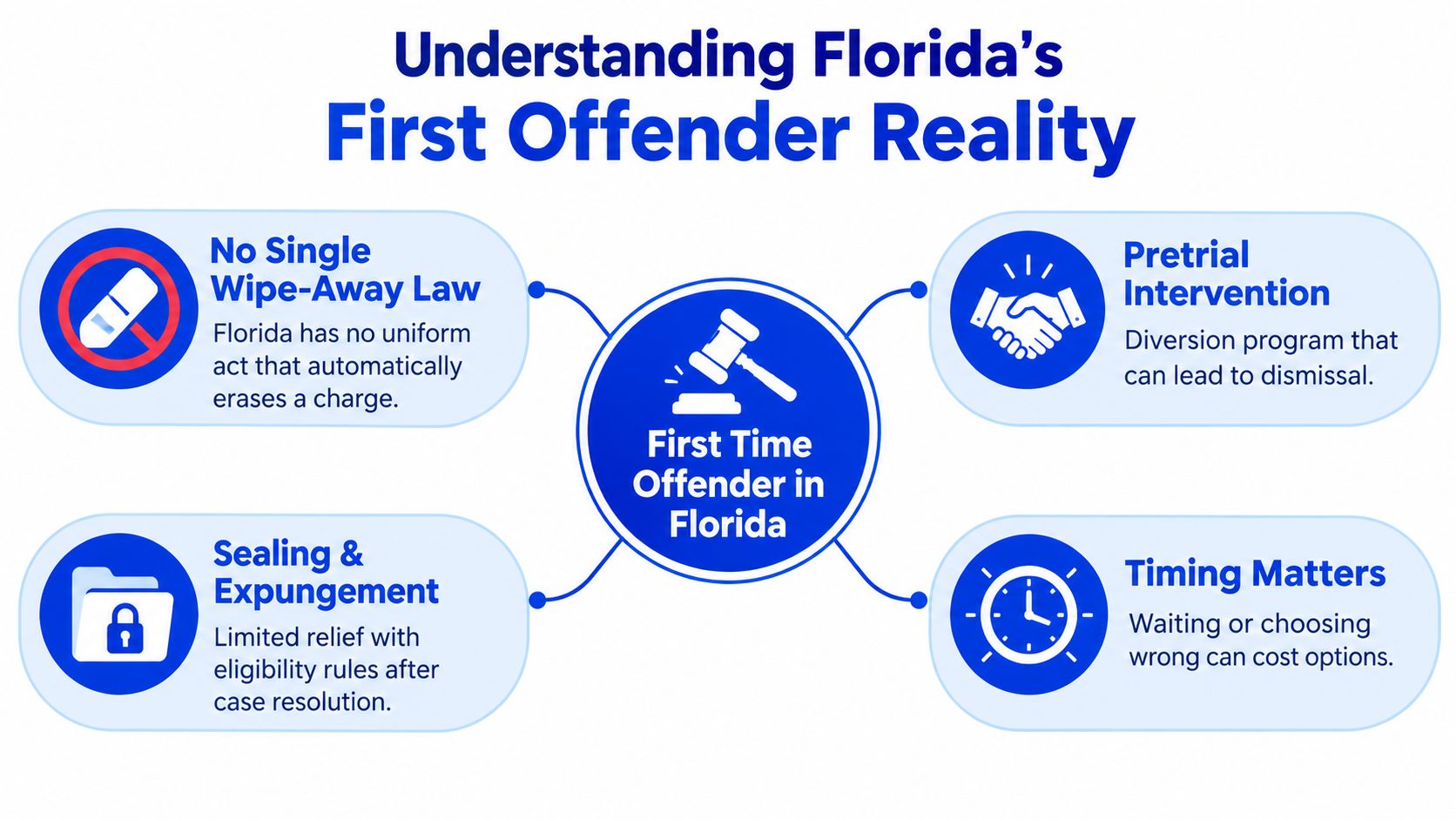
Understanding Florida's First Offender Reality
Florida doesn't have one statewide law that automatically wipes away every charge against a person with no criminal record. That assumption is understandable because the phrase “first time offender act” sounds like a single clean-slate statute. In practice, the result depends on the specific offense, the court handling the case, the prosecutor's position, and whether the defendant can satisfy every program condition.
A first arrest may still affect employment, professional licensing, housing, immigration matters, and other parts of daily life while the case is pending. A dismissal through diversion can be far more protective than a conviction, but the defendant usually has to request the appropriate path, qualify for it, obtain approval, and complete the conditions.
What happens after a first arrest
The practical sequence usually looks like this:
The charge is classified. A misdemeanor and a felony follow different procedures and carry different long-term consequences.
The record is reviewed. The court and prosecutor may examine prior arrests, convictions, diversion history, pending matters, and the facts of the new case.
The available program is identified. Pretrial intervention and a local diversion program aren't interchangeable, even when both are designed for people with limited criminal histories.
The terms are negotiated or imposed. Conditions may include supervision, classes, community service, treatment, reporting, or other requirements.
Completion is documented. A defendant who finishes successfully may be positioned for dismissal and later record relief, subject to separate eligibility rules.
A person with no prior conviction isn't necessarily treated the same as someone with no prior arrest. Prosecutors may also consider the alleged victim's position, the strength of the evidence, the seriousness of the conduct, and whether the person has previously received a similar opportunity.
Practical rule: Don't assume that “first offense” means “automatic dismissal.” It means your record may support a better outcome, not that the State must offer one.
The distinction between a conviction and a nonconviction disposition is important. Learn how adjudication withheld works in Florida, but don't treat it as identical to pretrial diversion. Timing matters because a plea, admission, or program decision can affect later options.
Federal History and Why It Does Not Control Florida Cases
The policy behind first-offender treatment has been developing for a long time. The United Kingdom's Probation of First Offenders Act 1887 was enacted on August 8, 1887, and allowed conditional release for first offenders in certain cases. More than a century later, the federal First Step Act of 2018 was signed on December 21, 2018. Both developments reflect a broader move toward individualized treatment instead of automatic punishment for people with limited criminal histories, but neither creates a universal Florida remedy. The historical background appears in the Probation of First Offenders Act record.
A Florida state charge is controlled by Florida law and the local court process. A federal statute doesn't convert a Broward, Miami-Dade, or Palm Beach case into a federal case. The Federal First Offender Act is also narrow. It generally operates as a deferred-probation mechanism for certain simple-possession matters, where successful completion can result in dismissal without a conviction entering the record. It isn't a general-purpose answer for theft, weapons allegations, violent charges, or every drug case.
Why the label creates confusion
The phrase “first-time offender” can describe several different situations:
No prior arrests, which is a stronger mitigation fact than merely having no prior conviction.
No prior convictions, but some other criminal-history indicator.
A person with limited prior convictions, who may qualify for a state program in some circumstances.
A person who already received diversion or first-offender treatment, which may make another opportunity unavailable.
Those categories matter because the federal research identified a meaningful risk gradient. A U.S. Sentencing Commission analysis reported a 6.8% recidivism rate for offenders with no prior arrests, 8.8% for another first-offender group, and 17.2% for people with no prior convictions but other indicators of criminal contact in the groups it examined. The U.S. Department of Justice summary of the first-offender recidivism analysis describes the research.
The numbers don't decide an individual case, but they explain why courts and prosecutors distinguish between a completely clean history and a record that only appears clean because it lacks convictions. Defense counsel should collect the underlying details, not just write “no priors” on a form.
The population affected by these decisions is substantial. In England and Wales, approximately 65,700 first-time offenders were convicted in 2024, representing 22% of all offenders, while approximately 68,600 were recorded in 2025, representing about 21% of sentencing occasions. The 2025 figure included roughly 32,300 indictable convictions, the highest level observed in the 2015 to 2025 period, according to the official first-time entrant and offender-history statistics. Those figures are not Florida statistics, but they show why jurisdictions continue to debate how first offenders should be handled.
Florida Pretrial Intervention Eligibility and Approval Process
Florida's pretrial intervention statute provides a specific route for some people to avoid traditional prosecution. It allows a first offender, or someone with no more than one nonviolent misdemeanor conviction, to enter a pretrial intervention program when charged with a misdemeanor or a third-degree felony. Eligibility alone doesn't place a person into the program. The Florida pretrial intervention statute requires approval from multiple decision-makers.
The four approvals that control entry
The statute's approval structure is where many people discover that qualification isn't the same as acceptance.
Program administrator: The administrator must agree to supervise and accept the case. This office evaluates whether the person can comply with the program's structure.
Victim: The victim's consent is required where the statute calls for it. A defendant can't assume that the State can override the victim's position.
State attorney: The prosecutor must approve the referral or agreement. The State may consider the alleged facts, evidence, restitution issues, public safety, and prior history.
Judge: The judge who handled the initial appearance must approve the placement. Judicial approval gives the court an independent role rather than making diversion solely a prosecutor's decision.
That means a person can appear eligible on paper and still be denied. A serious allegation, disputed facts, lack of victim consent, prior program participation, or an inability to complete the conditions can affect the decision.

Conditions are part of the legal strategy
Pretrial intervention usually requires active compliance rather than passive waiting. Supervision may involve reporting, community service, education, treatment, testing, payment obligations, or restrictions tied to the alleged conduct. The exact terms vary by program and case.
Before accepting, a defendant should understand what counts as a violation, when reports are due, whether missed appointments can be excused, and what happens if a new arrest occurs. A lawyer should also examine whether the proposed agreement contains admissions or waiver language that could create avoidable consequences.
For a plain-language overview of the process, review Florida's PTI program requirements. The important point is that PTI is not a guaranteed shortcut. It is a negotiated opportunity that must be protected from the first court appearance through final completion.
How Broward County Applies Diversion in Practice
Broward County illustrates why local procedure matters. The State Attorney's Office identifies a Misdemeanor Diversion Program for first-time offenders, supervised by Broward Sheriff's Office Probation. Its Felony Pre-Trial Intervention program is run by the Florida Department of Corrections and is intended to help first-time felony offenders avoid a criminal conviction. The Broward County diversion program information describes those separate tracks.
For a misdemeanor, the supervision experience may involve regular contact with sheriff's office probation personnel, completion of assigned requirements, and documentation showing that each condition was satisfied. A felony PTI participant may deal with a different supervising agency and a more demanding compliance structure. The charge may look manageable at the first hearing, but failing to report or complete an assigned condition can put the negotiated outcome at risk.
What supervision looks like for the client
Consider a person charged with a qualifying offense who receives a diversion offer. The client shouldn't treat the offer as the end of the case. The work begins after acceptance:
Read every condition: The written agreement controls, not a casual explanation at the courthouse.
Track every deadline: Keep proof of appointments, payments, classes, and service hours.
Report problems immediately: A missed appointment or unexpected conflict should be addressed before it becomes a pattern.
Avoid new legal trouble: A new arrest can affect the program and the underlying case.
Confirm completion: Obtain written confirmation and verify what the prosecutor and clerk will file next.
Florida policy analysts describe pretrial intervention as one of the principal ways to divert low-risk offenders from prison early in the criminal process, alongside plea bargaining, problem-solving courts, and probation. The Florida Office of Program Policy Analysis and Government Accountability report places PTI within that broader system.
Local practice also differs outside Broward. Miami-Dade and Palm Beach cases may involve their own referral procedures, forms, screening standards, and supervision arrangements. A defendant should never assume that a program available in one courthouse transfers automatically to another.
For local representation and case-specific guidance, a defendant can review the Broward criminal defense resource, while remembering that eligibility must be evaluated against the actual charge and court.
What Success Looks Like for Record and Sentencing Outcomes
The most valuable result of diversion is often not a shorter sentence. It is the possibility of avoiding a conviction in the first place. Successful completion of Florida pretrial diversion typically results in dismissal of the charges, and the process may involve supervision, treatment, education, and community service instead of traditional prosecution, as described in this Florida diversion overview.
A dismissal still needs careful follow-through. The court file, arrest record, and background-check information may not all update at the same time. Record sealing or expungement can involve separate eligibility rules and paperwork. A dismissed case therefore isn't the same thing as an automatically invisible case.
Diversion outcomes compared
Outcome Type | Conviction Record | Typical Requirements | Long-Term Impact |
|---|---|---|---|
Pretrial diversion completed | Usually avoids a conviction when the program is completed and the charges are dismissed | Supervision, service, education, treatment, reporting, and other case-specific conditions | May preserve stronger options for employment, licensing, and later record relief |
Traditional probation after a plea | The outcome depends on adjudication and the plea arrangement | Reporting, conditions, and compliance with court orders | A conviction or other adverse disposition may create continuing consequences |
Standard conviction and sentence | A conviction enters the record | Court-ordered sentence, which can include custody, probation, fines, or other penalties | Can affect employment, licensing, housing, immigration, and other rights |
Case dismissal outside diversion | No conviction from the dismissed charge | Depends on the reason for dismissal and the court's disposition | May still require separate action to address arrest and court records |
Diversion has limits. Prior diversion, certain charge categories, unresolved cases, factual aggravation, or victim opposition can block the opportunity. A prosecutor may also conclude that the allegation is too serious for a local program even when the defendant has no prior record.
The practical consequences can reach beyond the criminal docket. Employers, licensing authorities, immigration officials, and other institutions may ask about arrests, dispositions, or sealed records under rules that don't all use the same definitions. Firearm eligibility can also involve separate legal questions. Never assume that a dismissal, withheld adjudication, sealing, and expungement have identical effects.
Why the first decision matters
A client who accepts an unfavorable resolution too quickly may lose the chance to seek a better nonconviction outcome. A client who rejects a reasonable diversion offer without understanding the violation risks may also make an avoidable mistake. The right choice depends on evidence, charge severity, collateral consequences, and the precise language of the proposed disposition.
Information about record sealing in Florida can help explain the next stage, but eligibility should be checked after reviewing the complete case history. Relief is a process, not a label attached automatically to every first arrest.
Protecting Your Rights Before Negotiations Begin
The strongest first-offender strategy usually starts before the State makes a formal program offer. Early counsel can preserve evidence, identify weaknesses, document a clean history, and determine whether diversion is better than litigating the charge. Waiting until a plea is entered may leave fewer choices.
Bring the lawyer the arrest paperwork, notice to appear, court documents, witness information, messages, videos, and records showing prior dispositions. Ask direct questions: Is this a state or federal case? What exact charge is pending? Has any prior diversion occurred? Does the local program require victim consent? What happens if the program is rejected or later terminated?
An attorney may also identify an unlawful search, defective stop, unreliable identification, or other constitutional issue. A motion to suppress evidence in Florida can be relevant when the State's proof depends on evidence obtained unlawfully, although the correct motion depends on the facts and procedural posture.
Florida relief depends on jurisdiction, charge classification, prior history, evidence, and compliance. If you've been arrested for the first time in Broward, Fort Lauderdale, Miami-Dade, Palm Beach, or another South Florida jurisdiction, get advice before making admissions or accepting conditions that you haven't reviewed.
Ticket Shield, PLLC evaluates first-offender cases, diversion eligibility, evidence issues, and record-protection options for people facing Florida misdemeanor and felony charges. Visit Ticket Shield, PLLC to request a consultation and discuss the steps that may protect your rights before negotiations begin.