Resisting Arrest Florida
Jason Goldsmith, Esq
A routine traffic stop in Broward County can turn into a criminal case before you understand what's happening. You're asked to step out, your hands are shaking, you ask what's going on, and an officer interprets your movement as refusal. Seconds later, you're face down on asphalt, handcuffed, and facing a charge for resisting arrest in Florida.
That charge isn't automatically valid because an officer wrote it in an arrest affidavit. Florida law separates resisting with violence from resisting without violence, and the difference changes the entire defense strategy. The video, the officer's legal authority, the exact movement alleged to be resistance, and the timing of each command can decide whether the State has a real case.
Table of Contents
A Moment That Changes Everything
The patrol lights wash the inside of the car in blue and red. A Broward County driver lowers the window and hears the officer tell him to step out. He asks why. His voice is unsteady, and his right hand moves toward the center console before he places it back on the steering wheel.
The officer shouts again. The driver opens the door but hesitates. He looks down at his seat belt, then toward the officer. The command comes faster this time. When the driver rises, his shoulder turns away for a moment. The officer grabs his arm, another officer moves in, and the driver says he isn't trying to fight anyone.
His knees hit the pavement. The body camera records shouting, boots, and the scrape of handcuffs. The arrest affidavit later describes the encounter in a few words: the defendant pulled away, stiffened his arm, and resisted the officer. A felony charge is added to what began as a traffic stop.
The driver may believe the officer used too much force. The officer may believe the driver disobeyed a lawful command. A jury won't decide the case based on either person's belief alone. It will examine what the officer was legally doing, what the driver did, whether the conduct was intentional, and whether the alleged resistance involved violence.
Practical rule: An unlawful arrest is not permission to use force against an officer. The safer course is to comply physically, remain silent, and challenge the arrest in court.
A single misunderstood movement in a Miami-Dade or Broward encounter can create a charge carrying serious prison exposure. Understanding the statutory split before the encounter happens is the only reliable way to understand the stakes.
How Florida Defines Resisting Arrest
Florida uses two different statutory tracks. Resisting an officer with violence under section 843.01 is a third-degree felony. Resisting an officer without violence under section 843.02 generally follows a misdemeanor structure. Those labels are not interchangeable, and the State's proof must match the subsection charged.
The violence charge
Under the current version of Florida Statute section 843.01, the State must prove that the accused knowingly and willfully resisted, obstructed, or opposed an officer by offering or doing violence. In plain English, the prosecution must connect intentional resistance to conduct it characterizes as violence or an offer of violence.
That could involve a push, strike, shove, or physical movement the State says was directed against the officer. But the label in the arrest report isn't the final answer. In a Broward courtroom, defense counsel should isolate the exact contact, review the body-camera angle, and determine whether the movement was intentional, defensive, accidental, or caused by the officer's own tactics.
The 2026 statutory change removed the word “lawful” from the violence provision, creating an important distinction between the two charges. Recent Florida statutory guidance on the 2026 change explains why old advice about an “unlawful arrest defense” cannot be applied broadly to every resisting case.
The non-violence charge
Resisting without violence focuses on obstruction or opposition without violence. The conduct might include pulling away, refusing to place hands behind the back, going limp, or failing to follow a command. None of those descriptions proves guilt by itself. The State still has to establish that the officer was performing a lawful duty and that the defendant's conduct resisted, obstructed, or opposed that duty.
Questions, confusion, fear, or a brief delay may matter greatly. The defense should ask what happened second by second, not accept a report's conclusion that “resisted” without examining the underlying conduct.
The force rule
Section 776.051 sharply limits the use of force against an arresting officer. Under Florida Statute section 776.051, a person isn't justified in using or threatening force to resist an arrest or detention when the officer is acting in good faith and is known, or reasonably appears, to be an officer. The statute defines good faith in terms of sincere and reasonable efforts to comply with legal requirements, even if the arrest is later found unlawful.
Florida Resisting Arrest, Two Statutory Tracks | Classification | Maximum Penalty | Typical Conduct |
|---|---|---|---|
Section 843.01, resisting with violence | Third-degree felony | Felony sentencing exposure, including possible state-prison consequences | Striking, pushing, or offering violence during an officer's duty |
Section 843.02, resisting without violence | Typically a misdemeanor offense | Misdemeanor sentencing exposure | Pulling away, going limp, or obstructing without violence |
The charge selected controls the bond posture, motion strategy, negotiation position, and potential record consequences. A lawyer must identify the subsection before discussing any plea or sentencing decision.
What the State Must Prove
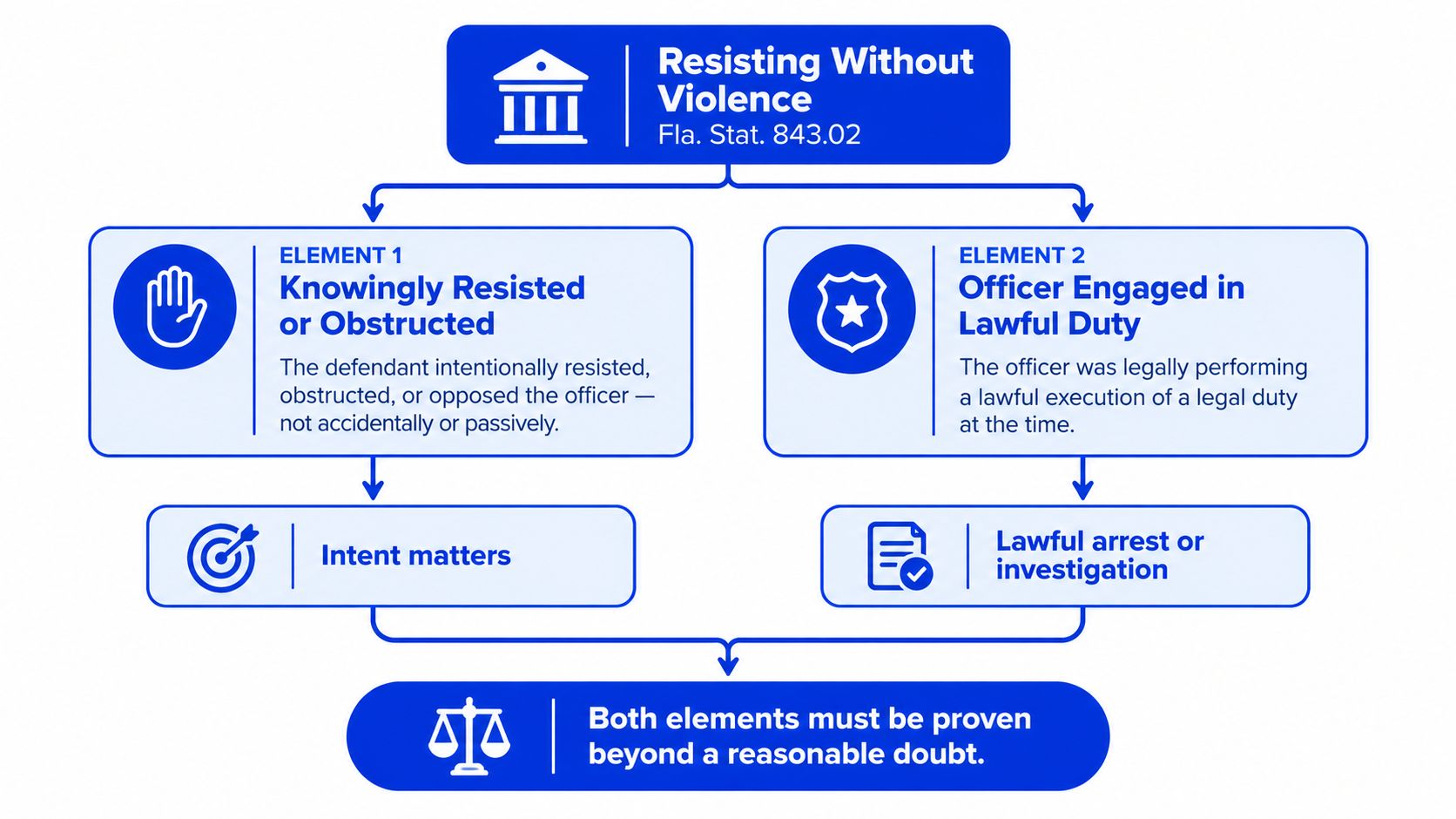
A resisting-without-violence case turns on two elements. The State must prove that the officer was performing a lawful duty and that the defendant knowingly resisted, obstructed, or opposed that duty through words, conduct, or both. The Eleventh Circuit describes the same requirements in its discussion of Florida resisting without violence (Florida law requires lawful execution of a legal duty and knowing, willful resistance, obstruction, or opposition).
Element one requires a lawful duty
The State must identify the officer's specific duty and the legal basis for performing it at the moment of the alleged resistance. Was the officer conducting a valid traffic stop? Did lawful grounds support the detention? Had probable cause developed before the arrest?
In Miami-Dade or Broward, the defense hinges on whether the officer had a lawful basis when the command was given. Counsel should compare dispatch records with the report, examine the original reason for the stop, and subpoena training or incident materials that test the officer's account. A later-disputed arrest does not answer whether the officer's duty was lawful at the relevant moment.
Element two requires actual resistance
The prosecution must point to a specific act that obstructed or opposed the officer. “Resisted” in an affidavit is a conclusion, not proof. The evidence may come from body-camera footage, dashboard video, witness testimony, or the officer's description of a particular movement.
Pulling away during handcuffing presents a different issue from an arm moving because the officer suddenly grabbed it. Going limp can support an obstruction allegation in some circumstances. A brief hesitation followed by compliance may leave the State unable to prove intentional resistance. The defense should demand precise answers: What did the defendant do? How long did it last? How did it interfere with the officer's duty?
Probable cause also matters at the start of the encounter. Courts assess it from a reasonable officer's perspective and under the totality of the circumstances. In a Florida-related federal decision, the court explained that a verbal command alone did not establish even arguable probable cause for resisting arrest. A guide explaining probable cause provides useful background on that analysis.
During trial preparation, the defense should target the missing element. That may be the officer's lawful duty, the reliability of the account, or conduct that never amounted to intentional obstruction.
Resisting Arrest vs Other Criminal Charges
A resisting count often appears beside the charge that started the encounter. Prosecutors may allege several theories because each offense focuses on a different act. That doesn't mean every count is supported, and it doesn't mean a defendant should accept the most serious label without testing the evidence.
Resisting Arrest vs Related Florida Charges | Key Element | Typical Classification | Penalty Range |
|---|---|---|---|
Resisting with violence | Knowingly and willfully resisting by offering or doing violence | Third-degree felony | Felony sentencing exposure |
Resisting without violence | Obstructing an officer during a lawful duty without violence | Typically misdemeanor | Misdemeanor sentencing exposure |
Obstruction under section 843.03 | Hindering or opposing an officer's investigation or duty through the conduct alleged | Classification depends on the charged offense and facts | Depends on the specific subsection |
Battery on a law enforcement officer | Intentional physical contact or striking that satisfies battery law and the officer-status requirement | More serious treatment may apply because of the officer's status | Depends on the charged battery and facts |
Fleeing or attempting to elude under section 316.1935 | Failing to stop or fleeing from an officer under the statute's requirements | Classification depends on the manner and circumstances alleged | Depends on the charged subsection |
Disorderly conduct | Conduct alleged to disrupt public order or create a legally recognized disturbance | Generally misdemeanor structure | Misdemeanor sentencing exposure |
A Broward stop that ends with a pushed officer can generate both resisting with violence and battery allegations. The State may claim the push was the violent resistance and also charge the same contact as battery. Defense counsel must examine whether the factual acts are distinct or whether the counts overlap.
The less serious count can also become the key negotiation point. If the video disproves violence but supports an argument that the person delayed or pulled away, counsel may push to remove the felony violence theory and address the remaining allegation separately. That strategy must account for the client's record, immigration position, employment, licensing, and eligibility for a resolution that avoids an adjudication.
Read the firm's discussion of resisting with violence in Florida for the practical significance of the felony classification. The right question isn't, “What can the prosecutor offer?” It's, “Which allegation can the evidence prove?”
Defenses That Actually Work
A serious defense starts with the legal duty, then moves to the alleged conduct, then addresses resolution. Starting with a plea offer before reviewing the video is backwards.
Challenge the officer's legal authority
For a non-violence charge, the lawful-duty element is a direct attack point. Counsel examines the reason for the stop, detention, or arrest at the time the alleged resistance occurred. A later-discovered problem doesn't automatically answer the timing question.
The force-defense analysis is different. Section 776.051 limits the right to use force even when the arrest is later found unlawful. That means an unlawful-duty argument may defeat a non-violence charge, but it doesn't create a general street-level justification for pushing or striking an officer.
Separate reflex from intent
The State must prove knowing and willful conduct where the charged statute requires it. A person stumbling, recoiling from sudden force, protecting an injured arm, or moving instinctively may not have intentionally obstructed an officer.
Counsel should synchronize body-camera footage, dispatch audio, witness recordings, and medical evidence. A report may describe “pulling away,” while the video shows the officer pulling the person in the opposite direction. That difference can change the case.
Test the evidence
The defense should compare every version of the event. Look for missing footage, blocked camera angles, inconsistent commands, differences between the affidavit and recorded audio, and witnesses who saw only the end of the encounter.
An unlawful stop may also affect evidence supporting other charges. A motion based on search or seizure issues should be considered where the facts support it. See this explanation of illegal search and seizure issues.
Reduce the charge when dismissal isn't available
Negotiation is strongest after the defense identifies the State's actual weakness. Possible goals can include removing the violence allegation, resolving the matter as obstruction, seeking a withhold of adjudication, or pursuing a pretrial diversion option where the client qualifies under Florida law, including the framework associated with section 948.08.
Each option has a trade-off. A quick plea may reduce uncertainty but create immigration, licensing, employment, or firearm consequences. A trial preserves the chance of acquittal but carries risk and requires preparation. The recommendation should follow the evidence, not a generic promise.
Inside the Florida Criminal Process
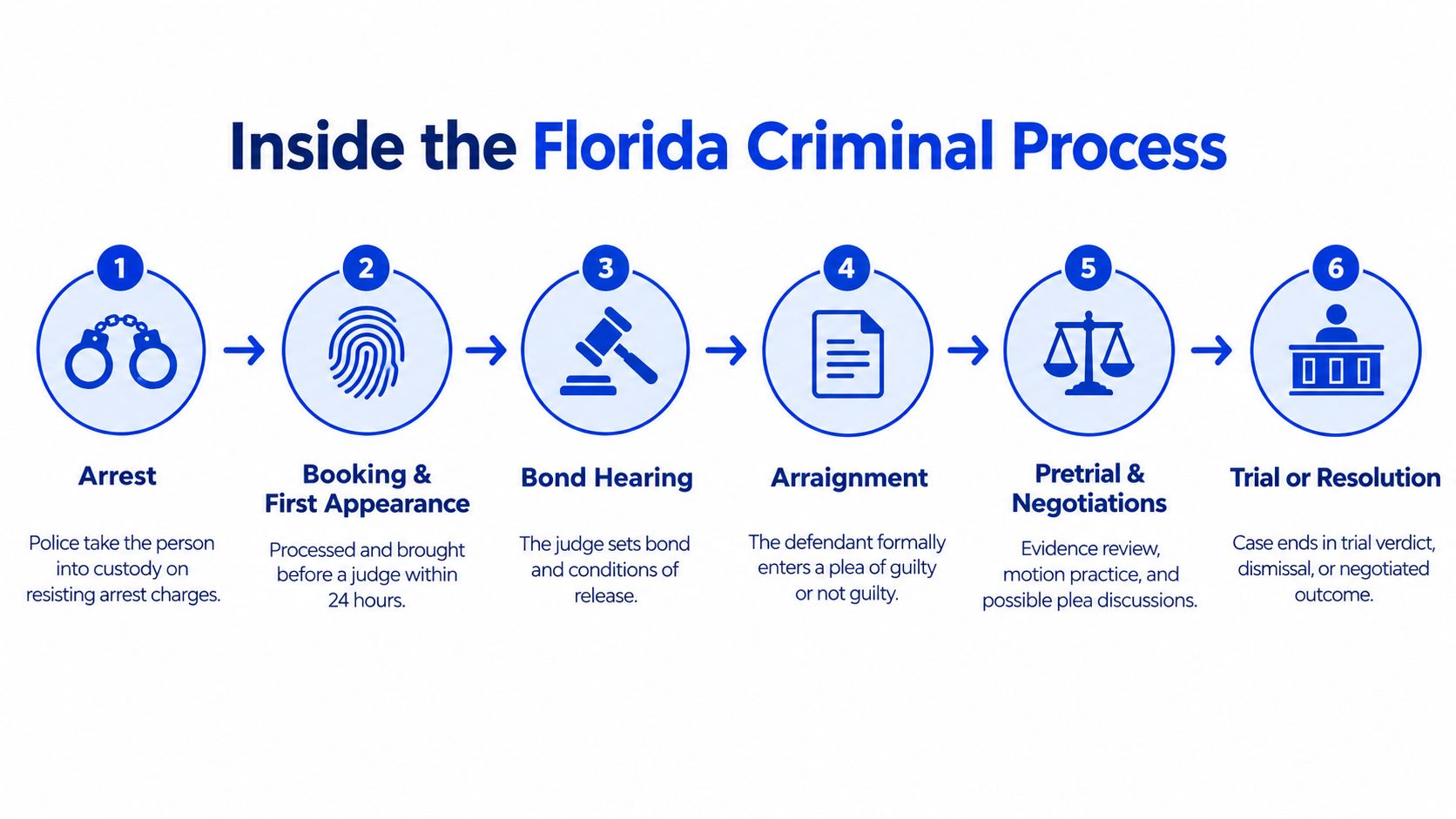
After arrest, the person is booked and brought before a judge for first appearance, generally within 24 hours. The judge addresses probable cause, bond, and release conditions. Conditions may include reporting, no-contact provisions, travel limits, or other requirements tied to the allegations.
The next formal stage is arraignment. The charges are read or acknowledged, and the defendant enters a plea. Florida's speedy-trial framework includes a 21-day rule in the circumstances governed by Florida Rule of Criminal Procedure 3.191, but that rule isn't a deadline that automatically ends every case. Waivers, continuances, exclusions, and procedural events can change the calculation.
Discovery creates leverage
The defense requests body-camera and dashboard footage, dispatch audio, arrest affidavits, witness information, photographs, medical records, and other discoverable material. Lawyers may depose the officers and file motions addressing suppression, dismissal, unlawful detention, or evidentiary problems.
In Broward and Miami-Dade, the case may move through several hearings before the prosecutor makes a final recommendation. The decision points are practical:
Early review: Determine whether the footage supports dismissal, a reduction, or further investigation.
Motion practice: Challenge the legal basis for the stop or the admissibility of important evidence.
Negotiation: Compare a withhold, diversion, or reduced count against the consequences of trial.
Trial preparation: If the State won't offer a fair resolution and the evidence is defensible, prepare to cross-examine the officers and present the client's case.
Watch this video for additional context about the post-arrest process:
A case can resolve through dismissal, negotiated disposition, or trial verdict. The timeline depends on the court, discovery, motions, officer availability, and the client's decisions.
How a Defense Attorney Protects Your Case
A defense lawyer protects the evidence before anyone starts arguing about it. Body-camera footage, 911 audio, business surveillance, and bystander recordings can disappear. Counsel should request them promptly, preserve relevant records, and locate witnesses while their memories remain reliable.
The lawyer then tests the arrest story against the records. The affidavit should be compared with video, audio, dispatch history, photographs, and medical records. If the report says the client “lunged,” but the recording shows the officer moving first, that conflict can support a motion, a negotiation position, or cross-examination.
Former-prosecutor perspective
A former prosecutor knows how an assistant state attorney reviews an arrest file. The practical questions are whether the evidence proves each element, whether the officer will withstand cross-examination, and whether the recording creates a trial problem. That analysis matters under Florida's 2026 statutory split between resisting with violence and resisting without violence. Counsel must test the alleged conduct against the correct version of the offense instead of accepting a violence allegation because it appears in the affidavit.
A former-prosecutor's approach to criminal defense in Florida can also guide early decisions in Broward and Miami-Dade. The lawyer may seek a withhold, diversion, a lesser obstruction resolution, or trial, depending on the client's record, injuries, conflicting witnesses, and what the video shows.
Courtroom preparation
Counsel should question the officer about probable cause, the sequence of commands, the precise movement claimed as resistance, and contradictions in the affidavit. The defense should also determine whether prior credibility issues are legally admissible and properly supported.
Preparation must match the charged version. A violence allegation requires focused examination of the claimed contact, injury, intent, and timing. A non-violence charge calls for close attention to the command, the client's conduct, and whether the officer was impeded.
The client deserves a clear explanation of sentencing exposure, collateral consequences, plea positions, and trial risk. No lawyer can promise an outcome. Good advice gives the client enough information to choose intelligently.
Ticket Shield, PLLC provides Florida criminal defense representation, including cases involving resisting with violence and related allegations. The firm's former-prosecutor perspective has value when it produces specific work, including preserving evidence, challenging probable cause, and testing whether the violence allegation fits the recording.
Questions People Ask After the Charge
Can passive behavior support a conviction?
It can, depending on the conduct and circumstances, but the State must prove actual resistance or obstruction. Going limp, refusing to place hands behind your back, or briefly hesitating isn't automatically enough. The court must examine what happened, whether the officer gave a lawful command, whether the defendant knew what was expected, and whether the conduct impeded the officer.
Recent Florida appellate discussion has emphasized fact-specific line drawing. A short pause followed by compliance may be treated differently from sustained physical refusal. The video usually matters more than the label in the affidavit.
Can resisting and battery both be charged?
They can arise from the same encounter when the State alleges separate legally significant conduct, such as resistance plus intentional physical contact that qualifies as battery. But overlapping counts may create a double-jeopardy problem when prosecutors treat one continuous act as multiple offenses or multiple resisting counts. Counsel should analyze the acts, timing, location, intervening events, and whether a new criminal intent formed.
Can a felony affect probation, immigration, or firearms?
A felony conviction can affect eligibility for certain probationary outcomes and can create lasting consequences beyond the sentence. Non-citizens should obtain immigration advice before any plea because the effect depends on the person's status, the exact disposition, and the statutory language involved. Firearm restrictions also depend on the conviction, the person's status, and applicable federal and Florida law. Never accept a plea without reviewing those consequences.
What should you do immediately?
Invoke your right to remain silent and request a lawyer before discussing the incident. Don't consent to searches, don't explain the movement that led to the arrest, and don't argue with officers about whether the arrest is legal.
Photograph injuries, obtain medical records, save text messages, and preserve contact information for witnesses. Don't post about the encounter. At first appearance, take bond conditions seriously, including no-contact orders and travel restrictions.
If you're facing a resisting arrest charge in Broward, Fort Lauderdale, Miami-Dade, Palm Beach, or another Florida jurisdiction, contact Ticket Shield, PLLC for a prompt review of the arrest affidavit, video, probable-cause issues, and available defense or reduction strategies. Ask counsel to preserve evidence immediately and explain the difference between fighting the charge, negotiating it, and accepting a resolution with known consequences.