
What to Do When Arrested: Florida Step-by-Step Guide
Jason Goldsmith, Esq
If you're reading this from a holding cell, a hospital, or your home after release, focus on the next decision, not every possible outcome. An arrest is serious, but it isn't a conviction. What you say, sign, open, delete, or send during the first hours can shape the evidence available to prosecutors and the options available to your defense.
For Florida residents in Broward County, Fort Lauderdale, Miami-Dade, Palm Beach, and surrounding South Florida communities, the safest approach has three parts: control your behavior, protect your digital information, and use your limited communication window wisely. Stay calm, invoke your rights clearly, preserve information, and get case-specific legal advice before trying to explain what happened.
Table of Contents
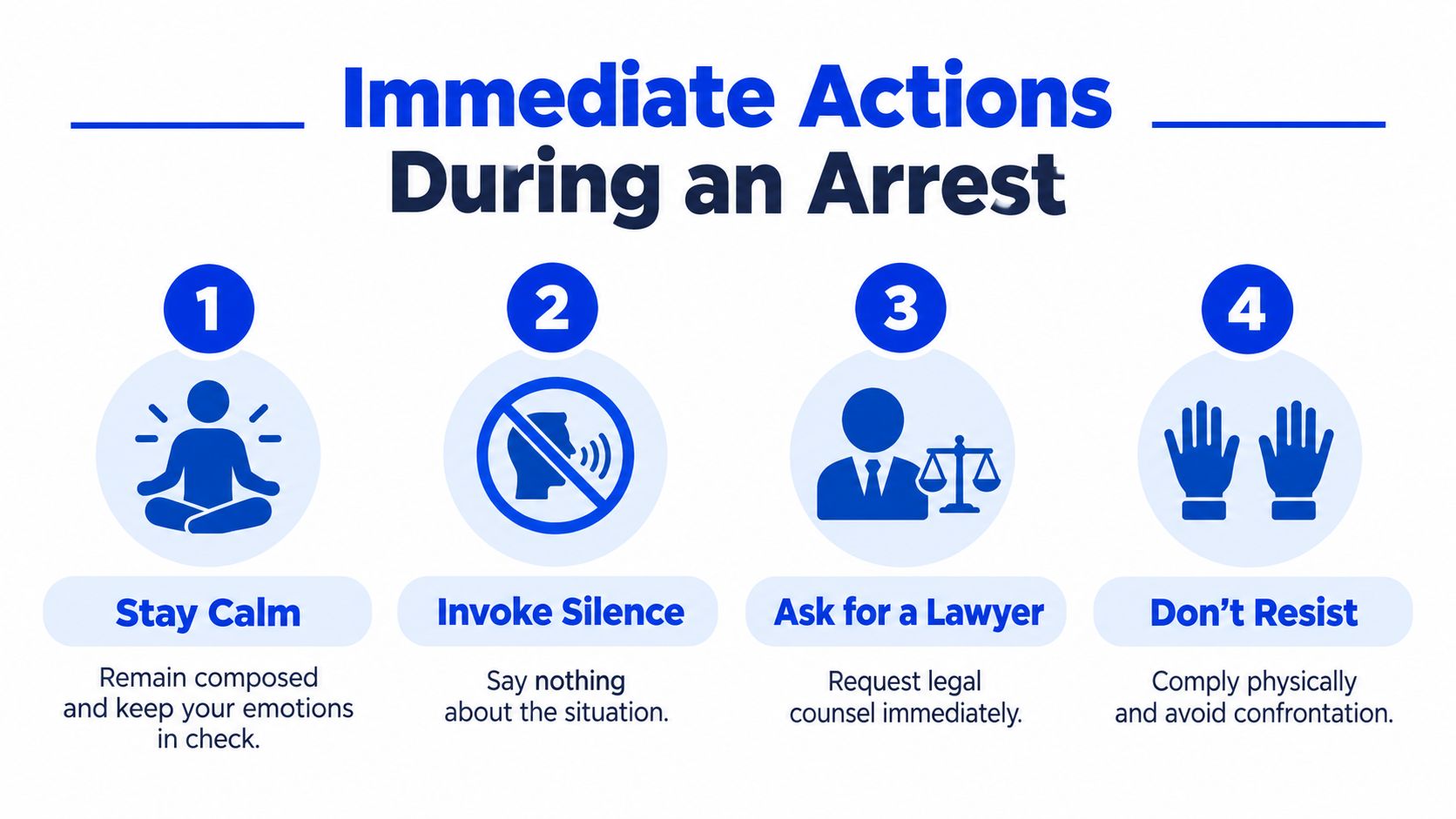
Immediate Actions During an Arrest
The first rule is simple: don't physically resist. Keep your hands visible, follow physical directions, and avoid arguing about the arrest on the street. Compliance with the mechanics of an arrest isn't an admission of guilt. It reduces the chance of additional allegations, injury, or statements made under pressure.
Use a clear verbal protocol
Provide identifying information required by Florida law, but don't answer questions about the incident. Don't guess, fill in gaps, or try to correct an officer's theory by offering your own explanation. Say this clearly:
“I am invoking my right to remain silent and want a lawyer.”
Then stop discussing the facts. A vague response such as “Maybe I should talk to someone” can create confusion. The protection works best when your request for silence and counsel is unmistakable. Don't sign a statement, waiver, consent form, or search authorization without legal advice.
The difference between Miranda rights and the practical steps after an arrest matters. Miranda warnings don't require you to volunteer an explanation, and being polite doesn't require you to surrender constitutional protections.
Situation | What to Do | What to Avoid |
|---|---|---|
Officers approach you | Keep your hands visible and remain calm | Physical resistance, sudden movements, or arguing |
Identification questions | Provide information required by local law | Explaining where you were or what happened |
Substantive questioning | Clearly invoke silence and request counsel | “Just answering one quick question” |
Search request | State that you don't consent and ask for counsel | Agreeing because an officer says it will help |
Written statement | Wait for legal advice | Signing, initialing, or correcting paperwork alone |
Florida procedure can differ based on the alleged offense, location, and whether officers claim an urgent investigative need. Those differences are exactly why guessing is dangerous. Your job during the arrest is not to win the argument. Your job is to avoid making the situation harder for your lawyer to defend.
Understanding Your Legal Safeguards Under Florida Law
An arrest starts a process with judicial safeguards. It doesn't give police an unlimited period to hold someone without explanation, court review, or access to counsel. The foundational rule remains the same: stop discussing the facts and request a lawyer before answering substantive questions.
International standards recognize access to legal assistance from the moment a person loses liberty, including before questioning. The United Nations Working Group on Arbitrary Detention materials identify legal assistance as an important protection against arbitrary detention, require detained people to be informed of that right promptly, and describe a 48-hour maximum guideline for access to counsel in applicable circumstances. The UNODC materials also recognize consultation with counsel before interviews and independent counsel during questioning and other procedural actions.

Track the clock and the paperwork
Article 9 of the International Covenant on Civil and Political Rights requires an arrested person to be told the reasons for arrest and promptly informed of charges. It also requires a person held on a criminal accusation to be brought promptly before a judge or another legally authorized judicial officer. These international standards don't replace Florida's own rules, but they explain why the first appearance, detention review, and counsel access matter.
A family member should record the arrest time, location, agency, alleged offenses, booking number, medication needs, and every stated court or bond date. Ask when the first appearance will occur. If questioning continues after a clear request for counsel, tell the lawyer exactly what happened.
Timeframe | Key Event | Recommended Action |
|---|---|---|
At arrest | Officers take control of the person and identify the alleged offense | Record the time, location, agency, and stated charges |
During questioning | Police may seek admissions or a waiver | Invoke silence and counsel, then stop substantive conversation |
Promptly after custody begins | A judicial officer should review the detention process under applicable procedure | Ask when the first appearance will occur |
Before release or transfer | Conditions and future dates may be set | Preserve every document and give it to counsel |
Probable cause affects whether police and prosecutors can proceed with a criminal case. A plain-language explanation of how probable cause functions in Florida criminal cases can help families understand why the arrest decision and the eventual proof at trial are separate questions.
The practical lesson is direct. Don't assume a delay means your rights disappeared, and don't assume a release means the case is over. Record the details, ask for counsel, and let a lawyer identify missed deadlines or unlawful detention issues.
Protecting Your Digital Privacy After Arrest
Your phone may contain location history, photographs, messages, contacts, cloud access, and evidence unrelated to the allegation. Treat digital decisions with the same care as spoken statements. Don't open your device, volunteer a password, or agree to a digital search without legal advice.
The U.S. Supreme Court generally requires police to obtain a warrant before searching cellphone contents after a seizure during an arrest. That rule doesn't prevent officers from taking the phone, preserving it, seeking a warrant, or reviewing information obtained through another lawful method. A message may also remain visible on another person's device, and a cloud account may involve separate credentials and legal issues.
Follow a digital arrest protocol
State your position clearly. Say that you don't consent to a search of the device or its contents, then request counsel.
Don't manipulate the data. Don't delete messages, reset the phone, remotely wipe it, edit photographs, or alter account information. Preservation protects your position. Destruction or alteration can create a separate problem.
Document the seizure. When safe, record where the phone was taken, who took it, whether it was open to access, and what access officers requested.
Tell counsel about connected accounts. Mention cloud storage, shared devices, location services, messaging platforms, and privileged communications.
Stop discussing the case electronically. Don't post, text, direct-message, or ask someone else to delete or change anything.
Digital extraction can involve specialized personnel, retention systems, and audit trails. In weapons, drug, theft, and violent-crime cases, location information and communications may become central evidence. The Florida statute addressing interception and electronic communications is one reason digital privacy questions require careful, fact-specific review rather than a casual assumption that every phone search is lawful or unlawful.
A seized phone is not automatically proof of guilt. It is evidence whose collection, scope, warrant, consent, and handling must be examined. Tell your lawyer what happened, preserve the device as it is, and don't try to investigate the investigation by changing digital records.
Safe Communication Strategies for Families and Release Logistics
The first phone call after arrest should solve practical problems without creating evidence. Calls to lawyers should be confidential under applicable rules, while calls to family, friends, cellmates, and other people may be monitored or recorded. Assume that non-legal communications can be repeated in court.

Use the call for logistics, not storytelling
Ask for a lawyer or appointed counsel first. If you must call family, discuss medication, childcare, transportation, housing, work notifications, and documents. Don't describe the alleged offense, identify witnesses, explain your version, or ask anyone to contact another person involved.
The person receiving the call should write down the booking information, agency, bond status, court date, release conditions, and medication needs. They should not post about the arrest or begin contacting witnesses. A family member's attempt to “clear things up” can create statements, pressure, or messages that prosecutors later interpret in an unfavorable way.
The first call should protect access to counsel and basic needs, not build a defense over a recorded line.
Release creates a separate responsibility. Posting bail doesn't end the case. Every condition is an enforceable order, and violations can create new exposure or lead to detention.
Treat every release condition as binding
Review the paperwork for:
No-contact terms: Don't call, text, message, visit, or use another person to send a message to an alleged victim or witness.
Firearm restrictions: Ask counsel exactly what must be surrendered, stored, or avoided.
Testing and reporting: Record appointment times and comply with each requirement.
Travel limits: Don't leave the permitted area without legal guidance.
Probation conditions: A new arrest or technical violation can trigger separate proceedings.
Immigration, disability, language, or mental-health concerns: Tell counsel immediately so communication and representation can be addressed.
Families arranging release should use a written checklist and keep every receipt, order, and court notice. Guidance on how to arrange bail for someone in custody should never replace a lawyer's review of the actual bond and release conditions.
Felony Versus Misdemeanor Classifications in Florida
Florida's classification system affects the seriousness of the charge, court procedure, release conditions, negotiation strategy, and possible sentencing exposure. Felonies include capital, life, first-degree, second-degree, and third-degree felonies. Misdemeanors are divided into first-degree and second-degree misdemeanors under Florida Statutes section 775.081.
If a Florida statute calls an offense a felony without identifying its degree, it generally is treated as a third-degree felony. If it calls an offense a misdemeanor without specifying the degree, it generally is treated as a second-degree misdemeanor. The charging document still requires careful review because the exact statute, enhancements, prior record, and alleged facts can change the analysis.
Classification | Examples | Typical Consequences |
|---|---|---|
Capital felony | Offenses classified by statute at the highest level | Extraordinary sentencing exposure and highly complex proceedings |
Life felony | Offenses designated as life felonies | Severe potential punishment and restrictive release considerations |
First-degree felony | Serious offenses designated at the first-degree level | Significant sentencing exposure and formal felony procedure |
Second-degree felony | Felonies designated at the second-degree level | Felony court process, possible incarceration, and lasting record consequences |
Third-degree felony | Felonies designated at the third-degree level or left unspecified under the statute | Felony prosecution, possible incarceration, and substantial collateral effects |
First-degree misdemeanor | Misdemeanors designated at the first-degree level | Misdemeanor court process, possible custody, and a criminal record |
Second-degree misdemeanor | Misdemeanors designated at the second-degree level or left unspecified under the statute | Lower classification, but still possible conviction and collateral consequences |
Classification also matters to criminal-history records. FDLE explains that its fingerprint-based repository generally receives electronic arrest and disposition data when the arresting agency submits fingerprints, commonly including felony and serious-misdemeanor arrests. A later court disposition can be added when transmitted to the agency, so an arrest shouldn't be treated as invisible merely because the charge is reduced or dismissed. Notice-to-appear matters and cases without jail booking may be handled differently, which makes release paperwork and court records important.
Preserving Evidence and Avoiding Common Pitfalls
Once you're released or transferred to counsel, stop improvising. Build a private record while memories are fresh, then preserve original evidence without editing it. Your lawyer needs facts, dates, documents, and context, not a polished story created after discussions with other people.
Create a preservation file
Write down:
The arrest details: Exact time, location, officers, witnesses, injuries, and every statement you remember making.
A private chronology: Events before, during, and after the arrest, including who was present and where relevant records may exist.
Physical evidence: Clothing, photographs, medical records, receipts, and property documents.
Digital evidence: Messages, call records, location data, photographs, videos, and account information.
Case deadlines: Bail, first appearance, charging, suppression, probation, discovery, and every scheduled court date.
Don't delete messages, conceal files, destroy clothing, or ask another person to change a record. Don't contact an alleged victim, co-defendant, witness, or investigating officer. Even an apology or an attempt to correct a misunderstanding can be portrayed as intimidation, obstruction, or witness tampering.
Technical review should test whether officers had lawful authority for a search, whether consent was voluntary and documented, whether custody and interrogation requirements were satisfied, whether identification procedures were suggestive, and whether forensic evidence has reliable collection and chain-of-custody records. Counsel may also request body-camera, dash-camera, dispatch, booking, interrogation, warrant, consent, and evidence-handling materials.
Preserve first. Explain later. A defense lawyer can evaluate evidence that exists, but cannot reliably reconstruct evidence you deleted or altered.
Exoneration research shows why this audit matters. A Registry analysis of known exonerations identified recurring involvement of perjury or false accusations, official misconduct, mistaken identification, false or misleading forensic evidence, and false confessions. Those are patterns in exoneration cases, not a prediction of dismissal or acquittal in an ordinary Florida arrest. The chain of custody for evidence can determine whether an item is reliably connected to the investigation and whether the State can establish proper handling.
When to Contact Ticket Shield for Legal Representation
Contact counsel before a police interview, first appearance, bond decision, or evidence-preservation mistake. A lawyer can review the charging document, explain the alleged offense level, address release conditions, preserve evidence, and identify whether a search, identification, statement, or interrogation requires challenge.
Ticket Shield, PLLC is a Florida criminal defense firm led by Attorney Jason S. Goldsmith, a former prosecutor. Based in Broward County and available 24/7, the firm handles misdemeanors and felonies statewide, including violent crimes, theft offenses, drug charges, weapons crimes, and probation violations. The firm provides direct attorney access by phone, text, or email and develops a custom strategy focused on weaknesses in the State's case.

Before calling, gather the booking number, arrest time, agency, charging paperwork, bond terms, court date, and any notice about probation or no-contact restrictions. Don't delay because you haven't organized everything. Give counsel what you have, explain what remains unknown, and follow advice before contacting anyone connected to the allegation. Ticket Shield offers free consultations to evaluate options early and handles court appearances in many jurisdictions.
If you or a family member has been arrested in Broward County, Fort Lauderdale, Miami-Dade, Palm Beach, or elsewhere in Florida, contact Ticket Shield, PLLC for a free consultation and direct guidance on silence, digital privacy, release conditions, and evidence preservation. The firm is available 24/7 to review the arrest details and help you take the next lawful step.