
What Are Miranda Rights? Florida Legal Guide 2026
Jason Goldsmith, Esq
You see flashing lights in the rearview mirror on a South Florida road. Your chest tightens. Maybe it's a DUI stop in Fort Lauderdale. Maybe police want to ask about a theft, a domestic violence allegation, a gun charge, or a probation issue. You keep thinking the same thing people hear on TV: “Aren't they supposed to read me my rights?”
That question matters, but not in the way commonly believed. In real Florida courtrooms, Miranda rights are not a magic phrase that makes a case disappear. They are a narrow but powerful protection against improper custodial interrogation. If you understand how they work, you put yourself in a much stronger position from the first police contact forward.
As a former prosecutor and Florida criminal defense lawyer would tell you, the first battle in many criminal cases is not trial. It is what happened at the roadside, in the patrol car, at the station, or during a “casual” conversation before an arrest. If police crossed the line, the defense can challenge the statement. If you spoke too freely, the State will try to build the case around your own words.
Table of Contents
Your Rights When Facing a Florida Arrest
If you're reading this after an arrest or police encounter in Broward County, Miami-Dade, Palm Beach, or elsewhere in South Florida, you're probably dealing with fear, confusion, and bad advice from friends or the internet. Miranda rights matter because they protect you when police questioning turns coercive. They are part of the larger shield that protects your freedom, your record, your license, and sometimes your job.
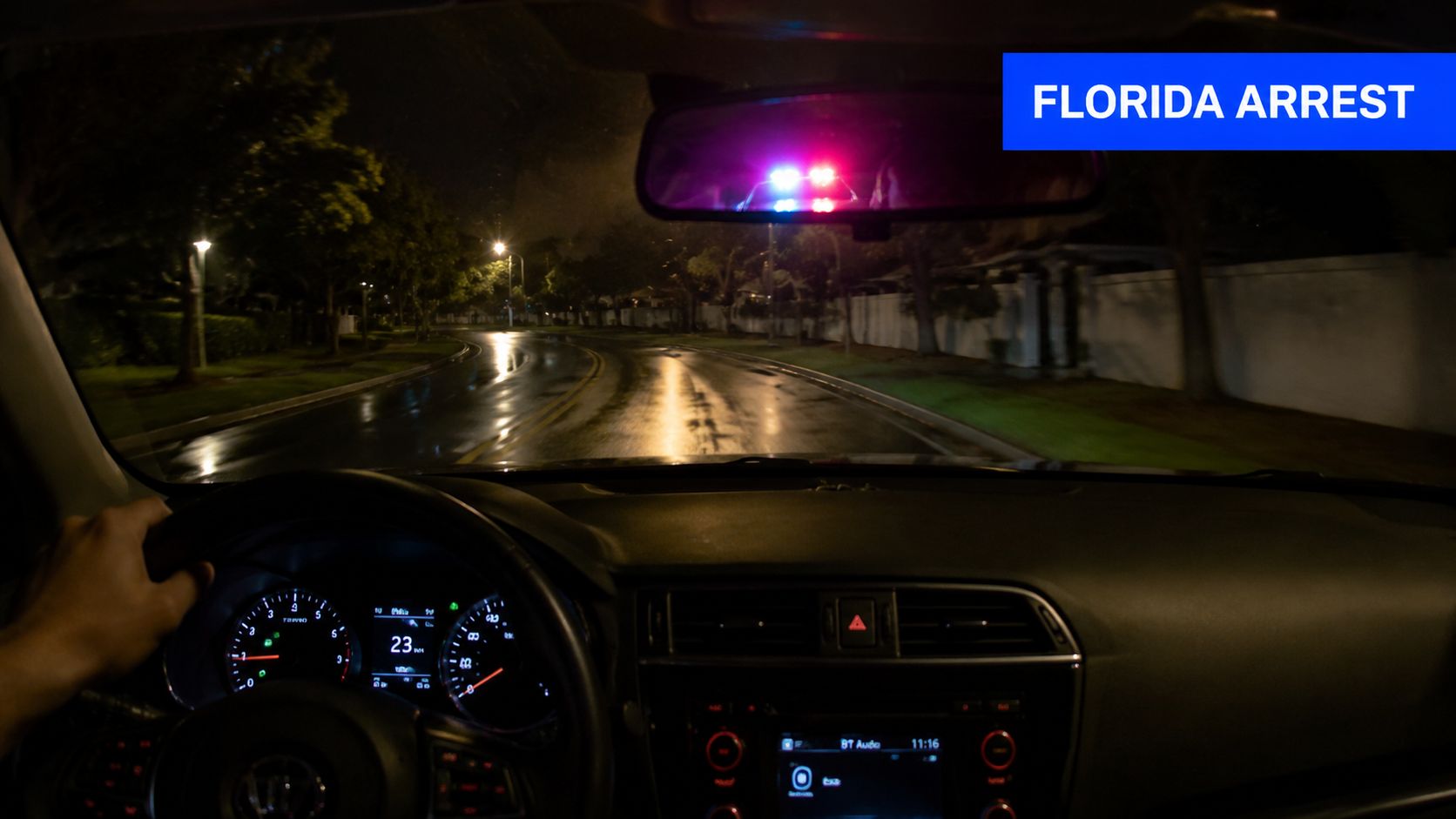
In practice, people usually misunderstand Miranda in two ways. First, they assume police must read rights the moment handcuffs appear. Second, they assume a violation means the whole case gets thrown out. Neither is a safe assumption. If your case also involves questions about a vehicle search, home entry, or phone search, it's worth understanding related illegal search and seizure issues in Florida cases.
Why this matters early
Miranda issues show up in almost every kind of criminal defense case:
DUI and traffic crimes: roadside questioning, field investigation comments, and post-arrest statements.
Drug charges and theft crimes: admissions about ownership, possession, or intent.
Domestic violence and violent crime allegations: statements made in the heat of an investigation.
Gun and weapons charges: comments about possession, permits, or who the weapon belonged to.
Probation violations and juvenile matters: statements made without appreciating the consequences.
Practical rule: The safest assumption is that if police are asking questions that could help build a case, your words can hurt you.
A calm, informed response helps more than trying to explain your way out of the situation. Most bad statement cases start with someone who thought cooperating would clear things up.
The Core of Miranda What Police Must Tell You
The phrase “what are Miranda rights” starts with a Supreme Court case. The key historical turning point came on June 13, 1966, when the U.S. Supreme Court issued its decision in Miranda v. Arizona, holding that the prosecution cannot use statements from custodial interrogation unless it shows procedural safeguards protecting the Fifth Amendment privilege against self-incrimination, as described in the City of Phoenix summary of Miranda v. Arizona.

Why these warnings exist
The Court recognized a basic reality. Police questioning in custody carries pressure. A person who is isolated, stressed, and unsure what happens next may say things they would never say freely in an ordinary conversation. Miranda warnings exist to reduce that pressure by making sure the person knows certain rights before custodial questioning begins.
That is why the warning is not just a script. It is supposed to communicate a choice. You can speak. You can refuse. You can ask for a lawyer. If you cannot afford one, one can be appointed before questioning if you want counsel.
The four warnings in plain English
You have the right to remain silent. Anything you say can be used against you in court. You have the right to the presence of an attorney. If you cannot afford an attorney, one will be appointed for you prior to any questioning if you desire.
Each part matters.
Right to remain silent. You don't have to answer investigative questions.
Anything you say can be used against you. Police are gathering evidence, not offering therapy or neutral advice.
Right to an attorney. You can have counsel present before and during questioning.
Right to appointed counsel. Lack of money does not erase the right to legal help.
What people get wrong
Many people hear the warning and still think, “If I just explain myself, they'll understand.” That is rarely how criminal investigations work. Officers can lawfully listen, document, and later testify about what you said. Prosecutors then fit your words into the State's theory of the case.
The point of Miranda is not to make police stop working. It is to give you a meaningful chance not to help the prosecution build its case with your own mouth.
When Do Miranda Rights Apply The Two Part Test
Miranda doesn't apply every time an officer asks a question. It applies only when both custody and interrogation are present. The doctrine activates only upon those simultaneous conditions, meaning custody involves a significant deprivation of freedom and interrogation includes express questioning or conduct likely to elicit an incriminating response, as explained in this overview of the custody and interrogation test.
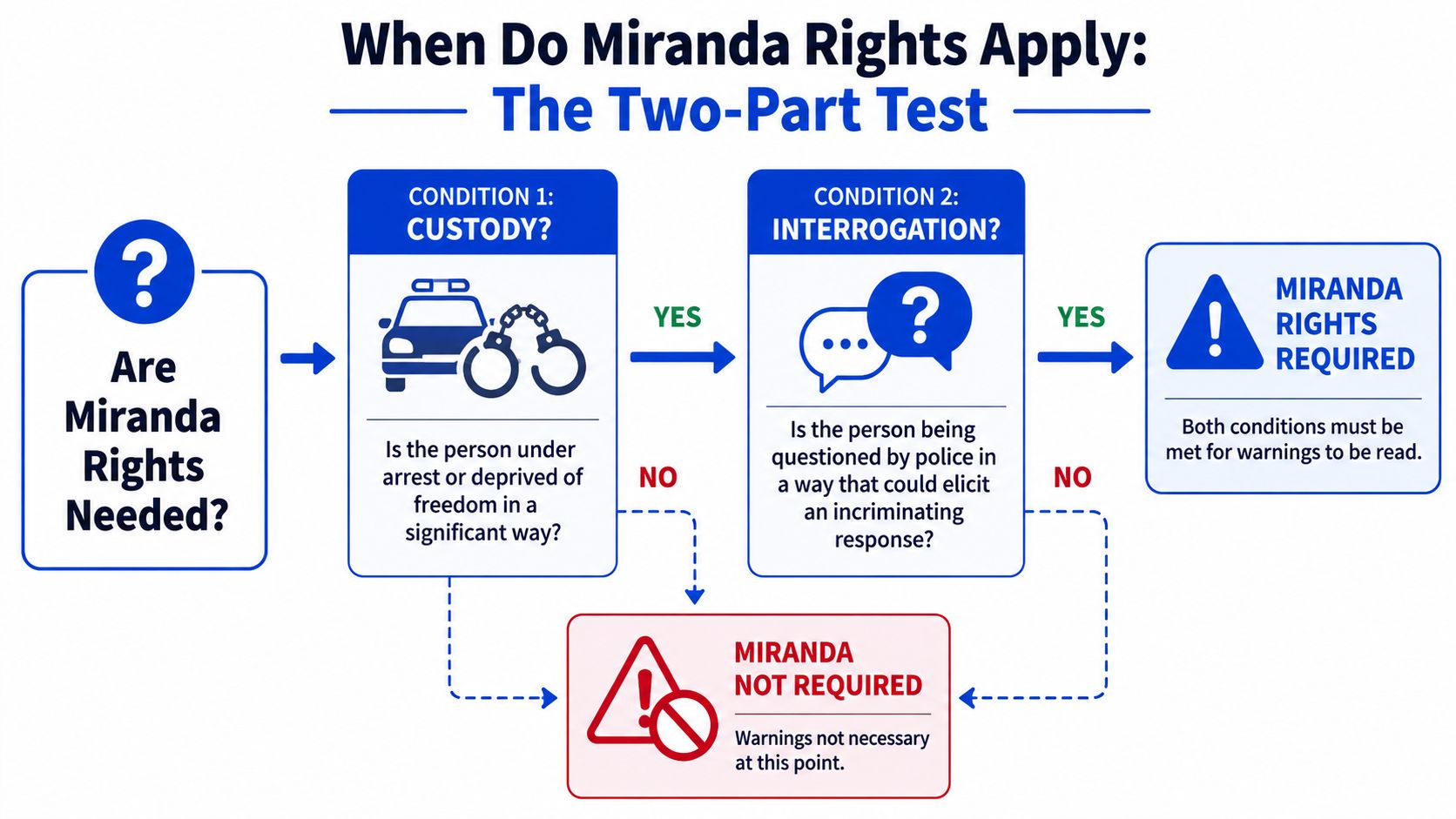
Custody means more than formal arrest
Custody doesn't always require a formal arrest announcement. The key question is whether your freedom of movement has been restrained in a significant way.
A routine traffic stop usually doesn't trigger Miranda by itself. An officer can ask for license, registration, and basic information. The same is often true during an early-stage investigation when you're speaking voluntarily and are not effectively under police control.
On the other hand, being handcuffed, placed in a patrol car, or taken into a station interview room can move the situation toward custody. Context matters. So does whether a reasonable person would feel free to leave.
Use this simple comparison:
Situation | Likely custody | Likely Miranda requirement |
|---|---|---|
Brief roadside stop for speeding | Usually no | Usually no |
Voluntary interview where you can leave | Usually no | Usually no |
Handcuffed in back of patrol car and questioned | Often yes | Often yes |
Stationhouse questioning after arrest | Yes | Yes, if interrogation follows |
A short explanation helps. Police can gather information in many settings without triggering Miranda. That surprises people because television collapses every police encounter into an “arrest scene.” Real life is more technical.
A video explanation can help make that distinction easier to spot in the moment.
Interrogation is more than direct questions
Interrogation includes more than “Did you do it?” It can include words or actions that police should know are reasonably likely to draw out an incriminating response.
Examples can include:
Direct accusations: “Those drugs are yours, right?”
Prompting explanations: “Tell me why the store video shows you there.”
Guilt-based conversation tactics: comments designed to get you talking about the event.
If police create a setting designed to make you explain, deny, or justify, a court may view that as interrogation even if the officer never used a formal question.
The pre-custody trap often takes hold. People often talk before custody attaches because they think no warning means no risk. That is backwards. If Miranda hasn't attached yet, your voluntary statements may still be admissible.
Invoking Your Rights Versus Waiving Them
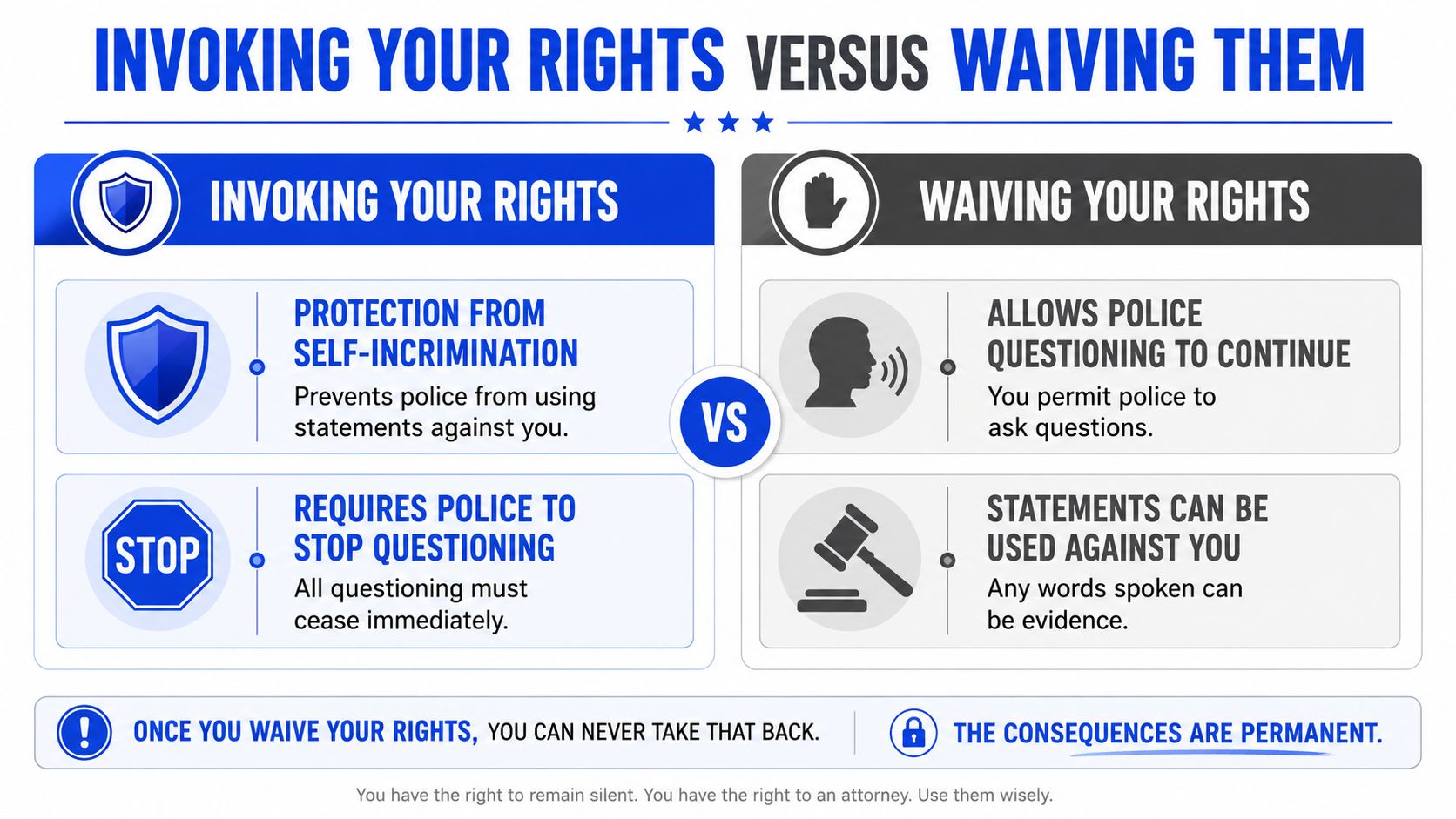
Once Miranda applies, the most important decision is whether you invoke your rights or waive them. Courts don't treat those as vague feelings. They look at words and conduct.
Under Berghuis v. Thompkins (2010), a suspect must unambiguously invoke the right to remain silent or the right to counsel. Indirect statements are not enough, as discussed in this summary of invocation clarity and waiver rules under Berghuis.
What counts as a clear invocation
The law rewards clarity. If you want questioning to stop, say so plainly.
Good examples include:
“I am exercising my right to remain silent.”
“I want a lawyer.”
“I will not answer questions without my attorney.”
Bad examples include:
“Maybe I should get a lawyer.”
“I don't know if I should say anything.”
Silence with no clear statement.
That last point catches many people off guard. Staying quiet may feel like asserting the right, but silence alone often creates room for police to keep trying.
What waiver looks like in practice
A waiver can be explicit or implied through answering questions after hearing and understanding the warning. Once you waive, police can continue questioning, and your statements can become evidence.
Real-world pressure matters greatly. People waive because they are scared, embarrassed, trying to protect someone else, or convinced cooperation will bring leniency. Sometimes they believe they can talk their way out of an arrest that has already effectively happened.
Empirical work cited in the UCLA Law Review study discussed by Prison Legal News indicates that approximately 78% to 80% of suspects waive their Miranda rights. That doesn't mean waiver is wise. It means many people speak when the safer legal choice is not to.
Words that work better than silence
If you're under pressure, use a short script and repeat it.
“I want a lawyer. I am remaining silent.”
That is clearer than arguing, protesting innocence, or trying to outsmart the officer.
A useful side-by-side comparison:
Invoking rights: questioning should stop once the invocation is clear.
Waiving rights: questioning continues, and your answers may become the backbone of the prosecution's case.
Staying passively quiet without a clear statement: often creates confusion, not protection.
When clients ask what works, the answer is simple. Clear words work. Half-measures don't.
Common Exceptions and Legal Loopholes
TV dramas make Miranda sound absolute. It isn't. Police can sometimes lawfully obtain information without first giving the warning, and that creates a lot of confusion after an arrest.
Public safety questions
If officers face an immediate threat, they may ask limited questions aimed at neutralizing danger. A classic example is asking where a weapon is located when someone nearby could get hurt.
Those questions are not about giving the suspect a fair chance to tell their side. They are about stopping an immediate risk. Courts often treat them differently for that reason.
Booking information
After an arrest, police can ask routine biographical questions such as your name, address, and similar identifying information. Those are generally administrative, not investigative.
That doesn't mean every question at booking is harmless. If an officer shifts from basic intake information to facts about the alleged offense, the analysis changes.
Volunteered statements and the pre custody trap
Miranda protects against custodial interrogation. It does not block a statement you blurt out on your own. If you volunteer information without being prompted, police may use it.
The more common trap in South Florida cases happens earlier. During a traffic stop, sidewalk conversation, probation contact, or station interview that police frame as voluntary, people talk because they think no warning means no consequences. It often means the opposite. If the encounter is non-custodial, officers may not need to Mirandize you at all before using your words later.
This issue comes up often in DUI investigations, retail theft cases, domestic violence calls, and weapons investigations. The practical lesson is the same. Don't assume the absence of Miranda language makes the conversation safe.
What Happens If Police Violate Your Miranda Rights
The biggest Miranda myth is that a violation automatically gets the case dismissed. That is incorrect. A Miranda violation results in the suppression of specific statements, not the dismissal of charges, and prosecutors may still proceed using other evidence, as explained in this discussion of Miranda violations and suppression strategy.
No automatic dismissal
This matters because people often make bad strategic choices after hearing, “They never read me my rights, so the case is dead.” It usually isn't that simple.
If police obtained a statement in violation of Miranda, the defense can ask the court to suppress that statement. The judge then decides whether the prosecution can use it as evidence of guilt. If the State has independent witnesses, video, physical evidence, or other admissible proof, the case can continue.
A related problem is comprehension. Standard warnings are sometimes delivered as a fast ritual rather than a meaningful explanation. That can matter when evaluating whether a waiver was knowing and intelligent.
A Miranda issue is not a technical side note. In the right case, it can remove the prosecutor's most damaging piece of evidence.
If you want a deeper look at litigation strategy, review how a Miranda rights violation can affect a Florida defense case.
Why suppression still matters
Suppression can change the entire posture of a case.
Consider what often happens in practice:
Drug case: the alleged confession ties the drugs to the accused.
Theft case: the statement supplies intent the video alone doesn't show.
Domestic violence case: the defendant's own words become the centerpiece when witnesses are inconsistent.
Weapons charge: a statement about possession fills a gap in the State's proof.
Take away the statement, and the prosecutor may need to rethink charging, plea offers, and trial risk. Sometimes suppression leads to reduced charges. Sometimes it supports arguments for dismissal. Sometimes it makes a jury trial much more defensible.
The point is not that every Miranda issue wins the case. The point is that a strong suppression issue can materially weaken the State's evidence.
How Miranda Rights Work Specifically in Florida
Florida follows the same core principle discussed earlier. Miranda warnings are required only when the suspect is in custody and police are conducting interrogation designed to elicit incriminating responses, as noted in this Florida-specific explanation of when officers must read Miranda rights.
South Florida examples that confuse people
In Fort Lauderdale DUI cases, people often assume rights must be read at the window of the car. Usually that is too early for Miranda analysis. In a Broward or Palm Beach theft investigation, store security or police may ask questions before the situation becomes custodial. In Miami-Dade domestic violence calls, officers often separate people and ask each side for a statement before any arrest decision is finalized.
Those details matter because Florida courts look closely at the setting, the restraint on movement, and the nature of the questions. The label police use does not control the outcome by itself. “You're not under arrest” is relevant, but not always decisive if the circumstances show functional custody.
How to assert your rights in a Florida case
In Florida, passive silence is a poor strategy. Clear verbal invocation is better. If you are in custody and questioning starts, state that you are remaining silent and that you want a lawyer.
If your case later requires a formal challenge, that usually happens through a motion to suppress evidence in Florida criminal court. That motion can address statements, searches, seizures, and other constitutional problems. For clients facing DUI, drug crimes, gun charges, probation violations, or white collar allegations, this procedural step is often where a strong defense begins.
What to Do If You Are Arrested Your Immediate Next Steps
Panic causes people to talk. Discipline protects them. If you're arrested in Broward County, Fort Lauderdale, Miami-Dade, Palm Beach, or anywhere else in Florida, keep the response simple.
A simple checklist to protect yourself
Stay calm and keep your hands visible. Don't argue on the roadside or in the house. Don't resist.
Say the words clearly. Tell police, “I am exercising my right to remain silent. I want a lawyer.”
Stop talking about the facts. Don't explain, justify, apologize, or try to talk your way out of it.
Don't consent to searches. If officers search anyway, let your lawyer challenge it later.
Don't sign statements or waivers you don't understand. A rushed signature can create avoidable problems.
Don't discuss the case on jail phones or in text messages. Assume those communications can be used against you.
Get legal counsel involved fast. Early intervention can affect bond, charging decisions, suppression issues, and case strategy.
Prepare for first court dates. If you're unsure what comes next, learn what happens at arraignment in a Florida criminal case.
The best immediate move after arrest is usually the simplest one. Stop giving the State evidence. Start protecting your rights.
If you're facing accusations involving DUI, drug crimes, domestic violence, theft, violent crimes, sex crimes, juvenile charges, federal allegations, injunctions, or record sealing issues, early defense work matters. Statements made in the first hour can shape the next year of your life.
If you or a loved one has been arrested in Broward County, Fort Lauderdale, Miami-Dade, Palm Beach, or anywhere in South Florida, contact Ticket Shield, PLLC for a confidential consultation. The firm defends clients in misdemeanor and felony cases across Florida and can evaluate whether police questioning, searches, or arrest procedures created issues that may help your defense. Early action can make a real difference in protecting your freedom, record, license, and future.
You have the right to remain silent — but what does that really mean? A plain-language guide to Miranda rights under Florida law.