
Is Mace Illegal in Florida? Legal Carry & Use Rules
Jason Goldsmith, Esq
No, mace and pepper spray aren't categorically illegal in Florida. A compact spray containing 2 ounces or less of chemical can qualify as a lawful self-defense chemical spray, but size, design, purpose, and the circumstances of use all matter.
That answer surprises many people because “pepper spray is legal” is only the beginning of the analysis. Florida law doesn't give every product labeled mace or pepper spray an automatic exemption. A product carried for intimidation, retaliation, or another offensive purpose may create legal risk, even if the container is small. Likewise, lawful possession doesn't make every deployment lawful.
For someone in Broward County, Fort Lauderdale, Miami-Dade, Palm Beach, or elsewhere in South Florida, the important question isn't merely whether police found spray. The important questions are whether the product fit Florida's statutory definition, whether you carried it for lawful self-defense, and whether you used it against an imminent threat.
Table of Contents
Understanding Whether Mace Is Illegal in Florida
Florida generally permits mace or pepper spray when it qualifies as a self-defense chemical spray. Under Florida's weapons statutes, that means the device must be compact, designed to be carried on or about the person, carried solely for lawful self-defense, and contain no more than 2 ounces of chemical. The statutory framework appears in Florida's weapons chapter.
The product name alone doesn't decide the issue. A small canister marketed and carried for personal protection may fit the statutory category. A larger device, an industrial chemical sprayer, or a product possessed for an offensive purpose may not. Florida's law focuses on both physical design and intended purpose, not merely on what appears on the label.
The three questions that control the analysis
When reviewing a defensive-spray accusation, start with three questions:
What is the product? Examine the container, its capacity, design, labeling, and how it was sold.
Why was it carried? Lawful personal protection is different from carrying it to threaten, punish, or intimidate someone.
How was it used? The circumstances surrounding deployment can create a separate assault or battery allegation.
This is why a person can possess a product that appears ordinary but still face a weapons-related investigation. Prosecutors may argue that the spray falls outside the statutory definition or that the surrounding conduct defeats the self-defense purpose.
Practical rule: Treat possession and use as separate legal questions. A lawful defensive tool can become evidence in a criminal case if the deployment was unjustified.
The most common mistake is reducing the issue to “mace is legal” or “mace is illegal.” The accurate answer is conditional. If you're concerned about a weapons allegation, Florida's weapons crimes guidance can help explain why the exact product and facts matter before you make statements to investigators.
How Florida Defines Legal Self-Defense Chemical Spray
Florida's statutory definition creates a narrow safe harbor for defensive chemical spray. The statute describes a qualifying device as compact, designed to be carried on or about the person, carried solely for lawful self-defense, and containing no more than 2 ounces of chemical. Those requirements work together. Satisfying one doesn't automatically satisfy the others.
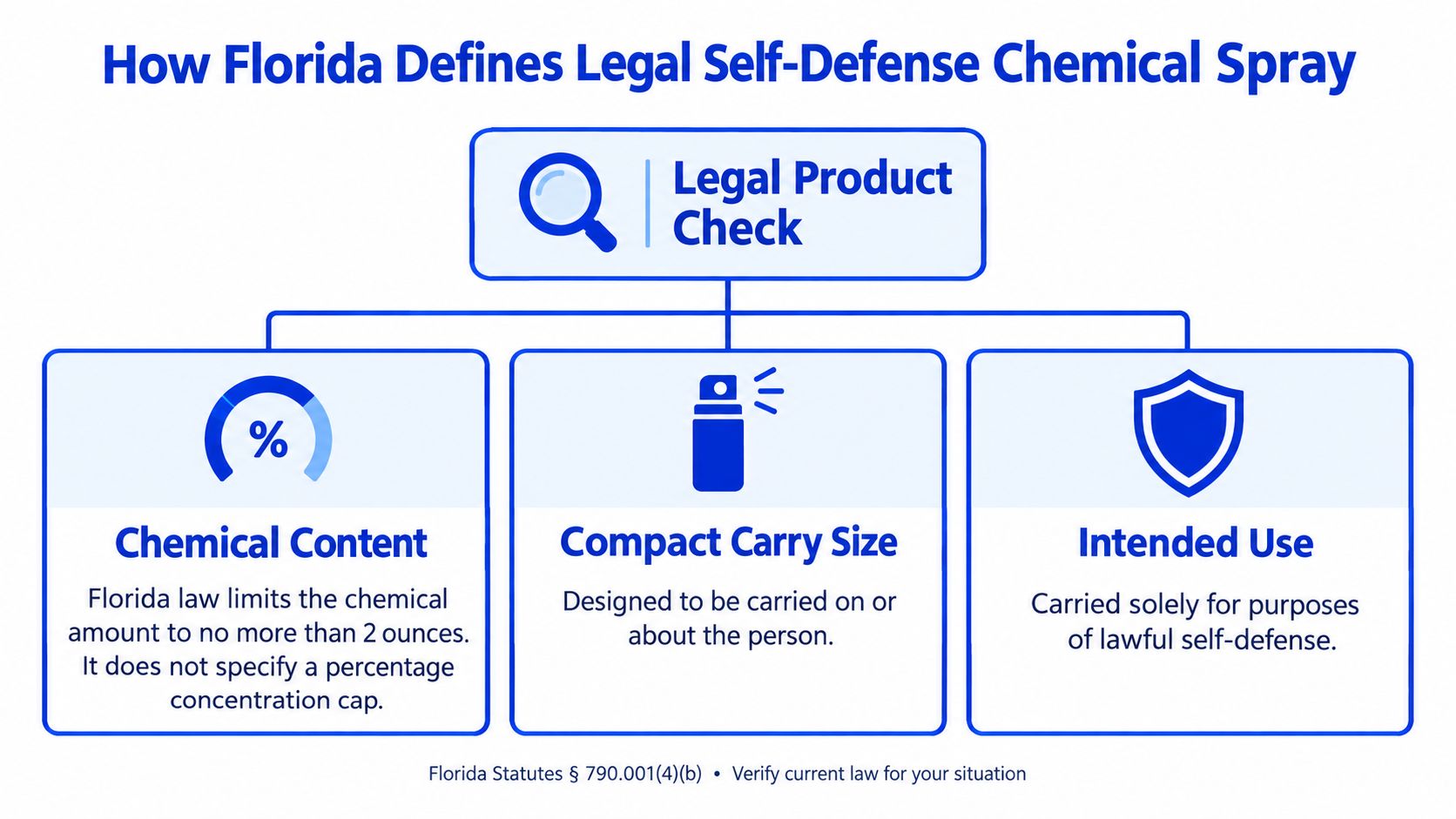
Size is a legal threshold
The 2-ounce limit is the principal numerical line in the statute. A compact spray containing 2 ounces or less can fall within the self-defense category, while a larger canister may not receive the same treatment. Florida's statutory language is available through the definition of weapons and related terms.
That makes the container worth preserving if you're questioned or arrested. Don't discard the canister, remove its label, or replace it with another product before a lawyer can examine it. The physical item may help establish whether the spray met the statutory requirements.
The law also distinguishes a self-defense chemical spray from a broader tear gas gun or chemical weapon or device classification. That distinction matters because a product designed for general chemical deployment, rather than personal defensive carry, may not fit the exemption.
Purpose can change the legal analysis
A person's stated purpose isn't the only evidence prosecutors may consider. Messages, witness accounts, surveillance footage, statements at the scene, and the sequence of events can all affect whether the spray was carried solely for lawful defense.
For example, carrying a compact spray in a purse for protection presents a different issue from bringing it to a confrontation to threaten another person. The container may be identical, but the surrounding facts can support very different interpretations.
When reviewing a product, preserve:
The original container, including its capacity and labeling.
The purchase information, if available.
Photographs of the device, including its size and design.
Messages and video, which may show why it was carried and what happened before deployment.
A product that doesn't qualify isn't automatically proof of criminal guilt. It does mean the statutory safe harbor may be unavailable, and the state may rely on other weapons or criminal statutes. The defense must then address both the product's classification and the circumstances of possession.
Carrying Pepper Spray Concealed or Openly in Florida
Florida permits a qualifying self-defense chemical spray to be carried concealed or openly for lawful self-defense. The concealed-weapons statute expressly protects concealed carriage of a qualifying spray for lawful self-defense, generally without requiring a concealed-weapons license. The statutory exception appears in Florida's concealed-weapons provision.
Open carry is also authorized when the spray meets the statutory definition and is carried for lawful self-defense. Florida's open-carry provision addresses self-defense chemical spray separately from other weapons, as described in the open-carry statute.
Concealed carry and open carry are not unlimited permissions
The method of carry doesn't cure a product defect or an unlawful purpose. A person carrying a nonqualifying device openly can still face a weapons allegation. A person carrying a qualifying spray concealed can still face criminal exposure if the evidence shows it was carried or used for an improper purpose.
The statutes also don't authorize deployment during another criminal offense. Lawful carry is protection for possession and carriage under the stated conditions, not immunity from every charge arising out of a confrontation.
Question | Why it matters |
|---|---|
Is the device compact? | The statutory definition applies to a compact spray designed for personal carry. |
Does it contain no more than 2 ounces? | The statute sets 2 ounces as the principal chemical limit. |
Is it carried solely for lawful self-defense? | Offensive or retaliatory purpose can undermine the exemption. |
Was it carried openly or concealed for lawful protection? | Florida recognizes both methods for a qualifying spray. |
A citation for an open-carry violation is legally distinct from a felony allegation based on using spray against an officer. That distinction can matter during charging and negotiations. If you're trying to understand how the open-carry rule operates in practice, review this explanation of Florida open-carry law.
The safest approach is simple. Carry a product that fits the statutory definition, use it only for lawful personal protection, and avoid displaying it to escalate an argument. If police have already seized the spray, don't try to explain its legality in detail before speaking with counsel.
Why Legal Possession Does Not Guarantee Legal Use
A lawful canister doesn't give its owner a license to spray anyone who is angry, insulting, or standing nearby. Florida evaluates the reason for deployment, the immediacy of the threat, the person targeted, and whether the force was reasonably connected to defense.
The line often becomes clear when the facts are separated into time periods. What happened before the spray was used may establish an imminent threat. What happened after the threat ended may show that the force continued after justification disappeared.
Situations that create immediate problems
Spraying during a heated verbal argument can support an assault or battery investigation if the other person wasn't using or about to use unlawful force. Spraying someone after they've backed away or left can create the same problem. So can spraying an uninvolved person who wasn't the source of the threat.
Those facts don't automatically resolve a case against the accused. They identify the issues a defense lawyer must investigate, including whether witnesses misunderstood the confrontation, whether video contradicts the initial report, and whether the accused reasonably perceived an imminent attack.
A useful way to analyze the incident is to ask:
What did the other person do immediately before deployment?
Was the threat still occurring when the spray was used?
Did the accused start or escalate the confrontation?
Did the accused stop using force once the threat ended?
What do independent video and witness accounts show?
A nonlethal label describes the product. It doesn't decide whether the use of force was lawful.
Florida's self-defense principles can support defensive use when the facts justify it, but they don't erase ordinary criminal laws governing unwanted or harmful physical contact. A prosecutor may characterize the spray as an intentional act that caused offensive contact, while the defense may argue necessity and lawful self-defense.
The difference often turns on evidence, not slogans. Security footage, 911 recordings, photographs, medical records, text messages, and witness positioning can all matter. If you've been accused of using spray during a confrontation, read the guidance on Florida battery charges, then avoid discussing the incident publicly or with the complaining witness.
The Serious Felony Risk of Using Spray Against Police
Florida treats the knowing and willful use of a self-defense chemical spray against a law-enforcement officer performing official duties as a third-degree felony. The rule concerns use, not merely possession. The statute is set out in Florida's provision addressing chemical spray used against officers.
That distinction matters during chaotic encounters. A person may legally carry qualifying spray for personal protection and still face a felony accusation if prosecutors believe the person intentionally sprayed an officer who was acting officially. The same facts that establish lawful possession won't necessarily defeat an allegation about deployment.

The facts that can drive the charge
A defense investigation should examine at least these questions:
Knowledge and willfulness: Did the accused knowingly and intentionally direct the spray at the officer?
Identification: Was the person clearly identifiable as law enforcement at the moment of use?
Official duties: Was the officer performing official duties when the spray was deployed?
Target and movement: Did the accused aim at the officer, or did exposure occur accidentally during a confused event?
Sequence: What did the officer and accused do immediately before the spray was released?
The statute doesn't say that every accidental exposure is automatically a felony. The language concerning knowing and willful use makes intent and circumstances central issues. That doesn't mean an accidental-exposure defense succeeds automatically, but it means the prosecution still must prove the required conduct.
Consider a chaotic arrest scene. The accused may claim they believed an unknown person was attacking them, while the state argues the person knew the target was an officer. Body-camera footage, commands, clothing, lighting, distance, and the timing of the deployment could become important evidence.
Felony use and misdemeanor carry allegations are different
A separate open-carry violation can be treated at the misdemeanor level under the relevant statute. That allegation shouldn't be confused with the felony provision governing knowing and willful use against an officer. The seriousness of the case may depend less on the fact that spray was found and more on who was sprayed, why, and what the accused understood at the time.
If you're facing an allegation involving an officer, don't assume the case is only a weapons citation. Review the broader consequences discussed in this resource about a prison sentence for assaulting a police officer, and speak with counsel before giving a recorded statement.
Protecting Your Rights After a Defensive Spray Charge
A defensive-spray case requires two separate investigations. The first concerns the product itself, including whether it satisfied Florida's statutory definition. The second concerns the encounter, including whether the accused faced an imminent threat, whether the spray was directed at the right person, and whether the force continued after the danger ended.
A former prosecutor approaches that investigation by testing the state's theory against the actual evidence. If the state treats every pepper-spray case as a weapons violation, counsel should examine the container and statutory requirements. If the state treats every deployment as battery, counsel should examine the threat, timing, witness reliability, and available self-defense evidence.
What a careful defense review should address
An effective review commonly includes:
Product classification: Confirm the container's size, design, labeling, and intended use.
Search and seizure: Determine whether police lawfully stopped, searched, or seized the spray.
Statements: Identify admissions, inconsistencies, or questioning that occurred after the right to remain silent or counsel was invoked.
Video evidence: Seek body-camera footage, surveillance video, cell-phone recordings, and dispatch audio.
Witness accounts: Compare initial statements with later versions and identify witnesses who observed the threat.
Charging decision: Assess whether the filed charge matches the statute and the provable facts.
Don't make the state's case for it
People under stress often try to explain that the spray was legal. That explanation can create problems if it includes guesses about distance, timing, intent, or what another person did. A person may also unintentionally admit that the spray was carried to frighten someone or that deployment continued after the confrontation changed.
If police contact you after an incident, provide identifying information as required, clearly invoke your right to remain silent, and request a lawyer. Don't delete messages, contact the complainant, post about the incident, or discard the product. Those actions can create separate problems or destroy evidence that may support your defense. The practical steps after an arrest are addressed in this guide to protecting your rights.
For clients in Broward County, Fort Lauderdale, Miami-Dade, Palm Beach County, and surrounding South Florida communities, early review can affect how the case is framed. The goal may be dismissal, a reduction, a negotiated resolution, or trial preparation, but no lawyer can promise a particular outcome. The immediate priority is protecting constitutional rights and separating lawful possession from allegedly unlawful use.
Ticket Shield, PLLC defends Floridians accused of weapons offenses, assault, battery, and other criminal charges involving defensive spray. Visit Ticket Shield, PLLC for a confidential consultation focused on the product, the encounter, the evidence, and the defense options available in your case.