Florida 10 20 Life Law Explainer Guide
Jason Goldsmith, Esq
A lot of people first hear about Florida 10 20 Life in the worst possible moment. A detective mentions a firearm enhancement. A bond hearing goes badly. A family member in Broward County, Fort Lauderdale, Miami-Dade, or Palm Beach calls asking one question: “Am I really looking at mandatory prison time?”
If your case involves a felony and a gun, that fear is understandable. Florida's 10-20-Life law has shaped plea negotiations, trial strategy, and sentencing decisions in South Florida courts for years. What makes it so confusing is that the answer often turns on details people miss at the start: the filing date, the exact felony charged, whether the gun was only present or discharged, and whether the case involves an attempted offense.
This is where early legal analysis matters. A firearm allegation doesn't automatically mean the same sentencing result in every case. The charging document, the evidence, and the post-2017 discretion rules can change the entire direction of a defense.
Table of Contents
Introduction to Florida 10 20 Life Law
Florida 10 20 Life is the shorthand for a sentencing structure tied to firearm use during certain felonies. In plain English, it means the State may try to force a minimum prison term based on what the prosecution says happened with the gun during the alleged crime.
That's why this law shows up so often in Florida gun charge defense cases, violent crime cases, and attempted robbery or burglary prosecutions in Broward County and across South Florida. A person may think, “Nobody got hurt,” and still face a serious enhancement allegation.
Why people get confused fast
Most confusion starts in three places:
The conduct alleged: possession, display, discharge, and injury don't carry the same exposure.
The date of the case: post-2017 judicial discretion is a critical issue.
The stage of the offense: an attempted felony can still trigger the enhancement.
Practical rule: In a Florida 10 20 Life case, the most important questions usually aren't emotional ones. They're technical ones. What felony was filed, what exactly does the State claim happened with the firearm, and when was the case filed?
If you're searching for answers after an arrest in Fort Lauderdale, Broward County, or another South Florida court, start there. Those details usually decide whether the case is a mandatory minimum fight, a plea advantage fight, or both.
History of Florida 10 20 Life Law
Florida's 10-20-Life law took effect on July 1, 1999, was promoted by then-Governor Jeb Bush under the slogan “Use a gun, and you're done,” and was codified as Florida Statute § 775.087, according to this Encyclopedia.com summary of Florida's 10-20-Life law. It was widely regarded as one of the toughest gun-crime statutes in the United States.
The original political message was simple. Florida wanted severe, automatic punishment when a firearm was involved in listed felonies. The law was built to remove much of the sentencing flexibility judges normally have.
The law's early impact
Over time, the statute reached far beyond the headline cases people usually imagine. The same Encyclopedia.com reference states that a report analyzing trends since enactment showed an 83% increase in felons imprisoned under 10-20-Life compared to 1999 levels.
That matters because it shows how the statute expanded in practical effect, not just in theory. Prosecutors used it. Courts applied it. Defendants felt the pressure early in cases because the mandatory structure changed plea decisions from day one.
The 2017 shift that changed today's cases
A major change came when Governor Rick Scott signed Senate Bill 228 on March 29, 2017, suspending the mandatory minimum sentencing provisions effective July 1, 2017, according to this Miami Herald editorial discussing Senate Bill 228.
The key point isn't just that the law changed. It's who benefits from that change. The practical distinction is filing date. Current coverage often blurs that line, but the core issue is whether the case falls into the post-amendment framework that allows judges to consider case-specific factors.
The most damaging misinformation usually sounds hopeful. “Everybody can ask for resentencing now.” That isn't how this law works.
For anyone dealing with a pending case in South Florida, the history matters because it explains why older cases and newer cases can look similar on paper but operate very differently in court.
Statutory Basis and Covered Felonies
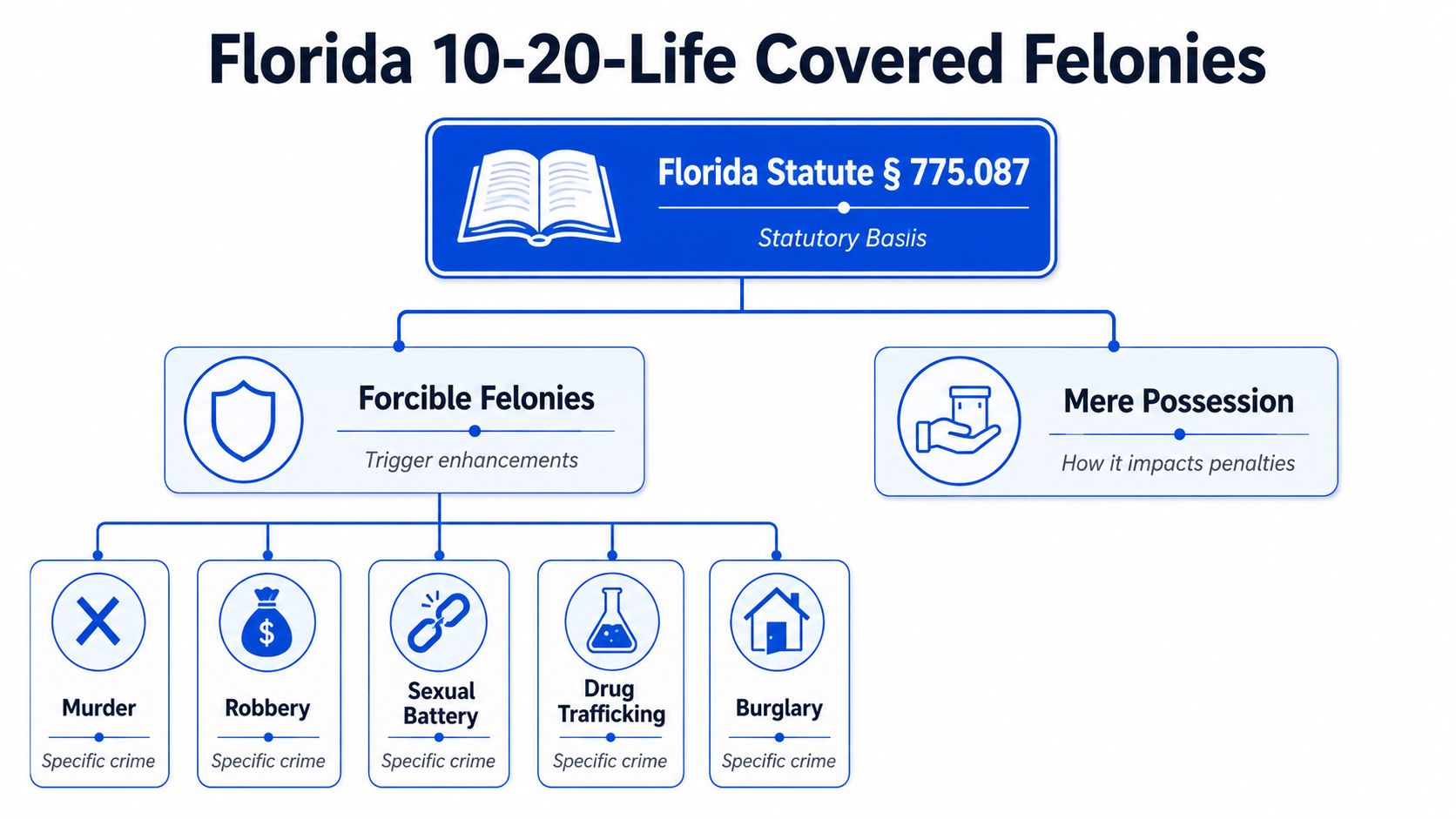
The legal foundation for Florida 10 20 Life is Florida Statute § 775.087. That statute is where lawyers start when they need to answer two urgent questions: Does this felony qualify? And if it does, what firearm allegation is the State trying to prove?
The law doesn't apply to every gun-related arrest. It applies to listed felonies and firearm-related conduct attached to those felonies. That distinction matters in Fort Lauderdale and Broward County courts because the label on the charge can drive the entire sentencing conversation.
Which crimes can trigger the enhancement
Florida's 10-20-Life statute applies to over 80 specific felony offenses, including drug trafficking, robbery, burglary, arson, and sexual battery, according to this Florida offense list summary.
Some of the offenses people in South Florida most often see tied to the statute include:
Robbery-related charges: especially where the State alleges a firearm was carried or displayed.
Burglary allegations: including attempted entries where the prosecution claims the weapon was present during the offense.
Drug trafficking counts: because a firearm allegation can sharply raise the stakes.
Violent felony accusations: such as battery-related or other forcible felony conduct.
If you want a broader look at how prosecutors categorize serious offenses, this guide to violent crime examples in Florida gives useful context.
Why attempted felonies cause so much confusion
Attempt cases confuse people because they assume “nothing was completed” means the firearm enhancement won't apply. That's often wrong. In practice, prosecutors may still pursue the enhancement in an attempted robbery or attempted burglary case if they believe they can prove the required possession element.
That creates one of the most important defense issues in these prosecutions. Was the gun possessed in a legally meaningful way, or was it merely nearby?
In many attempted felony cases, the entire fight centers on control, reach, and proof. A gun in the area isn't always the same as actual possession under the enhancement theory.
That's why a careful reading of the arrest affidavit is never enough. The real analysis comes from body camera footage, witness statements, forensic details, and how the State framed the charge.
Mandatory Minimum Sentences Explained
A client sits across from me and says, “No one got hurt, so this can't be a life-sentence case, right?” That reaction is common, and it is exactly why this part of the law trips people up. Florida's 10-20-Life statute works less like a flexible sentencing guide and more like a staircase. Once the State proves certain firearm facts during a qualifying felony or even an attempted felony, the case can jump to a much higher sentencing floor, as explained in this overview of Florida's 10-20-Life sentencing structure.
How the tiers work
Here is the structure in plain English:
Action | Standard Tier | Enhanced Tier |
|---|---|---|
Possessing or displaying a firearm during a qualifying felony | 10 years | 15 years for certain semiautomatic firearms with high-capacity magazines or machine guns |
Discharging the firearm | 20 years | No additional enhancement applies for discharge alone |
Discharge causing great bodily harm or death | 25 years to life | 25 years to life |
The easiest way to read that table is to focus on what the prosecutor must prove. Mere possession can trigger one floor. Firing the gun raises it. If the discharge causes great bodily harm or death, the exposure rises again, and the sentencing range becomes dramatically harder to control.
That last part matters in attempted felony cases. People often assume an attempted robbery or attempted burglary cannot trigger these penalties because the underlying offense was not completed. The statute can still apply if the charged felony is one of the covered offenses and the State proves the firearm element that matches the tier.
Why the sentencing floor matters
Before the 2017 amendment, judges had far less room to sentence below these minimums. The older version of the law operated like a locked floor. A judge could hear about a clean record, steady work history, military service, family support, or genuine remorse and still be required to impose the statutory minimum if the enhancement was proven.
After the 2017 change, the picture became more nuanced. Judges may now have discretion to depart from the mandatory minimum in some cases, but that does not mean every defendant qualifies, and it does not mean the enhancement suddenly became easy to avoid. The central question is whether the court has lawful authority to go below the minimum and whether the facts give the judge a sound reason to do it. That post-2017 discretion issue is often missing from online explanations, yet it can shape plea decisions, sentencing strategy, and trial risk from the start.
One more point causes confusion. These minimums are still serious because they set the baseline for the case. If the State proves the firearm allegation, the defense usually gets the best results by attacking the enhancement itself, narrowing the facts that support it, or building a record for judicial discretion where the amended law allows it.
For example, a firearm allegation attached to a violent charge can change the case far more than the title of the offense suggests. A reader comparing underlying offenses can see that problem clearly in this explanation of felony battery charges in Florida.
Defense takeaway: In many 10-20-Life prosecutions, the key fight is not just whether a felony occurred. It is whether the State can prove the specific firearm conduct that triggers the sentencing tier, and whether post-2017 discretion gives the court any room to sentence below that floor.
Real World Case Examples
Courtroom reality is messier than the statute. Two cases may both mention a gun, but one becomes a negotiable possession dispute while the other becomes a high-risk discharge case.
Attempted robbery with a gun allegation
A common South Florida fact pattern starts with an attempted robbery charge. The police report says a firearm was present. No shot was fired. The person arrested says the gun stayed in a waistband, bag, or vehicle and was never used.
That kind of case often becomes a possession fight. The defense may argue the State can't prove actual possession during the attempt phase or can't link the weapon closely enough to the alleged offense conduct. The prosecution, by contrast, will try to frame presence plus access as enough to support the enhancement theory.
A discharge case with room to fight
Another typical case involves a struggle, a chaotic scene, and a claimed firearm discharge. In those cases, the legal battle may center on whether the defendant discharged the weapon, whether the discharge happened in the way the State claims, and whether forensic evidence supports that story.
Sometimes the strongest defense isn't “no gun existed.” It's narrower. The defense attacks the higher tier and pushes the case away from a discharge allegation toward a lower-exposure dispute.
A post-2017 plea hearing
In post-2017 cases, plea hearings can look very different from older mandatory minimum cases. The defense may present mitigation that matters in a more meaningful way, including background, mental health history, cooperation, lack of injury, evidentiary weaknesses, or circumstances that make the floor unjust.
That doesn't guarantee a favorable result. It does mean the defense has room to build a record instead of walking into a sentencing process where the outcome is mechanically fixed.
A firearm case isn't just about what happened on the street. It's also about how the case was charged, when it was filed, and whether the State's proof actually matches the tier it wants.
Common Defenses and Mitigation Strategies
The best defense in a Florida 10 20 Life case usually starts before anyone talks about sentencing. It starts with the evidence. Who had the firearm, where it was found, how police seized it, and how closely the weapon ties to the alleged felony often decide the outcome.

Challenge actual possession early
Defendants often contest the 10-year enhancement by arguing the firearm was not possessed during an attempted felony, which puts the burden on the State to prove intent and control, according to this discussion of actual possession in Florida 10-20-Life cases.
That issue comes up constantly in attempted robbery, attempted burglary, and vehicle-based arrests. A gun under a seat, inside a bag, or near multiple people may create real factual disputes.
Key defense moves often include:
Separating proximity from possession: A nearby firearm doesn't automatically prove actual possession.
Testing control evidence: Who owned it, touched it, carried it, or had immediate access matters.
Examining statements carefully: A rushed admission or ambiguous remark can become the State's central possession proof.
Attack the link between the gun and the felony
Even when a gun is present, the State still has to connect it to the qualifying felony in a legally meaningful way. That's where defense work often becomes very specific.
A lawyer may focus on:
The underlying felony itself
If the State can't prove the qualifying felony, the enhancement collapses with it.The timeline
Was the weapon present during the offense, or only discovered afterward?Witness reliability
In many cases, witnesses describe fear first and details later. Their certainty may exceed their accuracy.The charging theory
Prosecutors sometimes file the highest version of the case first and sort out the proof later.
If the weapon was recovered through a questionable stop or search, a suppression challenge may change everything. This overview of what a motion to suppress evidence does in Florida criminal cases is directly relevant in gun and weapons prosecutions.
When the firearm is the gateway to the enhancement, the search and seizure issue isn't technical. It can be the whole case.
Use suppression and mitigation strategically
Mitigation still matters, especially in cases where the court has discretion. But it only works well when paired with factual and legal pressure.
Common mitigation themes include:
Personal background: trauma history, youth, family support, employment, or treatment efforts.
Case conduct: cooperation, no injury, limited role, or evidence of overcharging.
Practical presentation: letters, records, treatment documents, and witness testimony that give the court a concrete reason to view the case differently.
A short video can help frame how lawyers think about defending high-stakes weapon cases:
In Broward County and across South Florida, the strongest results usually come from combining these approaches. Suppress what shouldn't come in. Narrow what the State can prove. Then present mitigation from a position of strength.
Plea Negotiation Options and Attorney Assistance
You are offered 10 years at first appearance, and the prosecutor says the offer will get worse if you wait. That moment feels final to a lot of people. In a Florida 10-20-Life case, it usually is not.
A plea discussion in one of these cases turns on a few concrete questions. When was the case filed. What exactly did the State charge. Does the information clearly allege possession, discharge, or injury. Is the case built around a completed felony, or an attempted felony where the enhancement is still being claimed. Those details often decide whether the prosecutor is bargaining from a strong position or from an assumption that no one has tested the charge yet.
The post-2017 amendment matters for that reason. As discussed earlier, cases filed after July 1, 2017 may give the court more room to sentence below what used to be treated as automatic. That does not mean every judge will do it. It means the defense has a reason to build a record for discretion, and that changes how plea talks should be handled from the start.
Why timing shifts the negotiating position
Timing works like wet cement. Early on, the shape of the case can still change. Once the charging theory hardens and the State invests in that theory, changing course gets harder.
That is why early plea work is not just about asking for a lower number. It often includes close review of:
The charging document itself, especially the firearm language
The filing date and whether the post-2017 discretionary framework may apply
Whether an attempted felony is being used as the predicate offense
Whether the alleged facts fit the tier the State selected
Any weakness that makes the firearm allegation harder to keep in the case
Attempt cases deserve special attention here because they are often misunderstood. A client may say, "No shot was fired, so 10-20-Life cannot apply." Sometimes that instinct is wrong. If the State alleges actual possession during an attempted robbery, attempted burglary, or another qualifying attempt, the enhancement fight may still be very real. That issue should be evaluated early, before plea positions harden around a bad assumption.
In the right case, counsel may also push to resolve the matter before the firearm allegation becomes the centerpiece of the prosecution. That can mean asking the State to amend the information, agree to a plea to a non-qualifying offense, or treat the case more like a probationary or diversion-screening matter where the facts and the client's background support it. For readers comparing alternatives, this overview of pre-trial intervention in Florida explains how early case framing can affect non-trial outcomes.
What a defense lawyer is trying to accomplish
The strongest plea bargaining position usually comes from preparation that shows the State what can go wrong for them, not just what can go right for you.
In practice, that often means a lawyer is trying to accomplish plea-specific goals such as:
Getting the firearm allegation removed from the information or rewritten more narrowly
Pushing the case into a lower sentencing tier by disputing possession versus discharge
Resolving the case to an offense that does not trigger the enhancement statute
Creating enough trial risk that the prosecutor treats the first offer as a starting point, not the finish line
Presenting a sentencing record that gives the judge a reason to use post-2017 discretion where available
Clients often ask whether this kind of work really changes outcomes. It can. Prosecutors do not evaluate plea offers in a vacuum. They look at whether the defense understands the statute, whether the firearm theory fits the facts, whether an attempted felony enhancement will hold up, and whether a judge may have room to sentence differently after 2017.
For clients in Fort Lauderdale, Broward County, Palm Beach, or Miami-Dade, the practical point is simple. Get the case reviewed early by a lawyer who handles firearm enhancement litigation regularly. In these cases, the first offer may reflect the State's opening position, not the best result available.
Frequently Asked Questions
Can someone already serving time under the old law get the benefit of the post-2017 change
Not automatically. The most important point is that the change does not generally apply to people already incarcerated under the original 10-20-Life mandates before the amendment took effect. That's one of the biggest areas of confusion.
Does Florida 10 20 Life apply to juvenile cases
It can come up in juvenile-related prosecutions depending on how the case is charged and where it proceeds. The age of the accused matters, but so do the felony allegations, the court handling the case, and the prosecution's theory.
Can a judge waive the enhancement on their own
Under the traditional structure, judges did not have authority to sentence below the statutory floor because they felt it was fair. In current post-2017 cases, judicial discretion is a more important issue, but it still depends on the filing framework and case posture.
What if the case involved an attempted felony and no shot was fired
That's still a serious issue. Attempted robbery and attempted burglary allegations can trigger enhancement litigation if the State claims actual possession during the attempt. Those cases often turn on close factual questions.
Is a Florida state 10 20 Life case the same as a federal gun case
No. State and federal firearm prosecutions are different systems with different statutes, sentencing rules, and procedures. If there is any possibility of federal exposure, the case needs immediate Florida criminal defense review focused on both jurisdictions.
If you or a family member is facing a firearm-related felony in Broward County, Fort Lauderdale, Miami-Dade, Palm Beach, or anywhere in South Florida, don't try to decode Florida 10 20 Life alone. Ticket Shield, PLLC helps clients challenge gun enhancements, protect constitutional rights, and build an early strategy aimed at avoiding convictions or reducing penalties. Contact the firm for a confidential consultation and get clear answers about what your case is really facing.