How Much Pot Is a Felony in Florida? a 2026 Guide
Jason Goldsmith, Esq
A lot of people search how much pot is a felony in Florida after a traffic stop, a car search, or a call from someone in Broward County jail. Usually, the situation starts fast. An officer says they smell marijuana, asks questions, searches the car, and suddenly something that felt minor turns into a criminal charge with real consequences.
The part that catches people off guard is that Florida law doesn't only ask how much marijuana was involved. It also asks what form it was in. Raw cannabis flower is treated one way. THC oil, vape cartridges, wax, and many edibles can be treated very differently. That distinction changes the charge, the exposure, and the defense strategy.
If you're in Fort Lauderdale, Broward County, Miami-Dade, Palm Beach, or anywhere in South Florida, you need a clear answer, not internet rumor. Some people are arrested with a small bag of flower and face a misdemeanor. Others are found with a single cartridge or edible product and are looking at a felony. Both situations happen regularly in Florida courts.
That is why this issue deserves careful attention. The legal line is simple in one sense, but its practical application is not. Search and seizure issues matter. Weight matters. Product type matters. Medical marijuana status matters. So does what you say to police before you have a lawyer.
Table of Contents
A Simple Question With a Complicated Answer
If police find marijuana during a stop in Fort Lauderdale or elsewhere in South Florida, the first question that arises is simple: Is this a felony?
The honest answer is that it depends on more than a quick guess about the amount. Florida draws one line for marijuana flower and a very different line for THC concentrates and many edibles. That difference surprises people who assumed all cannabis products were treated the same.
A common example looks like this. Someone has a small amount of flower in the console and thinks the case is minor. Another person has a vape cartridge bought legally in another state and assumes that because it is small, it must be less serious. In Florida, that assumption can be dangerous.
Why the product type matters
With raw flower, the legal analysis usually starts with the weight. With concentrates, the issue often starts with the classification of the product itself. That means a case can shift from something manageable to something much more serious before a person ever sees a judge.
Practical rule: If you're trying to answer how much pot is a felony in Florida, don't stop at the number. Identify whether the substance is flower, concentrate, or an edible first.
Why early legal advice matters
Drug cases often overlap with other criminal defense issues. The stop may involve a traffic offense. The search may raise Fourth Amendment concerns. The police may claim the item was in your possession even if it was found in a shared car or home. Those details can make the difference between a weak case and a strong one for the State.
That is especially true in Broward County, Miami-Dade, and Palm Beach, where fast charging decisions can shape the entire direction of a case.
The 20-Gram Line for Marijuana Flower
For raw cannabis flower, Florida gives a direct answer. Under Florida marijuana possession penalties explained, possession becomes a third-degree felony only when the weight exceeds 20 grams of raw cannabis. Possession of 20 grams or less is a first-degree misdemeanor under Florida Statute § 893.13(6)(a), carrying a maximum penalty of 1 year in jail and a $1,000 fine. If the amount is more than 20 grams, the charge becomes a third-degree felony punishable by up to 5 years in prison and a $5,000 fine.
What the law says about flower
The 20-gram line is the starting point for understanding felony marijuana possession in Florida. If the substance is flower, and the prosecution can prove the weight, then the misdemeanor-felony line is clear.
Here is the practical breakdown:
Metric | Possession of 20 Grams or Less | Possession of More Than 20 Grams |
|---|---|---|
Charge level | First-degree misdemeanor | Third-degree felony |
Governing law | Florida Statute § 893.13(6)(a) | Florida Statute § 893.13(6)(a) |
Maximum incarceration | 1 year in jail | 5 years in prison |
Maximum fine | $1,000 | $5,000 |
Core issue | Weight at or below the legal line | Weight above the legal line |
If you're facing a flower-based charge, a lawyer handling Florida marijuana possession defense should immediately examine how law enforcement weighed the substance, whether packaging affected the result, and whether the State can properly identify it.
Why small weight differences matter
The difference between a misdemeanor and a felony can come down to a few grams. That is why defense lawyers don't treat the reported weight as automatically reliable. The police report is not the final word. Lab process, packaging issues, field handling, and chain of custody all matter.
A felony record affects much more than court dates. It can affect employment, professional licensing, firearm rights, immigration consequences, and the bargaining position in plea negotiations. In many cases, the first defense goal is to challenge whether the State can really prove the amount crossed the felony line.
In practice, clients often underestimate how aggressively prosecutors treat a charge once it is filed as a felony, even when the amount seems close to the statutory cutoff.
When the substance is flower, the 20-gram threshold is the key legal line. But that is only part of the picture, because many South Florida marijuana arrests do not involve flower alone.
The Felony Trap Cannabis Concentrates and Edibles
Many people think a tiny cannabis product must lead to a minor charge. In Florida, that isn't always true.
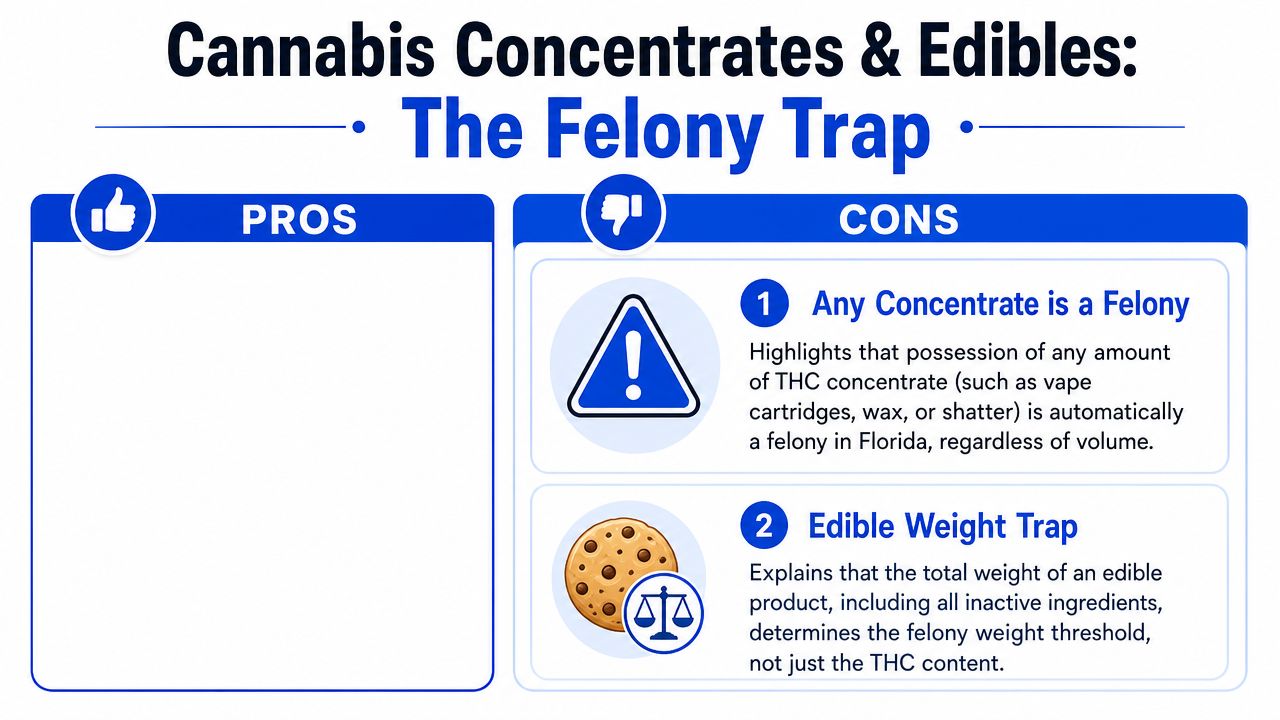
Under Florida cannabis penalties for concentrates, any amount of THC concentrates (wax, oil, edibles) is a felony regardless of weight, while 20g of flower is merely a misdemeanor. The reason is that Fla. Stat. § 893.13(6)(a) and § 893.03 classify concentrates as Schedule I derivatives punishable as felonies for any quantity.
Why a cartridge can trigger a felony
This is the trap people miss. A person can possess flower under the misdemeanor threshold and avoid a felony charge, but a single vape cartridge, a small amount of wax, or another THC extract can expose that same person to a felony.
That comes up often in real life:
Travel carryover: Someone bought a cartridge or gummies legally in another state and forgot it was in a bag.
Vehicle stop discovery: Police search a car after a stop in Broward County and find a pen or cartridge in the center console.
Shared-property problem: A concentrate is found in an apartment, and multiple people deny ownership.
These are not rare fact patterns. They are exactly the kind of cases where people say, "It was barely anything," and still end up charged with a felony.
What people get wrong about edibles
Edibles create confusion because people focus on THC content, not on how Florida classifies the product. Many buyers think a few gummies are the same as a small amount of flower. They aren't.
The safer assumption is this: if the product is a THC concentrate or extract, treat it as a potential felony issue from the start. Don't rely on common-sense comparisons like smell, package size, or how little was left in the container.
A small cannabis product isn't necessarily a small criminal case in Florida.
This distinction matters well beyond marijuana defense. It also shows why search and seizure litigation, lab analysis, and possession arguments matter in South Florida drug prosecutions. The label on the package, the chemical form, and the testing method can drive the charge more than a person expects.
When Possession Becomes Felony Trafficking
Florida doesn't stop at possession charges. At a certain point, the law escalates from possession to trafficking, and it can do that based on weight alone.
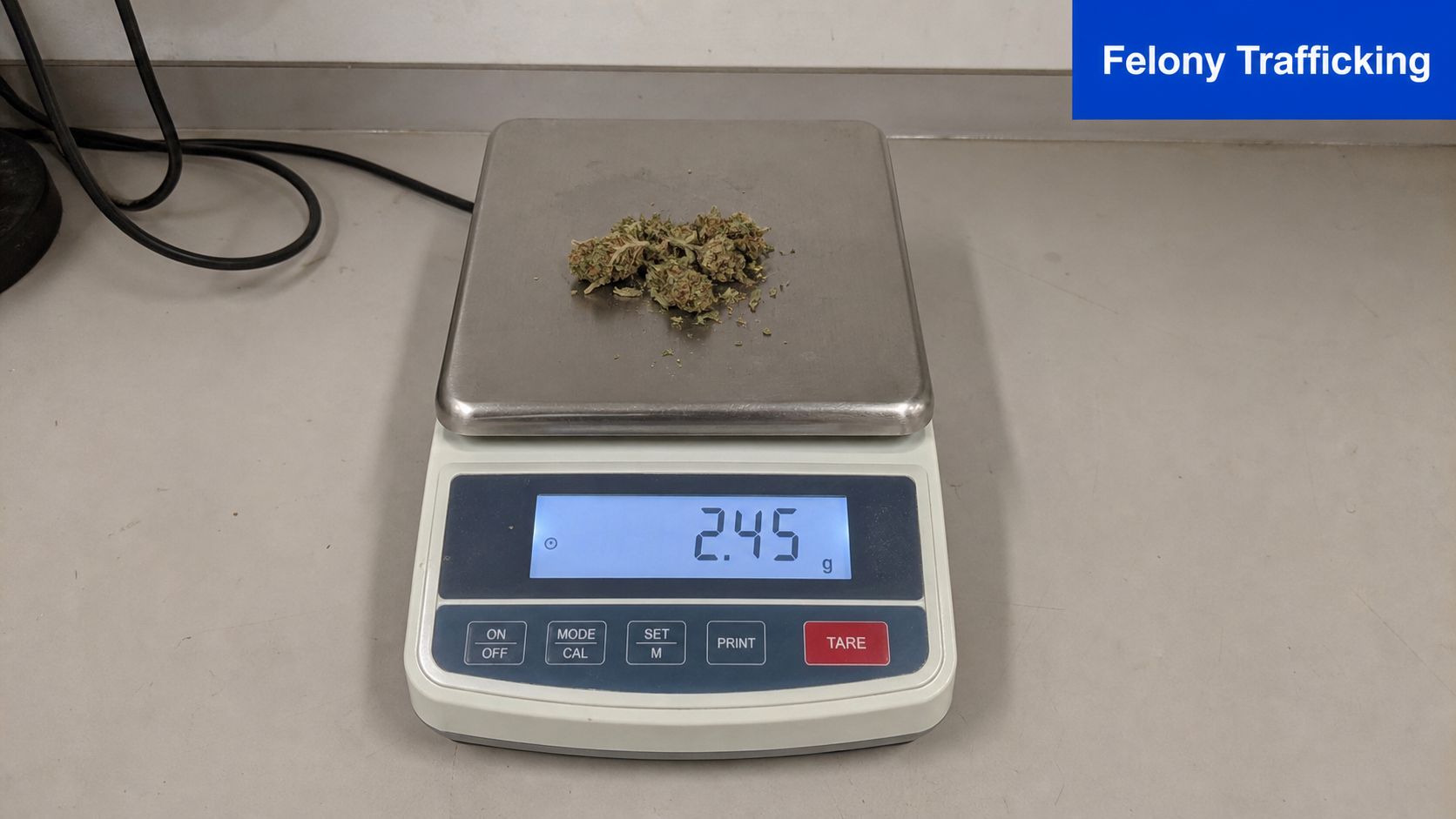
According to Florida drug trafficking thresholds, fentanyl possession of 4 grams or more crosses into trafficking under § 893.135(1)(c), triggering mandatory 3-year minimums and $50,000 fines, while the marijuana trafficking threshold is 25 pounds. The same source explains that possession of the statutory weight alone constitutes trafficking, regardless of intent.
Trafficking can be based on weight alone
That surprises many people. They assume trafficking requires proof of sales, packaging, text messages, or money changing hands. Florida law can be much harsher than that. Once the weight reaches the statutory trafficking threshold, the prosecution doesn't need the kind of evidence people usually associate with dealing.
For marijuana, the key trafficking threshold is 25 pounds. That is a different legal category from simple possession and a far more serious one.
For context, Florida treats other drugs with similarly strict weight-based triggers. Fentanyl is one of the clearest examples. A relatively small amount can shift the case into trafficking territory with mandatory prison exposure.
A charge described as "possession with intent" often sits in the space between simple possession and trafficking, and these cases require a careful review of the evidence, as discussed in possession with intent to distribute defense issues.
Why these cases need immediate defense work
Trafficking cases move differently. Prosecutors evaluate them more aggressively. Bond arguments become more serious. Early investigation matters more. If officers searched a vehicle, intercepted a package, or tied multiple people to the same drugs, the defense needs to identify weak points fast.
Focus areas often include:
Weight proof: The State still has to prove the threshold amount.
Knowledge and control: Possession is often disputed in shared vehicles, homes, or luggage.
Search challenges: A bad stop or unlawful search can change the whole case.
Statements: Admissions made during roadside questioning can create avoidable problems.
If your case is in Broward County, Fort Lauderdale, Miami-Dade, or Palm Beach, don't assume the name of the charge tells you whether the evidence is strong. In trafficking litigation, details matter.
Important Exceptions and Common Legal Defenses
Not every marijuana-related arrest leads to a conviction, and not every case should end in a plea. Florida law includes exceptions, and criminal defense work often turns on whether police respected constitutional limits.
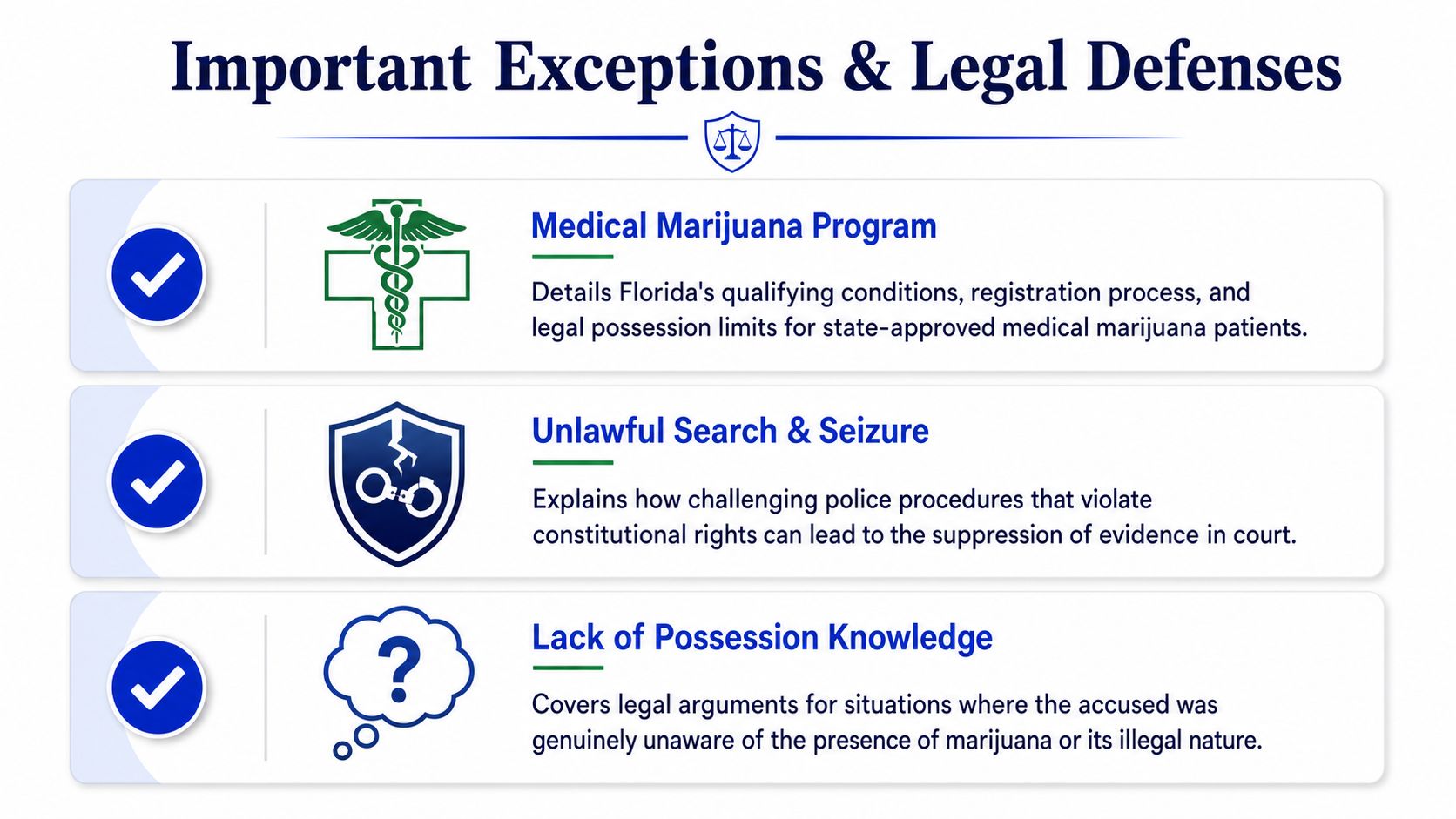
Under Florida medical marijuana possession limits, medical marijuana patients in Florida can legally possess up to 2.5 ounces of smokable flower (approx. 70.9 grams) and a total of 4 ounces of medical cannabis. The same statutory exception exempts qualified patients from felony possession charges that would otherwise apply.
Medical marijuana exceptions
A valid medical marijuana status can completely change the analysis. For a qualified patient who is within authorized limits, possession that would otherwise create criminal exposure for a non-patient may fall within the law's exception.
That doesn't mean every person who says they use marijuana medically is protected. The defense still needs to verify:
Valid patient status: The authorization must be legally recognized.
Compliance with limits: Being over the allowed amount can create criminal exposure.
Correct product and documentation: The details matter if the State disputes lawful possession.
A medical defense is strongest when records, authorization, and possession limits line up cleanly.
Defense issues that often matter
Even when no medical exception applies, a marijuana case may still be defensible. Some of the strongest issues have nothing to do with whether the client uses marijuana and everything to do with whether the State can lawfully prove the charge.
Key examples include:
Illegal search and seizure: A traffic stop, car search, or home search may have violated the Fourth Amendment.
Constructive possession disputes: Drugs found near you are not automatically yours. Shared vehicles and shared residences often create factual disputes. This issue comes up often enough that it helps to understand how constructive possession works in Florida cases.
Knowledge problems: The State may struggle to prove you knew the substance was there.
Weight or identity challenges: The prosecution has to prove what the substance was and, when relevant, how much there was.
Police procedure errors: Body camera footage, report inconsistencies, and chain-of-custody issues can matter.
Case focus: In many Broward County drug cases, the first serious question isn't whether police found something. It's whether they found it through a lawful search and whether they can prove the accused knowingly possessed it.
These defense themes also overlap with other criminal practice areas. Search challenges matter in gun and weapons charges. Knowledge and possession issues matter in theft and white collar cases. Procedural errors matter everywhere, from DUI to probation violation litigation. Good defense work starts by slowing the case down and testing every assumption in the State's version.
What to Do If You Are Charged in South Florida
The first hours after an arrest or investigation matter. What you say and do can either protect your defense or make the case harder than it needs to be.

Under Florida cannabis possession law basics, possession of 20 grams or less of cannabis is a first-degree misdemeanor, not a felony, with penalties capped at 1 year in prison and a $1,000 fine. Even so, a misdemeanor arrest can still affect your record, license concerns, job prospects, and future charging decisions. A felony case raises the stakes much more.
What to do immediately
If you're charged in Fort Lauderdale, Broward County, Miami-Dade, Palm Beach, or nearby South Florida courts, take these steps right away:
Stay silent. You don't need to explain where the marijuana came from, who it belonged to, or whether you forgot it was there.
Don't consent to searches. If police ask to search your car, phone, bag, or home, don't agree.
Preserve documents and facts. Save receipts, medical marijuana records, messages, and names of witnesses.
Get legal help quickly. Early intervention often shapes charging, bond conditions, and defense strategy.
Ask for a lawyer clearly, then stop talking about the facts of the case.
Why early action changes the case
Drug cases are built from police observations, statements, searches, testing, and assumptions about possession. Those issues can be challenged, but only if the defense gets involved early enough to preserve video, identify witnesses, and review the stop carefully.
That is particularly true if your case overlaps with other allegations such as DUI, a weapons issue, juvenile charges, probation concerns, or search-and-seizure litigation. Florida criminal cases often expand fast once a person starts talking.
If you're trying to find the right next step after an arrest, start with guidance from a Broward criminal defense attorney who handles South Florida criminal courts and understands how prosecutors build marijuana and controlled substance cases.
The most important point is simple. Don't guess your way through a felony-risk case. Whether the issue involves flower, concentrates, edibles, trafficking allegations, or a disputed search, a fast legal review can expose problems the arrest paperwork won't show.
If you're facing a marijuana charge, a DUI, a weapons case, a probation violation, or another criminal allegation in Broward County, Fort Lauderdale, Miami-Dade, Palm Beach, or surrounding South Florida areas, contact Ticket Shield, PLLC for a free, confidential consultation. The firm is available 24/7 and can help you protect your rights, evaluate the evidence, and build a defense strategy specific to your case.