What Is Adjudication Withheld: Florida Law 2026
Jason Goldsmith, Esq
You're standing in a Broward County courtroom, or waiting outside one in Fort Lauderdale, Miami-Dade, or Palm Beach. Your case gets called. The prosecutor offers a deal and says the words “adjudication withheld.” It sounds like relief. No conviction, right? So the case is over and life goes back to normal?
Not so fast.
This is one of the most misunderstood turning points in a Florida criminal case. People hear “withhold” and assume it means the charge disappears, won't matter for work, or won't follow them later. In practice, the answer is more complicated. Sometimes adjudication withheld is a smart result. Sometimes it's only the least harmful option on the table. Sometimes taking it too quickly creates problems you didn't see coming.
That's why this decision deserves more than a fast hallway explanation. If you're still early in the case, it helps to understand what happens at arraignment in Florida, because plea offers often start before people understand the long-term consequences.
Table of Contents
Adjudication Withheld Explained The Plain English Definition
Frequently Asked Questions About Adjudication Withheld
Facing an Offer of Adjudication Withheld
Most clients first hear this phrase under pressure. The prosecutor is moving cases. The judge wants the docket moving. You want the stress to stop. If the offer sounds better than a conviction, it's tempting to say yes on the spot.
That instinct is understandable. It's also where mistakes happen.
In plain terms, adjudication withheld often means you enter a plea, the court imposes conditions, usually probation, and the judge does not formally adjudicate you guilty. To someone scared about a permanent criminal record, that sounds like a clean win. Sometimes it is a useful result in a theft case, drug case, traffic-related offense, or another lower-level charge in South Florida courts.
But the phrase “not a formal conviction” doesn't answer the important questions people care about:
Will employers still see it
Will a professional board care
Will immigration treat it like a conviction
Will it hurt me if I'm charged again
Can I later seal the record
Practical rule: Never judge a plea offer by the label alone. Judge it by what it does to your record, your license, your immigration status, and your exposure if something goes wrong later.
As a former prosecutor would tell you from the inside, plea language often sounds cleaner than the consequences feel. Prosecutors may focus on the benefit that there's no formal conviction under Florida law. They usually aren't focused on your job application, your background check, or your ability to travel.
For clients in Broward County, Fort Lauderdale, Miami-Dade, Palm Beach, and nearby South Florida courts, the important question isn't whether adjudication withheld sounds good. Instead, the pertinent question is whether it's the right result for your life.
Adjudication Withheld Explained The Plain English Definition
A simple way to understand what is adjudication withheld is this. The court says you are responsible for the offense, but it stops short of entering a formal conviction.
Consider a workplace discipline case. An employee breaks a rule. The employer could put a final reprimand in the permanent file. Instead, the employer places the employee on a corrective plan with conditions. If the employee completes the plan, the formal reprimand never gets entered. The incident still happened. It just wasn't finalized in the harshest way.
That's close to how a withhold works in Florida criminal court.
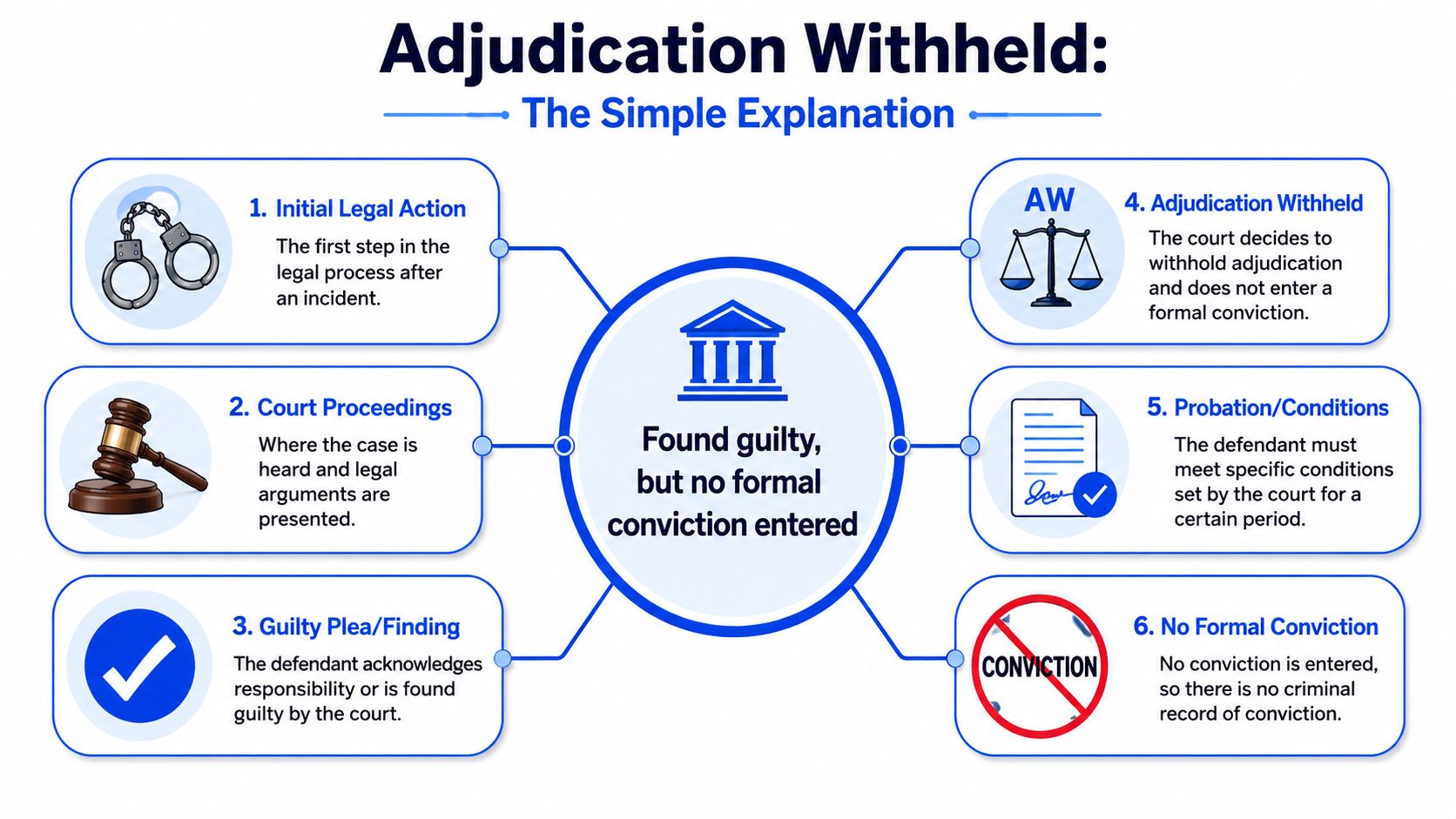
Under Florida Statute §948.01, judges have authority to withhold adjudication after imposing probation, which means the defendant is found guilty of a crime but is never formally convicted, avoiding the loss of civil rights such as firearm possession and voting privileges that come with a formal conviction under state law, as explained in this discussion of Florida withheld adjudication under §948.01.
What usually happens in court
In many cases, the process looks like this:
A plea is entered. Usually guilty or no contest.
The judge accepts the plea.
The court imposes conditions. Often probation, classes, treatment, costs, community service, or other requirements.
Adjudication is withheld. That means no formal conviction is entered under Florida law.
That's why a withhold can matter in cases involving Florida domestic violence defense issues, theft crime penalties in Florida, misdemeanor drug charges, or some probation violation resolutions. It may help avoid the harshest state-law consequences of a conviction.
What a withhold does not mean
A withhold is not a dismissal.
A withhold is not the same as being found not guilty.
A withhold does not mean the arrest and charge vanish from public view.
The most common misunderstanding is this. People hear “no conviction” and assume “no record.” Those are not the same thing.
That distinction matters in nearly every criminal defense practice area, from DUI and drug crimes to weapons charges, white collar cases, and record sealing Florida petitions. If you're evaluating a plea in Fort Lauderdale or Broward County, the legal definition is only the starting point. The practical impact is what should drive the decision.
Adjudication Withheld vs Conviction Dismissal and Diversion
Not all case outcomes are equal. If you're deciding whether to accept a plea, it helps to compare the likely alternatives side by side.
Florida Case Outcomes Compared
Outcome | Formal Conviction? | Requires Guilty/No Contest Plea? | Impact on Public Record | Potential for Sealing/Expunging |
|---|---|---|---|---|
Adjudication Withheld | No formal conviction under Florida law | Usually yes | Arrest and court case generally still appear | May be eligible to seal if other requirements are met |
Conviction | Yes | Usually yes, or guilty finding after trial | Appears as conviction on the record | Often much more limited |
Dismissal | No | No plea required | Arrest may still appear unless later cleared | May support expungement if eligible |
Pre-Trial Diversion | Often designed to avoid conviction if completed | Often no plea at the front end, depending on program structure | Case may still be visible while pending | Frequently stronger path to a cleaner final result if completed |
A dismissal is usually better than a withhold because there is no plea and no finding of guilt. If the State can't prove the case, or legal problems weaken the prosecution, the defense should push for that result first.
A conviction is the outcome individuals often try to avoid. That's where a withhold can become valuable. It may protect rights that a conviction would take away under Florida law.
Why diversion can be better
Diversion often sits in a different category. Programs such as pre-trial intervention may allow a person to complete conditions and end the case without the same plea consequences tied to a standard withhold. If that option is on the table, it should be evaluated carefully. This overview of pre-trial intervention in Florida helps explain why diversion can sometimes produce a cleaner long-term outcome.
What this comparison means in practice
A withhold can be a good result when the realistic alternatives are worse. But it isn't the top outcome in every case.
Ask these questions before accepting it:
Is dismissal still possible: If the stop, search, identification, or witness proof is weak, a plea may be premature.
Is diversion available: In some first-time or lower-level cases, diversion may leave you in a better position.
What are the exact conditions: Probation terms can be manageable or burdensome, depending on the case.
What matters more in your life: Employment, immigration, licensing, firearm rights, and future exposure don't all move the same way.
For someone charged with a Broward County drug offense, a Fort Lauderdale theft case, or a South Florida traffic-related charge, the best resolution is the one that protects both the immediate case and the years after it.
The Real-World Consequences of a Withheld Adjudication
A client sits in court, hears “no conviction,” and feels the pressure lift. Then the harder questions show up later. Will this appear on a background check? Does a licensing board care? Will immigration treat this as a conviction anyway? Those are the questions that should drive the decision before any plea is entered.
From the defense side, and from having seen how prosecutors present these offers, I can say this plainly. A withhold can be a good outcome. It can also create long-term problems that get minimized in plea discussions because they do not affect the prosecutor's file once the case closes.
Employment and licensing problems
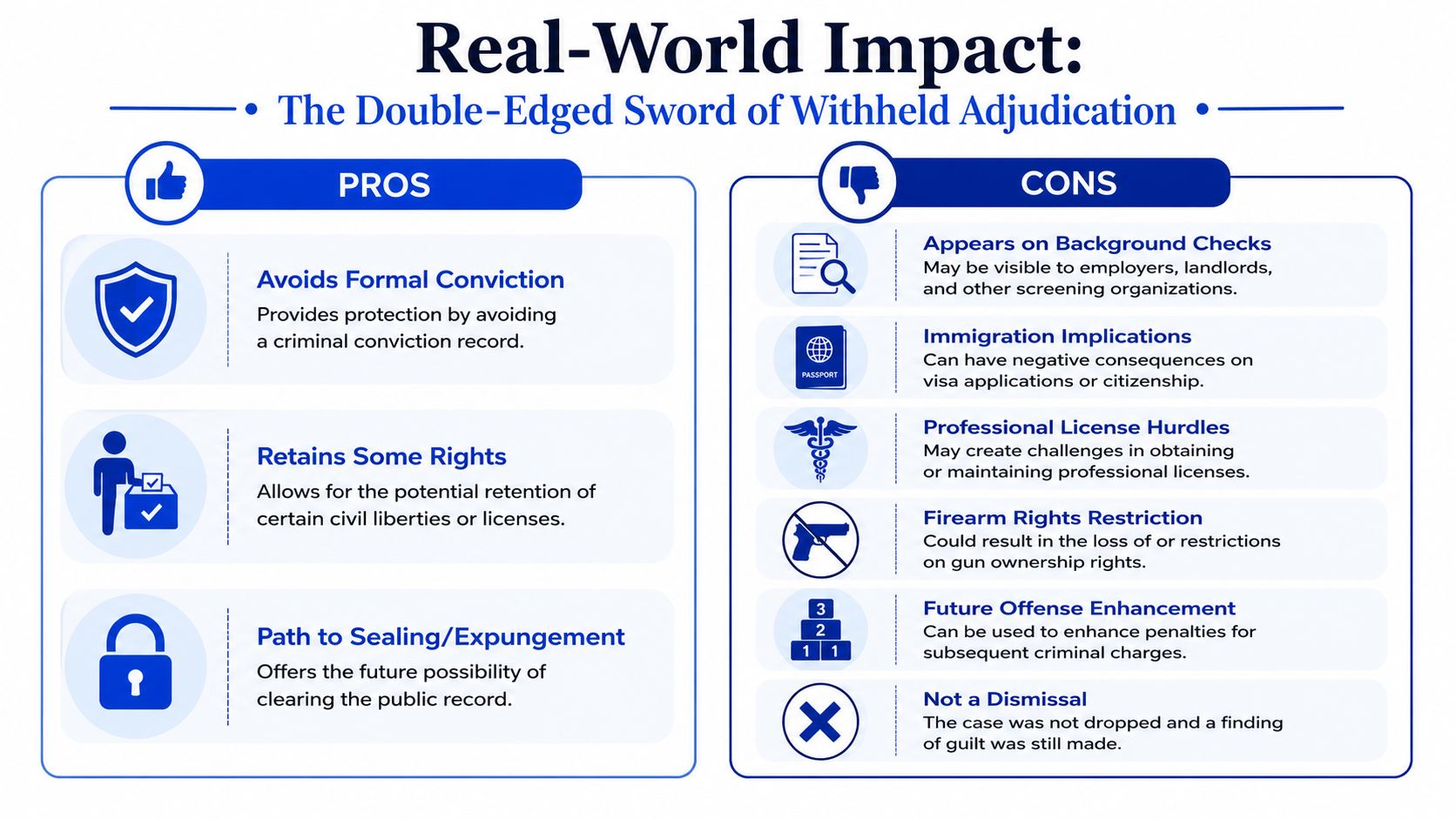
Employers often ask more than one question. They may ask about arrests, charges, pleas, probation, or any court-ordered supervision. A withheld adjudication may still have to be disclosed, especially in jobs involving money, children, driving, healthcare, education, or security clearance.
Licensing boards can be tougher than private employers. Nurses, teachers, real estate professionals, commercial drivers, and other licensed workers are often judged under reporting rules that do not turn only on the word “conviction.” A withhold may lead to extra paperwork, a delayed application, an investigation, or discipline.
The record can also remain visible unless it is later sealed. That is often the part people do not expect.
Immigration can change the analysis completely
For a non-citizen, the legal label used in Florida court is not the end of the analysis. Federal immigration law may treat a withhold and plea as a conviction for immigration purposes, even though Florida does not call it a conviction under state law.
That gap causes some of the worst outcomes I see. A plea that sounds manageable in county court can trigger detention, removal issues, inadmissibility, or problems with status and future applications. Prosecutors often describe the offer in state-court terms. Immigration does not.
If you are not a U.S. citizen, the safe approach is simple. Do not accept a withhold until a lawyer has reviewed the exact charge, the plea language, and the immigration consequence tied to that specific offense.
Future charges may be treated more seriously
A withheld adjudication can also come back in a later case. In practice, it may be used as part of the history that shapes bond arguments, charging decisions, sentencing exposure, and how a judge views a second arrest. Clients hear “no conviction” and assume the matter will carry no weight later. That assumption is dangerous.
I tell clients to ask a harder question. If this case is over today, what can the government still do with it tomorrow?
A withhold still means the case ended with a plea
A withhold is better than an adjudication of guilt in many cases. It is still a plea-based resolution with court conditions, and that is very different from the State abandoning the prosecution through a nolle prosequi in Florida.
That difference matters in daily life. A dropped case and a withhold do not read the same to an employer, a licensing investigator, an immigration officer, or a prosecutor reviewing a new arrest.
For many first-time defendants in Broward County, Fort Lauderdale, and across South Florida, a withhold is still the right result if the other options are worse. The practical impact should control the decision. “No conviction” is only the starting point.
Who Is Eligible for Adjudication Withheld in Florida
Eligibility depends on the charge, the person's record, and the judge's authority under Florida law. In day-to-day practice, withheld adjudication is most commonly considered in lower-level cases and for people who don't have a serious criminal history.
That's why you'll often hear it discussed in misdemeanor theft, simple drug possession, some traffic-related offenses, and selected third-degree felony cases. It's much less available in serious felony prosecutions.
Where a withhold is commonly considered
These are the situations where a withhold may be more realistic:
First-time offenders: Judges and prosecutors are often more open to alternatives short of formal conviction.
Lower-level charges: Misdemeanors and some less serious felony allegations are the usual context.
Cases with mitigation: Treatment progress, restitution, lack of violence, and personal background can all matter.
Negotiated resolutions: A strong defense presentation can help frame a withhold as an appropriate compromise.
That doesn't mean it's automatic. It never is. Even in a favorable case, the court has to agree, and the terms still matter.
Where Florida law limits or blocks it
Florida law draws hard lines around certain offenses. Florida Statute §775.08435 explicitly prohibits courts from withholding adjudication for capital, life, or first-degree felony offenses, and severely restricts it for second-degree felonies unless the state attorney requests it or the court makes written findings. Certain offenses like DUI and specific drug trafficking charges are also generally ineligible, as stated in Florida Statute §775.08435.
That statutory framework matters in several common South Florida practice areas:
DUI / Drunk Driving: Many clients assume a withhold is available because they've heard of it in traffic court. DUI is a major exception and needs case-specific analysis.
Domestic Violence: These cases often carry additional restrictions and concerns.
Violent Crimes and Sex Crimes: Serious allegations usually fall outside the range where withholds are realistically available.
Federal Crimes: Federal court works differently, so Florida withhold rules don't control there.
A withhold is a discretionary tool, not a default outcome. The charge itself may remove it from the table before negotiation even starts.
If you're facing charges in Broward County, Fort Lauderdale, Miami-Dade, Palm Beach, or elsewhere in South Florida, eligibility should be analyzed early. That helps shape strategy. In one case, the right move is fighting for diversion. In another, the focus may be dismissal. In another, the goal may be reducing the charge into a category where a withhold becomes legally possible.
Can a Withheld Adjudication Be Sealed or Expunged
A lot of people hear "withhold" and assume the record disappears. It does not.
In Florida, a withheld adjudication often puts you in a better position to seal the case later, but it does not automatically remove the arrest, the court file, or the online docket from public view. That distinction matters in real life. Employers, landlords, schools, licensing boards, and federal agencies often see the case long before anyone asks whether adjudication was formally withheld.
Why sealing matters
From a defense standpoint, the value of a withhold is often overstated if nobody talks about the record afterward. I have seen clients accept a plea because they were told it was "not a conviction," then learn during a background check that the case is still very visible.
That is the gap people need to understand. "No conviction" is a legal label. Public-record exposure is a separate problem.
For many plea cases that end in a withhold, sealing is what turns a decent courtroom result into something more usable outside the courtroom.
When the case may qualify
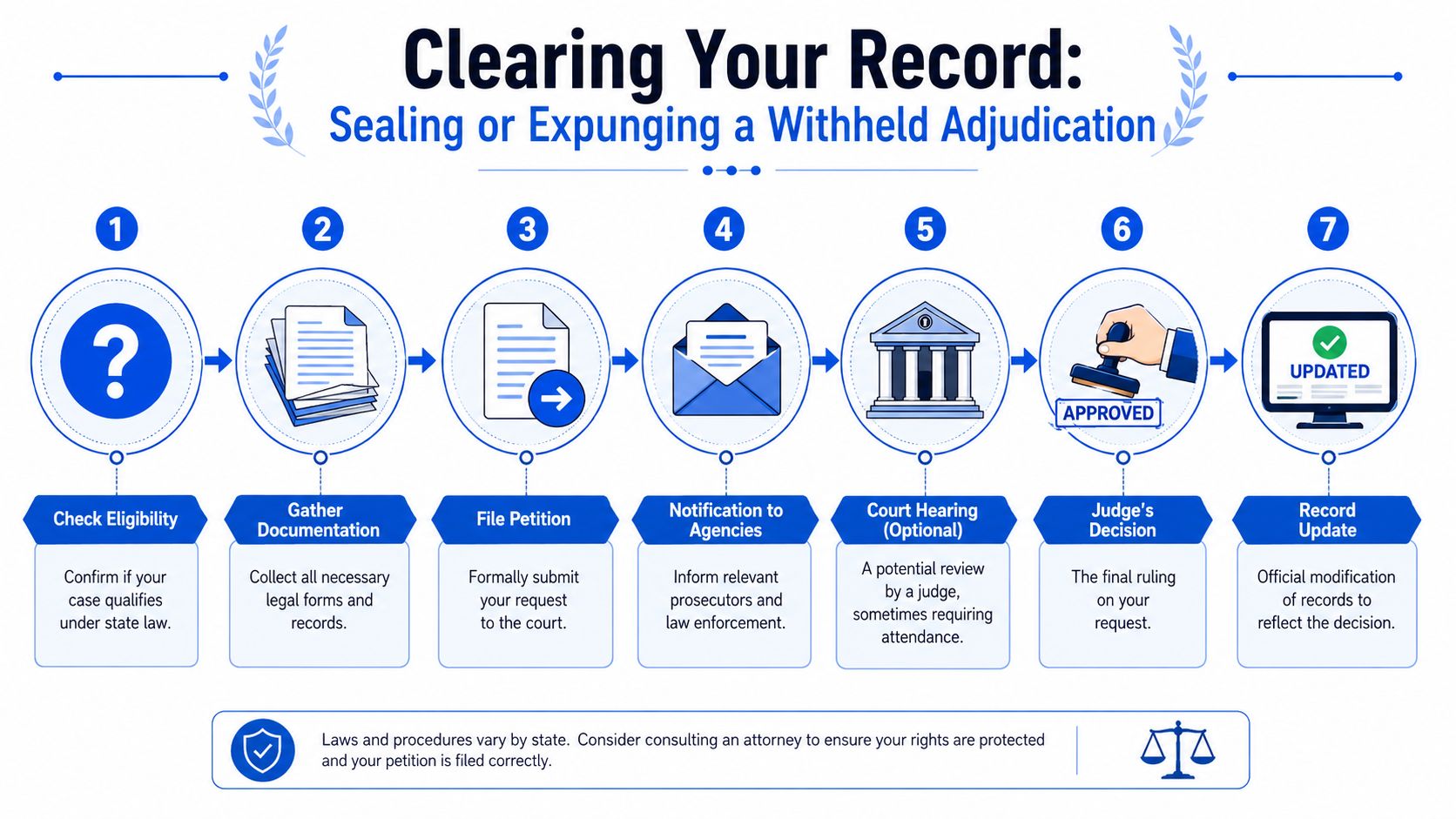
A withheld adjudication can make a case eligible for sealing if the person was not adjudicated guilty, the charge is not one of Florida's disqualifying offenses, and the person otherwise qualifies under the sealing rules. In many plea-based cases, sealing is the realistic post-case remedy. Expungement is usually harder because a plea was entered.
The details matter. The exact charge matters. The final paperwork matters. Your prior record matters.
Probation matters too. If probation was part of the sentence, finishing every condition cleanly is usually the first step before pursuing a seal. If you are still on supervision, or trying to shorten it so you can address the record sooner, it helps to understand how early termination of probation in Florida works.
A careful review usually focuses on four things:
The final disposition. One word in the judgment can affect eligibility.
Completion of all sentence terms. Open costs, classes, or community service can stall the process.
Whether the offense is barred from sealing. Some charges cannot be sealed even with a withhold.
Whether sealing solves the client's problem. Immigration, licensing, and federal reporting issues do not always disappear just because a Florida record is sealed.
That last point gets missed. As a former prosecutor, I can tell you that plea discussions often focus on whether the case avoids a formal conviction under Florida law. Clients deserve a broader analysis. A sealed record can help with many private background checks, but it does not erase every consequence, and it does not rewrite how immigration law or future sentencing issues may treat the underlying case.
If you already have a withhold, do not assume the work is over. In many cases, the primary question is not whether the plea avoided a conviction. The primary question is whether the outcome protects your future in the places that matter most.
What to Do If You Are Offered Adjudication Withheld
You are standing in court. The prosecutor says you can take a withhold today, avoid a formal conviction, and go home on probation. That can sound like an easy answer. Sometimes it is a smart result. Sometimes it is the plea a person regrets later, after a background check, a licensing application, an immigration review, or a new arrest exposes what the first deal did.
Slow the decision down.
A withheld adjudication should be reviewed the same way I would review any serious plea offer for a client. I want to know what you are giving up, what you are getting, and what follows you after the case is over. As a former prosecutor, I can tell you this gap gets glossed over in negotiations. The courtroom label matters, but the practical consequences often matter more.
Use this checklist before you say yes:
Do not agree on the spot. Relief in the courtroom can lead to expensive problems later.
Get every term stated clearly. That includes probation, classes, costs, community service, drug testing, travel restrictions, reporting requirements, and deadlines.
Ask what the judge can do if probation is violated. A plea that looks manageable at sentencing can become much harsher after a violation.
Measure the offer against your actual risk. Immigration status, employment screening, professional licenses, firearm issues, and future charging decisions all need separate review.
Ask whether a better resolution is still available. In some cases, dismissal, diversion, a reduced charge, or a continued negotiation is still on the table.
Probation deserves special attention. Many clients focus on avoiding a conviction and do not spend enough time on the conditions that come with the deal. If probation is part of the offer, review how the terms work in daily life and what options exist later, including early termination of probation in Florida.
Legal advice matters most at this stage. One lawyer may stop at whether the offer avoids a conviction under Florida law. A better review asks harder questions. Will this plea create immigration problems even without a formal conviction? Will an employer still see it? Will a licensing board care more about the underlying conduct than the wording of the judgment? Could the plea give a future prosecutor more room to seek a harsher sentence if you are charged again?
Ticket Shield, PLLC handles that kind of Florida criminal case review in matters involving DUI, drug charges, theft offenses, gun cases, and probation violations.
The right plea is the one that still makes sense after the case leaves the courtroom.
Frequently Asked Questions About Adjudication Withheld
Can you still go to jail with adjudication withheld
Sometimes, but that depends on the case and sentence. A withhold often comes with probation rather than a formal conviction, but jail can still be part of some negotiated outcomes. If you violate probation, the court may have broader sentencing authority. Never focus only on the word “withhold” and ignore the punishment terms attached to it.
Is adjudication withheld the same in juvenile court
Juvenile court uses different language and procedures. The broad idea is similar in that avoiding a formal adjudication can protect the child from harsher long-term consequences, but juvenile cases need their own analysis. Parents should not assume an adult criminal court explanation fully answers a juvenile delinquency issue.
Does a withhold protect firearm rights
State-law consequences can differ from federal consequences and from the wording of the charge itself. In general, one reason a withhold matters is that it avoids a formal conviction under Florida law. But firearm questions are fact-specific and can become complicated fast, especially with felony-level charges, domestic violence-related allegations, injunction issues, or overlapping federal rules.
Will a background check show adjudication withheld
It can. A withhold is not the same as the case disappearing from view. The arrest and court history may still appear unless the record is later sealed. That's why sealing is often the step that gives the result more practical value.
Is adjudication withheld available in DUI cases
DUI is one of the areas where people often assume a withhold is available because they've heard the phrase in traffic court. Florida law places important limits on that assumption. A DUI case needs specific legal review before anyone relies on a withhold as the expected result.
Is adjudication withheld a good plea deal
Sometimes yes. Sometimes no. It can be a strong result when the alternative is a conviction, especially in a first-offense or lower-level case. It can be a poor choice if dismissal, diversion, or a charge reduction is still realistic, or if immigration and licensing consequences make the plea too risky.
What should I ask before accepting it
Ask about the plea, the exact probation terms, the effect on your record, whether the case can later be sealed, and whether the result creates issues for work, immigration, firearm rights, driving, or future charges. If you're searching for a Fort Lauderdale DUI lawyer, a Broward County drug crime attorney, help with Florida domestic violence defense, a probation violation lawyer, or guidance on record sealing Florida, those answers should be specific to your case, not generic.
If you've been offered adjudication withheld in Broward County, Fort Lauderdale, Miami-Dade, Palm Beach, or anywhere in South Florida, don't accept the label without understanding the consequences. A confidential consultation with Ticket Shield, PLLC can help you review the offer, the charge, the probation terms, and the long-term impact on your record, license, and future.
A withhold of adjudication can keep a conviction off your record. Learn how this powerful Florida outcome works and who qualifies.