2nd Degree Murders Florida: Laws, Penalties & Defenses 2026
Jason Goldsmith, Esq
A knock at the door, a detective's call, or a voicemail asking you to “come in and clear something up” can turn a normal day in Broward County into the worst one of your life. In a 2nd degree murder investigation, the state may already be treating ordinary facts as a homicide case, which means every word you say, every phone record, and every object collected under a warrant can matter fast.
That is where panic usually takes over, and it's also where bad decisions start. In Florida, second-degree murder is filed under section 782.04(2), and the accusation is serious enough that families often assume bond will be impossible and that the case is already over before anyone has even reviewed the evidence. It isn't over, but it does move through a system built for speed, pressure, and high stakes.
Table of Contents
When the Charge First Reaches Your Door in Florida
A Fort Lauderdale detective doesn't need to hand you a neat explanation. Sometimes you just get the phone call, then a search warrant for your car, your phone, or your home, and suddenly your routine becomes a homicide investigation in Broward, Miami-Dade, or Palm Beach County. If you're sitting at the kitchen table with a family member reading a court docket and seeing 2nd degree murders Florida language for the first time, the first question usually isn't legal theory, it's, “Am I being arrested right now?”
The answer can be messy because homicide investigations often move before the charge is finalized in the form a family expects. The State Attorney's Office may be preparing an information, or a grand jury process may already be in motion, and the filing choice affects how quickly the case advances. For context on the first court appearance process, the arraignment stage is covered in this Florida arraignment guide.
What makes the first hours so dangerous
Second-degree murder is not the same as manslaughter, even if the facts sound similar to a frightened family member. Manslaughter usually centers on a lesser mental state, while second-degree murder under section 782.04(2) turns on an act the state says was imminently dangerous and showed a depraved mind regardless of human life. That distinction is why the detective's questions matter so much, because the state is often building the depraved-mind theory from conduct, texts, and statements long before trial.
Practical rule: don't try to “explain it away” in a police interview. In a homicide case, the state can use your own words to prove the mindset it says existed during the act.
Families also ask about bond, diversion, and whether something like a felony diversion track exists. Homicide charges are treated at the top tier of Florida's criminal system, so the practical answer is usually that there's no quick off-ramp and no casual fix. That's why the first call to a defense lawyer matters before the statements harden into a recorded version of events.
How Florida Law Defines Second-Degree Murder
Florida's definition is short, but the way courts apply it is not. Under section 782.04(2), second-degree murder is an unlawful killing committed by an act “imminently dangerous to another and evincing a depraved mind regardless of human life,” and it does not require premeditation. The statute also places the offense in the first-degree felony category, which is why the charge sits much higher than expected when one hears the word “second-degree.”
The three things prosecutors must prove
To convict, the state still has to prove the killing, prove it was unlawful, and prove the defendant's act reflected the kind of dangerous disregard Florida law calls a depraved mind. That last part is the pressure point. Florida appellate and jury-instruction materials explain that the act must be one a person of ordinary judgment would know is reasonably certain to cause death or serious bodily injury, done from ill will, hatred, spite, or evil intent, and objectively showing indifference to human life. The legal framing from Florida appellate authority on depraved mind is why prosecutors focus on what was done, what was said, and what happened around the act.
That is also why second-degree murder is often argued through conduct examples rather than a confession of intent. Firing into an occupied vehicle, discharging a firearm from a highway, or other dangerous conduct can support the theory because the law does not require proof that the person planned the death in advance. The state can try to prove the mindset from the act itself.
Why intent to kill is not the issue
The biggest mistake people make is assuming “I didn't mean to kill anyone” ends the case. It doesn't. Florida's statute is broader than many states because the prosecutor does not need a planned intent to kill, only the dangerous act and depraved-mind element. That is why a defense lawyer often starts by attacking the state's characterization of the conduct, not just the outcome.
For background on how Florida criminal statutes are structured, see this overview of Florida criminal laws. The point is simple, if the state cannot prove the legal mindset, the charge can't stand just because the result was tragic.
Penalties and the Florida Sentencing Grid
Second-degree murder is treated as one of the most serious non-capital homicide charges in Florida. The charge is a first-degree felony, and Florida's general sentencing statute caps most first-degree felonies at 30 years unless another provision authorizes a higher punishment. Second-degree murder is one of those exceptions, because the murder statute itself allows a sentence up to life. That difference is why a docket entry that looks like “just another first-degree felony” is not just another first-degree felony.
How the score drives exposure
Florida's Criminal Punishment Code places 2nd degree murder - death at a 240-point score, which reflects the seriousness of the offense inside the sentencing grid. The state's homicide and public-safety reporting systems, including Florida Department of Law Enforcement offense data and CDC homicide mortality tracking, are part of the broader framework that treats homicide as a statewide enforcement priority. The sentencing structure is not academic, it is the machinery that pushes the case toward severe prison exposure.
Florida Second-Degree Murder Penalty Snapshot | Statute / Score |
|---|---|
Offense classification | First-degree felony under section 782.04(2) |
General felony cap | 30 years under Florida's general sentencing law, unless a higher statute applies |
Maximum exposure under the murder statute | Life |
Criminal Punishment Code entry | 240 points for “2nd degree murder - death” |
Why mitigation still matters
Even in a high-exposure homicide case, mitigation can change the conversation. Broward judges still consider the full record, including whether the defendant is young enough to fit within youthful-offender concepts, whether treatment is realistic, and whether substance-abuse history helps explain the conduct without excusing it. Those arguments don't erase the charge, but they can affect how the case is evaluated for resolution.
For a related discussion of felony grading, see this Florida second-degree felony guide. In practice, the sentencing grid is where a lawyer starts measuring risk, not where the story ends.
How Firearm Use Changes the Charge
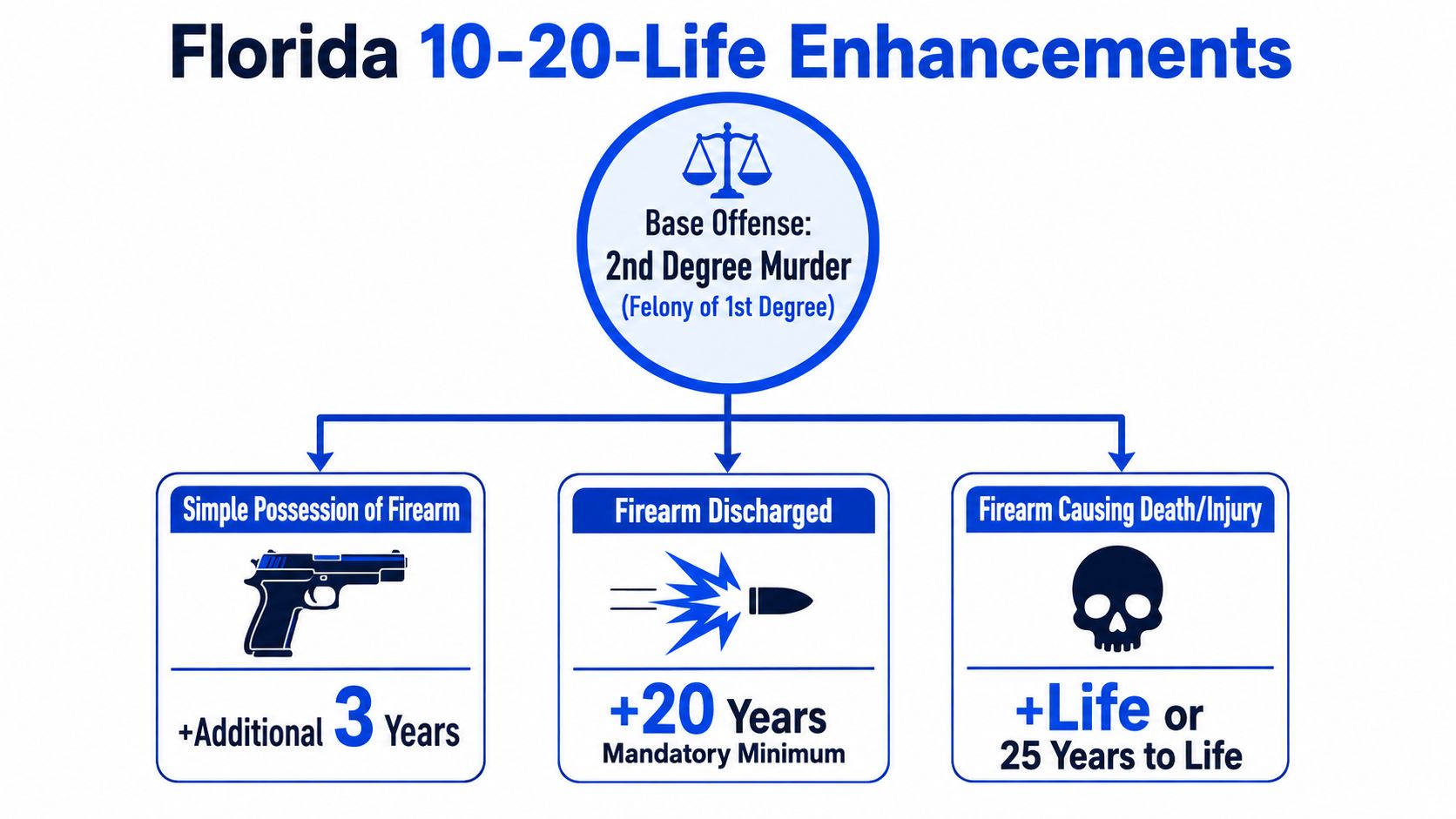
Florida's firearm reclassification law can change the stakes quickly. Under section 775.087, if a defendant is charged with a first-degree felony and, during the commission of that felony, carries, displays, uses, threatens to use, or attempts to use a weapon or firearm, the offense can be reclassified to a life felony. Appellate decisions applying that rule to second-degree murder have recognized firearm use as the basis for the reclassification, which makes the gun allegation a major sentencing issue, even though the firearm is not an essential element of the murder charge itself.
What the state has to prove and what it doesn't
The state still has to prove the depraved-mind murder elements independently. Firearm reclassification doesn't replace the homicide proof, and it doesn't let the prosecutor skip the part where they must show an imminently dangerous act and indifferent state of mind. It changes the penalty range, not the core legal theory.
That distinction matters in court because a client may assume, “If they can't prove I meant to kill, the gun allegation should disappear too.” That's not how Florida law works. The state can argue the underlying homicide as second-degree murder and then separately argue the firearm fact pattern to ratchet up the exposure under the sentencing statutes.
Why the weapon allegation changes the defense posture
The moment a firearm is alleged, the case often becomes more aggressive in plea discussions, bond litigation, and trial strategy. A jury can hear the same event very differently when the conduct includes a weapon, and the sentencing judge may be looking at a more severe reclassified offense if the state proves the gun facts. For more on that sentencing structure, review Florida's 10-20-Life law.
The gun allegation is often the hidden lever in these cases. It doesn't just color the evidence, it can move the whole sentencing framework.
Second-Degree Murder Versus Manslaughter and First-Degree Murder
The line between homicide charges in Florida usually comes down to mental state, not just the fact that someone died. First-degree murder under section 782.04(1) requires premeditation or felony-murder theory. Second-degree murder under section 782.04(2) requires a depraved mind and an imminently dangerous act without premeditation. Manslaughter under section 782.07 generally sits below that, often tied to sudden provocation, imperfect self-defense, or criminal negligence rather than the extreme indifference required for second-degree murder.
The practical differences a jury is told to look for
A jury asked to sort these charges is usually judging what the defendant was thinking at the moment of the act. If the evidence supports a planned killing, the state will push first-degree murder. If the evidence shows an extraordinarily dangerous act done with indifference to life but without preplanning, the state may push second-degree murder. If the facts look more like an impulsive, unlawful killing without that depraved-mind showing, manslaughter becomes the more realistic charge.
For a related state-law overview, see this manslaughter resource in Florida.
Comparing Homicide Charges in Florida | Mental State Required | Typical Conduct | Penalty Range |
|---|---|---|---|
First-Degree Murder | Premeditation or felony-murder proof | Planned killing or death during qualifying felony | Capital felony exposure |
Second-Degree Murder | Depraved mind, no premeditation | Extremely dangerous act showing indifference to human life | Up to life under the murder statute |
Manslaughter | Lesser culpability, often negligence or provocation | Unlawful killing without depraved-mind proof | Lesser homicide exposure |
Why negotiations often turn on intent
Most charge-reduction arguments in Broward County come down to whether the state can really prove the mental state it alleges. If the facts support a rash act but not a depraved mind, the defense has room to push back. If the facts show planning, the state will argue upward. The fight is usually over where the evidence lands on that spectrum.
Defense Strategies a Florida Lawyer Can Raise
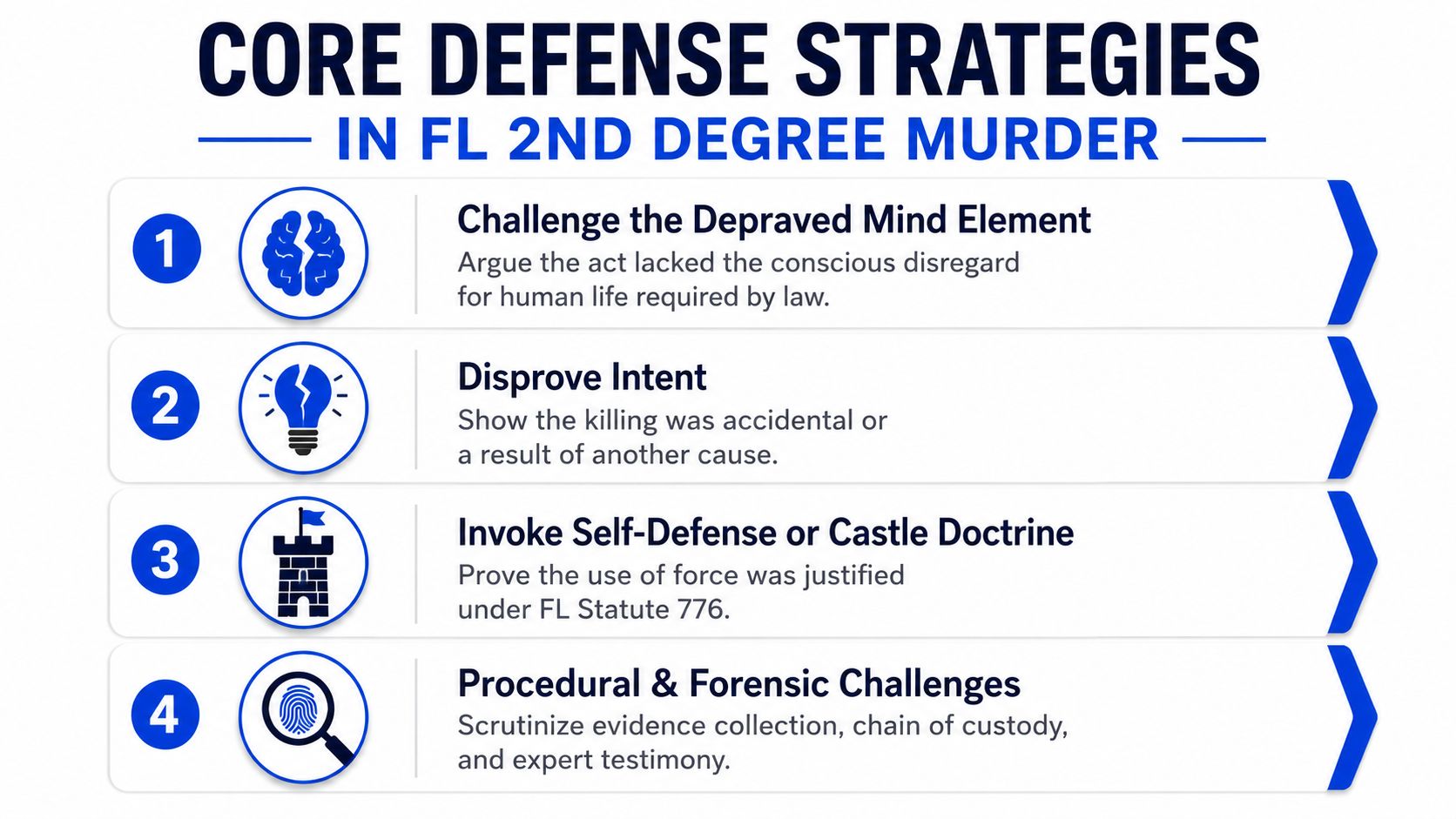
A real defense starts with the elements, not with wishful thinking. If the state must prove an imminently dangerous act, a depraved mind, and an unlawful killing, then the defense has to attack one or more of those pillars directly. In South Florida homicide cases, that usually means looking at the conduct, the timeline, the medical evidence, and every statement the client made before the case became public.
What a defense lawyer looks for first
The most obvious target is the depraved mind element. If the act was careless, impulsive, or a terrible accident, that is not the same thing as proving extreme indifference to human life. The state may describe the conduct in the harshest possible terms, but the defense can argue the facts support a different legal category entirely.
Another target is causation. Forensic pathology, toxicology, and medical records matter because the state has to show the alleged act caused the death in the way it claims. If the timing of death, a preexisting condition, or another intervening factor muddies that chain, the defense can expose the weakness.
Self-defense and statement suppression still matter
Self-defense under section 776.012 can be a complete answer in the right case, especially where the evidence shows justified force rather than a depraved act. The same is true for Miranda issues and involuntary statements. If the police questioned someone without proper warnings, or pushed a statement out of a frightened suspect, that evidence can be challenged.
A defense lawyer also checks:
Eyewitness reliability, especially where lighting, distance, stress, or cross-identification problems exist.
Search and seizure issues, including whether the phone, car, or other evidence was lawfully seized.
Forensic lab work, because chain of custody and interpretation mistakes can matter a lot more than people realize.
If the state's theory depends on one shaky witness and one contested forensic conclusion, the case is not as fixed as it first looks.
A practical note on counsel
Ticket Shield, PLLC is one Florida defense firm that handles violent-crime cases and can step in early to evaluate the file, but any lawyer handling a homicide charge should be focused on the same job, protecting the record before it gets worse. In Broward, Miami-Dade, and Palm Beach, early motions and evidence review often do more than dramatic speeches ever will.
What to Do in the First Days After Being Charged
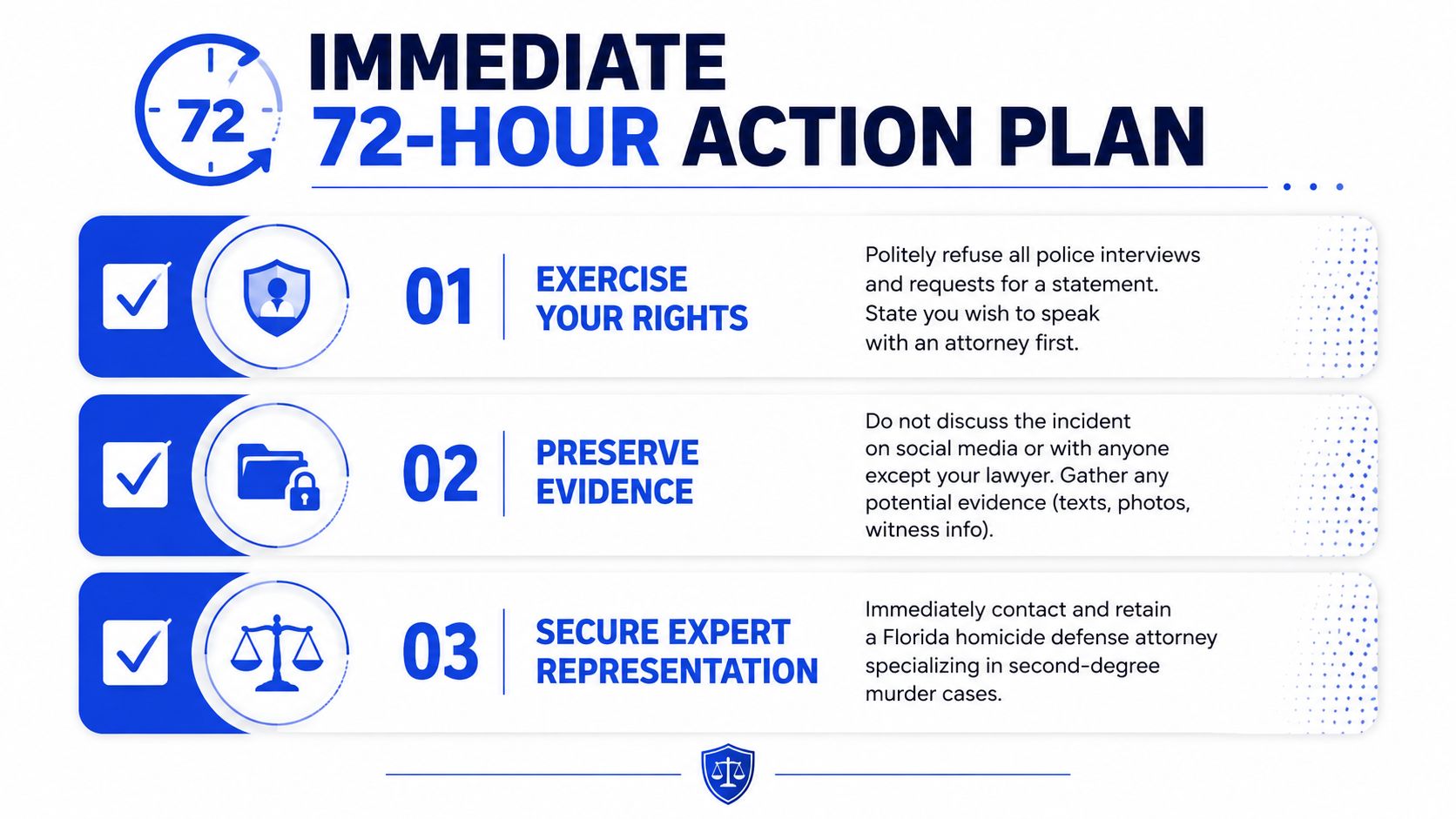
The first 72 hours are not for debating facts with police, friends, or people online. They're for protecting the case. If you're under investigation or have just been charged in a South Florida homicide case, every unnecessary conversation can become evidence, and every delay can let video, texts, or witness memories disappear.
The first moves that actually help
Exercise your rights: Politely refuse police interviews and ask to speak with a lawyer before giving any statement.
Preserve evidence: Save texts, photos, voicemails, social media messages, surveillance footage, and witness names before they vanish.
Lock down the timeline: Write down what happened while your memory is still fresh, including who was present and what was said.
A family should also gather employment records, medical records, and any information that may help later with mitigation. That can matter at bond, during negotiations, and at sentencing if the case goes that far. The point is to build the defense file before the state finishes building its own.
Why speed changes the case
When a defense lawyer gets involved early, the conversation with the prosecutor changes. Sometimes that means influencing the initial filing, sometimes it means stopping a bad statement from becoming the centerpiece of the case, and sometimes it means preserving enough context to push for a better result later. In a 2nd degree murder case, waiting usually helps the state, not the defense.
If you or someone you love is facing a second-degree murder allegation in Broward County or anywhere in South Florida, contact Ticket Shield, PLLC for a confidential review of the facts, the warrant history, and the statements already in play. Visit Ticket Shield, PLLC to speak with a Florida criminal defense lawyer who can move quickly, protect the record, and help you understand the options before the case hardens.