Mental Health Court Florida: A Defendant's Guide
Jason Goldsmith, Esq
You're sitting in a South Florida holding cell or trying to calm a family member after an arrest, and the charge doesn't look like the whole story. Maybe the person stopped taking medication, spiraled, and ended up booked on trespassing, disorderly conduct, or a minor drug case. That's when people start asking about Mental Health Court in Florida, because they want a path that deals with the crisis, not just the arrest.
Florida does have that path, but it's not a magic exit ramp. Mental health courts are problem-solving dockets that combine judicial supervision with treatment, and they're built to move qualifying defendants away from standard prosecution when mental illness is tied to the conduct. Florida's system is statewide, monitored, and real, with 32 adult mental health courts and 1 juvenile mental health court reported in July 2024, plus 2,217 participants admitted in 2023 according to the Florida courts' problem-solving court reporting. The broader national picture matters too, because a Bureau of Justice Assistance snapshot found that more than 40% of all adult mental health courts in the United States were concentrated in California, Ohio, Florida, and Washington. Florida Courts mental health court reporting shows this is a tracked part of the justice system, not a judge doing anyone a favor on the side.
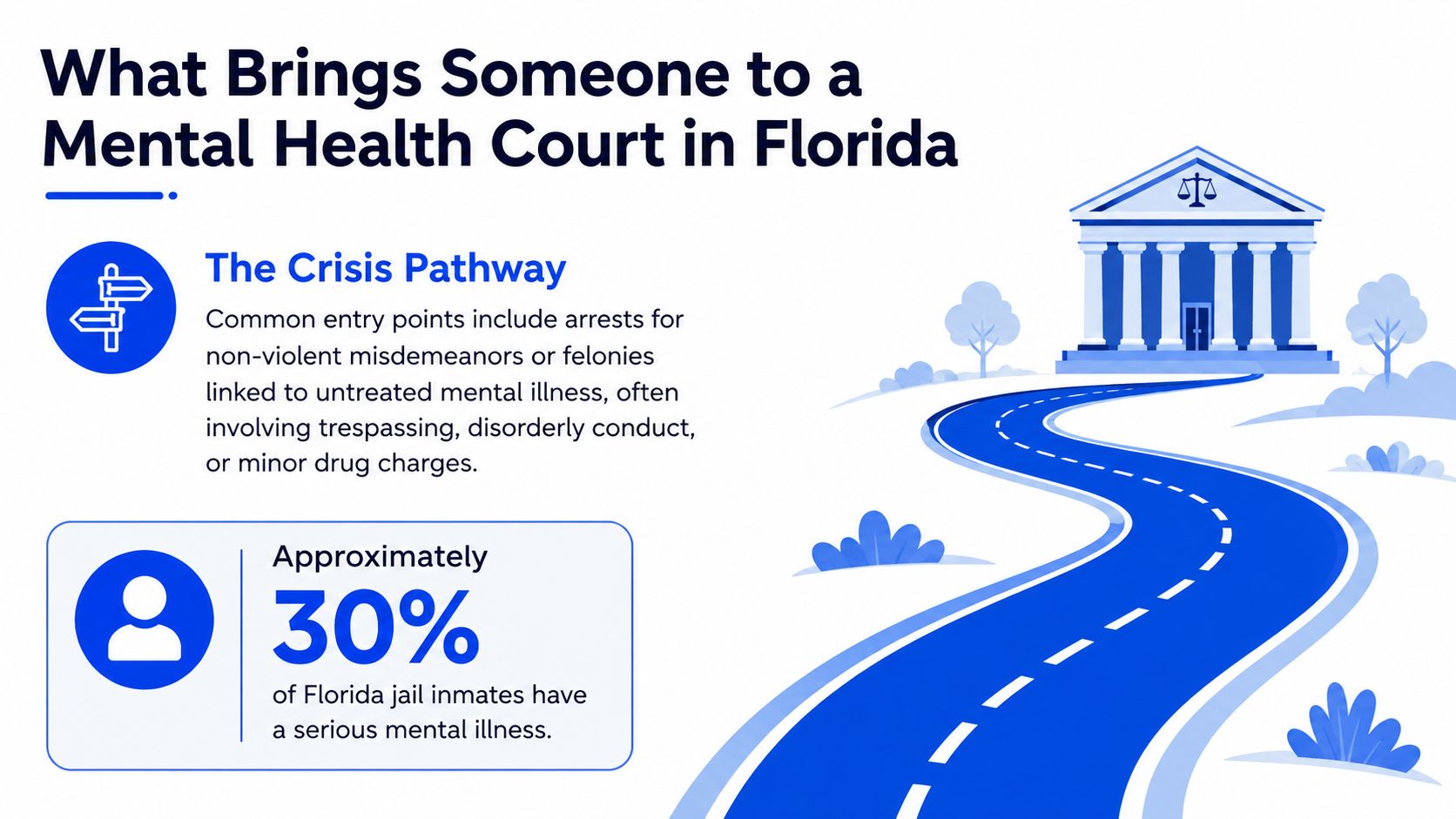
Table of Contents
What Brings Someone to a Mental Health Court in Florida
The crisis pathway
In Broward, Miami-Dade, and Palm Beach, these cases often start the same way. A family member gets a call from jail, learns the arrest followed a mental health crisis, and then has to make sense of a case that already looks sideways. The charge may be non-violent, but the conduct that led to the booking was real, disruptive, and often could have been handled with treatment instead of arrest.
Mental health court is Florida's answer to that pattern. It works as a problem-solving docket that puts judicial supervision together with treatment, monitoring, and compliance checks, because repeated booking does not fix serious mental illness. Florida's statewide reporting shows the model is no longer a side project. It operates through 32 adult courts, 1 juvenile court, and admissions are reported each year to the Office of the State Courts Administrator under state law. Florida Courts mental health court reporting
Practical rule: if the arrest came after a crisis, the first question is not whether the person has a diagnosis. The first question is whether the diagnosis can be tied to the conduct that led to the arrest.
That is why people mix up mental health court with drug court or veterans court. Drug court focuses on substance use disorder, veterans court serves military-connected defendants, and mental health court is for defendants whose mental illness drives, or strongly shapes, the case. A case with a simple DUI, domestic violence allegation, or gun charge usually becomes a tougher eligibility fight, even when the person is plainly in crisis.
The bigger Florida context matters because the system is already carrying too much. A Florida Senate interim report said the state spent more than $210 million annually on forensic mental health services, served roughly 3,000 individuals under forensic commitment, and had 40,000 individuals under community correctional supervision with serious mental illness. The same report estimated that up to 125,000 adults with mental illnesses or substance use disorders needing immediate treatment were arrested and booked into Florida jails each year, and prisons had grown from 8,000 to nearly 17,000 inmates with mental illness or substance use disorders over nine years. Those numbers explain why this docket matters in real cases, not just in policy talk. Florida Senate interim report
A defense lawyer looking at eligibility also has to treat this like a case strategy decision. Some circuits will steer the person toward a pretrial track if the charge and record fit, while others will bounce the case back to standard prosecution the moment the offense class, victim issue, or local screening rule looks wrong. If you want to understand how that screening works in practice, start with a look at Florida pretrial diversion program rules, because the same kind of charge-level sorting shows up there too.
Who Qualifies for a Mental Health Court in Florida
Florida law gives you the framework, but the local circuit decides whether the case fits. Under Florida Statute 394.47892, pretrial entry is voluntary, and postadjudicatory placement depends on a court's assessment of criminal history, mental-health screening, amenability to services, sentence points, the State Attorney's recommendation, and victim input if there is one. The statute matters, but the practical screen is even stricter than the text suggests. Florida Statute 394.47892
The diagnosis is not enough
A diagnosis alone won't get you in. Courts and prosecutors want a documented nexus between the mental illness and the arrest, meaning the defense needs to show how symptoms affected decision-making, conduct, or the events around the charge. If that link is weak, the case usually goes back to standard prosecution.
Most programs also screen out categories that raise public-safety concerns. In many circuits, that includes:
DUI or drunk driving charges, especially where driving risk is the core issue
Domestic violence cases, because victim safety changes the analysis
Sex offenses, which almost always trigger a harder review
Firearm-related charges, since weapon involvement usually cuts against diversion
The best mental health court candidates are not just sick. They're clinically supportable, legally eligible, and realistic about supervision.
If you're trying to self-screen before calling counsel, the question is whether the charge class, history, and treatment record line up with diversion. A person who looks sympathetic but cannot satisfy the offense screen is still likely headed into ordinary court. A separate issue is what happens after the case, and that depends on the disposition, not the label of the program.
For a general primer on how Florida courts resolve some cases without a formal conviction, see Florida adjudication withheld basics. That matters here because mental health court outcomes can sometimes line up with a withhold, but they don't automatically create one.
The Referral and Admission Process Step by Step
A mental health court case rarely starts itself. Sometimes the judge or the court team spots the issue early, but in plenty of cases the defense has to push the file forward, contact the program director, and ask for screening before the case hardens into standard prosecution. Families miss that step all the time, then wonder why the case keeps moving through ordinary arraignment and status dates instead of getting reviewed for diversion. The older Florida guidance says screening can be started by the defendant or counsel if the case has not already been flagged. Florida Adult Mental Health Court Best Practice Guidelines

From arrest to admission
The route usually runs through a few hard checkpoints, and the county where the case is filed changes the details.
Arrest and booking. The case enters the regular criminal system first.
Defense involvement. Counsel reviews the charge, the mental-health history, and the local screening rules that control whether the case can even be considered.
Screening and assessment. The program looks at diagnosis, offense class, treatment needs, and risk.
State Attorney review. In some programs, the State Attorney files the Information before transfer, as the Eighth Judicial Circuit rule requires.
Consent and covenant. The defendant must voluntarily consent and sign the covenant and agreement, including the sanctions protocol.
The Eighth Circuit rule shows how formal the process gets once the court is serious about admission. In Alachua, Bradford, and Levy Counties, the program is a pre-trial diversion program for defendants with mental illness or developmental disability who are arrested for misdemeanors, criminal traffic offenses, and certain approved third-degree felonies. It also uses three phases, and the court appearances become less frequent as the participant moves forward. Eighth Judicial Circuit Mental Health Court rule
That is where many cases turn. Admission is a legal and clinical decision, not a feel-good one. If the offense class does not fit, if the history raises too much risk, or if the defendant will not agree to the terms, the court closes the door and the case stays in the normal prosecution track.
How Programs Differ Between Florida Counties
County filing changes the case from day one. Mental health court in Florida is not one statewide machine, and the local circuit decides how much room there is for diversion, what charges are even eligible, and how much treatment the county can support. In a larger urban county, a defendant may find more providers and more program slots. In a rural county, the same person may run into tighter screening, fewer beds, and a slower start to treatment.
The Eighth Judicial Circuit shows how narrow a program can be. Its rule limits the court to Alachua, Bradford, and Levy Counties, uses a three-phase structure, and allows only misdemeanors, criminal traffic offenses, and certain approved third-degree felonies. Treatment can include evaluations, urinalysis, case management, group sessions, individual sessions, and residential treatment. That is a controlled diversion track, and it is far more selective than many defendants expect when they hear the words “mental health court.” As noted earlier, the circuit rule lays out those admission limits in detail.
Circuit / Counties | Offense Eligibility | Structure | Treatment Components |
|---|---|---|---|
Eighth Judicial Circuit, Alachua, Bradford, Levy | Misdemeanors, criminal traffic offenses, certain approved third-degree felonies | Three phases, pre-trial diversion | Evaluations, urinalysis, case management, group sessions, individual sessions, residential treatment |
Urban South Florida circuits, such as Broward, Miami-Dade, Palm Beach | Often broader in volume, but still offense-screened | More participants, locally managed dockets | Provider-based treatment plans, monitoring, court review |
Rural or under-resourced counties | Eligibility may exist, but treatment capacity can be thinner | Can move more slowly because services are limited | Access depends on local community partners and available slots |
The real trap is access. Florida research on behavioral-health facility density found that affordable community treatment is less available in rural census tracts, while access is higher in urban tracts. That means the judge's order is only part of the equation. If the county cannot place the person into treatment quickly, the case can sit in supervision longer than anyone expected. Florida behavioral-health facility density research
Bottom line: the county where the case is filed can decide whether mental health court works like a practical diversion or turns into a longer supervision track.
What a Typical Week Inside a Mental Health Court Looks Like
The people who succeed in these dockets aren't the ones who treat them casually. They're the ones who can keep showing up. Weekly court hearings, ongoing assessment, counseling, random drug and alcohol testing, case management, and discharge planning are part of the ordinary rhythm in many Florida programs, because the court is measuring adherence, not just giving second chances.
That daily reality looks different depending on where the case is filed. In a busy Broward or Miami-Dade setting, the program may move with a heavier docket and more layered providers. In a smaller county, the same participant might still have to comply with the same basic expectations, but the treatment options may be narrower and the scheduling less forgiving. The public hears “diversion” and thinks “lighter.” In practice, it can be a demanding supervision track.
One common feature across Florida programs is phase progression. Court appearances may become less frequent as the participant advances, but the early stages are usually more intense, and that's by design. The courts want to catch relapse, missed medication, or decompensation early, before a new arrest or violation shows up. Some programs use a five-phase structure lasting at least one year, while others run up to two years with the possibility of early termination after successful compliance. Florida Sixth District mental health court information
The best way to think about it is simple.
If the client can't make appointments, the docket gets harder.
If the client won't take treatment seriously, the court sees that fast.
If the client can manage structure, the program can be a workable path.
This is why I tell families to stop asking whether mental health court is easier. Ask whether it's sustainable. A person who can handle repeated hearings, medication compliance, and community supervision may do well. A person who needs more stabilization than the community can provide may struggle, even with a good defense.
Legal Outcomes and What Happens to Your Record
The result matters because Florida treats mental health court as a pressure valve, not a free pass. Once a person is accepted, the court is deciding whether treatment and supervision can keep the case out of the usual conviction track. As noted earlier in the Florida Senate interim report, the system is built around serious forensic and community supervision burdens, which is why judges pay close attention to completion and compliance.
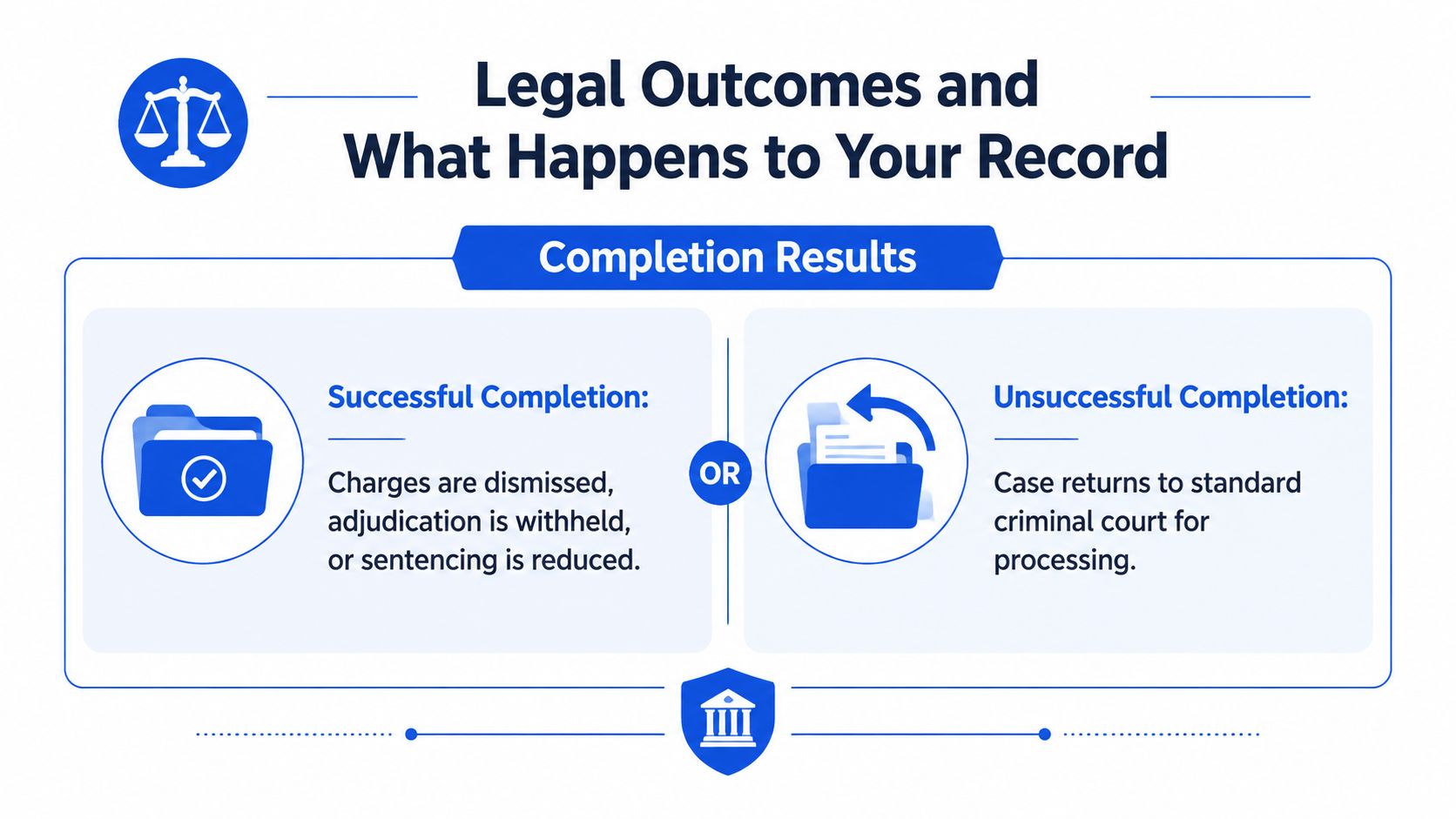
Completion results
A successful finish usually gives the defense a better result at the end of the case. Depending on the charge and the county, that can mean dismissal, a withhold of adjudication, or a reduced sentencing outcome. An unsuccessful finish sends the case back to standard prosecution, and that usually means the defendant is now dealing with the original charge plus the fallout from a failed supervision track.
The record question needs to be handled early. Mental health court participation does not automatically erase a record, and sealing or expungement depends on the final disposition, the offense, and Florida's eligibility rules. If the goal is to protect employment, licensing, or immigration posture, counsel has to evaluate that issue before entry, not after the program ends. For a plain-English overview of the record side, see Florida record sealing rules.
A clean exit from the program can keep the case from turning into a straight conviction, but that is not the same as wiping the slate clean. If the case has the wrong disposition, the wrong offense class, or the wrong county posture, the record can still carry consequences. The smart move is to work that problem from day one, because once the case is resolved the options get narrower fast.
How a Defense Attorney Helps at Every Stage
A good defense lawyer does not treat mental health court like a feel-good referral. The lawyer treats it like a case strategy, because that's what it is. The defense has to identify eligibility early, push screening when the court hasn't flagged the case, and build the factual bridge between the symptoms and the arrest conduct.
That's where the work happens. Counsel negotiates with the State Attorney, reviews the consent language, explains the sanctions protocol in plain English, and makes sure the client understands what repeated supervision requires. If the client is not ready for structure, the lawyer needs to say that. If the county's program is a bad fit because the offense class is wrong or the treatment supply is too thin, the lawyer needs to say that too.
A defense lawyer also has to think past admission. A person who gets into the program but can't complete it has not won much. That's why planning for treatment records, medication continuity, transportation, and court attendance matters before the first hearing, not after the first violation. For a broader overview of the defense role in Florida criminal cases, see Florida criminal defense lawyer guidance.
The lawyer's job is to protect options, not to sell hope.
In South Florida, that means being ready to move fast in Broward, Miami-Dade, and Palm Beach when a case looks eligible, while still being blunt about the cases that won't fit. Mental health court can be the right move. It can also be the wrong one if the facts don't support diversion.
Next Steps for Defendants and Families
If you're dealing with an arrest right now, don't wait for the system to volunteer solutions. Start by gathering treatment records, prescription history, prior hospitalizations if they exist, and anything that shows the mental-health picture before the arrest. Then figure out the county and circuit of filing, because the local rules will shape everything from eligibility to supervision length.
Take these steps immediately:
Collect medical proof. Bring treatment notes, medication lists, discharge paperwork, and therapist or psychiatrist information.
Identify the charge class. A DUI, domestic violence case, sex offense, or firearm-related charge may be a dead end for mental health court.
Ask for screening early. Don't assume the court will flag the case for you.
Use your right to silence. Don't give the State extra facts before counsel reviews the file.
Get counsel before the first appearance. That's when strategic decisions start mattering.
A mental health court case is not a quick fix. It's a structured decision about whether treatment-based supervision is better than the normal criminal track, and it only works when the defense moves early and the client can handle the program. If you're helping a loved one, stay focused on documentation, timing, and the local court rules, because those are the details that move the case.
If you're facing charges in South Florida and think mental health court might be part of the solution, contact Ticket Shield, PLLC for a confidential consultation. The firm handles Florida criminal defense cases with a direct, strategic approach, and that includes evaluating whether diversion, treatment, or a different defense path gives you the best shot at protecting your record and your future.