How to Cross Examine Witnesses in a Florida Criminal Case
Jason Goldsmith, Esq
If you're facing criminal charges in Broward County, Fort Lauderdale, Miami-Dade, or anywhere in South Florida, you're probably focused on one immediate fear. What happens when the State's witnesses take the stand and point the finger at you?
Clients often expect cross-examination to look like television. A lawyer rises, asks one devastating question, and the whole case falls apart. Real trial work doesn't happen that way. In a Florida criminal case, the strongest cross-examination is usually quiet, controlled, and built long before anyone walks into court.
That matters in DUI cases, drug prosecutions, domestic violence allegations, theft accusations, gun charges, and violent crime cases alike. A witness doesn't have to be lying for their testimony to be weak. They may be mistaken, biased, rushed, influenced by reports, or trying to sound more certain in court than they ever were before. Knowing how to cross examine witnesses means knowing how to expose those weaknesses without losing control of the room.
Table of Contents
The True Purpose of Cross-Examination in a Criminal Case
Cross-examination is not about theatrics. It's about pressure, precision, and proof. In a Florida criminal courtroom, defense counsel uses cross to test whether the State's witness can really support the charge the way the prosecutor claims.
The law treats cross-examination as one of the core protections in an adversarial trial. The U.S. Supreme Court described it as the "greatest legal engine ever invented for the discovery of truth", and modern criminal procedure still treats it as the main tool for testing a witness's perception, memory, bias, and consistency, as discussed by the National Association of Criminal Defense Lawyers' confrontation and cross-examination guidance.
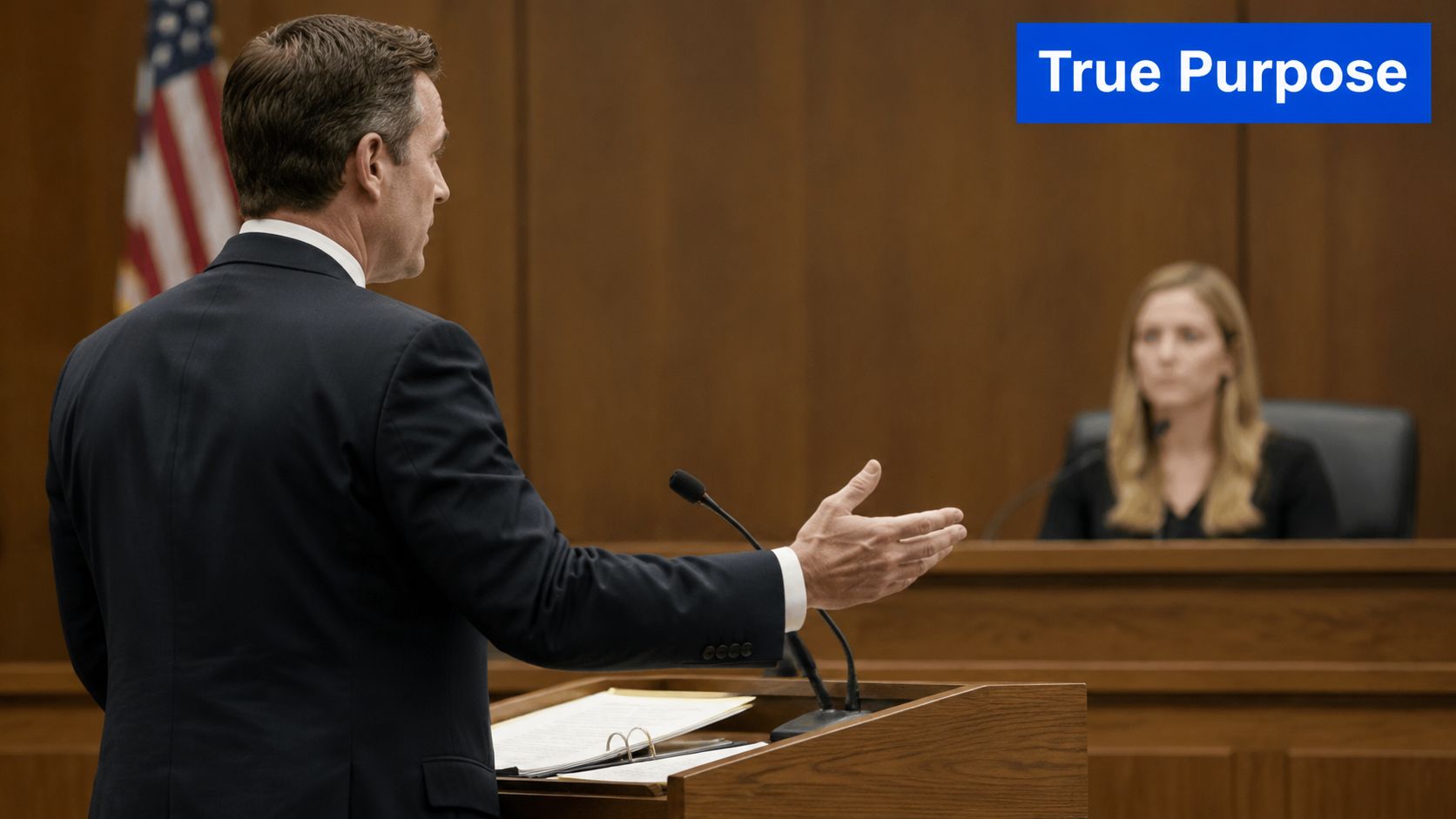
What defense cross is really trying to accomplish
A skilled cross usually does one or more of these things:
Cuts down the story: The witness may have sounded confident on direct examination. Cross narrows that testimony to what the witness truly knows.
Builds reasonable doubt: The defense doesn't need a dramatic confession. It needs enough uncertainty about reliability, accuracy, or credibility.
Locks in helpful facts: Sometimes the State's own witness gives testimony that supports the defense if the questioning stays tight.
Exposes overstatement: A witness may say more in court than they wrote in a report, said in a deposition, or personally observed.
Practical rule: Good cross-examination doesn't ask, "Can I win an argument with this witness?" It asks, "Can I make this testimony smaller, weaker, or less certain?"
What doesn't work
Jurors usually don't reward lawyers for showing anger. They reward clarity. If a defense lawyer argues with the witness, repeats the prosecutor's direct examination, or asks broad questions that invite speeches, the witness gets another chance to repair the State's case.
That's why effective cross is disciplined. In Broward County and throughout South Florida, the strongest criminal defense cross often sounds simple. A short sequence of controlled questions can do more damage than a long confrontation.
A witness may begin direct examination looking solid. By the end of cross, the jury may see something very different: limited observation, shaky memory, missing details, bias, assumptions, or confidence that came later.
Winning the Battle Before It Begins Through Preparation
Most successful cross-examination happens at counsel table, in the office, and in the discovery file. It isn't improvised. It's assembled.
Before any witness takes the stand, defense counsel studies the same event from every available angle. That includes police reports, body-worn camera footage, dashcam footage, recorded statements, dispatch records, text messages, lab paperwork, deposition transcripts when available, and prior sworn testimony. In a DUI case, that may also include field sobriety materials and video from the stop. In a theft or battery case, it may include store surveillance, witness statements, and booking documents.
The file is where contradictions live
Preparation starts by asking basic but powerful questions:
What did the witness say first
What changed later
What did the witness leave out
What does the video show
What does the witness know firsthand
A lot of criminal cases turn on these gaps. An officer may write a short report and later add detail in testimony. A civilian witness may describe distance, lighting, or timing in a way that doesn't match the scene. A complaining witness may omit facts that matter to self-defense, identity, or motive.
When search issues or stop issues are involved, that preparation often overlaps with suppression work. In many Florida cases, witness examination and pretrial motions fit together. If you're dealing with that issue, it's worth understanding what a motion to suppress evidence does in a criminal case.
Why good lawyers choose only a few points
One of the most reliable cross-examination methods is surprisingly narrow. Strong trial guidance recommends identifying only two or three strongest issues, then building a closed-ended, chronological series of questions that proves one fact at a time, as described in this cross-examination strategy guide for mock trial and trial preparation.
That approach works because scattershot questioning usually helps the witness.
Instead of trying to attack every flaw, defense counsel often selects the few points the judge or jury will remember:
Witness type | Strong attack point | Weak attack point |
|---|---|---|
Arresting officer | No clear basis for one key conclusion | Minor wording issue in a long report |
Civilian eyewitness | Poor vantage point or distraction | Small memory slip that doesn't matter |
Alleged victim | Prior statement that omits a major fact | Emotional reaction on the stand |
Preparation isn't about writing clever questions. It's about deciding which facts deserve air time and which ones don't.
A prepared cross also has an exit plan. Once the witness makes the needed concession, the questioning should end. That's part of preparation too. The lawyer who knows exactly where to stop usually sounds more confident than the lawyer still hunting for a better point.
The Art of the Leading Question to Control Testimony
Cross-examination runs on leading questions. Those are questions that suggest the answer and usually call for a short response. That's how the lawyer controls the pace instead of handing control back to the witness.
On direct examination, a prosecutor can ask, "What did you observe?" On cross, defense counsel asks, "You were across the street when this happened, correct?" One invites a narrative. The other pins down a fact.
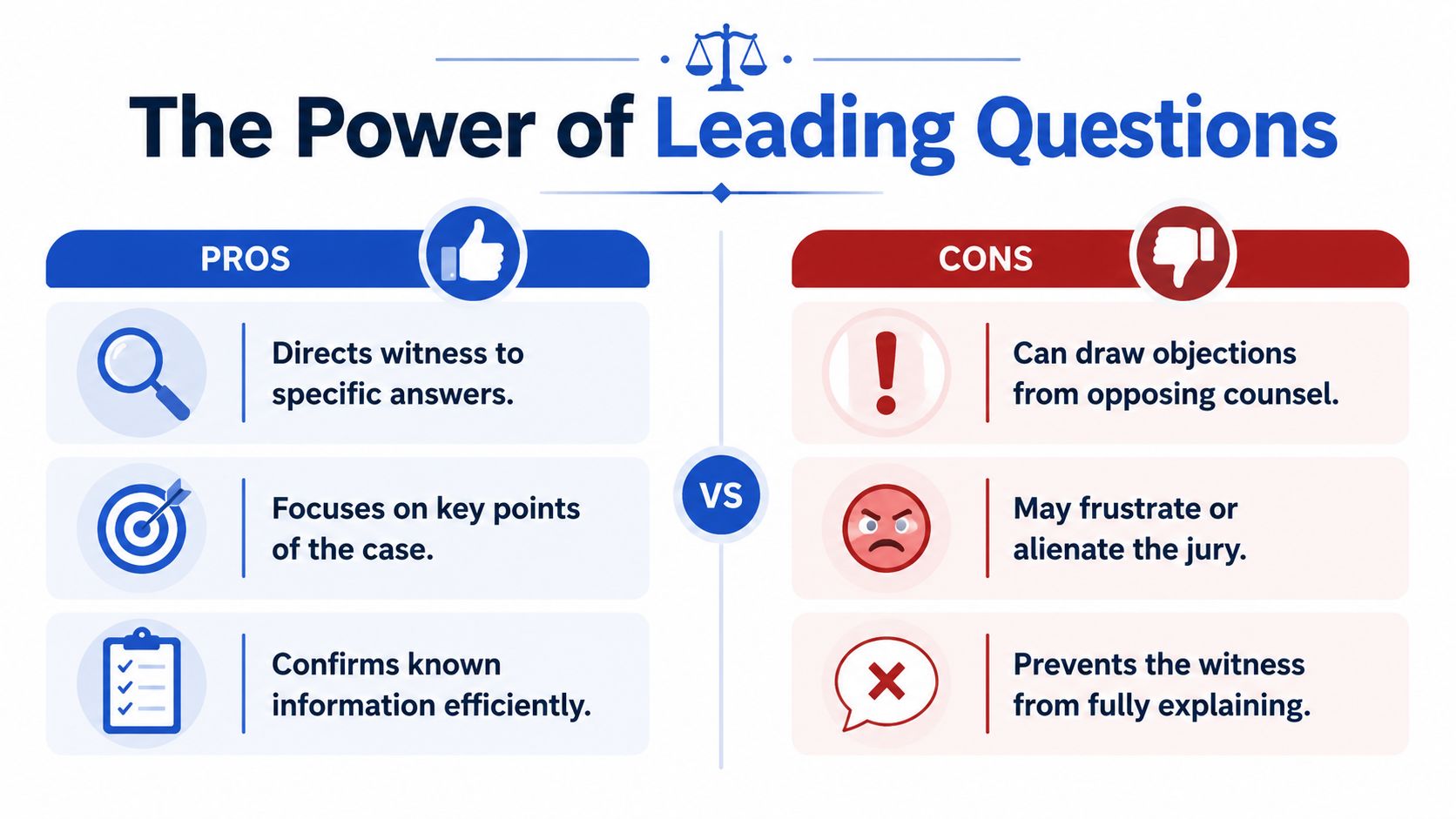
What a controlled question sounds like
A useful leading question usually has three traits:
Short: One fact per question.
Concrete: Time, distance, lighting, sequence, location, wording.
Closed: The answer should be yes, no, or a very short correction.
That keeps the witness from explaining. It also makes the point easier for the jury to follow.
Here is the difference in practice:
Open question that loses control | Leading question that keeps control |
|---|---|
What happened after you stopped the car | You approached on the driver's side first, correct |
How did my client perform | He did not fall during the exercise, correct |
What made you think he was impaired | Your conclusion relied in part on your observations, correct |
A Florida DUI example
In a Broward or Fort Lauderdale DUI case, cross often works best when it breaks the stop into small pieces instead of challenging the officer with one broad accusation.
For example:
Driving pattern: You were behind the vehicle for only a limited portion of the drive, correct.
Speed estimate: You didn't use a pacing measurement to calculate exact speed, correct.
Lane observations: The vehicle did not strike another car, correct.
Initial contact: My client handed over license and registration when asked, correct.
Balance: You did not note a fall to the ground, correct.
Video review: The body-worn camera records part of this interaction, correct.
That style matters in DUI defense because courtroom testimony often sounds stronger than the raw encounter looks on video. A careful cross can separate conclusion from observation.
For a deeper look at courtroom technique, this trial video is a useful example of how lawyers use controlled phrasing and pacing:
What clients should notice about this method
It doesn't sound dramatic. That's the point.
Ask questions that contain the fact you want the jury to hear.
The witness is not there to help the defense. If counsel asks, "Why did you think he was intoxicated?" the witness gets a platform. If counsel asks, "You never measured exact speed," the witness is boxed into a smaller answer.
That's one of the most important lessons in how to cross examine witnesses. The lawyer isn't trying to discover the story live in court. The lawyer already knows the record and uses each question to place one controlled fact in front of the jury.
Key Impeachment Techniques to Expose Witness Flaws
Impeachment means challenging credibility. Sometimes that means showing the witness changed the story. Other times it means showing the witness had a reason to shade the truth, didn't have a fair chance to observe, or carries credibility problems the jury is allowed to consider.
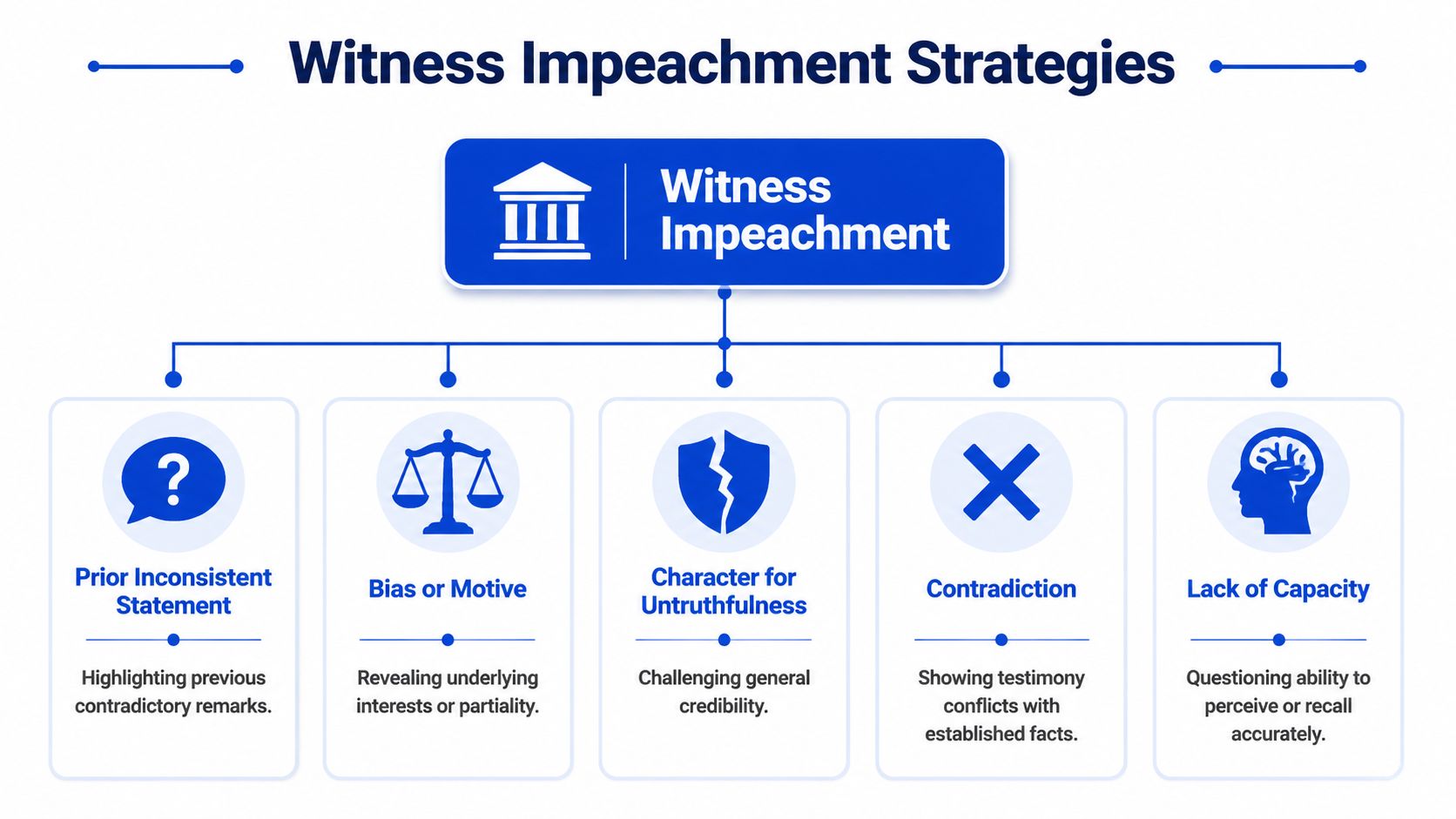
One reason this matters so much is that eyewitness testimony can be badly mistaken. The Innocence Project reports that eyewitness misidentification appeared in about 69% of DNA exoneration cases in the United States, making it the single most common contributing factor, as noted in this discussion of cross-examination and eyewitness reliability.
Prior inconsistent statements
This is one of the cleanest forms of impeachment. The witness says one thing in court and said something different before.
That earlier statement may come from:
A police report
A sworn deposition
A written statement
A recorded interview
Prior hearing testimony
Example in a theft case. A store employee testifies at trial that they had a clear, unobstructed view of the person who took merchandise. But in an earlier statement, they said shelving blocked part of their line of sight. Cross doesn't need drama here. It only needs the inconsistency.
Bias or motive to lie
Not every unreliable witness is confused. Some are invested.
A co-defendant hoping for favorable treatment, an ex-partner in a domestic violence case, or a witness trying to avoid blame may all have reasons to tilt their testimony. The jury is entitled to hear that context if the rules allow it.
A witness can sound calm and still be biased. Tone is not the same thing as truthfulness.
Inability to perceive or recall
This is often where cases are won or defended. A witness may be sincere and still wrong.
Questions in this area test things like:
Viewing conditions: Was it dark, crowded, brief, or chaotic.
Distance: How far away was the witness.
Distraction: Was the witness focused on something else.
Memory fade: Did time pass before the first statement.
Impairment: Was the witness tired, intoxicated, or stressed.
This issue appears constantly in DUI litigation too, especially when testimony about driving, roadside performance, or behavior doesn't line up with the record. If your case involves roadside exercises, this overview of the Florida field sobriety test process and defenses helps explain why observation-based testimony deserves close scrutiny.
Prior convictions
Florida law can permit questioning a witness about certain prior convictions to challenge credibility. This is not a free-for-all, and the exact scope matters. But when allowed, it can give jurors additional context about whether the witness deserves confidence.
This is also where inexperienced questioning can backfire. If counsel asks too broadly or opens the wrong door, the witness may get a chance to explain in a way that softens the impact. A measured approach is usually better than a dramatic one.
Using Exhibits and Adapting to Different Witness Types
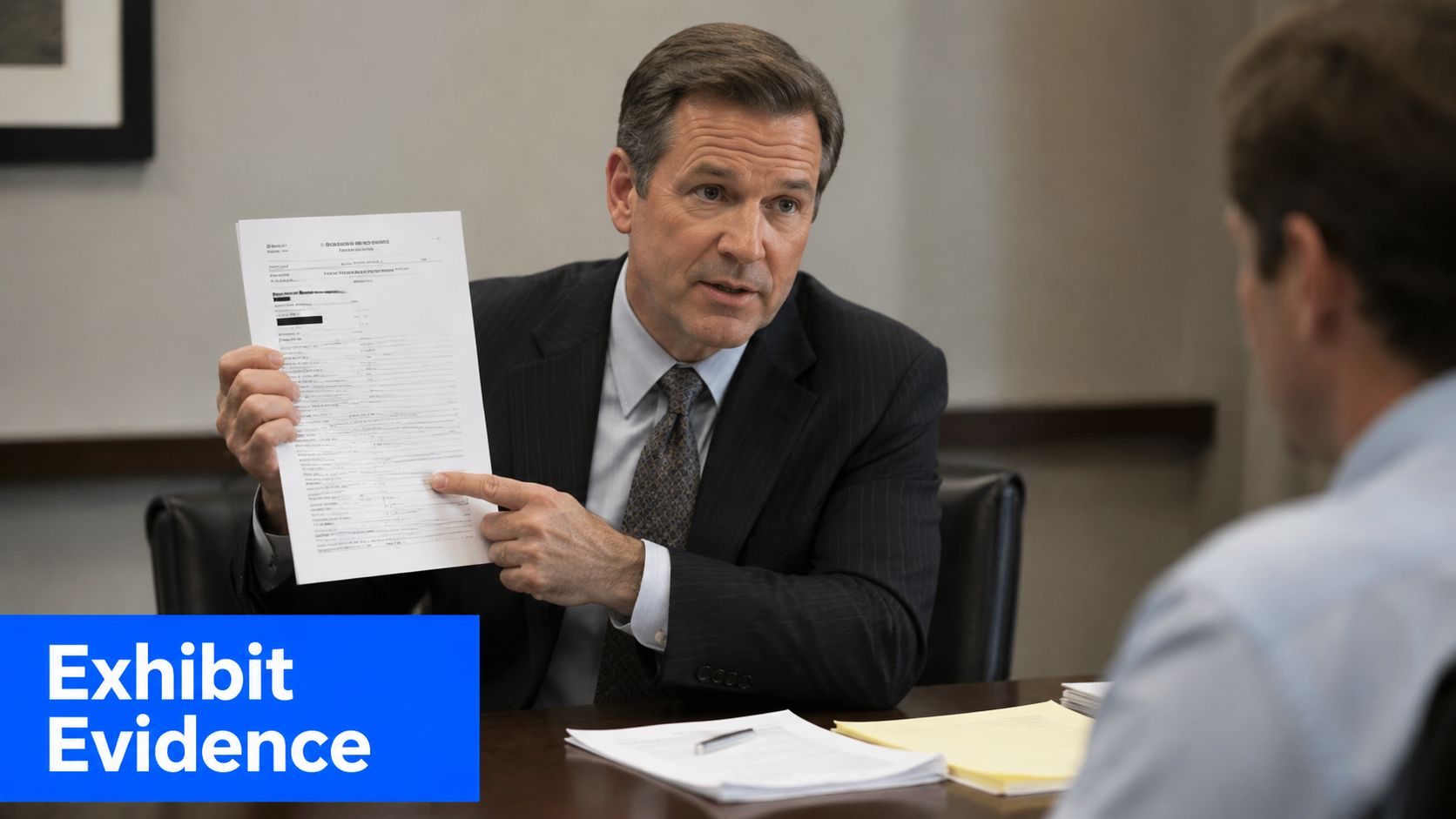
Cross-examination is not only oral. Often the strongest question in the room is attached to a document, a screenshot, a still frame, a diagram, or a video clip.
A police report can expose an omission. A dispatch log can pin down timing. A bodycam clip can test whether the officer's words match what happened. A text message can show context that testimony left out.
How exhibits do the heavy lifting
The exhibit matters because it limits retreat. A witness can argue with a broad accusation. It's much harder to argue with their own report, their own prior statement, or a visible timestamp.
Common exhibit uses in Florida criminal court include:
Reports: Showing what the officer included and what was left out.
Maps or photos: Testing line of sight, lighting, distance, and location.
Video: Separating what was seen from what was inferred later.
Messages and screenshots: Challenging motive, sequence, and context.
Digital evidence creates a modern cross-examination problem that many older guides ignore. A witness may talk confidently about what a clip "shows" even when the witness lacks firsthand knowledge of what happened outside the frame, before the recording started, or after it ended. In many South Florida prosecutions, especially DUI and violent crime cases, that distinction matters.
Civilian witnesses police officers and experts
A civilian witness usually requires a different tone than a trained officer. With a civilian, the focus is often on perception, memory, relationship bias, or emotional involvement. With an officer, the focus may shift to training claims, report writing, procedure, and whether conclusions go beyond observed facts.
Expert witnesses require even more preparation. Effective cross often starts before trial by locking the expert into exact opinions in deposition, then attacking qualifications, bias, and factual foundation through prior writings, methodology, and measurements, as discussed in this guide to cross-examining expert witnesses.
That same discipline shows up in DUI litigation when the State relies on officer interpretation of clues rather than straightforward fact testimony. If your case involves roadside eye testing, it helps to understand how horizontal gaze nystagmus is challenged in Florida DUI defense.
A short comparison helps:
Witness | Best cross focus |
|---|---|
Civilian eyewitness | Opportunity to observe, memory, bias |
Police officer | Procedure, omissions, assumptions, report language |
Expert witness | Foundation, method, qualifications, locked-in opinions |
Florida Rules Common Mistakes and When Not to Cross Examine
Florida practice puts real limits on cross-examination. In general, cross stays within the scope of direct examination and matters affecting credibility. That means the defense doesn't get unlimited freedom to ask anything it wants just because the witness is on the stand.
That rule shapes strategy. If a prosecutor didn't ask the witness about a topic, defense counsel may not be able to turn cross into a brand-new direct examination. Smart trial lawyers work inside the lane the law allows and use credibility issues, prior statements, and firsthand knowledge problems to make their points.
Where cross-examination usually stays
In practical terms, this means the defense often asks:
Questions tied to what the witness already discussed
Questions that test memory, perception, or bias
Questions that expose omissions or inconsistency
Questions that show lack of firsthand knowledge
What doesn't usually help is trying to deliver a speech through the witness. Jurors hear that immediately. So do judges.
The mistake that hurts more cases than clients realize
One of the worst habits in criminal court is crossing a witness just because the lawyer feels obligated to do it. Practitioner guidance emphasizes that cross-examination should be conservative and limited to questions that produce beneficial answers, and it warns that aimless or argumentative questioning can damage the lawyer's own case. Sometimes the strongest choice is to ask no questions at all, as noted in this Department of Justice practitioner guidance on cross-examination.
That decision takes discipline.
If the witness didn't hurt your case, don't give them a second chance to help the State.
Sometimes a witness is polished, sympathetic, and prepared. Sometimes the direct examination was flat and forgettable. Sometimes the only likely result of cross is that the witness gets to repeat key allegations with more confidence. In those moments, "No questions, Your Honor" can be the smartest line in the courtroom.
Common mistakes usually look like this:
Asking one question too many: The point was already made.
Arguing instead of questioning: The lawyer looks frustrated and the witness looks patient.
Repeating direct testimony: The jury hears the bad facts again.
Chasing every issue: The important point gets buried.
This is why trial experience matters so much in Broward County and across South Florida. Knowing how to cross examine witnesses includes knowing when silence is the stronger move.
Frequently Asked Questions About Witness Examination
What's the difference between direct examination and cross-examination
Direct examination is when the lawyer calls their own witness and usually asks open-ended questions so the witness can tell the story. Cross-examination is when the opposing lawyer questions that witness, usually with leading questions designed to test accuracy, bias, memory, and credibility.
Can a witness refuse to answer questions in a Florida criminal case
Sometimes. A witness may claim a privilege, including the Fifth Amendment in the right circumstances. If that happens, the judge decides how the issue will be handled. A witness usually can't just refuse because the question is uncomfortable or inconvenient.
What happens if a witness lies under oath
Lying under oath is a serious matter. It can expose the witness to criminal consequences and can also damage the State's case or the defense case, depending on who gave the false testimony. In trial, the immediate issue is often credibility. Once a witness is caught in a lie or major inconsistency, the jury may distrust the rest of that testimony.
Can I cross-examine the witnesses myself
A person can represent themselves, but that is a dangerous choice in a criminal case. Cross-examination requires knowledge of evidence rules, courtroom procedure, impeachment methods, and strategy. It also requires emotional distance. Individuals accused of a crime are too close to the facts of the case to question a hostile witness effectively.
If you're trying to understand your options, the firm's criminal defense FAQ page answers many of the concerns people have before court.
If you're facing charges in Broward County, Fort Lauderdale, Miami-Dade, Palm Beach, or anywhere in South Florida, cross-examination may become one of the most important parts of your defense. Ticket Shield, PLLC helps clients challenge weak testimony, expose unreliable evidence, and protect their rights at every stage of a Florida criminal case. Contact the firm for a confidential consultation to discuss the charges, the witnesses against you, and the strategy that may be available in your case.
Effective cross-examination exposes inconsistencies and bias. Learn how it works in Florida criminal trials and why skill matters.