Breathalyzer Test for THC: Florida DUI Laws & Defenses
Jason Goldsmith, Esq
You get pulled over in Fort Lauderdale, Broward County, Miami-Dade, or Palm Beach after using cannabis earlier that day, or even the night before. The officer starts asking questions about drugs. Then the panic hits. Can a roadside breathalyzer test for THC tell them you used marijuana? Can they arrest you even if you aren't high anymore?
That fear is real, especially in Florida where many drivers assume police have some kind of marijuana breath test that works like an alcohol machine. Right now, that assumption causes people to make bad decisions during stops, say too much, and misunderstand what the State has to prove in court.
The current situation is more complicated than widely realized. Florida DUI law still focuses on impairment, not proof that cannabis was used at some point. At the same time, the science around a true THC breathalyzer is still developing, and that gap creates important defense issues in marijuana DUI cases across South Florida.
Table of Contents
The Flashing Lights A Driver's Biggest Fear
A common scenario looks like this. A driver used a legal cannabis product hours earlier, or maybe over the weekend, and now sees blue lights in the rearview mirror on I-95 or a local Broward road. The stop starts with a simple traffic issue. Then the officer says they smell something, asks whether the driver uses marijuana, and suddenly the whole encounter feels like a trap.
That moment is where confusion takes over. Individuals generally understand what an alcohol breath test is. They don't know whether the same handheld device can test for marijuana, whether Florida has a legal THC limit, or whether a positive test automatically means a conviction.
The answer isn't simple, but it matters. In Florida, a marijuana DUI case often turns on a mismatch between emerging science and what officers use on the roadside today.
Why drivers get this wrong
People understandably assume a machine is objective and final. If an officer mentions a breath test, many drivers think the device can read THC the same way alcohol breath devices measure alcohol. That's not how roadside enforcement currently works.
Cannabis cases are often built from a combination of officer observations, statements made by the driver, field sobriety exercises, and later chemical testing. Each part of that chain can be challenged.
A marijuana DUI arrest is not the same thing as proof of impairment at the time you were driving.
What worried clients need to know first
If you're facing this issue in Fort Lauderdale or anywhere in South Florida, focus on these points:
Roadside alcohol machines aren't marijuana detectors: The device often referred to as a breathalyzer isn't built for THC.
A positive drug result doesn't end the case: The State still has to connect the evidence to impaired driving.
Your own words can do serious damage: Admissions about when, what, or how much you used often become central evidence.
The stop itself matters: If the officer lacked legal justification, key evidence may be excluded.
That gap between fear and reality is where good defense work starts.
Alcohol vs THC Breathalyzers The Reality in Florida
The first thing to clear up is the biggest misconception. The breathalyzer an officer commonly uses on the roadside is for alcohol, not THC. Conventional roadside breathalyzers and ignition interlock devices are not designed to detect THC, and cannabis-breath technology is still in development rather than a practical field standard, as discussed in this Scientific American analysis of marijuana breath testing.
That matters because many Florida drivers hear the word "breathalyzer" and assume police can instantly measure marijuana impairment the same way they try to measure alcohol concentration. They can't. These are different substances, different detection problems, and very different legal issues.
What police carry now
In a typical DUI stop in Broward County or Miami-Dade, the handheld breath device is part of an alcohol investigation. It isn't a roadside THC detector.
If marijuana impairment is suspected, officers usually rely on other things:
Driving pattern evidence: Lane issues, delayed reactions, or an accident investigation
Personal observations: Eyes, speech, body movements, and behavior
Statements: Whether the driver admits using cannabis
Field sobriety exercises: Balance, divided attention, and following instructions
Chemical testing later: Depending on the case, law enforcement may seek blood, urine, or another sample
Why that distinction creates defenses
A true breathalyzer test for THC is still being studied because THC presents a hard scientific problem. The same Scientific American review notes that impairment can't be inferred from concentration alone, and it also references NHTSA's position that it's inadvisable to predict effects from blood THC concentrations alone.
That is a major defense issue in Florida court. Prosecutors may try to present cannabis-related evidence as if it tells a straightforward story. It often doesn't.
Practical rule: If a case involves suspected marijuana impairment, ask what the officer actually used, what it was designed to detect, and whether the State can tie that evidence to impaired driving instead of past use.
Breath test refusal confusion
Another source of confusion is refusal law. Drivers often think every request to blow into a device means the same thing. It doesn't. The rules and consequences can vary depending on the stage of the investigation and the type of test requested.
If you're trying to understand how refusal issues work in Florida DUI cases generally, this guide on refusal to submit to a breath test in Florida gives useful background. In a marijuana case, the key point is simpler: don't assume a standard alcohol machine can prove THC impairment.
How New THC Breath Technology Aims to Work
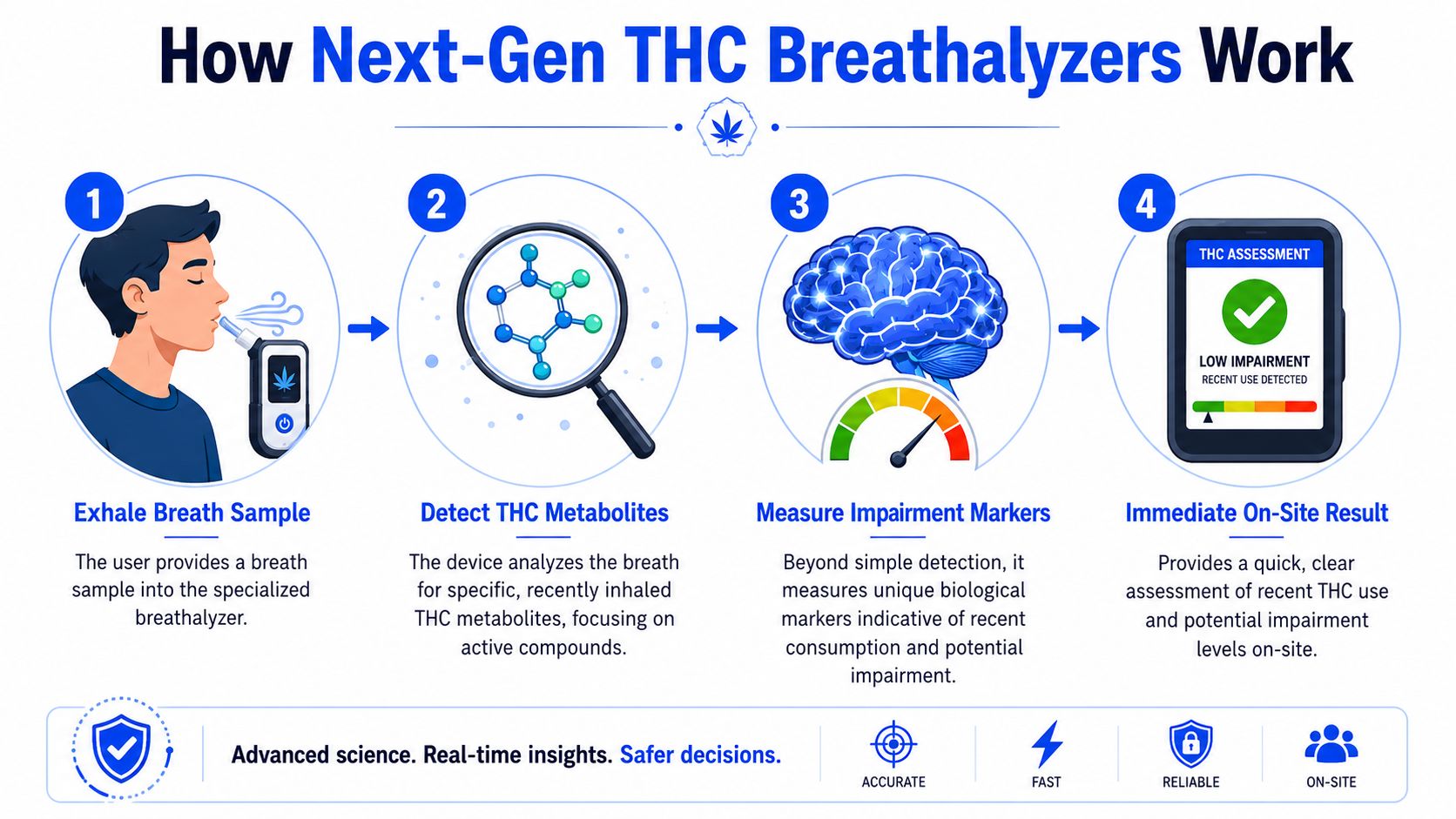
Researchers aren't trying to build a marijuana version of an ordinary alcohol machine by copying it exactly. They are trying to solve a narrower problem. The goal is to identify very recent cannabis use, not just any prior exposure.
The science focuses on recency
That difference matters because blood, urine, and saliva can stay positive after the period of likely impairment has passed. A modern breathalyzer test for THC is being developed around a shorter time window.
A controlled 2021 study found that a combined breath-and-blood THC test distinguished recent use from prior use with 0/34 false positives before smoking and 44/44 positives within the first three hours after smoking, according to this published study on breath and blood THC testing. The same study reported a breath THC half-life ranging from 1.0 to 19.1 minutes in those recent-use cases, which helps explain why breath may be useful for identifying very recent consumption rather than old residual exposure.
In plain English, researchers are trying to detect the kind of signal that fades quickly. That is very different from a urine test that may remain positive well after active effects are gone.
Why one sample may not be enough
Another important point from that research is that a two-sample approach may work better than a single sample. In the same 2021 study, the breath-to-blood Δ9-THC ratio was less than 2 before smoking and greater than 2 immediately after smoking, which supported the idea that comparing samples can help separate recent use from prior use.
That concept is easy to understand if you think of it as a moving snapshot instead of one still photo. One reading may be ambiguous. Two readings, taken close together, may tell investigators whether THC markers are dropping in a way that suggests very recent use.
The real scientific target isn't "Has this person used cannabis before?" It's closer to "Did this person use cannabis very recently?"
Why this still doesn't solve the courtroom problem
Even promising technology doesn't erase the legal issue. Detecting recent use isn't the same as proving a driver was impaired in the manner Florida law requires. A machine may become part of the evidence, but it doesn't automatically answer the ultimate question in a DUI case.
That is why defense lawyers pay close attention to what a device is designed to detect, how the sample was taken, whether the protocol was followed, and what conclusions the prosecution is trying to draw beyond the science.
Understanding Florida's Marijuana DUI Impairment Laws
Florida does not treat marijuana DUI the way many people think. There is no simple THC number that works like the familiar alcohol limit. The legal question is whether the State can prove your normal faculties were impaired while you were driving.
What normal faculties means
In everyday terms, normal faculties include your ability to see, hear, walk, talk, judge distances, react, and carry out the ordinary mental and physical acts of daily life. In a marijuana DUI prosecution, the State has to persuade the court or jury that cannabis affected those abilities at the time of driving.
That distinction is critical. Evidence that a person used marijuana is not automatically evidence that the person was impaired while driving in Fort Lauderdale, West Palm Beach, or anywhere else in Florida.
Why positive tests don't decide the case
The subsequent details often render many marijuana DUI cases defensible. A chemical result may suggest exposure. It does not necessarily prove the timing of use, the degree of any effect, or whether the driver's faculties were impaired on the road.
Officers often build these cases around subjective observations, such as red eyes, slow responses, or body sway. But those observations can have multiple explanations, including fatigue, stress, allergies, anxiety, poor roadside conditions, or simple nervousness during a police stop.
For background on changes that affect Florida DUI enforcement more broadly, review this discussion of new Florida DUI laws.
What prosecutors usually try to argue
In a marijuana DUI case, the State often tries to stack several pieces of evidence together:
Driving conduct: Why the officer says the stop happened
Physical signs: What the officer claims to have noticed
Statements: Any admission about cannabis use
Exercises and tests: Performance on roadside tasks and later toxicology
A defense lawyer's job is to break that stack apart and force the State to prove actual impairment, not suspicion, not stereotype, and not mere cannabis use.
In Florida, the fight is often not over whether cannabis was present. It's over whether the State can prove it impaired your normal faculties when you were behind the wheel.
Current THC Testing Methods Used by Florida Police
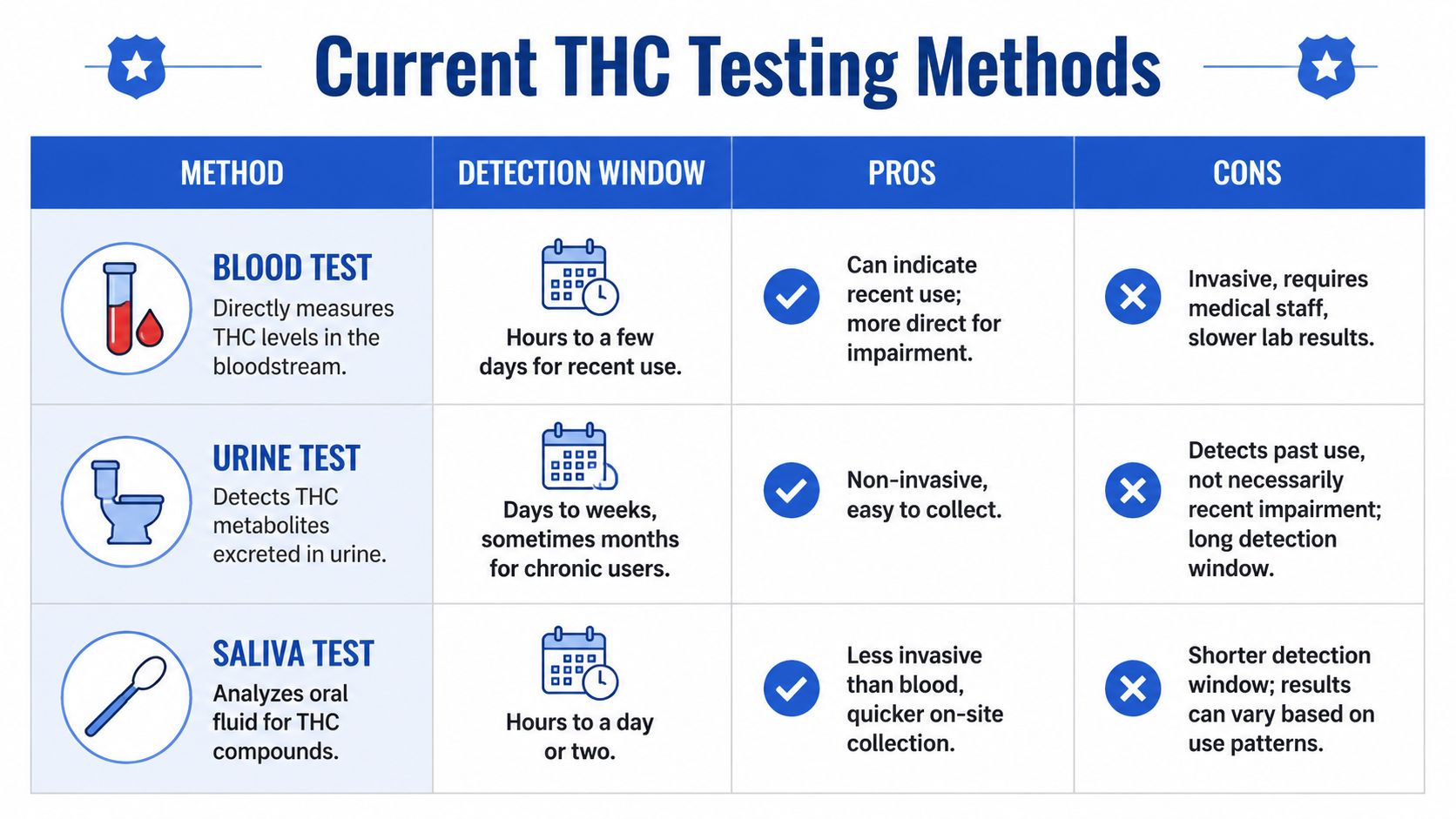
If police don't have a standard roadside THC breathalyzer in practical use, what are they using? In marijuana DUI investigations, Florida cases usually involve some combination of blood, urine, or saliva-related testing, plus officer observations.
This comparison helps show why each method has weaknesses.
A side by side look
Method | What it can show | Main weakness in court |
|---|---|---|
Blood | More useful for evaluating recent presence in the body | Collection is invasive, timing matters, and the State still must prove impairment |
Urine | Detects metabolites associated with prior use | Often says more about past exposure than driving impairment |
Saliva | Can be used to look for more recent exposure | Collection and interpretation issues can still limit reliability |
A short video overview can help make these testing differences easier to visualize before you speak with counsel.
Why researchers keep changing the breath approach
The reason new breath testing has not replaced these methods is that the science remains unsettled. A 2024 NIST update reported that researchers moved away from a single-test concept toward two breath tests separated by roughly an hour after earlier work suggested one breath result might not reliably separate recent from past use, and the University of Colorado team later described two tests 10 to 20 minutes apart in a study of 45 regular cannabis users, as described in this NIST report on the evolving cannabis breath protocol.
That tells you something important from a defense perspective. If leading researchers are still refining basic collection timing, prosecutors should not be allowed to oversell any THC test as clean, simple proof of impairment.
What each method means for your defense
Different tests create different lines of attack:
Blood cases often turn on timing: When was the sample drawn, and what happened between driving and collection?
Urine cases often turn on relevance: Does the result show anything meaningful about impairment during driving?
Saliva cases often turn on reliability: How was the sample collected, stored, and interpreted?
Field exercises also remain central in these investigations. If you want to understand how officers use roadside tasks during DUI stops, this overview of field sobriety testing in Florida is worth reviewing.
Building a Strong Defense Against a Marijuana DUI
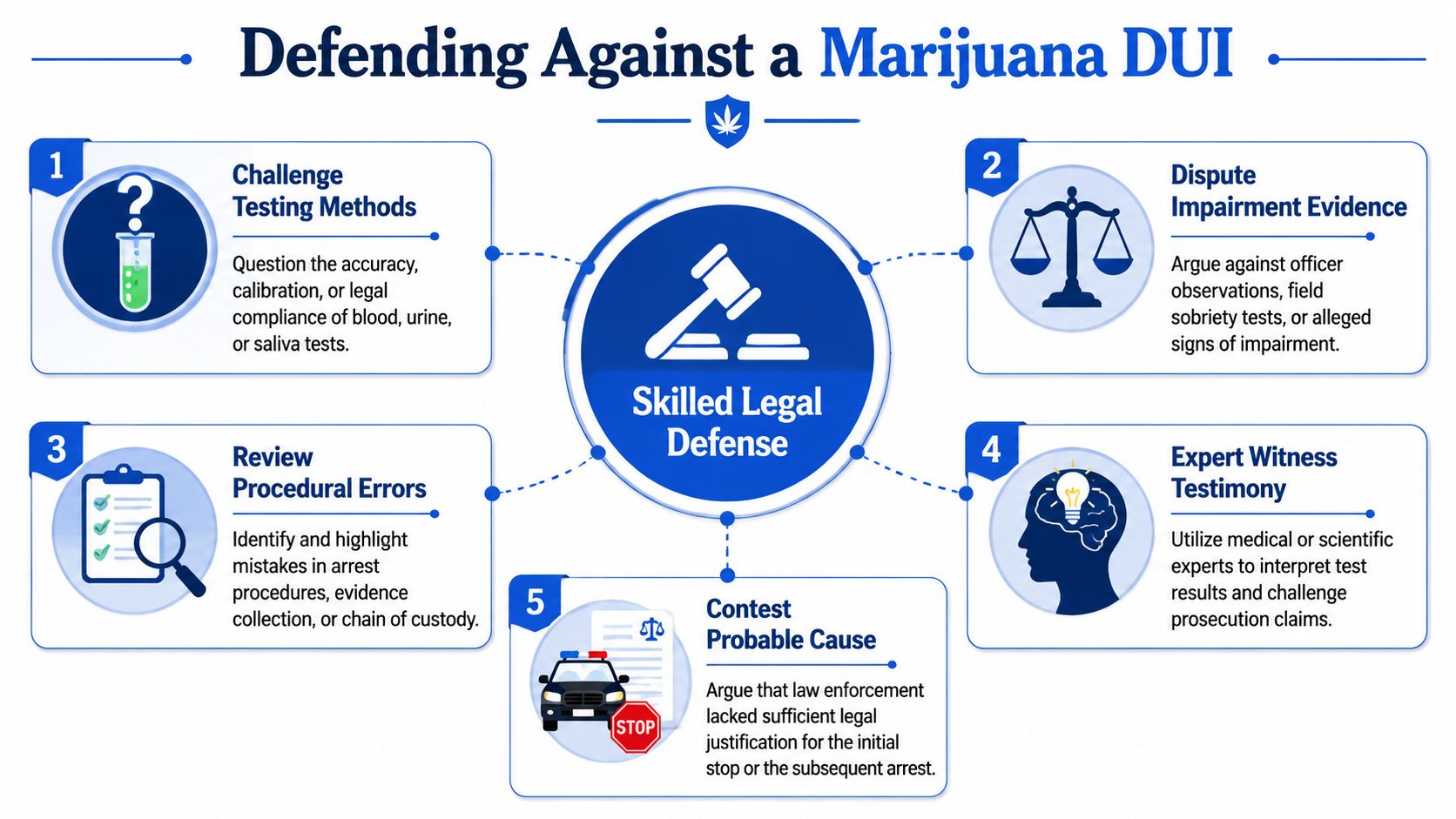
A strong marijuana DUI defense does not rely on one argument. It usually works by attacking the case at multiple pressure points until the State's theory stops holding together.
Start with the stop and the arrest
Every case begins with the same basic question. Did the officer have a lawful reason to stop the vehicle and then escalate the investigation?
If the stop was weak, if the detention went too far, or if the arrest lacked probable cause, the defense may be able to challenge the evidence that followed. That includes statements, exercises, and chemical test results.
Attack subjective impairment claims
Marijuana DUI cases often depend heavily on interpretation. Officers may describe a driver as slow, confused, unfocused, or unsteady. Those descriptions sound persuasive on paper, but they are still human judgments made in stressful roadside conditions.
A defense lawyer should examine details such as:
Environment: Uneven pavement, flashing lights, traffic noise, heat, rain, and fatigue
Medical explanations: Anxiety, injuries, eye conditions, or prescription medication effects
Officer wording: Whether the report uses vague labels instead of specific conduct
Video comparison: Whether body cam or dash cam footage matches the written report
Video can matter as much as any lab result. If the recording doesn't match the report, the State's case can weaken quickly.
Put the science on trial too
Chemical evidence often looks stronger than it is. Testing can be challenged through chain of custody problems, collection issues, storage concerns, timing, lab interpretation, and overstatement by the prosecution.
In the right case, expert review may be essential. A toxicologist or other qualified witness may help explain why presence does not equal impairment, why timing matters, and why broad conclusions from marijuana testing can be misleading.
Build the defense in layers
A practical defense framework often includes:
Stop legality: Was there valid reasonable suspicion?
Arrest basis: Did the officer really have probable cause?
Statements: Were admissions voluntary and lawfully obtained?
Testing procedures: Was the sample properly collected and handled?
Proof of impairment: Can the State show impaired normal faculties?
If you're facing this kind of case, this guide on how to fight a DUI gives a broader look at defense strategy in Florida DUI litigation.
What to Do Immediately if Stopped for THC Impairment
When an officer starts investigating possible marijuana impairment, small decisions matter. What you say on the roadside can become the backbone of the prosecution's case.
Keep the encounter controlled
Pull over safely. Be polite. Keep your hands visible. Provide your license, registration, and proof of insurance when requested.
After that, slow everything down. You do not have to explain where you were, what you used, when you used it, or how you feel.
Use clear and respectful language
A simple approach is usually best:
Identify yourself and provide documents: Nothing more than what the law requires
Invoke silence clearly: Say, "I am going to remain silent."
Don't volunteer explanations: Talking rarely helps in a DUI investigation
Don't admit cannabis use: Even a casual statement can be treated as evidence of impairment
Be careful with roadside exercises
Field sobriety exercises are often presented as routine. They are also designed to produce evidence. In a marijuana case, officers may use those exercises to support an arrest even when there is no reliable breathalyzer test for THC.
You should stay calm and avoid arguing on the roadside. But you should also understand that cooperation does not mean giving the State more evidence than necessary.
If an officer suspects drug impairment, the investigation usually gets stronger when the driver talks, guesses, explains, or tries to perform under pressure.
Get legal help immediately
Once the stop turns into an arrest or a notice of suspension issue, time matters. A lawyer can review the stop, the officer's reports, body cam footage, testing records, and the basis for any license action. Early action also protects your ability to challenge the State's case before weak evidence gets framed as settled fact.
If you were arrested in Fort Lauderdale, Broward County, Miami-Dade, Palm Beach, or elsewhere in South Florida, treat the case seriously from day one. Marijuana DUI cases often look simple at first. They usually aren't.
If you're worried about a marijuana DUI, a license suspension, or whether a breathalyzer test for THC can be used against you, contact Ticket Shield, PLLC for a confidential consultation. The firm defends clients across Broward County, Fort Lauderdale, Miami-Dade, Palm Beach, and throughout Florida, and can step in quickly to examine the stop, challenge the testing, and protect your rights, license, and future.
THC breath testing is far from settled science. Learn how Florida prosecutes marijuana DUI cases and how to challenge the evidence.