
Probation Violation Lawyer Cost: What You Really Pay
Jason Goldsmith, Esq
Most probation-violation defense in Florida falls between $1,500 and $5,000 for typical cases, with felony or contested hearings pushing higher. If you're staring at a probation officer call, a warrant notice, or a court date in Broward County, this guide breaks down why the probation violation lawyer cost changes so much and what you're really paying for.
Table of Contents
What a Probation Violation Lawyer Actually Costs in Florida
A probation officer calls. A warrant shows up. Or your phone rings with a court date you weren't expecting. In that moment, the question isn't abstract, it's how much a probation violation lawyer costs and whether paying now can keep the case from getting worse.
For most Florida cases, the practical starting point is $1,500 to $5,000, with more serious matters climbing higher because the lawyer has to fight revocation risk, not just appear and nod. A focused Florida VOP lawyer usually earns that fee by reviewing the violation affidavit, talking with the State Attorney, preparing for the violation hearing, and arguing for reinstatement or modification instead of revocation. The broader market also shows heavier pricing in more serious cases, including misdemeanor probation violations at $2,500 to $8,000 and felony violations at $5,000 to $15,000 in one California market guide, plus hourly rates that can run from $150 to $400 and higher in larger metros. Florida VOP representation overview gives the basic service framework clients should expect.
Practical rule: if the quote doesn't cover the hearing, the negotiation, and the paperwork review, it isn't the real price.
The hard truth is that probation defense is priced around risk. If the judge can revoke probation and impose custody, the lawyer is charging for the fight over liberty, not just the courtroom appearance. Florida's fee structure also sits inside a broader system where 44 states charge probation and supervision fees and 43 states charge public defender or legal-cost fees, so money pressure is already part of the case before you even hire counsel. That review also found 48 states increased civil or criminal court fees since 2010, and earlier research found 30 states allowed unpaid fees to become a condition of probation, which is why missed payments can become a new violation issue. Fines and Fees Justice Center review
A strong lawyer isn't selling a miracle. You're paying for skilled advocacy, preparation, and a better shot at staying on supervision instead of going back to jail. If you're deciding whether to spend the money, the next sections will show where the numbers come from, which case types cost more, and what add-ons turn a quoted fee into a bigger bill.
Technical Violations vs New Charges and Why the Fee Changes
The biggest mistake people make is treating every probation problem like the same problem. A technical violation is usually something like a missed check-in, a failed drug test, or travel without permission. A new charge means you got arrested again while on probation, and that changes everything about the lawyer's workload, the risk, and the price.
Why the same lawyer charge can look very different
A technical violation often stays focused on documentation, explanation, and damage control. A new arrest drags in police reports, witness statements, possible bond issues, and a bigger fight over whether the court should revoke probation at all. That's why a missed appointment is usually cheaper than a fresh misdemeanor or felony case, and why a new criminal charge almost always pushes the quote up.
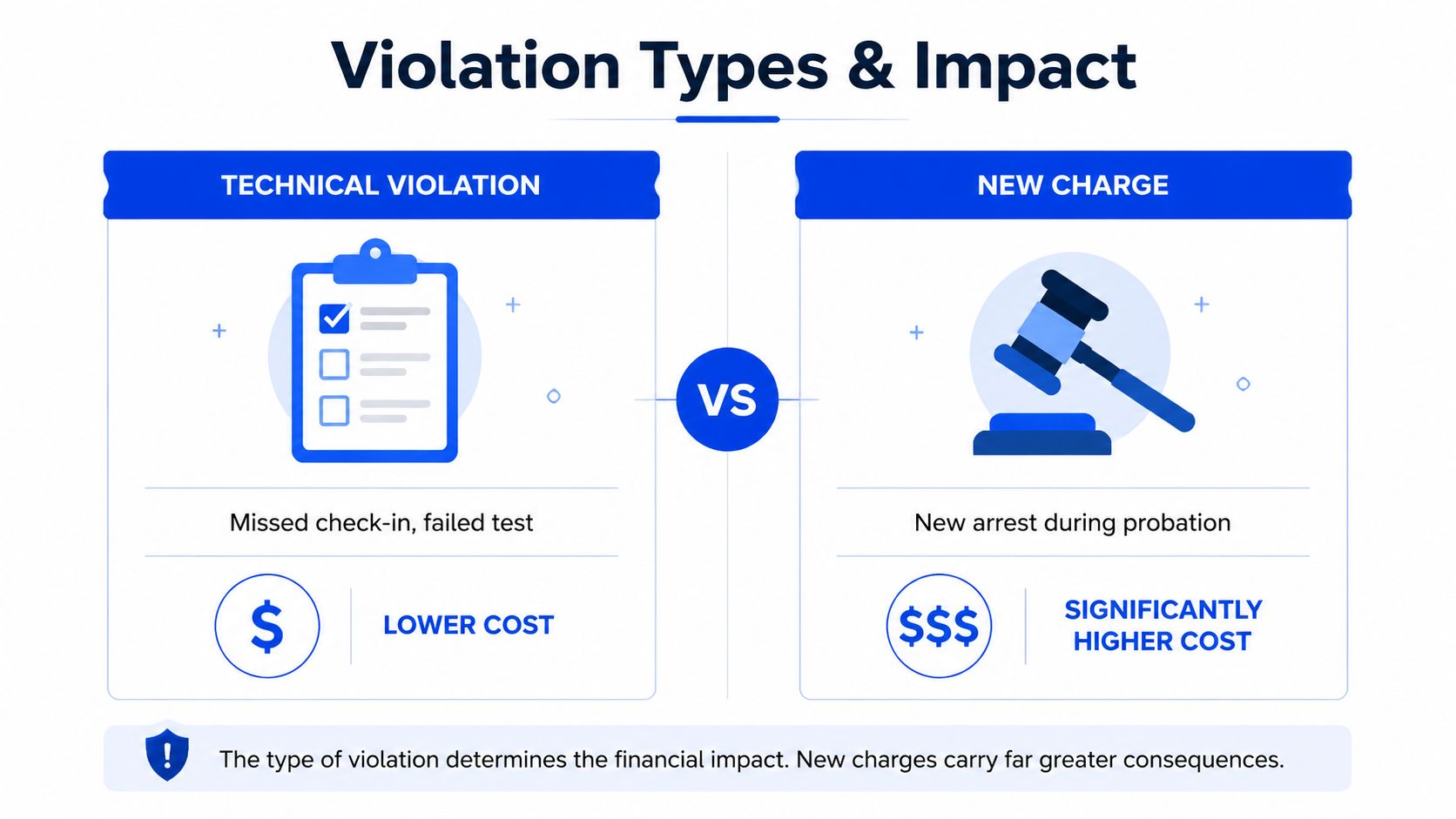
Think of it this way. A technical violation is closer to a parking ticket. A new charge is the speeding ticket that puts points on the license and triggers a bigger insurance mess. The court can treat the second one as a much more serious threat to the original sentence, so the defense has to do more work and the fee usually reflects that.
Florida technical violation defense is where many cases start, because the first job is figuring out whether the report can be corrected, explained, or negotiated before it snowballs. In Broward County, Miami-Dade, and Palm Beach, that distinction matters more than almost anything else. A lawyer who sees a simple compliance problem and a lawyer who sees revocation exposure are doing very different jobs, even if the case starts with the same court date.
If you're not sure which bucket your case falls into, get that answer before you talk yourself into the wrong budget.
Typical Fee Ranges and What Drives Each One
The market is not uniform, and anyone pretending it is hasn't spent enough time in criminal court. One legal-cost guide places common probation-violation work in the $1,500 to $5,000 range, with hourly billing around $150 to $400 and major-city rates reaching $250 to $400 per hour. Another published market guide puts misdemeanor violation defense at $2,500 to $8,000 and felony matters at $5,000 to $15,000, which lines up with the reality that the case gets more expensive when the consequences get uglier. Probation violation cost guide and Florida market fee guide point in the same direction, even though they describe different markets.
A simple fee map
Violation Type | Typical Flat Fee | Hourly Range |
|---|---|---|
Simple technical violation | $1,500 to $2,500 | $150 to $400/hour |
Failed drug test or repeated noncompliance | $1,500 to $3,500 | $150 to $400/hour |
Contested misdemeanor violation | $2,500 to $8,000 | $150 to $400/hour |
Felony violation or new charge | $5,000 to $15,000 | $250 to $400/hour in larger metros |
Those ranges are not random. A simple missed check-in usually requires less motion work and fewer hearings. A contested felony violation can require more court appearances, more evidence review, and more negotiation because the lawyer is trying to avoid revocation, preserve your freedom, and manage the exposure tied to the original sentence.
The attorney-reported market spread reinforces that point. Some practitioners report $1,500 to $7,000 for violation-of-probation work in district and circuit court, with entry points around $500 to $1,500 for simpler hearings. Attorney-reported fee ranges show how much the fee can swing once the case becomes contested or the stakes rise.
The blunt version is this. If your case is clean, contained, and likely to end with a short hearing, the lower end is realistic. If there's an arrest, a dispute over the facts, or a real chance the judge could revoke probation, expect the quote to move fast.
Retainer Structures and How Defense Fees Get Paid
Most clients hear the word “retainer” and assume it means one simple price. It usually doesn't. A flat fee means the lawyer agrees to handle a defined scope of work for one price. Hourly billing means you pay for the time spent. A hybrid structure sits in the middle, with a smaller upfront fee and added hourly charges if the case turns into a hearing-heavy fight.
What to read before you sign
A flat-fee VOP quote often includes the first consultation, file review, probation record review, negotiation, and the main hearing. It may not include a motion to suppress, a revocation fight that stretches across multiple dates, or work tied to a new charge that appears while the probation case is pending. That's where clients get surprised, because the agreement can trigger more billing once the case stops being routine.
Pay attention to language about replenishing the retainer. In practice, the lawyer deposits your upfront payment into a trust account and draws against it as work is done. If the balance drops, you may be asked to add funds before more work continues. That structure is normal, but it needs to be explained in plain English before you sign anything.
Florida criminal defense fee discussion should also remind you that payment plans sometimes exist, but they're not the same thing as a low total fee. Some offices take credit cards. Some don't. Some refund unused amounts if the matter resolves early, while others keep earned fees only. Those details matter more than the headline number.
Ask one direct question before you pay a retainer, “What happens if this turns into a contested hearing or a second court date?”
That one question flushes out the risk. If the answer is vague, you're not comparing prices, you're guessing.
The Hidden Costs Behind the Attorney Quote
A lawyer's fee is only the first layer. Families often budget for the retainer and then get hit with court costs, supervision charges, travel, bond, and expert expenses. That is how a case that looked manageable on paper starts to feel much heavier in real life.
Where the extra money shows up
Florida probationers often already live inside a fee-heavy system. Court systems around the country add probation, supervision, public defender, legal-cost, and court fees on top of the case itself, which is why the bill around a violation hearing can keep growing even after you pay the lawyer. A Fines and Fees Justice Center review helps explain how those charges stack up in practice.
The hidden costs usually fall into a few buckets:
Court and supervision charges: fees tied to the hearing and ongoing supervision.
Bond or warrant-related expenses: if the warrant leads to an arrest and release condition.
Expert help: drug testing disputes, treatment testimony, or other specialized proof.
Investigation and records work: checking compliance, pulling treatment records, or verifying timelines.
Motion practice: extra filing and hearing work if the case turns contested.
A practical way to think about it is this, a $2,500 attorney fee can sit on top of several smaller expenses that together make the case feel much closer to $6,000 in total pressure. That is not a statewide number, it is a budgeting reality families encounter when they need more than a quick appearance. One Florida cost article also notes that some serious matters rise when experts or depositions are needed, which is exactly the kind of add-on most fee pages leave out. Florida probation violation cost discussion
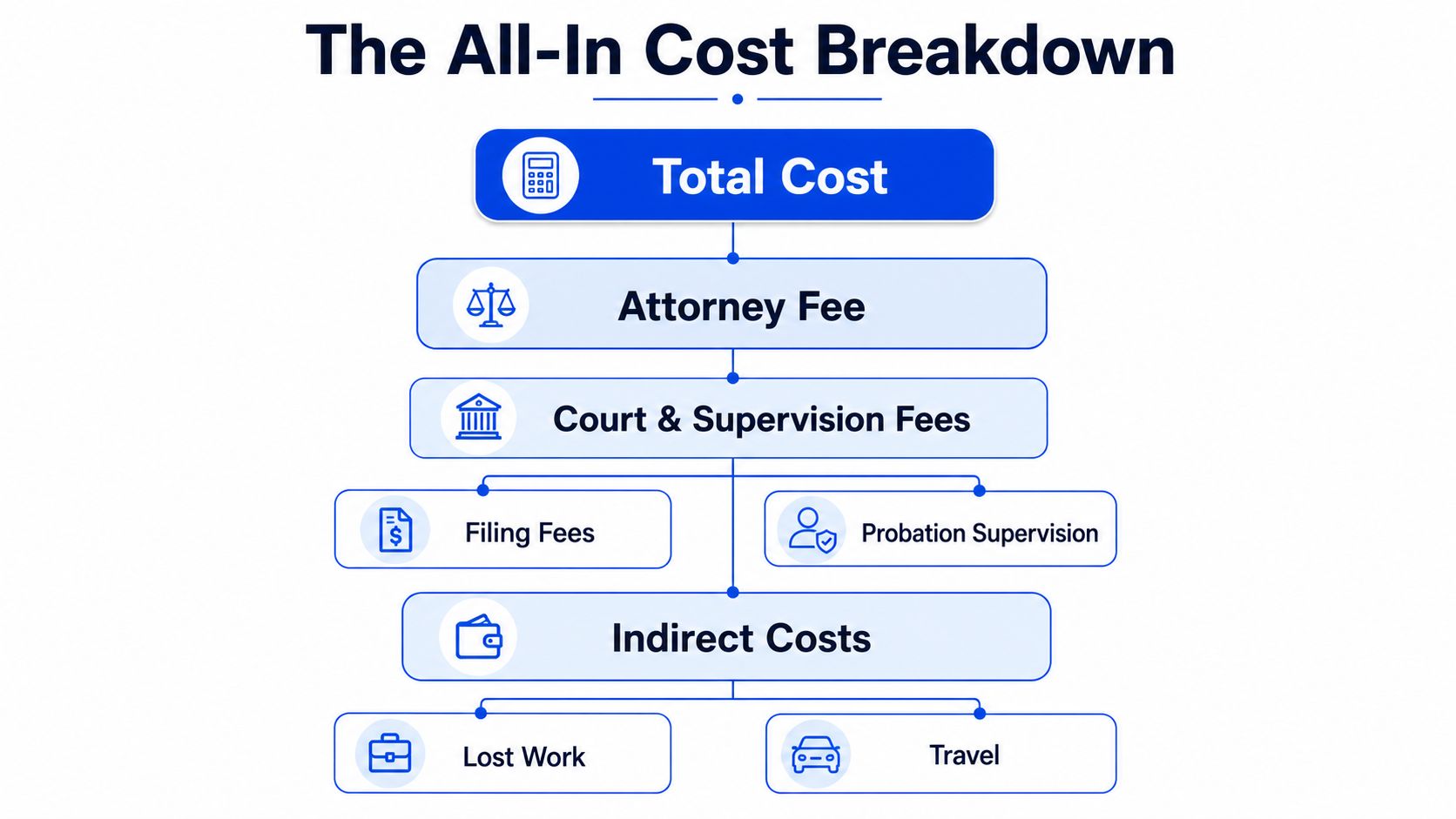
The point is simple. When you ask for a quote, ask for the full picture, not just the lawyer's opening number. The all-in cost matters more than the sticker price.
Florida probation violation jail-time overview matters because the financial discussion changes fast when the case carries custody risk. If jail is on the table, the legal work becomes more intensive and the practical value of defense rises with it.
Hiring a Lawyer vs Going Without One or Using a Public Defender
Going alone is usually the most expensive choice in the long run. People think they save money by skipping counsel, but probation court is not a place where a paperwork mistake gets forgiven because you were stressed. The State already has the advantage of an existing sentence, and the judge can move quickly if the violation is proven.
Florida defendants facing possible incarceration are generally entitled to court-appointed counsel, so a public defender is a real option if you qualify. That said, public defenders often carry heavy caseloads, which means less time per client and less room for detailed communication. That doesn't mean they don't care. It means they're working inside limits most families don't see from the outside.
Private counsel costs more, but you usually get more direct communication, earlier preparation, and a defense strategy built around your specific probation terms. In a VOP case, that matters because the lawyer may need to track down records, challenge the affidavit, or push for reinstatement instead of revocation. If you wait until the warrant is already active, you've often lost some bargaining power.
Representing yourself is the riskiest path. The hearing may look informal, but the consequences are not. One wrong admission, one missed objection, or one bad explanation can make a revocation easier for the court to justify. That's why the cheapest route can become the costliest one.
Ticket Shield, PLLC offers a practical example of a private defense option in Florida, with a free consultation and direct client intake through the firm's website. For someone trying to compare costs, that kind of first conversation is useful because it turns the question from “What does a lawyer cost?” into “What does my case require?”
The real comparison is not private lawyer versus no lawyer. It's preparation versus improvisation.
Practical Tips to Lower or Estimate Your Total Cost
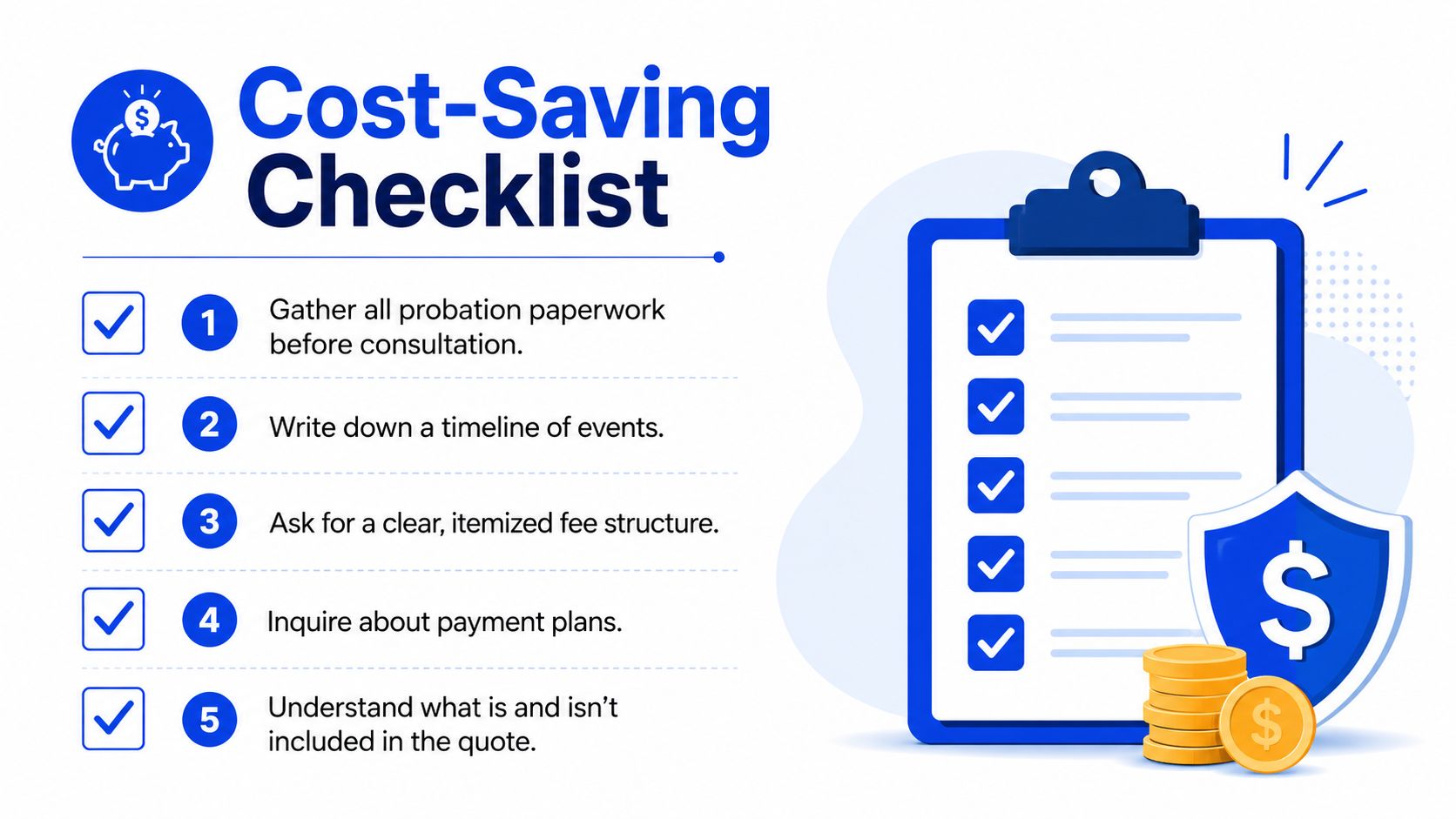
You do not control every part of a probation case, but you do control how ready you are when you ask for a price. Walk in with the paperwork, the dates, and a clear story, and the lawyer can tell you whether the matter looks simple, contested, or likely to pick up extra work. That is how you get a quote that reflects the case instead of a guess.
What to bring and what to ask
Gather every probation document: Bring the order, the terms, the affidavit, and any letters from probation.
Write down the timeline: Dates matter in VOP cases, and a clean timeline saves lawyer time.
Ask for an itemized quote: A flat fee only helps if you know exactly what it covers.
Ask what triggers extra charges: Hearing days, motions, new arrests, expert work, and depositions can all change the total.
Confirm payment options: Ask about payment plans, card acceptance, and whether unused funds are refundable.
Bring the facts that drive the bill. If you have a warrant, a new felony charge, or a violation report that is already close to a hearing, waiting usually costs more because the lawyer has less room to settle the case early. Early action can lower the total because counsel may be able to resolve the matter before it turns into a full revocation fight.
A custody risk changes the budget, too. If jail is a real possibility, you should focus less on the cheapest quote and more on the scope of the work. A low retainer that leaves out hearings, motions, or follow-up work can turn into a much larger bill once the case starts moving.
Probation violation jail-time considerations also affect budgeting because jail exposure changes how much work is worth doing. Ask the lawyer what is included, what counts as extra, and what the total looks like if the case does not end quickly.
Making a Smart Decision About Your Defense
A bad day at the courthouse starts with a simple mistake, choosing the wrong level of defense for the case in front of you. If the violation is minor and the probation record is clean, a focused lawyer may be enough. If the case involves a warrant, new charges, or a hearing that is already close, the budget should account for more work, more time, and more risk.
The right comparison is not private lawyer versus no lawyer. It's preparation versus improvisation. A low quote that leaves out hearings, motions, or follow-up work can turn into a larger bill once the case starts moving. A higher quote may still make sense if it includes the work needed to push back hard and keep the case from becoming a full revocation fight.
Early action usually keeps the bill lower because counsel can get involved before the State hardens its position. That does not promise a better outcome, but it keeps more options open. Once a warrant issues and the case moves toward revocation, the fee usually rises with the extra work and the extra risk.

If you are in Broward County, Fort Lauderdale, Miami-Dade, Palm Beach, or anywhere else in South Florida, get a direct estimate from a lawyer who handles probation cases every week. Bring the paperwork, ask what the quote covers, and ask for the cost if the case needs hearings, motions, or extra court appearances before you pay a dollar.
Ticket Shield, PLLC helps Florida clients facing probation violations, DUI, drug charges, theft, and other criminal accusations by reviewing the case, explaining the cost structure, and mapping out a defense plan. If you need a confidential consultation, visit Ticket Shield, PLLC and get a straight answer about your options before the case gets more expensive.