
Can I Get a DUI on a Bike in Florida? Legal Guide
Jason Goldsmith, Esq
Yes, you can get a DUI on a bike in Florida, and the same 0.08% BAC threshold applies because Florida treats bicycles as vehicles for DUI purposes. If you were stopped on a bike after drinking, don't assume the case is minor, because the arrest can still put your license, record, and future court exposure at risk.
You're probably trying to figure out whether the officer even had the right to stop you, whether the breath test matters, and whether this can spill over into a car DUI later. In Florida, those questions matter fast, and the wrong move at the roadside can make a bad situation worse.
Table of Contents
What Bicycle DUI Stops Look Like in Florida
A rider heads home through Fort Lauderdale after drinks, slows at a corner, and an officer decides the bike is wobbling enough to investigate. That is how a lot of these cases start, not with a crash, but with a stop that turns into a criminal charge. In Florida, that charge can absolutely be a DUI.
People hear “bicycle” and assume the law will treat it like a parking ticket or a simple municipal issue. That assumption can cost you. Florida is among the states where bicycle riders can be charged under DUI laws because bicycles are treated as vehicles for that purpose, and state-by-state summaries identify Florida alongside Georgia, Ohio, Oregon, and Pennsylvania in that category. Florida bicycle DUI overview
Why officers treat this as a real DUI case
Once the stop starts, the officer looks for the same broad indicators used in car cases, impairment, unsafe operation, and signs of alcohol use. If the facts support it, the State may push the case as a full DUI rather than a minor bike offense. That means a bicycle arrest can carry the same courtroom pressure you would face after a traffic stop in a car.
A bicycle stop also creates hidden fallout that riders miss until it is too late. A DUI charge can threaten a driver's license, leave you with a criminal record, and give the State room to tack on backup charges if the facts do not fit a clean DUI theory. That is where these cases get ugly fast.
Practical rule: if the officer says you were “operating” the bicycle while impaired, take the accusation seriously immediately.
Florida defense work in this space starts fast. The first 10 minutes and the first 10 days matter more than the final court date. A Fort Lauderdale DUI lawyer can challenge the stop, the roadside observations, and the State's proof before the case hardens into a record that follows you far beyond the bike ride.
How Florida Law Defines a Bicycle as a Vehicle
Florida's bike DUI problem starts with the statute itself. The DUI law reaches a vehicle, and that word is broad enough to pull a bicycle into the case when the facts line up. That is why a rider can face arrest on a bike even though there is no engine involved. Vehicle definition and bicycle DUI framework
The legal trigger is operation, not horsepower
The State does not need a car, a truck, or a motorcycle to make the charge work if the statute covers bicycles as vehicles. The fight usually turns on whether the person was operating the bicycle while impaired, not on whether the bike was motorized. Florida's DUI framework also uses the familiar 0.08% BAC threshold in full-DUI cases, so the legal focus stays on impairment and control, not on the size of the wheels. Statutory vehicle definition and BAC threshold
“Operating” can mean more than many riders expect. An officer does not need a long, dramatic ride through traffic to build exposure. If the State can claim you were in control of the bike and able to move it while impaired, that can be enough to start the DUI process.
Florida versus states that limit DUI to motor vehicles
The state split matters because it changes what police can file. Some states limit DUI statutes to motor vehicles, which leaves cyclists facing lesser offenses like public intoxication or reckless conduct instead of a standard DUI. Florida uses the word vehicle, not engine, so bicycle enforcement can fit inside the DUI statute. State-by-state split on bicycle DUI enforcement
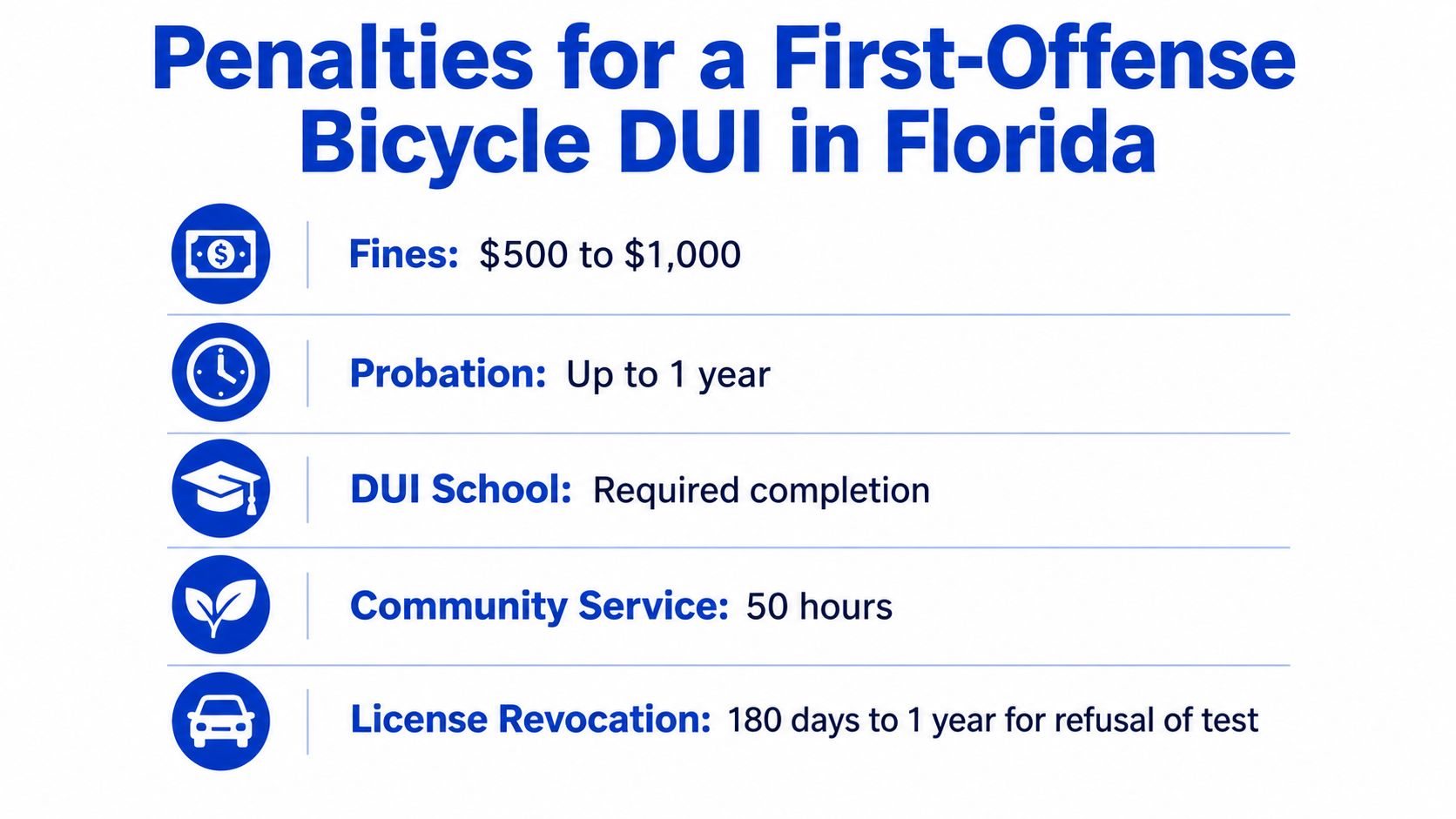
That definition matters because it drives the hidden fallout. A bicycle arrest can still put your driver's license at risk, create a criminal record, and open the door to backup charges if the facts do not support a clean DUI theory. For a clear look at what Florida DUI penalties can look like in practice, see Florida DUI penalties explained. In Florida, the bike does not protect you from DUI law. It only changes the facts the State has to prove, and that is where the defense should attack the case.
Penalties and Collateral Consequences of a Bike DUI
A bicycle DUI can look minor on the street and still leave a real legal mess. Florida does not treat the fact that you were on two wheels as a free pass once the State decides the DUI statute applies. You are still looking at criminal exposure, court supervision, mandatory programs, and a record that can follow you long after the stop.
What the criminal case can do
If prosecutors file the case as a DUI, the charge can carry misdemeanor penalties, and Florida DUI practice commonly includes fines, probation, DUI school, community service, and possible jail. The State may also push backup charges if the facts do not support a clean DUI theory, which means the arrest can snowball into more than one problem at once.
A bike arrest can still become a permanent criminal record if you treat it casually.
That record reaches beyond the courtroom. Employers see it. Landlords see it. Licensing boards can see it too. If you already have a record, a bicycle DUI can make the next case harder to defend and can give the State more room to argue a pattern of alcohol-related conduct.
Why the driver's license can still be at risk
This is the part people miss. Florida can still put your driver's license at risk even when the stop happened on a bicycle, because the DUI can still end up on your driving history. That collateral hit is often worse than the immediate court punishment, especially for anyone who needs a license to work, take care of family, or keep daily life moving.
For a plain-English breakdown of Florida DUI penalties and court consequences, read the firm's Florida DUI penalties guide. If the stop involved refusal issues or testing disputes, the fallout can get worse fast, especially when the State argues the refusal itself or tries to use it as an aggravating fact.
The bottom line is simple. A bike DUI can follow you like a car DUI. Treating it as a harmless bicycle ticket is how people get blindsided by a criminal record, license trouble, and extra charges they never expected.
Evidence Police Collect During a Bicycle DUI Stop
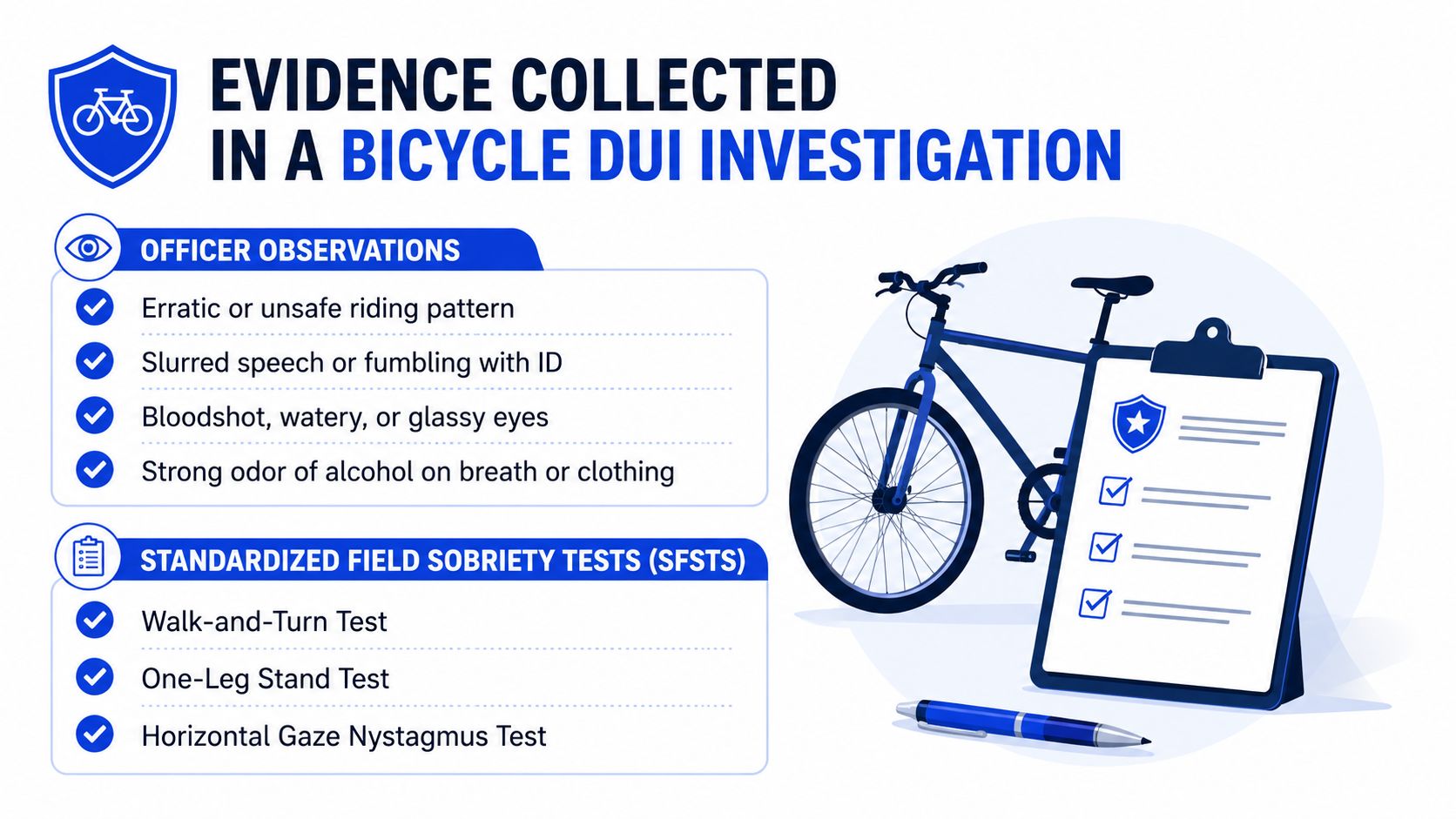
Police usually build bicycle DUI cases from observations first, then testing, then paperwork. The officer may describe erratic riding, slurred speech, bloodshot eyes, fumbling with ID, or the smell of alcohol. Those observations often carry the early weight of the case because they create the story the prosecutor will later try to repeat in court.
The roadside test problem
Field sobriety tests are especially shaky in a bicycle case. A rider may be winded, unsteady, tired, or wearing cycling shoes that make balance work worse. The tests still get used, though, including the walk-and-turn, one-leg stand, and horizontal gaze nystagmus tests, which is why defense lawyers look hard at how and when they were given. Florida field sobriety test issues
If the officer saw you on a bike, the State may try to turn that into proof of impairment. But those same observations can be explained by the ride itself, road conditions, lighting, fatigue, or the simple fact that a cyclist has just been balancing on a narrow frame.
Chemical tests and missing proof
Breath or blood testing can strengthen the prosecution's case if the procedure is clean. Refusal can create its own complications under implied-consent rules, and that's why the roadside decision matters. What's often missing in bicycle cases is the kind of objective driving footage car stops sometimes have, so the defense can attack what the officer says happened versus what can be proven.
Defense insight: the State usually has less video, less roadway context, and more room for assumptions in a bicycle stop than in a traffic stop involving a car.
A strong defense attorney uses those gaps aggressively. That means reviewing every report, bodycam clip, test result, and timing issue to see whether the State can prove impairment beyond a story told after the fact.
Strong Defense Strategies for Bicycle DUI Charges
A bicycle DUI case is not won by arguing that riding drunk sounds less serious. It's won by showing the State can't prove the case cleanly. The first pressure point is the stop itself. If the officer lacked a solid reason to detain you, the whole case becomes vulnerable.
Where these cases break down
The second pressure point is the field sobriety testing. A cyclist may look unsteady for reasons that have nothing to do with alcohol, and the officer's interpretation of balance, speech, or movement can be overstated. Breath testing can also be attacked when the machine calibration, observation period, or administration steps are sloppy.
Medical conditions, diet, exhaustion, and environmental factors can also mimic impairment or distort test results. That matters because prosecutors often lean hard on visual cues when they don't have a strong objective record.
Here's the part clients need to hear plainly. If the State cannot prove you were operating the bicycle while impaired, the case weakens fast. That issue comes up more often than people think, especially when the officer arrived after the alleged riding had already stopped.
How defense strategy should be built
Challenge the stop: If the officer didn't have a valid basis to initiate contact, suppressing the evidence may be possible.
Attack the testing: Field tests and breath procedures can be flawed, rushed, or badly documented.
Question operation: The prosecutor still has to prove the bike was being operated, not just nearby or present.
Use the facts against the narrative: Fatigue, balance, and footwear can all explain what the officer labeled as impairment.
If you want a fuller view of how DUI defenses are built in Florida, review how to fight a DUI. For a client, the right move is not pleading guilty early because the stop involved a bike. The right move is forcing the State to prove every element.
Ticket Shield, PLLC handles Florida DUI defense, including cases where the arrest happened on a bicycle and the State still wants to treat it like a full DUI. From a former prosecutor's perspective, that matters because weak stops, shaky testing, and thin proof stand out fast.
What to Do If You Are Stopped on a Bicycle
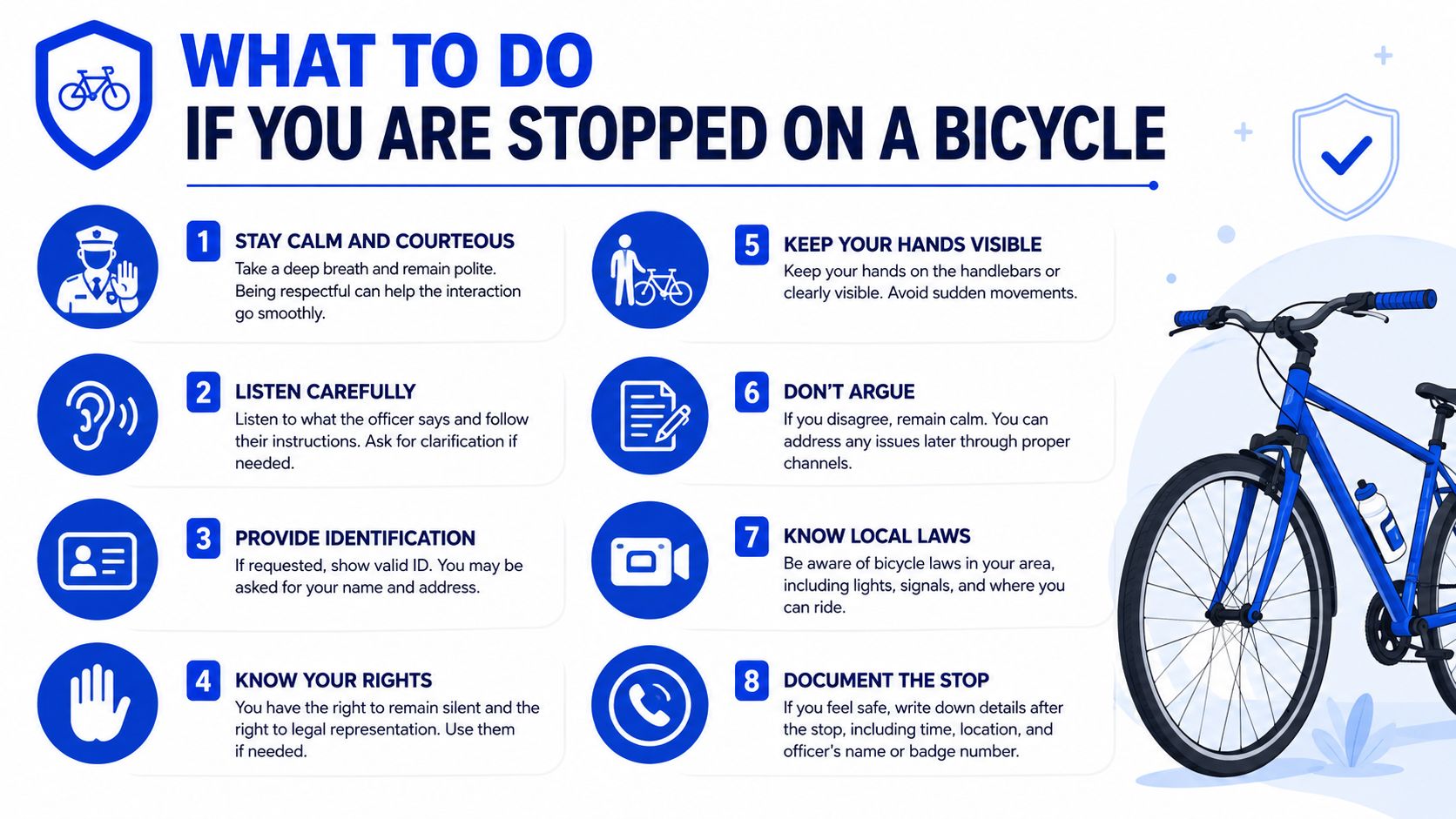
Stay calm and keep your answers short. You do not need to argue, explain, or volunteer that you had “just a few drinks.” Say as little as possible, because every extra sentence can become part of the arrest report.
Do the roadside basics, then stop talking
Ask for the officer's name and badge number if you can do that safely. If the officer wants field sobriety tests, understand that these tests are often used to build the case against you. If the officer requests a breath or blood test, the legal consequences can differ from declining roadside exercises, so the choice needs to be made carefully in context. Florida breathalyzer refusal issues
Practical rule: be polite, don't resist, and don't try to educate the officer about what you think the law should be.
If you're arrested, document everything you remember as soon as you can. Where you were riding, what the officer said, whether the bike was moving, and whether anyone saw the stop can all matter later.
After the arrest, move fast
Contact a Broward County DUI attorney right away, especially if your Florida driver's license might be affected. The clock matters in these cases, and early legal action is usually better than waiting for the first court date. A lawyer can also help preserve evidence that disappears quickly, including video and witness names.
If you live in South Florida, the sooner you get counsel involved, the better the chance of narrowing the damage. Bicycle DUI cases are still criminal cases, and the State is not going to slow down just because the arrest happened on a bike.
Frequently Asked Questions About Bicycle DUI in Florida
If you get a bicycle DUI in Florida, it can count as a prior offense if you're later arrested for a car DUI, because it's still a DUI record. That's one reason to fight the case early instead of assuming the bike context will protect you.
Passengers on a bicycle are usually not the primary target of DUI enforcement, because the law focuses on the person operating the bike. Electric bicycles and scooters can raise their own classification issues, so the first question is always how the vehicle is defined under Florida law. If you're unsure, don't guess, get the arrest reviewed.
A bicycle DUI can sometimes be harder to manage than people expect because it can leave a criminal record, and record relief depends on the exact charge and outcome. Some cases may be eligible for sealing or expungement, but you need a case-specific review before you count on that. A South Florida criminal defense lawyer can tell you whether the arrest, charge, or disposition blocks relief or leaves a path forward.
If you were stopped on a bike in Broward County, Fort Lauderdale, Miami-Dade, Palm Beach, or anywhere in South Florida, get legal help before the case defines your record. Ticket Shield, PLLC defends Florida DUI cases with a focus on license protection, criminal record risks, and challenging weak police evidence. Visit Ticket Shield, PLLC to request a confidential consultation and get your case reviewed quickly.