Broward Criminal Defense Attorney: A Complete 2026 Guide
Jason Goldsmith, Esq
If you're reading this after an arrest, a bond call, or a late-night phone call from jail, your head is probably spinning. You may not know what the charge means, whether you should talk, whether you can get out, or what happens to your license, job, immigration status, or record. That confusion is normal. What matters now is making smart decisions fast.
A criminal case in South Florida moves quickly, especially in Fort Lauderdale and Broward County. The right lawyer doesn't just stand next to you in court. A good Broward criminal defense attorney protects your rights early, challenges weak evidence, and stops you from making the kind of mistake that follows you long after the case ends.
Table of Contents
Facing a Criminal Charge in Broward County
An arrest in Broward County can feel like your life just split in two. Before the arrest, you had a routine. After it, everything is uncertainty. Court dates. Bond conditions. Missed work. Family pressure. Fear about what a conviction could do to your future.
That fear is justified. Broward County processes approximately 140,000 criminal cases annually, which makes it one of the largest criminal justice jurisdictions in the country, according to the Broward State Attorney's prosecutorial performance dashboard. In a system that busy, nobody is going to slow down and explain things for your comfort. You need counsel who already knows how to move inside that system.
Why Broward cases move fast
High volume changes everything. Prosecutors rely on police reports, charging documents, lab paperwork, videos, and tight court calendars. Judges expect lawyers to be ready. If your lawyer waits passively for the State to define the case, you're already behind.
That's why early strategy matters in Fort Lauderdale, Miami-Dade, Palm Beach, and the rest of South Florida. A defense lawyer has to look for flaws immediately. Was there probable cause? Was the stop lawful? Was evidence mishandled? Was a statement obtained in violation of your rights?
Practical rule: Your case doesn't become stronger by waiting. It becomes stronger when someone starts testing the State's assumptions right away.
If you've already been released, learn the difference between bond and supervision terms before you accidentally violate them. This guide on what pretrial release means in Florida is a useful starting point.
What your lawyer is supposed to do
A real criminal defense strategy is not just “fight the case.” That phrase means nothing by itself. Your lawyer should do specific work:
Protect your constitutional rights: Challenge illegal stops, searches, interrogations, and identifications.
Pressure-test the evidence: Compare reports to bodycam, witness statements, dispatch records, and physical evidence.
Control the narrative: Present mitigation where it helps and push back where the State is overstating facts.
Aim for the right result: That may mean dismissal, a reduction, diversion, suppression of evidence, or trial preparation.
A Broward criminal defense attorney should also keep you grounded. Not every scary charge ends in jail. Not every arrest ends in conviction. But no good outcome happens by accident. If you or your loved one has been charged in Broward County, get legal guidance now, while there's still room to shape the case.
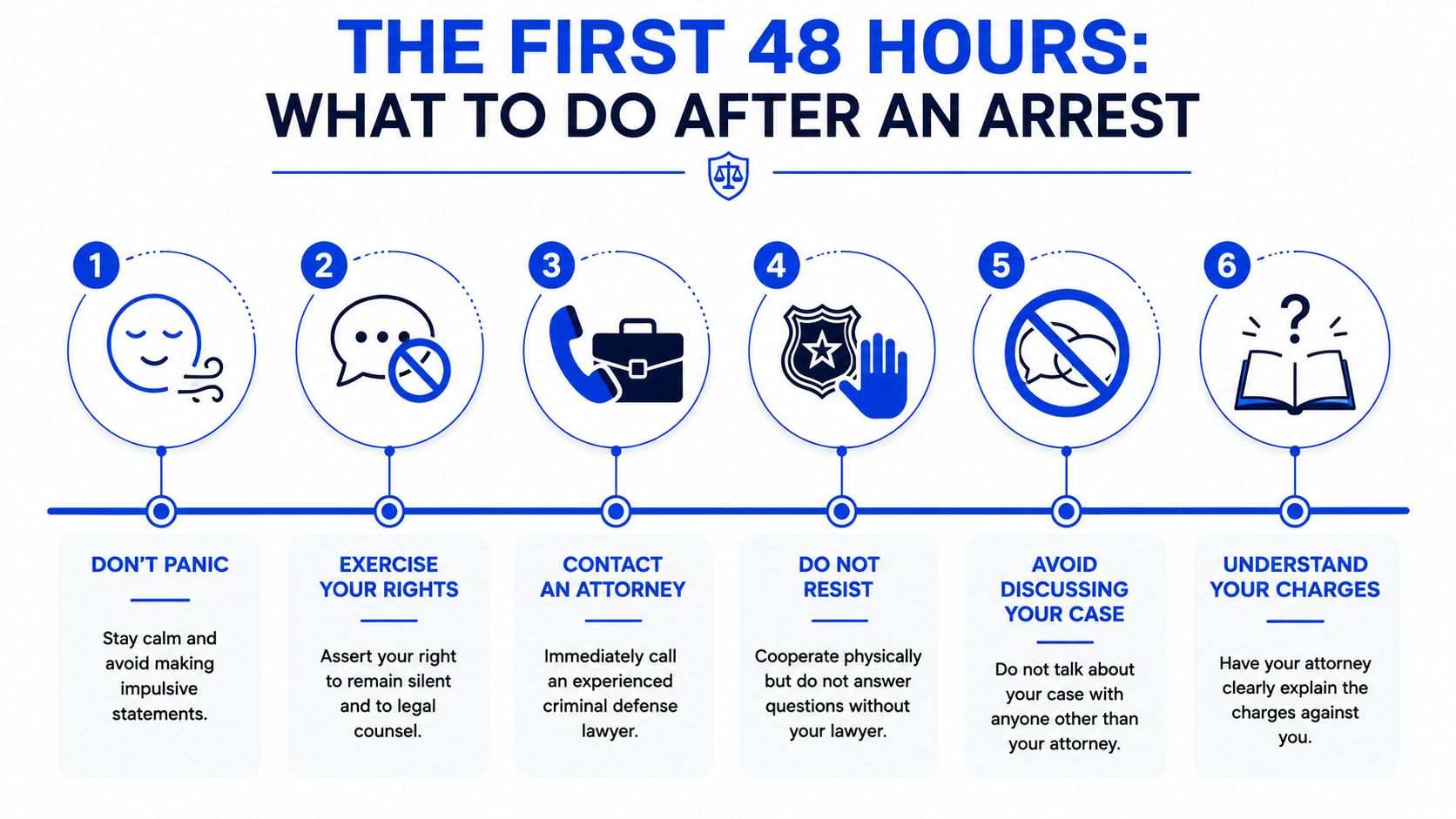
The First 48 Hours What to Do After an Arrest
The first two days after an arrest are often the most important part of the case. People hurt themselves here by talking too much, texting too much, apologizing to the wrong person, or trying to “clear things up” with law enforcement. Don't do that.
In Broward County's 17th Judicial Circuit, early intervention matters because approximately 68% of drug and weapons cases in Florida contain procedural errors that can lead to dismissal or charge reduction when addressed promptly, as explained in this Fort Lauderdale criminal defense discussion of early felony defense strategy. That is why the first 48 hours are not just stressful. They are strategic.
What to do immediately
Follow this sequence.
Stay calm
Don't argue on the roadside, in the station, or in holding. Anger creates new facts. New facts become new charges.
Use your right to remain silent
Give identifying information if required, then stop talking about the incident. If police keep asking questions, repeat that you want a lawyer.
Ask for counsel clearly
Be direct. “I want a lawyer.” Nothing vague. Nothing conversational.
Don't consent to searches
You don't need to fight physically. You do need to avoid helping the State. Say you do not consent.
Don't discuss the case with anyone but your lawyer
Not cellmates. Not family on the recorded line. Not friends by text. Not social media.
Get legal advice before first appearance if possible
Fast legal intervention can affect bond, conditions of release, and the defense path from day one.
If officers ignored your rights or kept questioning you after you invoked them, that issue can matter later. Read more about a Miranda rights violation in Florida cases.
What happens next in court
After booking, the court typically addresses release conditions and the formal progression of the case. You may hear terms like first appearance, arraignment, pretrial, and discovery. They sound technical, but the basics are simple.
Here's the short version:
Stage | What it usually means |
|---|---|
Booking | Processing, fingerprints, photo, and entry into the system |
First appearance | A judge reviews release conditions and related issues |
Arraignment | The charge is formally addressed and a plea is entered |
Pretrial phase | Evidence exchange, motions, negotiations, and investigation |
Your job is not to master procedure overnight. Your job is to avoid making admissions and get the right lawyer involved before the State hardens its version of events.
Common Criminal Charges We Defend in South Florida
A charge in Broward is never just a label on a booking sheet. The crucial inquiry focuses on what the State can prove, what evidence it plans to use, and where that case starts to break under pressure. That is where a former prosecutor's perspective matters. Ticket Shield, PLLC looks at these cases the way the State builds them first, then attacks the weak points that prosecutors often hope the defense will miss.
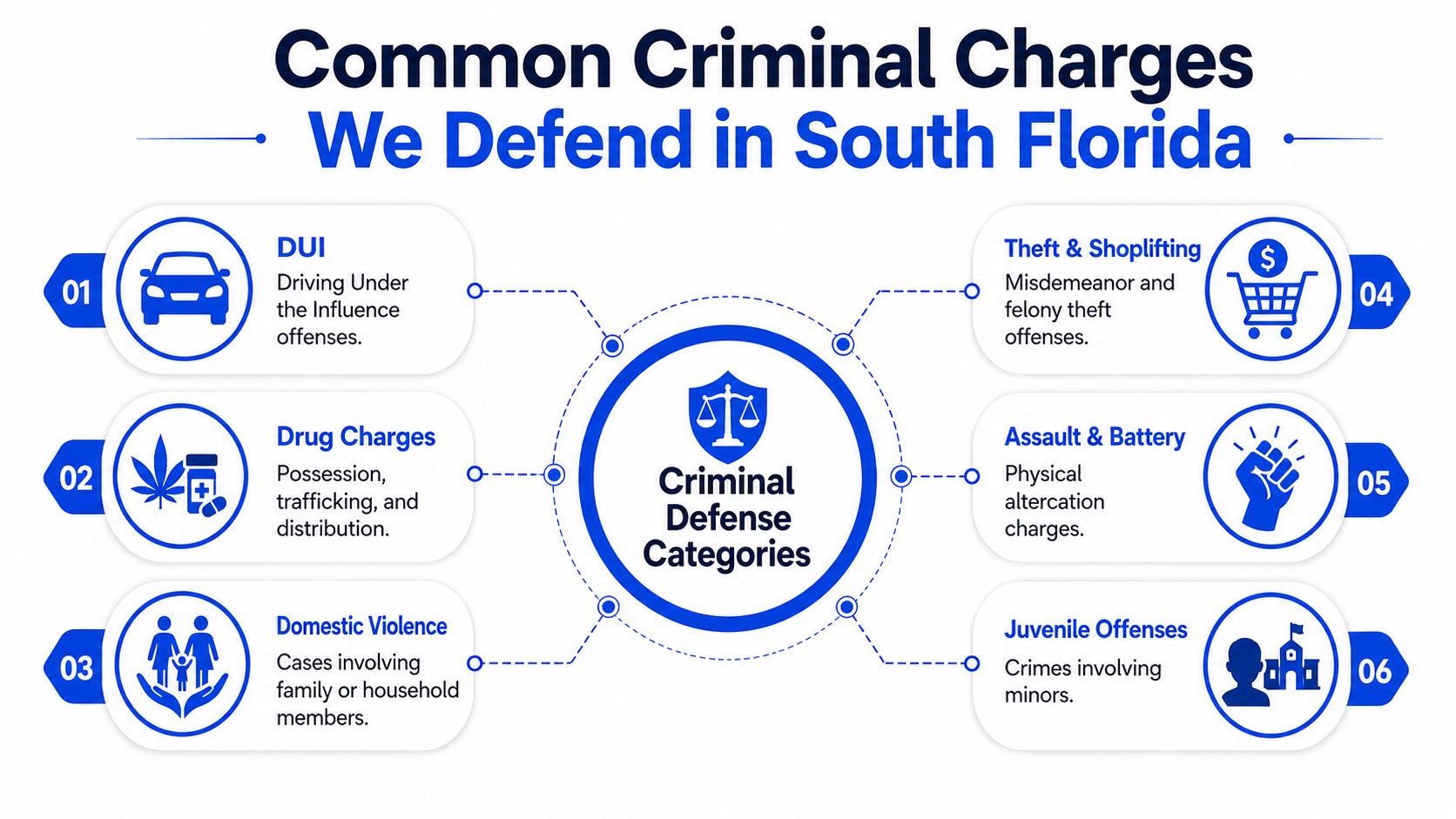
DUI and traffic-related criminal charges
DUI cases often look stronger on paper than they are in court. An arrest report may read clean and confident, but prosecutors still have to prove the stop was lawful, the officer's observations were reliable, and the testing process holds up.
For a first-time Florida DUI with an alleged BAC below 0.15 and no minor in the vehicle, the law can carry fines, jail exposure, and a driver's license revocation, as outlined in this Broward DUI defense overview. Penalties increase if the alleged BAC is 0.15 or higher or a minor was present.
A good defense does not revolve around explaining away a few drinks. It starts with the stop, the body camera, the timing of the investigation, the field exercises, the breath machine records, and the officer's exact wording. A former prosecutor knows which weaknesses tend to make the State rethink a DUI case early.
Drug crimes and search issues
Drug cases are often search cases first. Police may claim consent, plain view, odor, probable cause, or a lawful vehicle search. Sometimes those claims survive review. Sometimes they collapse once the video, reports, and timeline are compared side by side.
The pressure points usually include:
Possession: The State must connect the drugs to you, not just to a car, room, backpack, or house.
Search legality: A bad stop or unlawful search can put key evidence at risk.
Testing and chain of custody: Lab problems and handling gaps matter.
Charging decisions: Weight, packaging, text messages, and statements often drive whether the case is filed as simple possession or something far more serious.
If you are facing possession, trafficking, or another controlled-substance allegation, review this Florida drug crimes defense hub for issues that commonly shape Broward County cases.
Violent crimes and domestic violence allegations
Violent crime accusations change your life fast. Bond conditions, no-contact orders, firearm restrictions, and job consequences can start before your lawyer gets full discovery.
Domestic violence charges are especially misunderstood. The complaining witness does not control whether the case goes away. The prosecutor does. That means the defense has to focus on proof, not hope.
The first report is the State's opening version of events, not the final word.
A former prosecutor reads these files with a different eye. He knows where the State tends to overrely on one statement, one photograph, or one emotional allegation. Strong defense work often turns on inconsistent accounts, motive to exaggerate, self-defense, lack of visible injury, delayed reporting, and whether the evidence matches the accusation.
Theft crimes and white collar allegations
Theft and fraud cases usually come down to intent, identity, and records. Prosecutors may assume missing property, suspicious access, or a paper trail is enough. It often is not.
Key questions include:
Intent: Was this a mistake, a misunderstanding, a business dispute, or an actual theft?
Identity: Can the State prove you were the person who took, used, or moved the property?
Access: Shared access at work, home, or online weakens simple accusations.
Documentation: Video, receipts, bank records, inventory logs, and device data usually decide these cases.
Restitution pressure: Payment demands are often used to push fast pleas.
Don't just focus on the charge label for theft crime penalties in Florida. Focus on whether the State can prove intent and identity with evidence that holds up under scrutiny.
Gun charges juvenile cases and probation violations
Weapons charges often turn on possession, knowledge, location, and the legality of the search. In many cases, the central fight is whether the firearm was yours or merely near you. Prosecutors know juries react strongly to gun allegations. A disciplined defense keeps the case tied to proof, not fear.
Juvenile charges also demand immediate attention. Early decisions can affect school discipline, diversion options, record consequences, and whether the case stays in juvenile court or moves into a harsher setting.
Probation violation cases deserve the same level of scrutiny. Many alleged violations involve missed appointments, disputed testing results, reporting issues, unpaid obligations, or paperwork problems rather than a new arrest. Those cases are often more defensible than people realize. A former prosecutor knows exactly what documentation the State usually relies on, where supervision records fall apart, and how weak proof can be exposed before a judge accepts the violation as settled fact.
Defense Strategies from a Former Prosecutor
A former prosecutor doesn't guess how the State thinks. He's seen how charging decisions get made, what prosecutors trust too quickly, and which weaknesses they hope the defense won't press.
That perspective matters because criminal cases are built from habits. Police write reports in a familiar pattern. Prosecutors organize files in a familiar pattern. They expect certain defenses and sometimes underprepare for the ones that threaten the case.
How the State builds a case
Most prosecutions begin with a simple assumption. If the officer wrote it, the court will accept it unless the defense creates friction. That friction comes from facts, documents, timing, and legal challenges.
A prosecutor usually asks questions like these:
Can I prove identity?
Can I get the statement in?
Is the search likely to survive challenge?
Will the witness appear and stay consistent?
Is this a plea case or a trial risk?
If your lawyer understands that internal checklist, the defense becomes sharper. Instead of reacting to the accusation, your lawyer starts pulling apart the pieces the State depends on.
How an insider dismantles it
The most effective defense work is usually precise, not theatrical.
A former prosecutor often focuses on:
Suppression issues: If police stopped, searched, or questioned you unlawfully, key evidence may be vulnerable. This overview of motions to suppress evidence in Florida explains why that tool can reshape a case.
Report contradictions: Bodycam, dispatch timing, civilian video, and supplemental reports often don't line up cleanly.
Witness pressure points: A frightened witness, angry ex-partner, confidential informant, or biased observer may not present well under scrutiny.
Negotiation advantage: Prosecutors negotiate differently when they know defense counsel understands charging habits, proof problems, and courtroom risk.
Trial readiness: Real negotiations improve when the State believes the defense is prepared to litigate.
A prosecutor's file often looks stronger from a distance than it does under a microscope.
That's where a former prosecutor's value is practical, not cosmetic. He knows where overcharging happens. He knows when the State is bluffing confidence. He knows which facts matter to a current prosecutor because he used to evaluate cases from that side himself.
In Florida criminal defense, that can matter in DUI, drug crimes, domestic violence, gun charges, probation violations, injunction-related allegations, juvenile offenses, white collar matters, and even federal cases. Ticket Shield, PLLC is one Florida criminal defense option built around that former-prosecutor perspective and direct attorney communication for clients dealing with misdemeanor and felony cases.
How to Choose the Right Attorney for Your Broward Case
Hiring a lawyer while you're scared is difficult because every website sounds confident. Confidence is cheap. What matters is whether the attorney can explain your case clearly, spot the pressure points, and stay accessible while the case moves.
The wrong hire creates two problems. You still have the criminal charge, and now you also have poor communication.

Questions you should ask before hiring anyone
Use your consultation well. Ask direct questions and listen for direct answers.
Have you handled this kind of charge in Broward County before
A DUI, VOP, domestic violence case, theft charge, juvenile matter, or federal case each requires a different defense approach.
Who will handle my case
Some firms sell the consultation and hand the file off. You need clarity on who appears in court and who answers your questions.
How do you evaluate defenses early
Listen for specifics such as suppression issues, witness review, bodycam analysis, or evidentiary weaknesses.
How will we communicate
If you can't get calls returned at the start, it won't improve once the case gets busy.
Are you preparing for negotiation, litigation, or both
Good defense lawyers do both. Plea bargaining power often comes from trial readiness.
A useful attorney should leave you calmer and better informed after the first conversation, not more confused.
Public defender or private counsel
The Broward County Public Defender's Office operates 24/7 to represent indigent individuals, according to the Broward County Public Defender's Office. Many public defenders are experienced and work hard under difficult conditions.
Private counsel, though, can offer a different structure. That often means more direct attorney access, a more customized strategy, and a lower client-to-attorney ratio. For some clients, that difference matters most in cases involving complex evidence, professional licensing concerns, immigration concerns, injunction overlap, or a need for frequent case updates.
Here's a simple comparison:
Consideration | Public defender | Private counsel |
|---|---|---|
Eligibility | Based on indigency | Retained by client |
Attorney access | Often more limited by caseload | Often more direct |
Case strategy | Can be strong but time-constrained | Often more individualized |
Availability for updates | Depends heavily on volume | Often more flexible |
Hire the lawyer who answers hard questions clearly. Not the one who gives the most dramatic speech.
If you're deciding between attorneys in Fort Lauderdale, Broward County, Miami-Dade, or Palm Beach, focus on access, clarity, and real criminal defense experience. Rankings and slogans won't help you in court.
Frequently Asked Questions About Criminal Defense
How much does a criminal defense attorney cost
Fees depend on what the State is alleging and how much work it will take to challenge it. A simple misdemeanor with limited evidence costs less than a felony case involving video, forensic testing, multiple witnesses, suppression issues, or trial preparation.
Ask direct questions before you hire anyone. Is the fee flat or hourly. What court appearances are included. Who will appear with you. What happens if the case requires motions, investigators, experts, or trial. A lawyer who cannot explain the fee structure clearly will not make the rest of the process easier.
Price matters. Results and judgment matter more. A former prosecutor knows which cases are likely to expand because the charging decision, police reports, and early evidence often reveal where the State will push hard and where its case is weaker than it looks.
Do I need a lawyer for a misdemeanor
Yes.
A misdemeanor can still damage your record, your job, your professional license, your immigration situation, and your standing in family court. It can also affect future sealing or expungement options. Many people make the mistake of treating a misdemeanor like a ticket. It is not.
The bigger risk is pleading too fast just to get the case over with. Prosecutors evaluate prior history, facts that are not obvious from the charging document, and how a resolution today may affect later cases. A defense lawyer with prosecutorial experience sees those pressure points early and can often spot problems in the State's proof before you give up options you cannot get back.
What if I live out of state
That happens often in Broward County. Visitors are arrested in Fort Lauderdale, stopped on the way to the airport, or charged after a vacation or work trip.
You still need to deal with the case immediately. Florida will not ignore it because you went home. If you miss a required court date, the problem usually gets worse.
In many cases, a Florida criminal defense attorney can appear for you at routine hearings and reduce unnecessary travel, depending on the charge and the judge's rules. Ask that question early. A lawyer who regularly handles Broward cases should be able to tell you what can be done locally, what requires your presence, and how to avoid turning one bad incident into a warrant.
Is a consultation confidential
Usually, yes. You are seeking legal advice, and confidentiality is a basic part of that relationship.
Still, protect yourself. Speak in private. Tell the truth. Bring the notice to appear, bond paperwork, arrest report, court date information, and any screenshots or videos you have. Do not edit the story to make yourself look better. Your lawyer needs the bad facts now, not after the prosecutor raises them in court.
What should I ask during the first call
Ask how the lawyer sees the case, not just what the charge is called. You want to hear how the evidence will be attacked, whether any statements should be challenged, whether witnesses need to be interviewed, and what immediate mistakes to avoid.
Ask who will handle your case day to day. Ask how often you will get updates. Ask what the next court date means. Ask whether there are hidden issues involving immigration, probation, a driver's license, a professional license, or an injunction.
A former prosecutor's perspective is invaluable here because it focuses on how the State builds a case and where that process often breaks down.
The sooner you get accurate legal advice, the more options you usually have.
If you're facing DUI charges, drug accusations, domestic violence allegations, gun charges, theft offenses, juvenile issues, white collar allegations, federal charges, traffic crimes, injunction matters, or a probation violation in Broward County or anywhere in South Florida, get answers before you make another move.
If you need clear guidance right now, contact Ticket Shield, PLLC for a confidential consultation. You'll speak with a Florida criminal defense firm that handles Broward County cases, explains the process in plain English, and builds strategy around protecting your rights, your record, and your future.
The right Broward defense attorney can change your case's outcome. This guide covers what to look for and how local courts work.