
Careless Driving Florida: Penalties & Defense Strategies
Jason Goldsmith, Esq
A minor fender-bender in Fort Lauderdale can turn into an unexpected legal problem. You exchange information, arrange repairs, and assume the matter is over. Then a careless driving citation arrives, or an officer issues one at the scene, and you're left wondering whether paying the ticket is easier than fighting it.
That decision deserves more care than most drivers realize. In Florida, careless driving is generally handled as a noncriminal moving violation, but it can add points to your license, affect insurance, and compound existing driving problems. The right response depends on the evidence, your record, the circumstances of the incident, and whether your license is important to your job or family responsibilities.
Table of Contents
What to Do Immediately After Receiving a Careless Driving Citation
How a Former Prosecutor Builds Your Careless Driving Defense
Why a Careless Driving Ticket Is More Serious Than It Looks
A careless driving ticket is often seen as a routine fine. A driver with a clean record may assume the citation will disappear after payment. A driver who already has citations may not realize that one additional moving violation can bring the license closer to a suspension threshold.
Florida's careless driving offense carries 3 license points, as reflected in the state's official driver-license information and point system materials. The statute also treats the offense as a moving violation, not merely an informal warning. You can review the underlying rule in Florida Statute 316.1925.
The practical risk is cumulative. A person who relies on a vehicle to reach a job in Broward County, transport children, or travel between Fort Lauderdale and Miami-Dade may face consequences that extend beyond the ticket itself. Insurance companies may treat the conviction as a negative driving event, and existing points can make the overall effect more serious.
Practical rule: Don't evaluate a careless driving citation by the fine alone. Evaluate what the citation does to your license, insurance, and driving record.
Paying the ticket can also limit your options. In ordinary traffic practice, payment generally functions as accepting the citation and can result in the associated conviction and points. That may be a poor choice for someone with prior violations, a commercial driver's license, a job that requires driving, or a crash-related citation involving injuries.
A citation isn't the same as a criminal charge, but “noncriminal” doesn't mean “consequence-free.” The State still must rely on an officer's observations and prove that the driving fell below Florida's statutory standard. Those issues can create meaningful defense opportunities.
What Florida Law Actually Says About Careless Driving
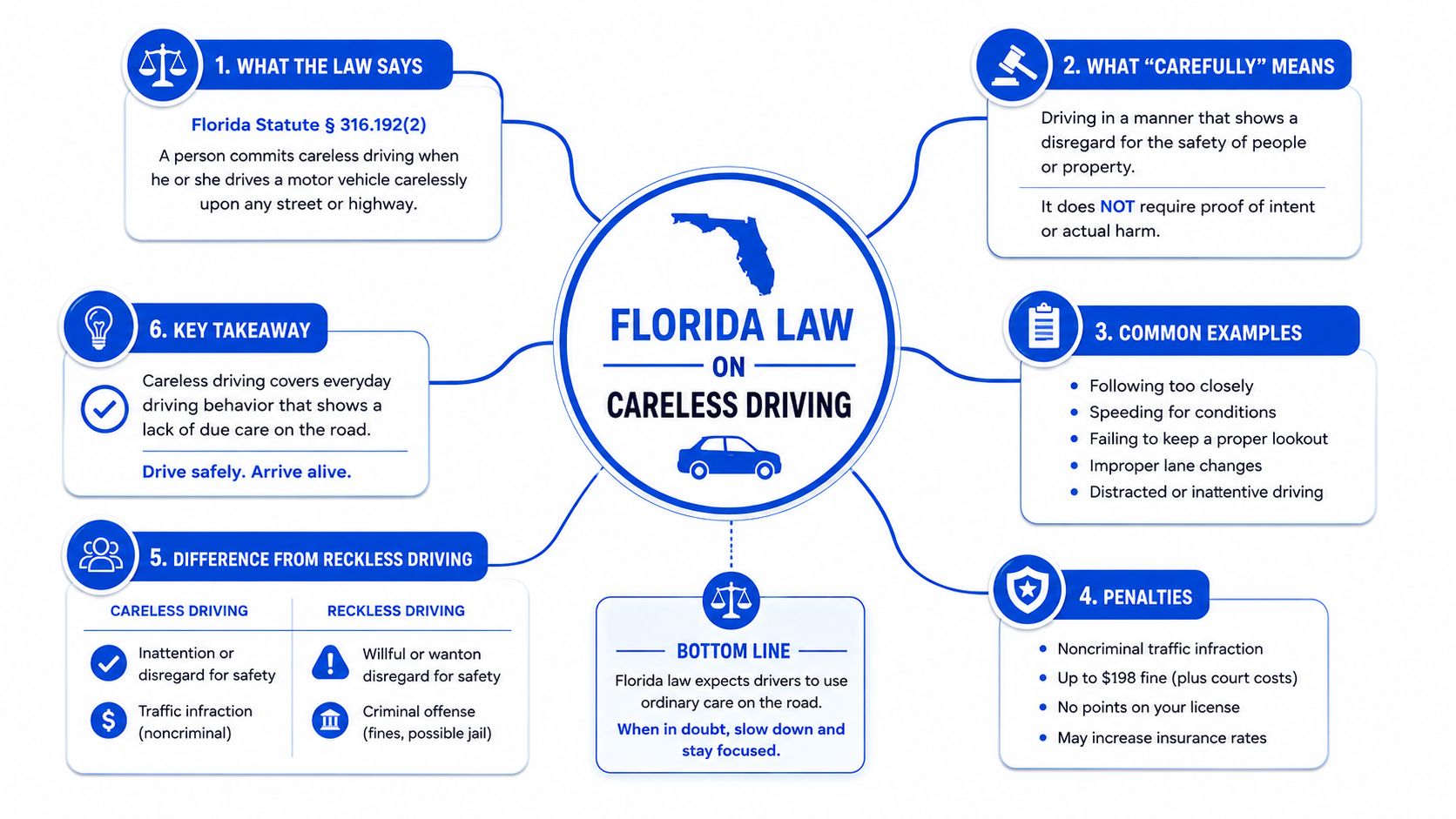
Florida Statute 316.1925 requires a driver to operate a vehicle in a careful and prudent manner, considering circumstances such as the road's width, grade, curves, corners, traffic, and other relevant conditions. The law prohibits driving in a careless or negligent manner that endangers life, limb, or property. The statute classifies a violation as a moving violation punishable under Chapter 318, rather than creating a criminal misdemeanor within the careless-driving provision itself. The Florida Senate's statutory text provides the language that governs this analysis.
The State's proof is fact-specific
The prosecutor generally needs to show more than the existence of a collision. A crash can support a citation, but the central question is whether the driver's operation was careless or negligent under the conditions at the time.
That requires attention to details such as:
Officer observation: Where was the officer positioned, and how long did the officer observe the vehicle?
Driving conduct: What specifically did the officer see, such as an unsafe lane movement, failure to yield, following too closely, or loss of control?
Road conditions: Did traffic, visibility, construction, weather, road design, or an unexpected obstruction affect the event?
Endangerment: Does the evidence show a danger to life, limb, or property, or only that an unfortunate accident occurred?
The phrase “careful and prudent” gives law enforcement a workable safety standard, but it also requires judgment. A brief observation from an unfavorable angle may not establish what happened. A report that describes the conclusion without identifying the underlying conduct may leave important questions unanswered.
The same statutory framework applies in Broward County, Fort Lauderdale, Miami-Dade, Palm Beach, and other Florida jurisdictions. Local court procedures can differ, but the State still has to connect the alleged driving behavior to the statutory standard.
Careless Driving vs Reckless Driving in Florida
Careless and reckless driving are not interchangeable. A careless driving citation is generally a traffic infraction, while reckless driving is a criminal offense under Florida Statute 316.192. Reckless driving requires proof of a more serious level of conduct, involving willful or wanton disregard for the safety of people or property.
The distinction affects the record, court process, and potential exposure. A careless driving case usually centers on whether ordinary care was lacking. A reckless driving case raises a more serious allegation about the driver's state of mind and disregard for safety. For a broader discussion of the reckless-driving statute, see Florida reckless driving law and defense issues.
Careless Driving vs Reckless Driving Comparison
Factor | Careless Driving | Reckless Driving |
|---|---|---|
Legal character | Generally a noncriminal traffic infraction | Criminal traffic offense |
Core allegation | Driving in a careless or negligent manner that endangers life, limb, or property | Driving with willful or wanton disregard for safety |
Proof focus | Whether the operation fell below the careful-and-prudent standard | Whether the conduct reflected a substantially more serious disregard for safety |
Court consequences | License points, traffic penalties, and possible insurance effects | Criminal record exposure, possible incarceration, fines, and license consequences |
Defense approach | Challenge the officer's observations, circumstances, causation, and statutory proof | Challenge intent, degree of disregard, identification, evidence, and the alleged driving pattern |
A prosecutor may consider a reduction from reckless driving to careless driving when the evidence doesn't support the more serious allegation or when the case has weaknesses. That outcome depends on the facts and the prosecutor's discretion, not an automatic rule.
The opposite risk also matters. A careless driving citation can sometimes arise from conduct that the State believes is more serious, particularly when the evidence includes multiple unsafe actions. Anyone facing a traffic charge should read the exact citation and understand whether the allegation is careless driving, reckless driving, or another offense.
License Points, Fines, and Hidden Consequences
Florida assigns 3 points for careless driving. The state's official point-suspension chart explains the escalating thresholds: 12 points within 12 months can trigger a 30-day suspension, 18 points within 18 months can trigger a 3-month suspension, and 24 points within 36 months can trigger a 1-year suspension. These thresholds appear in FLHSMV's point-suspension information.
The calculation is personal. A driver with no recent points may have more room than someone who already has several citations. You should obtain an accurate driving record rather than relying on memory, especially if you've received tickets in different Florida counties.

The cost extends beyond the citation
A careless driving conviction may affect insurance underwriting and premiums. The exact result depends on the carrier, policy, driving history, and other underwriting factors, so no lawyer can responsibly promise a particular insurance outcome.
Commercial drivers should treat the matter as especially important. A moving violation can create employment and licensing concerns even when the citation isn't criminal. Drivers under 18 may also face practical consequences because a limited driving history leaves less room for additional violations.
School-zone enforcement illustrates how Florida traffic penalties can change based on location. Florida law provides a $50 fine for exceeding a legally posted school-zone speed limit by up to 5 mph, and it requires double the base fine for speeding in a school zone or designated school crossing. That separate rule is described in Florida's traffic fine statute. It isn't the careless driving statute, but it shows why the location and exact citation matter.
For related South Florida traffic enforcement issues, Florida super-speeder law information can provide additional context.
Common Defenses That Can Beat a Careless Driving Ticket
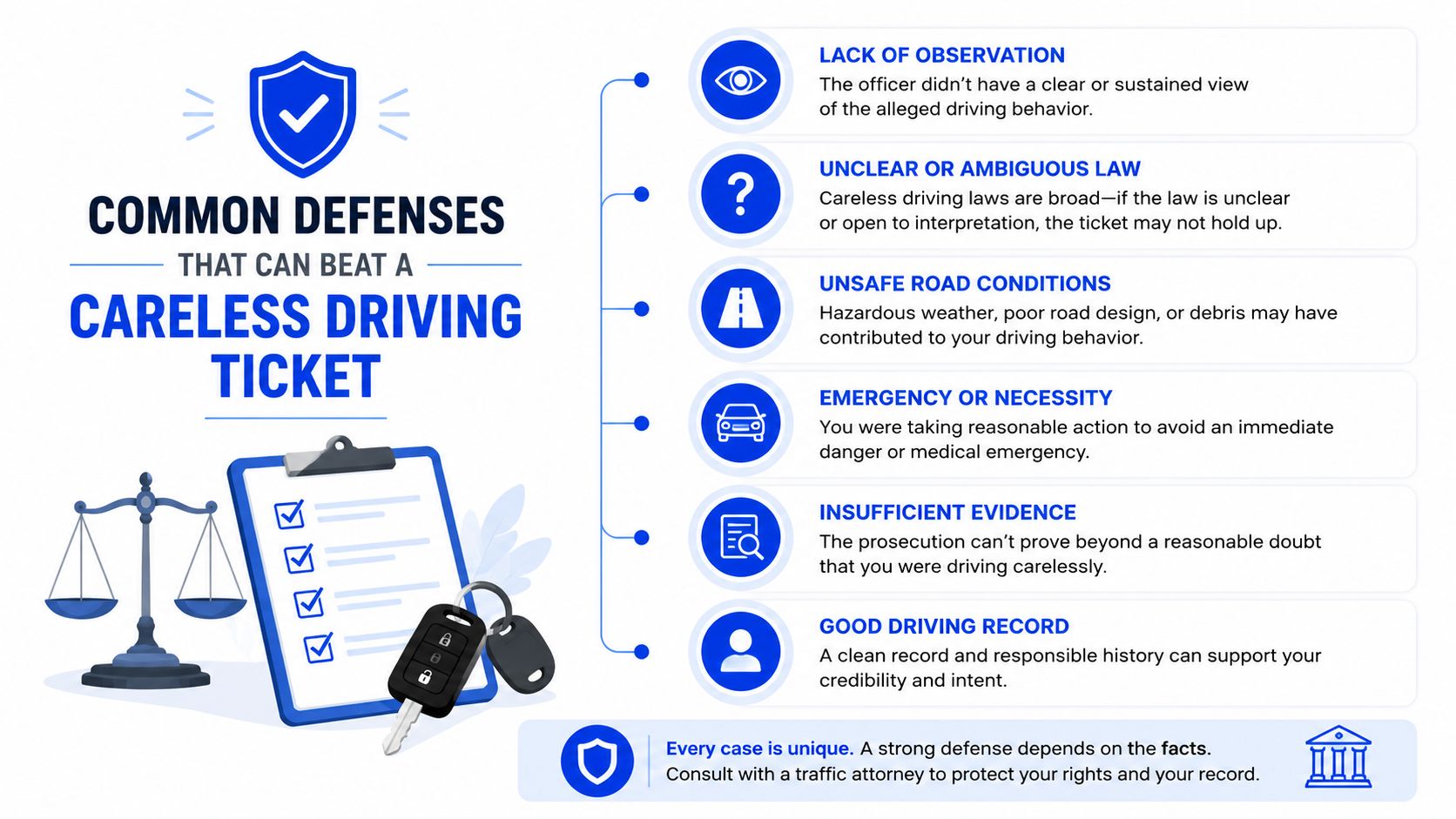
A careless driving citation often rests on a short officer observation, a crash scene, or a conclusion recorded after the event. That doesn't make the citation invalid, but it does mean the defense should examine how the officer reached the conclusion and whether the evidence supports it.
Attacking the observation
The officer's vantage point can matter. A driver's movement may look unsafe from one angle but reasonable when viewed alongside lane markings, traffic flow, a blocked roadway, or another vehicle's maneuver. Defense counsel can examine the officer's location, line of sight, distance, lighting, traffic, and whether the officer saw the entire sequence.
Body-camera footage, dash-camera recordings, photographs, passenger accounts, vehicle data, and witness statements may add context. The goal isn't to create an excuse. It's to test whether the State can prove the alleged conduct with reliable evidence.
Explaining the circumstances
Drivers sometimes react to sudden hazards, mechanical problems, emergency vehicles, debris, or another road user's unexpected action. A maneuver that appears careless in isolation may have been a reasonable response to an immediate danger.
The defense should also identify inconsistencies between the citation, crash report, officer's notes, photographs, and witness accounts. If the report says only that a collision occurred, it may not explain what specific driving behavior violated the statute.
Evidence matters more than labels. “Careless” is a conclusion. The defense should ask what the officer actually observed and whether those facts establish endangerment.
Crash-reporting issues
Florida law requires a driver involved in a crash causing injury, death, or apparent property damage of at least $500 to notify law enforcement immediately by the quickest available communication method. Failure to make the required report is a noncriminal traffic infraction punishable as a nonmoving violation, and knowingly repairing a vehicle without the required report can constitute a first-degree misdemeanor under Florida crash-reporting law.
That reporting rule doesn't automatically defeat a careless driving citation. It can, however, expose separate issues about what was reported, when it was reported, what investigators documented, and whether the State is relying on incomplete or inconsistent information. A motion involving improperly obtained evidence may also become relevant. Learn more about motions to suppress evidence in Florida cases.
What to Do Immediately After Receiving a Careless Driving Citation
Start by reading the citation carefully. Confirm the offense, court or clerk information, date, location, and any instructions for payment, election, or hearing. Deadlines matter, and missing one can create avoidable problems.
Take these steps before choosing an option
Preserve evidence: Save dash-camera footage, photographs, repair records, text messages, witness contact information, and insurance documents before files disappear.
Check your record: Determine whether prior points or unresolved citations make the new violation more consequential.
Avoid unnecessary statements: Don't send an argumentative explanation to the officer or prosecutor before receiving legal advice.
Review traffic-school eligibility: Traffic school may be available in some circumstances and can affect points, but it generally doesn't erase the underlying conviction. Confirm the current rules with the clerk or a lawyer.
Consider a hearing: Paying usually resolves the ticket in a way that can create a conviction and associated consequences. A contested hearing gives the defense an opportunity to challenge the State's proof.
Get advice promptly: A commercial driver, a driver under 18, a person with existing points, or anyone involved in an injury crash should obtain guidance before making an election.
Court procedures vary among Broward County, Fort Lauderdale, Miami-Dade, Palm Beach, and other Florida courts. The Florida traffic-ticket court appearance guide offers related procedural information, but the citation and local clerk instructions control the immediate deadlines.
Don't assume the first available option is the cheapest option. The right choice depends on the strength of the evidence, your driving history, your work requirements, and whether avoiding points is more important than resolving the matter quickly.
How a Former Prosecutor Builds Your Careless Driving Defense
A former prosecutor understands how the State usually evaluates a careless driving case. The review starts with the citation, officer notes, crash materials, photographs, witness information, and available video. Counsel looks for missing observations, inconsistent descriptions, weak proof of endangerment, and facts showing that the driver's response was reasonable under the circumstances.
The next decision may involve contesting the citation, negotiating a reduction, pursuing dismissal, or preparing for a hearing. Prosecutorial discretion can shape that process, as discussed in Florida prosecutorial discretion, but no result is guaranteed.
Ticket Shield, PLLC, led by former prosecutor Jason S. Goldsmith, handles traffic defense and court appearances in Broward County, Miami-Dade, Palm Beach, and surrounding South Florida jurisdictions. The firm offers confidential consultations to review the citation, driving record, and available defenses.
Ticket Shield, PLLC can review your careless driving citation, assess point and license risks, and identify whether challenging the officer's evidence or negotiating a resolution makes sense. Visit Ticket Shield, PLLC for a confidential consultation and practical guidance before you pay or elect an option that affects your record.