
Robbery by Sudden Snatching in Florida: Charges and Defenses
Jason Goldsmith, Esq
You got arrested or a detective called about a grab-and-run, and now the charge sounds more serious than the facts. That fear is normal, because robbery by sudden snatching is not treated like a minor theft in Florida, even when no one was hurt and no weapon was shown. The good news is that these cases often turn on narrow proof problems, and that's where a defense can do real work.
A lot of people hear the charge and assume the State already has a locked-up case. It usually doesn't. Prosecutors still have to prove each legal piece beyond a reasonable doubt, and in South Florida courts, sudden snatching cases often fall apart when the video is blurry, the witness is uncertain, or the facts look more like a simple theft than a felony robbery.
Table of Contents
Understanding Robbery by Sudden Snatching Charges
A man gets arrested outside a Fort Lauderdale shopping plaza after a fast-moving accusation. The police say he grabbed a phone from someone's hand, kept walking, and didn't stop until officers caught up with him. That kind of arrest feels overwhelming, but the charge itself has a very specific legal meaning, and that matters because it limits what the State can prove.
Florida treats robbery by sudden snatching as a distinct felony offense, separate from ordinary theft and separate from robbery that depends on force. Under Florida law, the key issue is whether property was taken from the victim's person and the victim was aware of the taking while it happened. That's why the charge shows up so often in purse-grab, phone-grab, and grab-and-run cases across Broward County, Miami-Dade, and Palm Beach.
The practical reality is blunt. An arrest is not a conviction, and the prosecutor still has to connect the dots with admissible evidence. If the facts are sloppy, if the witness is guessing, or if the item was not taken from the person, the case can weaken fast.
If you're looking for the legal framework behind a Florida robbery case, start with the basics in this Florida robbery defense resource. You need the charge broken down before you can judge whether it's strong or flimsy.
Practical rule: The State does not win these cases just because the police made an arrest. It wins only if the evidence proves each required element.
Elements the Prosecutor Must Prove
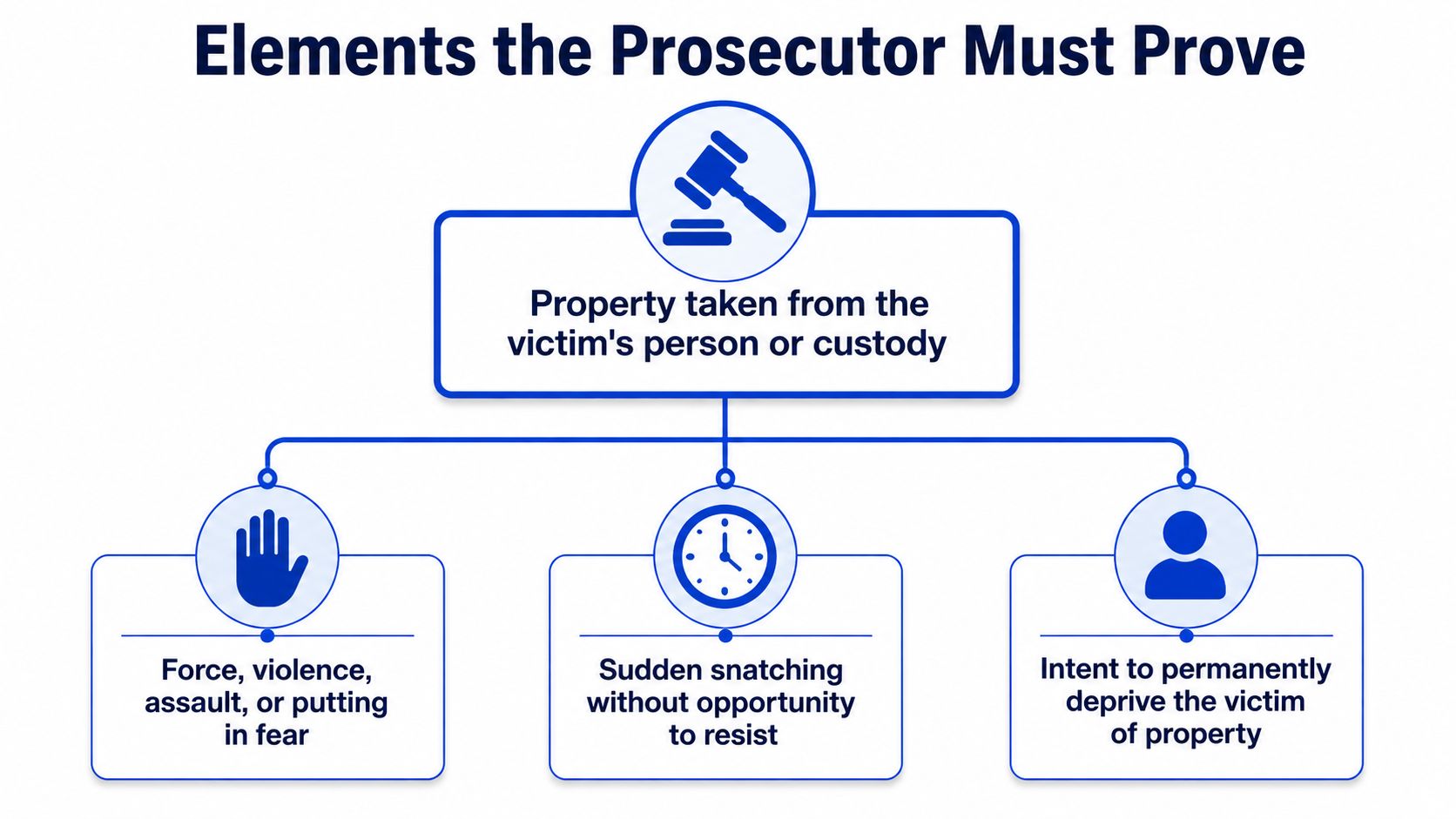
Florida's statute gives the charge its shape. The State has to prove that the defendant took money or other property from the victim's person, and that the victim was or became aware of the taking as it happened, because that is what separates sudden snatching from ordinary theft. The law also makes clear that the prosecutor does not need to prove force beyond what was necessary to get the property, victim resistance, or injury. See the current statutory text in Florida Statute 812.131.
Property from the person
This sounds obvious until you look at the facts closely. If a bag was sitting several feet away, or if a phone was taken from a table while the owner was in another area, that is not the same thing as taking property from the person. Prosecutors sometimes try to stretch the facts because the result sounds robbery-like, but the statute is narrower than that.
Awareness during the taking
Many cases crack on this point. The victim must be aware of the taking while it is happening, not merely notice the loss later. If a client can show the person only realized the item was missing after the suspect had left, the State may be overreaching.
Intent to deprive
The prosecutor also has to prove the taking was intentional and unlawful. If there's a credible claim of mistake, misunderstanding, or a disputed possessory claim, that can create doubt. The State wants a clean story, but street cases usually aren't clean.
If you want to see how this charge sits inside the larger theft spectrum, use the Florida theft and property crimes hub. The legal category matters because charging decisions drive the penalty exposure.
The weakest sudden snatching cases usually have one of two problems, no real proof of awareness, or no proof that the item was taken from the person at all.
How Sudden Snatching Differs from Other Theft and Robbery Charges
Florida property crimes get confused all the time, and that confusion helps prosecutors when the defense doesn't push back. Theft is about taking property without permission. Robbery requires force, violence, assault, or putting someone in fear. Robbery by sudden snatching sits in the middle, because the taking comes directly from the person and the victim notices it as it happens, but the State does not need a separate showing of force beyond the grab itself.
That distinction changes the entire case. A purse taken from a chair while someone is in the restroom is theft. A wallet taken from someone's hand in a parking lot is the kind of fact pattern prosecutors use for sudden snatching. A struggle, threat, or shove can move the case toward ordinary robbery or even a more serious variant, depending on the evidence.
Florida Property Crime Comparison | Key Element | Felony Degree | Max Prison Time |
|---|---|---|---|
Theft | Taking without consent, not from the person | Varies by degree | Varies by degree |
Robbery by sudden snatching | Property taken from the person, victim aware during the taking | Third degree, or second degree with a firearm or deadly weapon | Up to 5 years, or higher exposure if weapon-enhanced |
Robbery | Taking by force, violence, assault, or fear | Varies by degree | Varies by degree |
Prosecutors sometimes charge suddenly-snatched property cases aggressively to gain an early advantage. That pressure works only if the defense accepts the label without testing the facts. A careful attorney looks at where the item was, what the witness saw, and whether the State is trying to turn a theft case into a felony robbery.
If the facts are borderline, the defense should fight the classification hard. That can change the entire plea posture, the negotiation range, and the long-term damage to the record.
Penalties and Sentencing Exposure in Florida
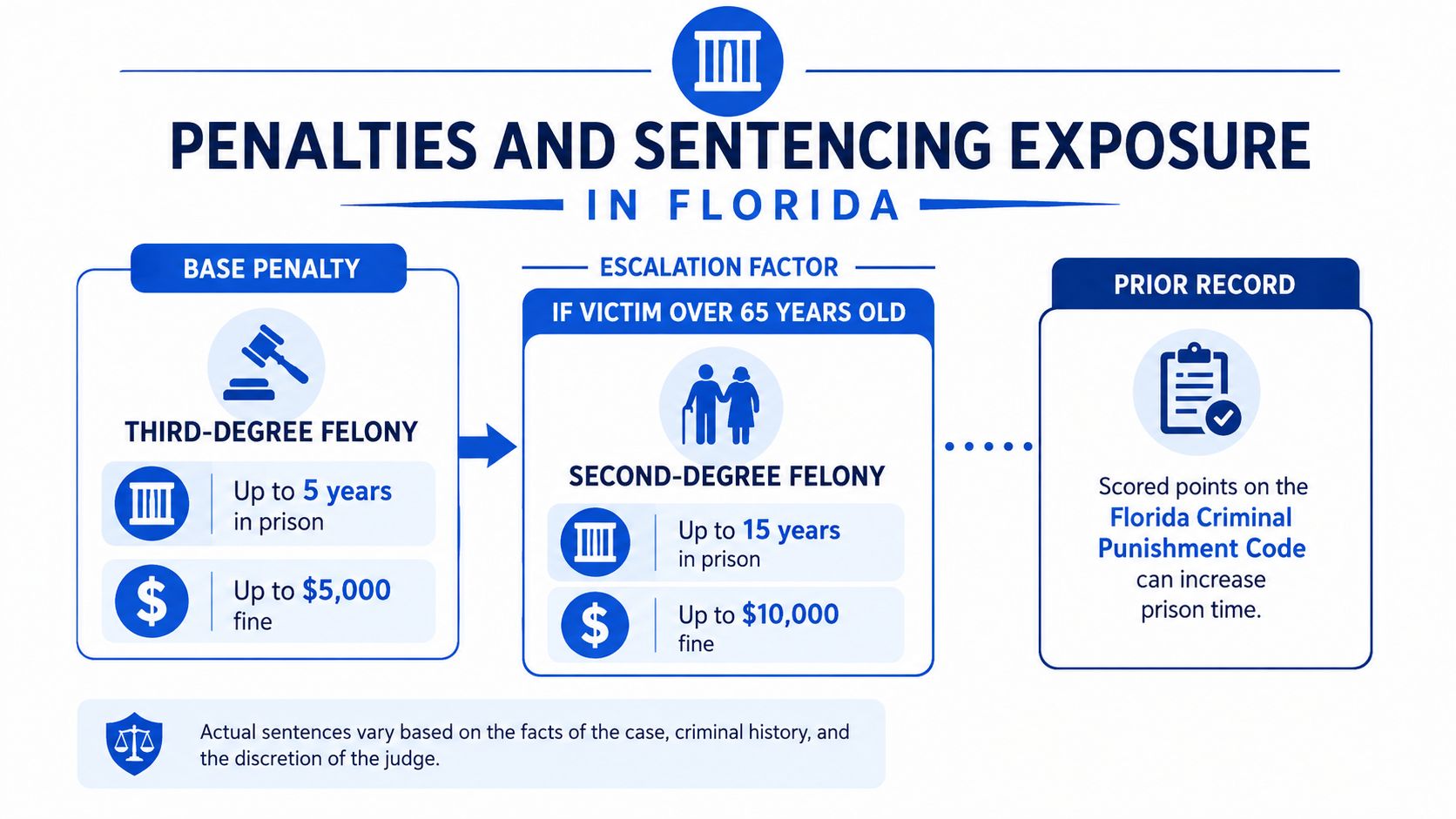
Florida treats the base offense as a third-degree felony when no firearm or deadly weapon is carried, with exposure up to 5 years in prison, and as a second-degree felony if a firearm or deadly weapon is carried, under the robbery by sudden snatching statute. That escalation is not cosmetic. It changes the sentencing picture and the weight the State brings into every plea discussion.
The sentencing consequences do not stop with jail or prison exposure. A felony conviction can leave a permanent record, affect probation terms, and create fallout in jobs that require trust, licensing, or background screening. If the person is not a U.S. citizen, the conviction can also create immigration problems that deserve immediate attention from defense counsel.
Why the weapon detail matters
Weapon allegations often appear early and sometimes loosely. Police reports may mention a gun or knife even when the proof is thin, because officers are trying to preserve every possible charging path. If the State can't connect the weapon to the taking, the defense has room to challenge the enhancement.
Why the record matters
People focus on the sentence and miss the long tail. A felony label can complicate housing, employment, and civil rights restoration issues. That's why a fast defense response is usually smarter than hoping the charge will somehow shrink on its own.
For broader context on felony exposure in Florida, review this second-degree felony overview. The degree of the offense drives the risk analysis from day one.
Bottom line: The sentence is only part of the damage. The record can outlast the case by years.
Common Defenses and Evidentiary Weaknesses

A sudden snatching case usually turns on a narrow question. Can the State prove the taking meets the statute, or is it filling gaps with assumptions? Florida law requires proof that the property came from the victim's person, that the victim knew what was happening, and that the taking did not depend on more force than necessary. Those details are where these cases fail.
The first weakness is identification. These incidents happen fast, under stress, and often with limited lighting or a poor view. A split-second glance, a shaky lineup, or a witness who is guessing can collapse the State's theory.
Awareness is another weak point. If the victim only realized the property was gone after the event, the charge gets harder to hold.
Location matters too. A grab from a counter, seat, or nearby surface is not the same thing as taking property from the person. Prosecutors know that distinction, and weak reports often blur it.
Surveillance evidence can help the defense more than the State. Blurry footage, missing angles, and bad lighting leave room for doubt, especially when the video does not show the actual taking clearly.
If police stopped, searched, or seized evidence unlawfully, suppression becomes a real issue. A good defense lawyer does not guess at that analysis. A criminal defense strategies guide can help frame the basic tools, but the case still has to be tested against the report, the video, the witness statements, and the timeline.
The right defense depends on the facts. Sometimes the strongest position is simple. The State charged a serious offense, but its proof does not cleanly fit the elements. That is where sudden snatching cases come apart.
What to Do Immediately After Arrest
Stay quiet. Say you want a lawyer and stop talking about the case to police, deputies, jail staff, or anyone else who can repeat your words later. Even a short explanation can get rewritten into an admission.
Do not consent to searches unless your attorney has already reviewed the facts. If officers ask for your phone, your bag, or your car, remember that consent can erase a suppression argument later. Keep your answers short, polite, and limited to basic identifying information.
Also, don't talk to cellmates or make casual comments on recorded jail calls. Prosecutors use those recordings often, and people hurt their own cases by trying to sound cooperative or tough. The smartest move is to wait, preserve the evidence, and let counsel examine the charging affidavit, the video, the witness statements, and the bond posture.
Practical rule: Early words help the State more often than they help you.
Bond hearings matter too. Judges look at the charge, the facts alleged, prior history, community ties, and any perceived safety risk. A defense lawyer who gets involved early can often start shaping those issues before they harden into a bad outcome.
How Ticket Shield Builds Your Defense Strategy
A former prosecutor reads a sudden-snatching file differently. That matters because these cases are built on pressure points, witness perception, body-cam footage, and charging decisions that often look stronger at arrest than they do in court. Attorney Jason S. Goldsmith and the team at Ticket Shield, PLLC use that inside view to test the State's version early, file motions when evidence was gathered the wrong way, and push for dismissals or reductions when the proof is thin. If you want a sense of the broader defense approach, review the firm's Florida criminal defense overview.
The practical work is straightforward. Interview the witnesses, secure the video before it disappears, analyze the report for element problems, and force the prosecutor to prove the case instead of assuming the label will carry it. Ticket Shield, PLLC represents people across Broward County, Fort Lauderdale, Miami-Dade, Palm Beach, and surrounding South Florida courts, and that local coverage matters when a case moves fast.
When a sudden-snatching charge is hanging over your head, you need a defense that attacks the weak points, not one that waits for the first court date to start thinking. A focused response can change the entire trajectory of the case.
If you're facing robbery by sudden snatching in Fort Lauderdale, Broward County, Miami-Dade, Palm Beach, or anywhere in South Florida, contact Ticket Shield, PLLC for a confidential case review. Visit Ticket Shield, PLLC to get a defense plan built around the actual evidence, not the accusation.