DUI Law Changes in Florida: What Drivers Must Know in 2026
Jason Goldsmith, Esq
If you got stopped on I-95 after dinner in Broward, or a Miami-Dade officer asked you to step out of the car on the way home, you're probably replaying every second of it. That's normal. The problem is that dui law changes have made the first few minutes of a stop matter just as much as what happens in court later, and people who guess wrong in that moment often give the State more to work with than they realize.
Florida DUI cases move fast, and the rules are unforgiving when you're tired, scared, and trying to make a split-second decision. The State will use your answers, your driving pattern, your performance on roadside exercises, and any test refusal to build its case. If you understand the pressure points before you walk into the room, you can protect your license, your record, and your options.
Table of Contents
How Prior DUIs Escalate Penalties Under Florida's 2026 Framework
Ignition Interlocks, Hardship Licenses, and Driving Restrictions
Common Misconceptions That Quietly Hurt Florida DUI Defendants
Immediate Steps and When to Call a Florida DUI Defense Lawyer
What Happens During a Florida DUI Stop in 2026
The arrest usually starts long before cuffs come out. A deputy or trooper sees something on the road, a lane drift, a late signal, speeding, a stop that takes too long, then the lights come on and the situation changes immediately.
The first minutes matter more than most people think
The officer will ask for your license, registration, and insurance, then start watching everything. Slurred speech, fumbling for documents, the smell of alcohol, glassy eyes, and confused answers all get written down or recorded on body camera. If the officer thinks impairment is possible, roadside exercises often come next, and those exercises are used to justify an arrest even when the driver thinks they were just nervous.
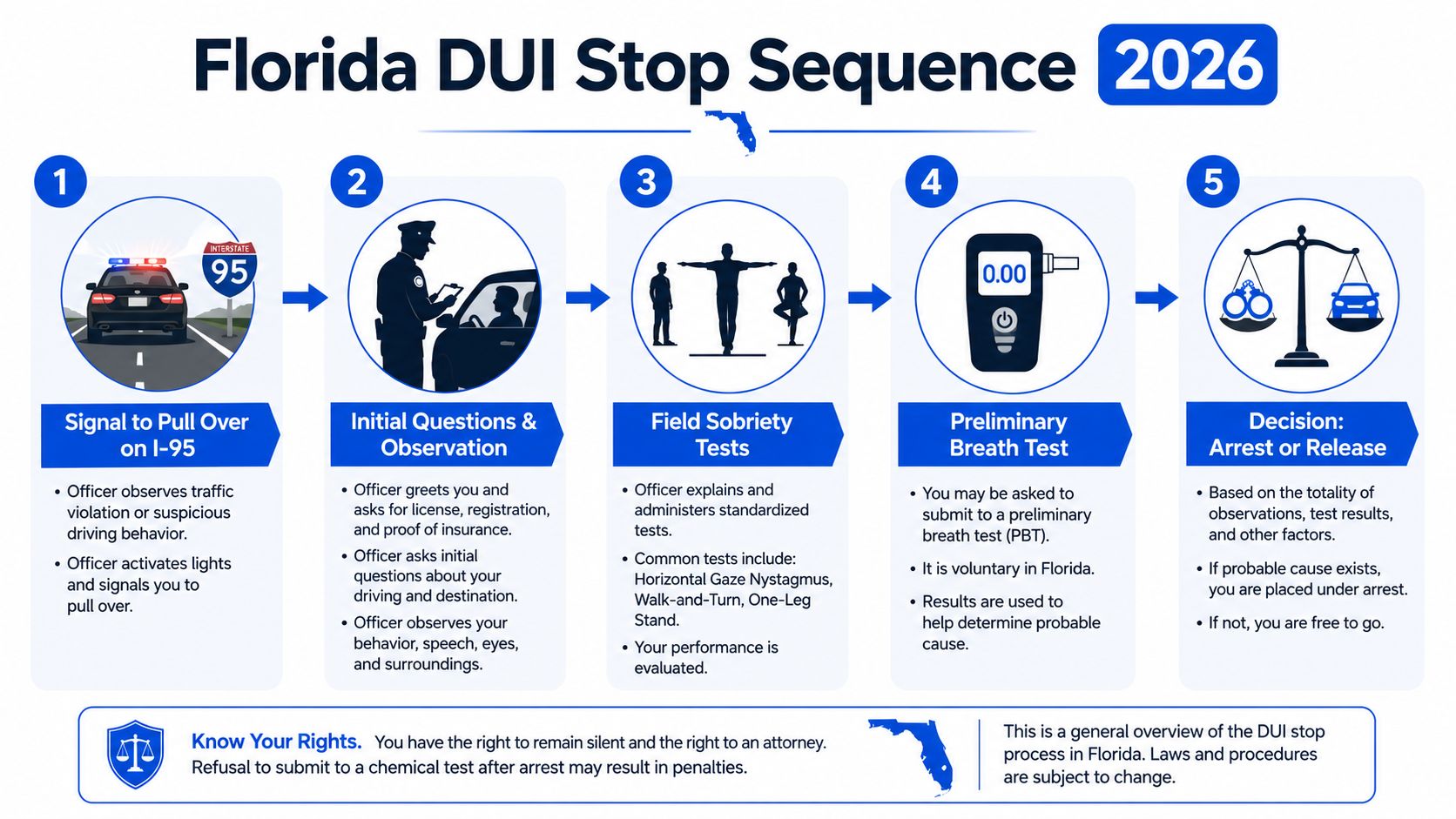
A driver is not required to help the State build a stronger case, but refusing everything without understanding the consequence can create new problems. Field sobriety exercises are often treated as evidence, not a harmless request, which is why video, lighting, footwear, road conditions, and the officer's instructions matter so much in a defense review. For a deeper look at how those roadside exercises get attacked later, see Florida field sobriety test defenses.
Practical rule: do not try to “explain your way out” of a DUI stop. Short, calm answers are safer than rambling explanations that the officer will later use against you.
The implied consent warning starts the legal clock
Once the officer believes DUI arrest is coming, the implied consent warning becomes critical. That warning is the point where the State starts treating your choice about testing as legally significant, not just procedural. If the officer reads it and asks for a breath or blood test, every word you say after that can matter in both the criminal case and the license case.
You need to understand one basic reality. The stop is not the whole case. It is the setup for the evidence the prosecutor will use later, and the less you say, the fewer admissions they can turn into a narrative of impairment.
Florida's BAC Limits and Implied Consent Rules Today
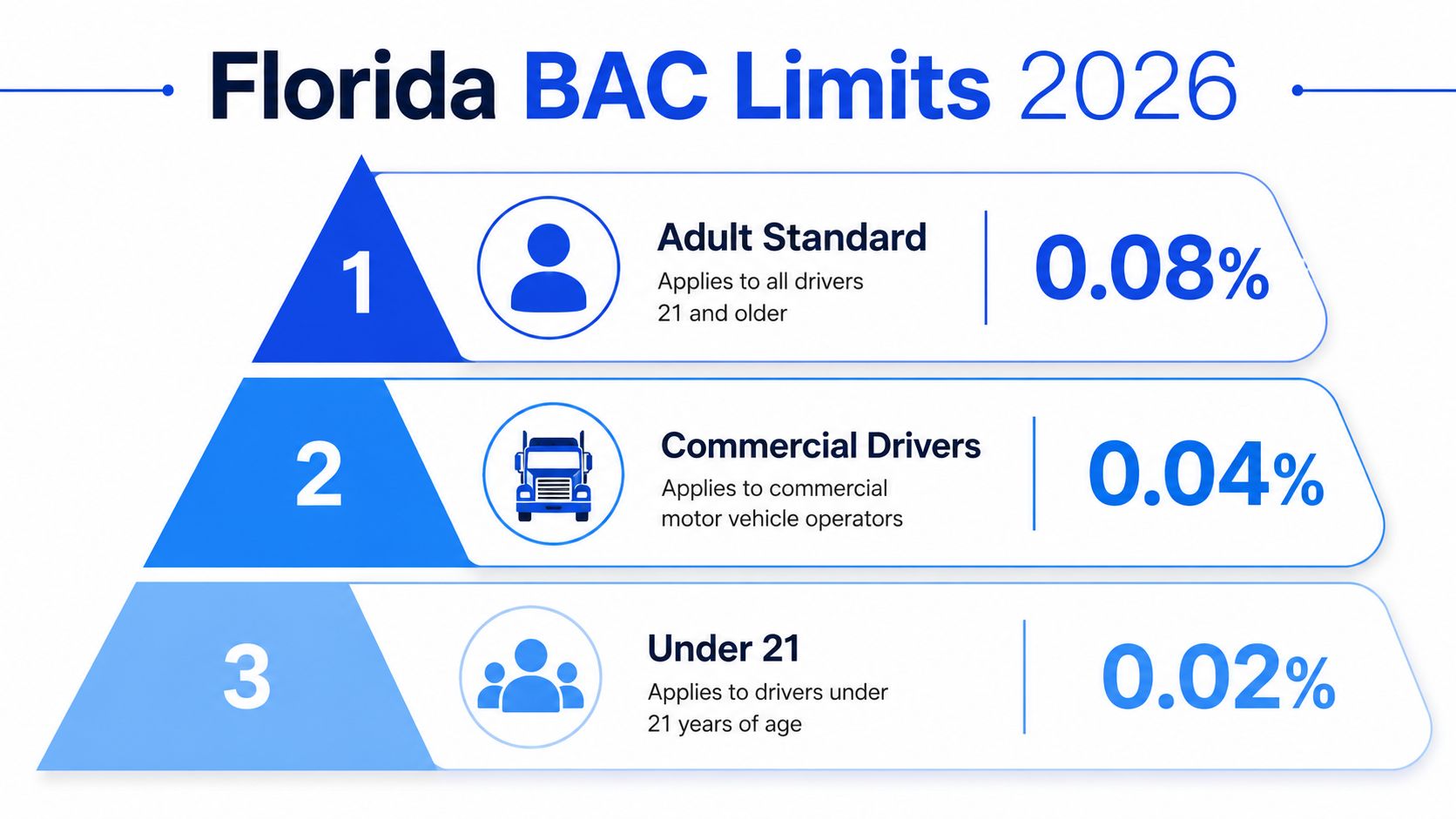
Florida still uses a 0.08% BAC standard for adult drivers, and that number remains the primary legal threshold widely known. The national move toward that standard is not new. Federal transportation data show only 2 states had 0.08 per se laws in 1986, that number reached 52 states/territories by 2005, stayed at 52 in 2013, and the shift was accelerated after President Bill Clinton signed federal legislation in 2000 that pushed states toward 0.08% or risked losing highway funds, according to the Bureau of Transportation Statistics table on 0.08 BAC adoption.
What the State tries to prove after a stop
The chemical test stage is where prosecutors want a clean number. If the test is above the legal threshold, they argue impairment is established. If the number is lower, they often fall back on the officer's observations, field exercises, and any admission the driver made at the roadside.
The refusal issue is where many drivers make a costly mistake. Florida's implied consent framework means the officer can treat refusal as a separate problem, and prosecutors can later argue that refusal shows consciousness of guilt. If you want the strongest explanation of the refusal risk in Florida, read can you refuse a breathalyzer in Florida.
Why the historical shift still matters
The BAC standard matters because it created a uniform baseline for arrests, license actions, and plea bargaining across most major U.S. markets. That uniformity changed the way DUI cases are charged and negotiated. It also made chemical testing more central, which is why a bad stop, a bad warning, or a bad machine calibration can still make the difference between a case that sticks and one that falls apart.
The practical takeaway is simple. The State likes bright lines. Defense lawyers look for the cracks around those lines.
How Prior DUIs Escalate Penalties Under Florida's 2026 Framework
A prior DUI is not just background noise. It can transform a case from a misdemeanor problem into a far harsher charging and sentencing exposure, and the timing of that prior matters. Florida's lookback rule is the part people underestimate, because they assume an old case is gone when it may still count.
The eight-year window changes everything
If a prior conviction falls inside the lookback period, the State can treat the new case as an escalation rather than a first-time matter. That can mean longer revocations, more aggressive plea positions, and mandatory device requirements that did not apply before. Two DUIs separated by nine years are not treated the same way as two DUIs separated by three, because the newer one may no longer trigger the same enhancement structure.
Florida DUI penalties by number of prior convictions
Offense | Max Jail / Prison | License Revocation | IID Required |
|---|---|---|---|
First DUI | Misdemeanor exposure | Administrative and court-ordered suspension can apply | May apply depending on case outcome |
Second DUI within the lookback period | Increased misdemeanor exposure | Longer revocation than a first case | Often required as part of reinstatement and restricted driving |
Third DUI within the lookback period | Can move toward felony-level exposure depending on history and facts | Much harsher revocation consequences | Commonly required |
More serious repeat DUI case | Felony exposure possible | Extended loss of driving privilege | IID and monitoring become central |
For a plain-English breakdown of how Florida prosecutors and judges usually stack these penalties, see DUI penalties in Florida.
A prior DUI from another state can still matter if it fits Florida's enhancement rules. Do not assume an out-of-state case disappears just because it was handled somewhere else.
The smartest defense move is to verify the prior conviction record early. If the State is using an old case to raise the stakes, that issue needs to be challenged at the start, not after a plea offer has already been shaped around it.
License Suspension and the 10-Day Hearing Window
The criminal case is one track. The driver's license case is another. People lose negotiating power because they treat them like the same thing, then miss the deadline that could have preserved a real defense opportunity.

The deadline is short for a reason
After an arrest, the administrative suspension can start quickly, and the request for a formal review hearing must be made within the 10-day window. That hearing is the chance to challenge probable cause, the arrest process, and the evidence supporting the suspension. If you miss that deadline, you may lose the best shot at fighting the license action before it hardens.
The review process is not a formality. It is where the State has to justify what happened on the road and in the testing sequence. A lawyer can use body camera video, the arrest report, and the implied consent sequence to attack weak spots before they become permanent damage.
Hardship driving is limited, not a free pass
A hardship or business-need license can keep you moving, but it does not restore normal driving privileges. It usually comes with conditions, restricted use, and compliance requirements. If you are thinking about license reinstatement, review license reinstatement after DUI before you assume you can just pay a fee and drive again.
What matters most is timing and documentation. Bring the notice, the arrest paperwork, any citations, and every piece of mail from the DHSMV. The more complete the record, the better your lawyer can argue that the suspension should not stand or that the hardship pathway should stay open.
Ignition Interlocks, Hardship Licenses, and Driving Restrictions
Ignition interlock rules are no longer an afterthought in DUI defense. They are part of the punishment structure, part of the reinstatement path, and part of the pressure the State uses to keep drivers under supervision. The device requirement is not just about getting a car started, it is about ongoing monitoring and compliance.
What the device changes in real life
An ignition interlock device forces the driver to blow before starting the car and at intervals while driving. That creates new failure points. A failed sample, a missed rolling retest, or a tamper alert can lead to more suspension trouble, and in some cases it can create new violations that give the State another opening.
The practical burden matters because the device ties driving privilege to constant technical compliance. If you are trying to keep working or get to school, those rules can become the difference between mobility and another suspension cycle.
What to plan for before you agree to a driving path
Installation and monitoring: expect a device that must be installed and checked on schedule, not something you can forget about.
Restricted use: a hardship license is not full driving freedom, and it only covers the limited reasons the law allows.
Alcohol exposure: even small amounts from drinks, mouthwash, or other products can create problems if the device reads a positive result.
Service compliance: missed calibrations or service visits can be treated as violations, even if you were not drinking.
The national shift toward vehicle-based impairment prevention is also changing how these cases are being discussed. NHTSA's 2023 report says the agency was directed to create a safety standard for advanced impaired-driving prevention technology in new passenger vehicles, and that the law is technology-neutral, allowing both breath- and touch-based sensing approaches, with projected device capabilities for 2023 and 2024 described in the report on advanced impaired-driving prevention technology. That shift matters because DUI enforcement is moving from roadside observation toward embedded hardware and data, which creates new fights over calibration and reliability.
Common Misconceptions That Quietly Hurt Florida DUI Defendants
The worst advice in a DUI case usually sounds simple. “Refuse everything.” “The breath machine is always wrong.” “If you've never been arrested before, they'll go easy on you.” That kind of thinking costs people power because prosecutors know exactly how to use it.
Refusal does not erase the case
A breath refusal can limit one piece of evidence, but it does not make the stop disappear. The State can still rely on driving pattern, officer observations, roadside exercises, video, and the refusal itself. Drivers who think silence solves the problem often hand the prosecutor a cleaner story than the one they were trying to avoid.
Field exercises are not harmless
Many people treat roadside exercises like a voluntary checkpoint they can ace by staying calm. That is not how the courtroom sees them. Officers use those exercises to support probable cause, and the defense often has to attack the conditions, the instructions, and the scoring, not just argue that the driver “felt fine.”
Breath results are not automatically final
Breath machines are not magic boxes. Maintenance, operator training, observation periods, and machine records all matter. If those records are weak or incomplete, the defense has room to challenge the result instead of accepting it as the end of the case.
Do not plead guilty just because the officer said you failed a test. That is a police conclusion, not a courtroom finding.
The same mistake shows up in pleas entered too fast. Once a person accepts a deal without reviewing the stop, the device records, or the hearing options, the damage is often permanent. In Broward, Miami-Dade, and Palm Beach courts, the State is perfectly happy to accept an early plea that saves them the trouble of proving a weaker case.
Defense Strategies That Actually Work in Florida DUI Cases
A DUI charge is not a verdict. It is a file full of issues that need to be tested. The best defense starts with the stop, then moves to detention, testing, and the quality of the paperwork the State relies on.
The strongest pressure points are usually factual
A lawyer should look at whether the officer had a real reason to stop the car, whether the detention stayed within lawful bounds, and whether the field exercises were administered correctly. If the stop was shaky, everything after it becomes vulnerable. If the officer overreached, a motion to suppress may be the right move.
Records matter as much as arguments
The defense should demand body camera video, dashcam video, breath machine maintenance logs, and the arrest report. Those records often expose gaps the arresting officer did not expect to be challenged on. If the machine was not maintained properly or the paperwork is inconsistent, that can change the direction of the case fast.
Early intervention gives you more choices
A local defense lawyer can sometimes negotiate reductions, resolve paperwork issues, or push for dismissal before the case hardens into a plea-or-trial posture. In South Florida, that early work matters because prosecutors know which cases have video problems, machine problems, or weak probable cause from the first review.
Ticket Shield, PLLC handles DUI defense by challenging illegal stops, unreliable field tests, and weak license actions, which is the kind of work that matters when the State's evidence is thin.
Immediate Steps and When to Call a Florida DUI Defense Lawyer
The first 72 hours after a DUI arrest are not for guessing. They are for protecting deadlines, gathering documents, and stopping avoidable mistakes before they become permanent.
Your first moves should be simple
Save the 10-day deadline. If you want to fight the suspension, do not wait.
Collect every paper you received. That includes the citation, notice of suspension, and any release paperwork.
Do not post about the arrest. Social media gives the State easy admissions.
Write down the stop while it's fresh. Where you were, what the officer said, what you were asked to do, and whether cameras were present all matter.
Call a defense lawyer before speaking to the State. You do not get points for being cooperative if you are giving away defenses.
A confidential consultation should focus on the stop, the test, the hearing deadline, and your driving needs. Ask what can be challenged now, what has to wait, and what outcome is realistic based on the facts, not on slogans.
If you're in Broward County, Fort Lauderdale, Miami-Dade, Palm Beach, or anywhere in South Florida, get counsel involved before the license issue and the criminal case start working against you at the same time.
Ticket Shield, PLLC helps people facing DUI charges and license suspension by reviewing the stop, the testing, and the hearing deadlines before the State gets too far ahead. If you need a defense plan that protects your driving privilege and your record, visit Ticket Shield, PLLC to request a confidential consultation.