Finding a Probation Violation Lawyer Near Me in 2026: A Guide for South Florida
Jason Goldsmith, Esq
If you’ve been accused of violating your probation in Florida, you need to understand one thing very clearly: the system is designed to move fast, and your freedom is in immediate jeopardy. The consequences can range from adding stricter rules to your supervision all the way to sending you to jail or prison, often without the possibility of bond until your case is heard.
Finding a skilled probation violation lawyer in Broward, Miami-Dade, or Palm Beach County isn't just a good idea—it's the most critical move you can make to protect yourself.
Table of Contents
What Happens After a Florida Probation Violation Accusation
The moment your probation officer (PO) even suspects a violation, a legal chain reaction begins that can land you in custody surprisingly quickly. It’s not like a new criminal case; the rules are different, and they are not in your favor.
First, it’s important to know what kind of violation you’re facing, as this will shape the entire case.
Technical vs. Substantive Violations
From a legal standpoint, violations fall into two main categories. A technical violation means you’ve broken one of the specific rules of your supervision. This could be anything from failing a drug test, missing a scheduled meeting with your PO, falling behind on court costs or restitution, or not finishing a mandatory class.
A substantive violation is much more serious. This happens when you get arrested and charged with a new crime—from a misdemeanor like shoplifting to a serious felony—while you’re still on probation. Prosecutors and judges in South Florida courts take these incredibly seriously, as they see it as a complete disregard for the second chance you were given.
No matter the type, if your PO believes you've violated your terms, they will draft and file an Affidavit of Violation of Probation with the court. This is a sworn statement that lays out exactly what they claim you did wrong. Once a judge reviews that affidavit and agrees there's probable cause, they will almost always sign a warrant for your arrest.
The infographic below shows how quickly this process can unfold.
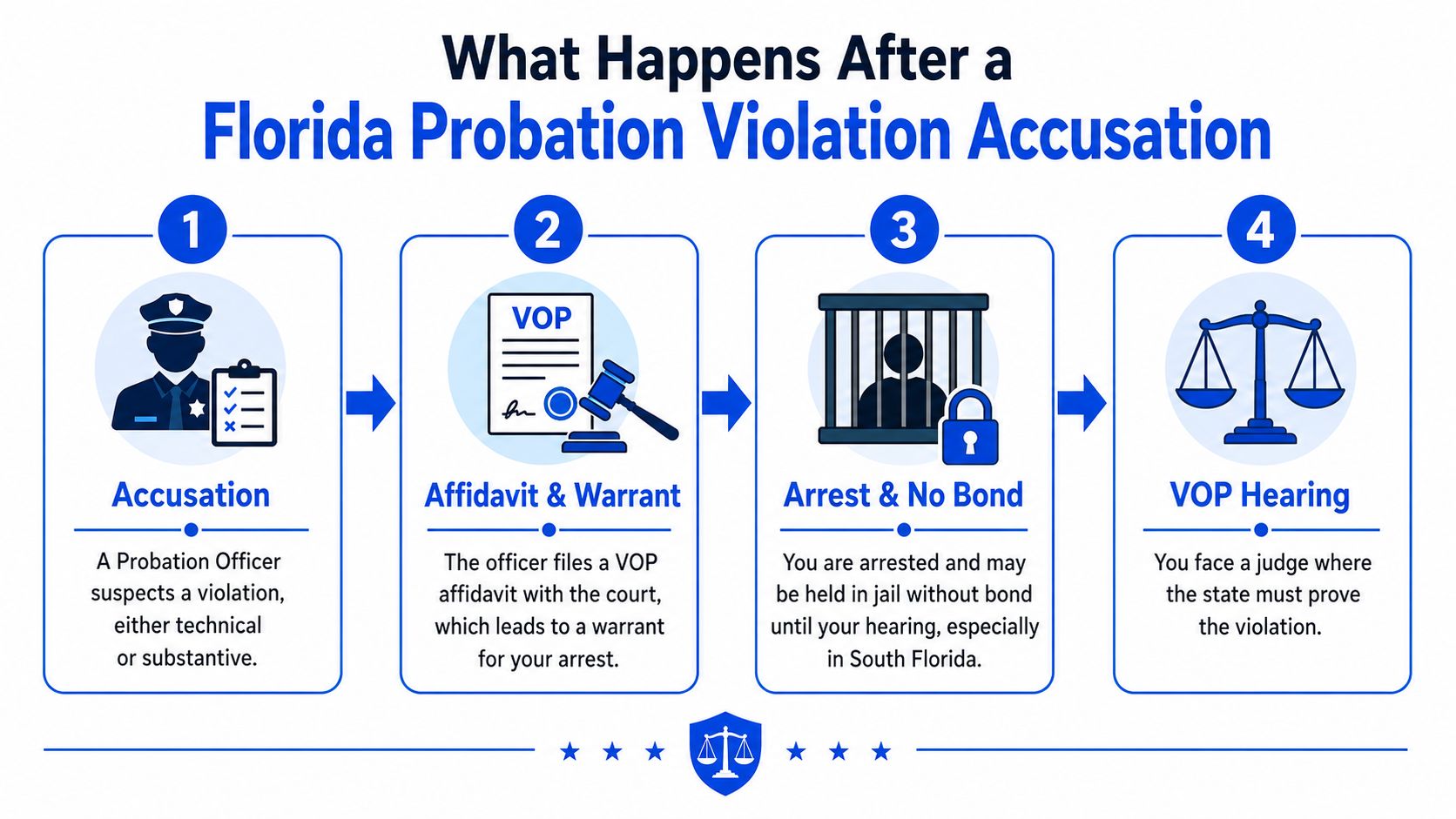
This process reveals a harsh reality for those in South Florida: unlike with a new criminal charge, you have no automatic right to bond for a VOP. In many courts across Broward, Palm Beach, and Miami-Dade counties, the judge will order you to be held in jail until your hearing. This makes it incredibly challenging to work, care for your family, and help your lawyer build your defense.
The biggest shock for most people is learning about the standard of proof. The State doesn't need to prove you violated your probation "beyond a reasonable doubt." They only need to show a "preponderance of the evidence," which simply means it’s more likely than not that the violation occurred.
This much lower bar makes it far easier for the prosecutor to win.
To give you a clearer picture, here’s a breakdown of common violations and what you might be facing.
Understanding Florida Probation Violations and Potential Outcomes
Violation Type | Example | Common Judicial Response in Broward, Miami-Dade & Palm Beach |
|---|---|---|
Technical (Minor) | Missing one meeting with your PO, being a few days late on a fine. | Verbal warning, reinstatement of probation, or addition of a new condition (e.g., more frequent check-ins). |
Technical (Serious) | Repeatedly failing drug tests, absconding (losing contact with your PO). | Brief jail sentence ("shock time"), modification of probation to a stricter level, or full revocation and imposition of the original sentence. |
Substantive (New Misdemeanor) | Arrested for something like Trespassing or Disorderly Conduct. | Revocation is highly likely. The judge could sentence you on the original charge, often with jail time. |
Substantive (New Felony) | Arrested for a new felony like Grand Theft or Battery. | Revocation is almost certain. The judge will likely impose a significant portion, if not all, of the original underlying sentence. |
Because the stakes are so high and the state's legal burden is so low, having an experienced South Florida criminal defense attorney in your corner from day one is essential. You can learn more about how we challenge these accusations and fight to keep our clients out of jail by reading our in-depth guide on probation violations.
Your Limited Rights at a VOP Hearing
One of the biggest—and most dangerous—misconceptions I see is the belief that you have zero rights once you're accused of violating probation. It's just not true. While a Violation of Probation (VOP) hearing in a Florida court doesn't offer the same level of protection as a full-blown criminal trial, you are by no means left defenseless.
The process starts with your right to receive written notice of the exact allegations. The state can't just vaguely accuse you; they must provide a document, often called an Affidavit of Violation, that spells out precisely how they believe you failed to meet your probation terms. This document is the starting point for your entire defense, and it’s the first thing a skilled probation violation lawyer near you will use to start poking holes in the prosecutor's case.
Why the Standard of Proof Changes Everything
When you step into a Broward County courtroom, you have the right to be there, to listen to the evidence presented against you, and to fight back with your own evidence and witnesses. You can even challenge the nature of the accusation itself, which is crucial if it's a technical violation of probation, as we explain in our detailed article.
But here’s the critical difference, and it’s a big one: the state’s burden of proof is much, much lower.
In a VOP hearing, the prosecutor doesn't need to prove you violated probation "beyond a reasonable doubt." They only have to show a "preponderance of the evidence." This legal standard simply means it is "more likely than not" that you committed the violation.
Think about that. It's a 51% standard. This makes it far easier for a prosecutor to succeed and for a judge to revoke your probation, potentially sending you to jail or prison to serve out the remainder of your original sentence.
This is why having an experienced legal advocate is absolutely essential. Modern probation laws, not just in Florida but across the country, give judges immense power in these hearings. While you have the right to notice and to be heard, the deck is stacked against you. An experienced lawyer's job is to level that playing field. You can explore more about the evolution of these legal rights on hufflawfirm.com. When your freedom is on the line, navigating this system alone is a risk you can't afford to take.
How a Fort Lauderdale Defense Lawyer Builds Your VOP Defense
Just because you've been accused of violating probation doesn't mean you're going back to jail. It’s a terrifying position to be in, but it’s crucial to remember that the state still has to prove its case. A proactive, aggressive defense is your best shield, and it all starts with poking holes in the prosecution's argument.
The first thing we do is get our hands on the state’s affidavit and scrutinize every word. Under Florida Statute § 948.06, the prosecutor must prove the alleged violation was both willful and substantial. This is a high bar, and it’s where many of their cases fall apart. Our entire strategy is built around showing the judge that whatever happened, your actions don’t meet that strict legal standard.
What does "willful" really mean? It means you intentionally defied the court’s order. If you missed a check-in with your probation officer because you were rushed to a Fort Lauderdale hospital, that’s not willful. We can prove that with medical records. Likewise, if you were late on a restitution payment because you got laid off, we can argue that your inability to pay wasn't a deliberate choice, especially if you have proof you were actively looking for a new job.
Questioning the State's Evidence
Challenging the evidence itself is another powerful angle. A failed drug test, for example, is far from an open-and-shut case. As an experienced defense lawyer, I immediately start asking questions that can dismantle the state’s evidence piece by piece:
Was the urine sample collected correctly and stored at the proper temperature? Any break in the chain of custody?
Is the lab that ran the test properly accredited? Mistakes happen, and subpar labs make them more often.
Could a new prescription medication have triggered a false positive? This happens more than you'd think.
Having a former prosecutor on your side is a huge advantage here. We know exactly where the state is likely to cut corners and how to expose those weaknesses to the judge.
In my experience, one of the most persuasive things you can do is demonstrate good-faith efforts. If you immediately called your P.O. to report a mistake, re-enrolled in a class you missed, or started making catch-up payments before the violation was ever filed, it sends a powerful message. It tells the judge that you respect the court and are taking your probation seriously.
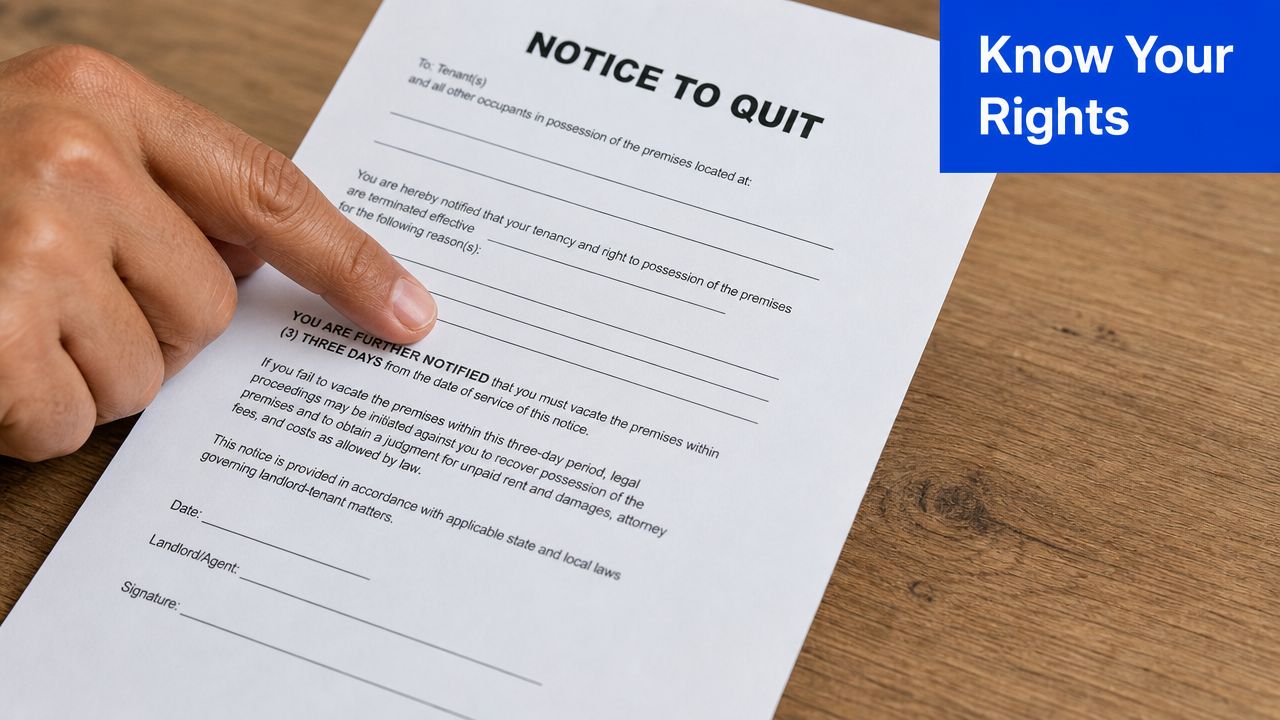
Ultimately, a strong defense is about telling your side of the story and backing it up with credible evidence. To learn more about specific strategies we use, you can explore our in-depth guide covering defenses for a Florida violation of probation. A well-crafted defense can be the difference between getting your probation reinstated—and maybe just extended—versus having it revoked and being sent to jail.
How a VOP Lawyer Fights for You in South Florida
When you're facing a violation of probation (VOP) accusation, it can feel like the walls are closing in. The good news is that hiring the right lawyer isn't just about getting advice—it's about launching an immediate and proactive defense to protect your freedom.
The moment you hire us, we get to work. Our first call is to your probation officer and the prosecutor handling your case in Broward, Palm Beach, or Miami-Dade. This opens a crucial line of communication, allowing us to present your side of the story before official opinions are formed and the system locks into a negative narrative about you.
Getting Ahead of an Arrest Warrant
One of the most terrifying parts of a VOP is the possibility of an arrest warrant. You could be picked up at home, pulled over in traffic, or even taken away from your job. We can often prevent this public and stressful experience by filing what's called a motion to surrender.
This legal tool allows us to schedule a time for you to appear in court voluntarily. It’s a game-changer.
Walking into court on your own terms, rather than in handcuffs, shows the judge you respect the court's authority and are taking the allegation seriously. This simple act can dramatically shift the judge's initial perception of you and often makes it more likely they will grant you a bond.
While arranging your surrender, we're also digging for evidence. We’ll help you gather everything from pay stubs and work schedules to medical records or text messages—anything that helps prove the alleged violation wasn't a willful or substantial breach of your probation.
Negotiating Alternatives to Incarceration
Let's be clear: the primary goal for most people is to resolve the VOP without going back to jail. This is where a lawyer's experience with the local prosecutors and judges really comes into play. We can often negotiate for outcomes other than incarceration, such as:
Reinstatement: Simply putting you back on probation, sometimes with the original conditions.
Modification: Changing the terms of your probation. This might mean adding a treatment class, more community service, or moving to a different level of supervision.
Termination: In some situations, we can argue for your probation to be terminated, even if unsuccessfully, without you facing more penalties.
This isn't always a dramatic courtroom battle. The reality is that the probation system is massive. The U.S. Bureau of Justice Statistics found that at the end of 2022, about 3.7 million adults were on probation in the United States, making it the country's largest correctional population.
This sheer volume means that judges in busy jurisdictions like Broward County have tremendous discretion. An attorney who understands the local system and knows how to frame your story is absolutely essential. You can learn more about how VOP cases are managed at walkerlawhouston.com. Having a skilled advocate in your corner can make all the difference.
It's Time to Act and Protect Your Freedom
If you've been accused of a probation violation in South Florida, you're in a high-stakes emergency. This isn't something to ignore or put off until tomorrow. The reality is that an arrest warrant could be issued at any moment, and you could find yourself sitting in jail—often with no bond—until your hearing. Your freedom, your job, and everything you’ve worked for is on the line.
I get it. The fear and stress of this situation can be paralyzing. But hesitation is the single worst thing you can do right now. As a former prosecutor, I have an insider's knowledge of how the State puts these cases together, which gives us a unique advantage in taking them apart. When you work with us, you get a direct line to your attorney—24/7—and a clear, decisive plan to defend you.
The most critical step you can take is to get an experienced lawyer on your side immediately. Don't risk your future by walking into a courtroom in Broward, Miami-Dade, or Palm Beach County alone.
Our team is ready to stand with you. Let’s talk about your situation and how we can help. Submit your case for a free, confidential consultation and start building your defense today.
Frequently Asked Questions About Florida VOP Cases
When you're facing a probation violation, your mind is racing with questions and what-ifs. It's a scary, uncertain time. As a criminal defense attorney serving Fort Lauderdale and all of South Florida, I've heard every question in the book from clients. Let's tackle some of the most common and urgent concerns right now.
Can I Get a Bond for a Probation Violation in Florida?
This is the first question on everyone’s mind, and the answer is tough to hear: usually, no. Unlike a new criminal charge, there is no automatic right to bond for a VOP in Florida.
If the violation is for a new crime (a substantive violation), the law actually presumes you’ll be held in jail without bond until your case is resolved. For technical issues—like a missed meeting, a late payment, or a failed drug test—it's entirely up to the judge. They can grant a bond, but they don't have to.
This is where an experienced lawyer makes a difference. We can file an aggressive motion for a bond hearing and argue why you should be released, but you have to be ready for the very real possibility of being held in custody. It’s why moving fast and getting a lawyer involved before an arrest is so critical.
What if I Violated Probation but Live Out of State?
Living in another state won't make a Florida warrant disappear. If your original sentence was handed down in a Florida court, whether in Miami-Dade, Broward, or Palm Beach County, that's where you'll have to answer for the violation.
The warrant issued by the Florida judge is valid nationwide. This means you could be arrested during a routine traffic stop in your home state and then extradited back here to face the music. It is absolutely vital to hire a lawyer in the specific Florida county where you were sentenced. They can get to work immediately on addressing the warrant and building your defense before you end up in custody.
A huge mistake people make is thinking their local probation officer in their home state has any real power. They don't. Their job is to report back to Florida. Only a Florida-licensed attorney practicing in the right courthouse can effectively negotiate with the prosecutor and the judge who hold your freedom in their hands.
My PO Said It Would Be Okay, So Do I Still Need a Lawyer?
Yes. Without a doubt, you absolutely need your own lawyer. I can't stress this enough. While your probation officer might seem understanding or even tell you "not to worry about it," their primary job is to report violations to the court. They are an arm of the state, not your advocate.
Any informal promise or casual assurance from a PO is completely non-binding and means nothing in a courtroom. The only people who decide what happens next are the prosecutor and the judge. Relying on a PO’s word is a gamble you simply can't afford to take.
Remember, only your own criminal defense attorney is 100% on your side. We have a legal and ethical duty to protect your interests and your interests alone.
At Ticket Shield, PLLC, we know the fear and stress a VOP charge brings. As a former prosecutor, I've seen these cases from the other side, so I know how the State builds its arguments—and more importantly, how to pick them apart.
Don't let an arrest warrant control your life. Call us 24/7 for a free, confidential consultation to start building your defense today. Take the first step and learn how we can fight for you at https://www.mycriminaldefense.com.
A probation violation can send you back to jail fast. Here's how to find the right South Florida violation lawyer and what to expect in 2026.