Florida Misdemeanor Probation Violation Defenses
Jason Goldsmith, Esq
You may have learned about the problem in the worst possible way. A probation officer leaves a voicemail. A clerk tells you there's a warrant. A family member checks the court docket and sees the words “violation of probation.” Now your mind jumps straight to jail, job loss, and whether you just threw away the second chance the court gave you.
That reaction is normal. It's also where people make expensive mistakes. They call the probation officer and start explaining. They wait, hoping it blows over. They assume an allegation means the judge has already decided the case.
It doesn't.
A misdemeanor probation violation in Florida is serious, but it is still a case the State must prove. In many technical violation cases, the fight is not just whether something happened. The fight is whether the violation was willful and substantial, whether the paperwork and notice are sound, and whether the judge should respond with revocation, modification, or reinstatement. From a former prosecutor's perspective, that distinction is often overlooked.
Table of Contents
Your Guide to a Misdemeanor Probation Violation in Florida
You miss one meeting with probation because work ran late. Or you fall behind on payments after rent goes up. A week later, you find out a violation affidavit was filed and a warrant may already be in the system. That is usually the moment a misdemeanor case stops feeling minor.
In Florida courtrooms, misdemeanor probation violations are common. What many people miss is that a violation is not automatic just because probation says you broke a rule. The State still has to prove the violation, and for many technical allegations, the primary fight is over willfulness. If you missed a payment because you could not pay, or missed an appointment because of a documented emergency, that is a different case from outright refusing to comply.
That distinction matters early. From the prosecution side, technical violations often look straightforward on paper and weaker once the reasons are examined. From the defense side, the goal is to identify whether the allegation involves a new law offense or a rule-based violation, what level of proof the State will rely on, and what records can show the conduct was not willful and substantial. That is why a Florida technical violation of probation defense often starts with documents, timeline reconstruction, and damage control before the first hearing.
Florida-specific probation data is reported in different ways than some large-state studies. Broad national research from the National Center for State Courts on misdemeanor trends and court volume still supports the larger point: lower-level cases make up a large share of criminal court work, and probation conditions create repeat contact with the court long after the original plea or sentence. In practice, that means violation hearings are a regular part of misdemeanor dockets, not an unusual sideshow.
The good news is practical. A probation violation allegation can often be answered with proof, context, treatment progress, payment history, employment records, or a negotiated fix before the court decides punishment. The worst move is trying to explain everything to probation or law enforcement without a plan. The better move is to treat the allegation seriously, protect your right to remain silent, and get counsel involved before the file hardens against you.
Technical vs Substantive Probation Violations
Probation is a court-ordered sentence with conditions attached. If the court says report monthly, complete treatment, avoid new arrests, perform community service, or pay fines and costs, those aren't suggestions. A violation allegation means the State claims you broke one of those conditions.
The first question is what type of violation the State is alleging.

Why the label matters
A technical violation usually means an alleged breach of probation rules without a new criminal offense.
Examples often include:
Missed reporting because you didn't appear as directed
Nonpayment issues involving fines, costs, restitution, or supervision fees
Failed treatment compliance such as not finishing a class or counseling program
Testing violations like a positive drug or alcohol screen when abstinence is a condition
Travel or curfew problems when the court imposed location or schedule limits
A substantive violation usually means the State says you committed a new offense while on probation.
That distinction affects strategy because courts generally view a new offense allegation as more serious than a rule-based compliance problem. In a probation outcomes study, technical violations had 31% to 51% lower odds of revocation than violations based on a new crime, according to the Robina Institute report on probation outcomes.
Common examples in Florida courtrooms
From a defense standpoint, technical violations often raise questions like these:
Violation type | Typical issue | Defense focus |
|---|---|---|
Technical | Missed appointment or failed payment | Was it willful, substantial, and clearly noticed? |
Technical | Incomplete classes or service | Was there a real effort to comply? |
Substantive | New arrest or new charge | Is the evidence reliable enough for a VOP finding? |
That's why classification matters so much. The same facts that sound bad in a probation officer's affidavit may look very different once the court examines whether the allegation is really technical, whether the condition was clear, and whether the person had the actual ability to comply.
If your case involves a rule-based allegation rather than a new offense, it helps to understand how Florida courts handle a technical violation of probation in Florida because the defense opportunities are often better than people assume.
A missed payment because you lost work is not the same as a flat refusal to pay. A missed appointment with medical proof is not the same as disappearing.
The Florida Violation of Probation VOP Process
A Florida VOP case usually moves faster than the original criminal case. That speed is what catches people off guard.
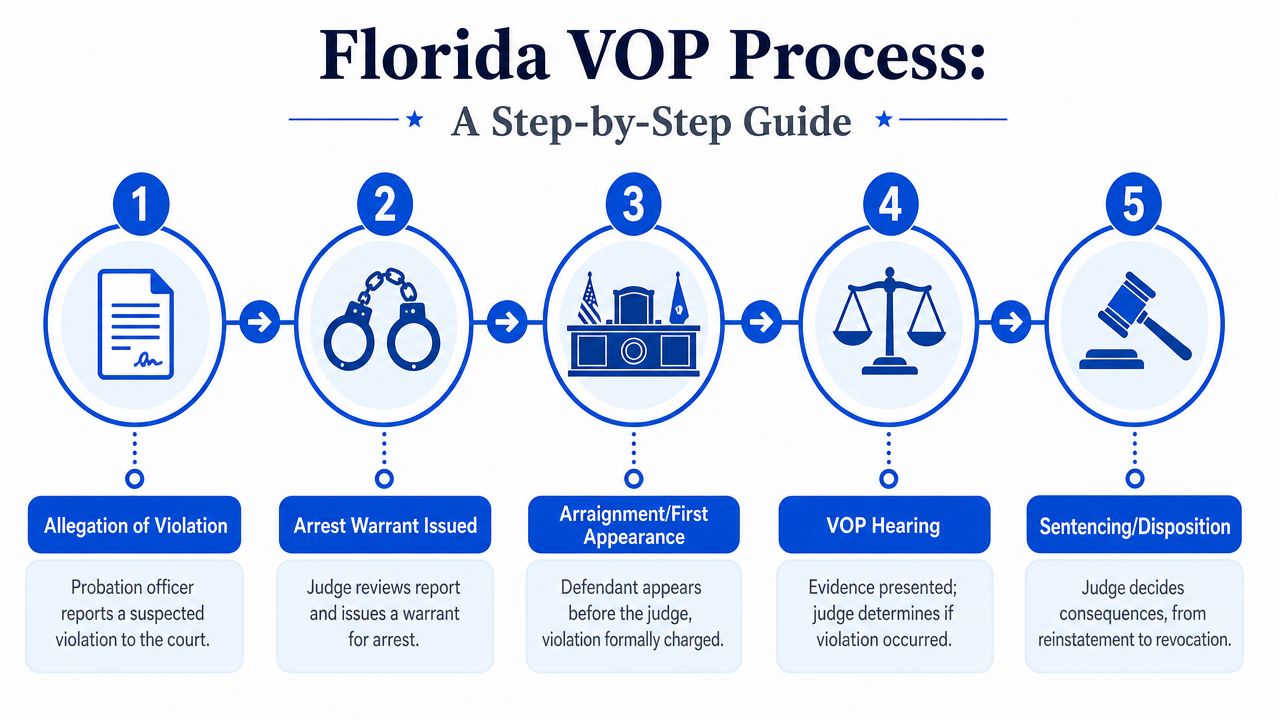
How a Florida VOP case usually starts
In most Florida misdemeanor probation violation cases, the process starts when the probation officer files an affidavit alleging a violation. A judge reviews that allegation and may issue a warrant.
In Broward County, Miami-Dade, Palm Beach, and other South Florida courts, that can lead to an arrest even if the underlying case began as a misdemeanor. People often expect to bond out quickly because the original charge was low level. A VOP case doesn't always work that way.
A lot of people also underestimate how broad this system is. As noted earlier, misdemeanor cases make up a massive share of criminal court traffic, and probation supervision remains a major feature of the system. If you need a broader overview of how these cases are handled, this page on Florida probation violations gives a useful starting point.
What happens after the arrest
After arrest on a VOP warrant, the court will bring you before a judge for first appearance. In practical terms, one of the first issues is release. VOP warrants are often treated as no bond matters until the court addresses bond or release conditions.
That doesn't mean release is impossible. It means your lawyer often needs to act affirmatively by filing the right motion, presenting your ties to the community, and framing the alleged violation in a way that lowers the court's concern.
The basic sequence usually looks like this:
Affidavit filed by probation
Warrant issued by the judge
Arrest or surrender
First appearance
Bond motion or release argument
Final VOP hearing
Disposition, which can range from reinstatement to revocation
If you know a warrant may exist, hiding usually makes the case worse. Controlled surrender through counsel is often the better move.
Unlike a jury trial, a VOP hearing is decided by a judge. The State's burden is lower than “beyond a reasonable doubt,” which is one reason these hearings require focused preparation from the start. Waiting for the hearing date and hoping things work out is not a defense plan.
Penalties for a Misdemeanor Probation Violation
The biggest risk in a misdemeanor probation violation case is simple. If the judge revokes probation, the court can sentence you on the original case up to the lawful maximum for that offense. That's why a violation allegation deserves immediate attention even when the original charge seemed manageable.
The full range of outcomes
Revocation is only one possible result. Depending on the facts, the judge may also:
Reinstate probation on the same terms
Modify probation by adding conditions such as treatment, testing, curfew, or stricter reporting
Impose a short jail sanction and then place you back on supervision
Terminate probation unsuccessfully in some circumstances tied to the original sentence structure
That range matters because many clients walk into court assuming there are only two outcomes: total victory or immediate jail. Real court practice is more nuanced.
Other jurisdictions illustrate that point clearly. Michigan training materials describe graduated sanctions for technical misdemeanor violations with statutory jail caps of 5 days for a first violation, 10 days for a second, and 15 days for a third, as shown in this Michigan probation sanctions training handout. The lesson isn't that Florida uses that exact framework. The lesson is that probation courts often distinguish between repeated technical noncompliance and conduct that justifies full revocation.
What judges often focus on
Judges tend to care about patterns.
A one-time lapse with documentation looks different from months of avoidance. A person who gets back into treatment before court looks different from someone who ignores every condition. A violation tied to chaos, illness, or unemployment is still serious, but it can be framed very differently from open defiance.
This overview helps explain the practical stakes:
The goal in many Florida VOP cases is to keep the judge from treating the allegation as proof that probation failed completely. That is where factual context, compliance records, and a sharp legal defense become critical.
Building a Strong Defense Against Your VOP Charge
The best defense depends on the kind of violation alleged. That sounds obvious, but many people miss it. They focus on apologizing instead of forcing the State to prove the right things.
Technical violation defenses often turn on willfulness
For a technical misdemeanor probation violation, one of the central issues is often whether the alleged noncompliance was willful. That matters because probation is not supposed to become an automatic jail trap for every setback.
Judicial guidance from other states highlights an important principle that defense lawyers use every day in probation cases: a violation is not automatic, and lack of notice or inability to comply can defeat a willfulness finding, as reflected in this judicial bench guidance discussing willfulness and notice.
In practice, defenses to technical allegations often include:
No willful nonpayment because you lacked the ability to pay despite real effort
No clear notice because the probation term or reporting instruction was unclear
No substantial violation because the issue was minor, isolated, or promptly corrected
Administrative error in reporting logs, payment credits, or treatment records
Substantial compliance where you completed most conditions and can document that effort
Courts often care less about excuses than proof. Bring records, not just explanations.
For example, if you lost your job and fell behind on payments, your lawyer should be collecting termination records, bank statements, job applications, and proof of partial payments. If you missed an appointment because you were hospitalized, that should be backed by discharge papers, prescription records, and communication logs.
Substantive violation defenses focus on the State's proof
When the alleged violation is a new offense, the legal posture changes. The State still has to prove the violation, but the hearing is not a full criminal trial. The judge decides whether the evidence is sufficient under the lower VOP standard.
That doesn't mean the State automatically wins.
A defense lawyer can still attack:
Weak witness testimony
Unreliable identification
Gaps in police investigation
Suppression issues tied to the stop, search, or seizure
The actual link between the client and the alleged conduct
Many clients think, “I was arrested, so I must be violated.” That's wrong. Arrest is not the same thing as proof. Some of the strongest VOP defenses come from exposing how thin the new-law allegation really is.
In South Florida courts, the practical strategy is often two-track. First, challenge the violation itself. Second, build mitigation that gives the judge a reason not to revoke even if the court finds some noncompliance occurred. Those are different jobs, and a good defense usually does both.
Five Immediate Steps to Protect Yourself
The first day after learning about a possible violation matters. So does the second. Delay gives the State control of the timeline.
What to do right now
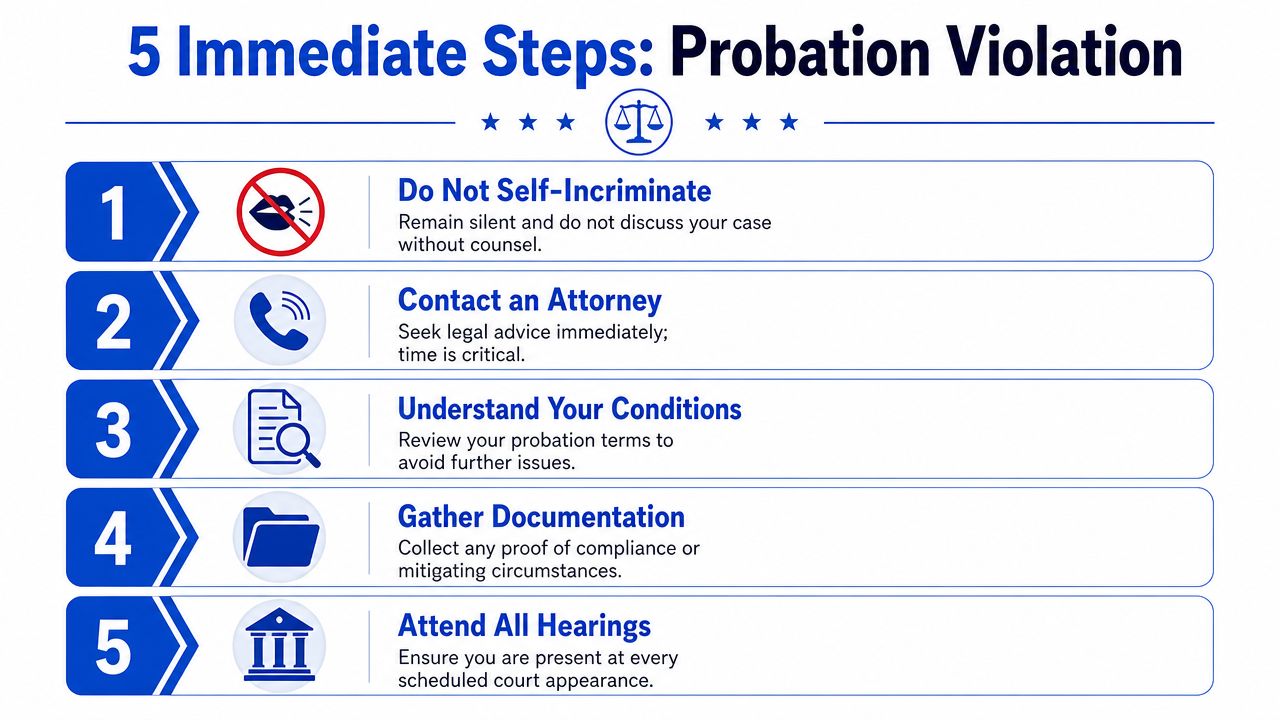
Stop explaining the case to probation.
You may feel pressure to “clear it up.” In reality, casual explanations often lock you into facts before a lawyer sees the affidavit, conditions, and court file.Find out exactly what condition is alleged.
Don't guess. Get the probation paperwork, sentencing order, receipts, testing history, class records, and any notices you received. If the issue involves compliance over time, details matter.Preserve every document that shows effort or inability.
Keep payment receipts, screenshots, text messages, GPS logs, hospital records, work schedules, rehab attendance sheets, and proof of transportation problems. A technical violation case often turns on records that people throw away.Talk to a Florida probation lawyer before surrendering or appearing.
In some cases, counsel can coordinate surrender, seek bond, narrow the issues, or start negotiating before the hearing. If you're reviewing options, one available resource is Ticket Shield, PLLC's discussion of probation matters and related defense strategy, which also helps people understand how courts evaluate probation performance over time.Get back into compliance where possible.
Start the class. Make the payment you can make. Re-engage in treatment. Resume community service if it's still available. That doesn't erase the allegation, but it gives the judge something concrete to work with.
A quick checklist helps:
Don't hide: warrants rarely improve with time
Don't freelance your defense: facts need legal framing
Do gather records: proof beats memory
Do prepare for court early: VOP timelines move fast
Silence is not avoidance. It is protection until your lawyer shapes the response.
How a Former Prosecutor Can Make the Difference
Probation violation cases reward experience in a different way than many standard misdemeanor cases do. The hearing is faster. The burden is lower. The judge has broad discretion. That combination means strategy matters from the first phone call.
What changes when your lawyer knows the State's approach
A former prosecutor often sees the pressure points earlier.
That includes knowing how probation affidavits are typically built, what kinds of weaknesses prosecutors tend to overlook, and which facts are most likely to move the judge from revocation toward modification or reinstatement. In Fort Lauderdale, Broward County, and nearby South Florida courts, local practice matters. Two judges may react very differently to the same missed payment case depending on the record, the explanation, and whether someone acted before the warrant served.
A lawyer with prosecutorial background can often help in ways clients don't anticipate:
Pre-hearing positioning by contacting the right people before the case hardens
Bond advocacy when the client is being held on a no-bond VOP warrant
Proof analysis to separate weak allegations from provable ones
Mitigation packaging so the court sees verified effort, not empty promises
Parallel-case management when a new arrest is driving the VOP
Sometimes the best result comes from winning the hearing. Sometimes it comes from narrowing the violation, stipulating carefully, or presenting enough mitigation to avoid the harshest outcome. Those are judgment calls, and they are easier to make when your lawyer understands how the State's side evaluates risk.
If you're searching for practical guidance on choosing counsel for this kind of case, this article on finding a probation violation lawyer near you in Florida addresses many of the issues that matter when time is short.
The key point is simple. In a misdemeanor probation violation case, your lawyer is not just arguing law. Your lawyer is managing momentum. That can change the result.
Florida Probation Violation FAQs
Can I get a bond for a VOP warrant in Florida
Yes, in many cases. A Florida VOP warrant often begins as a no-bond hold, but the judge can later set a bond or order release after hearing from both sides. The result usually turns on the allegation, your record, and what the court believes you will do if released.
Timing matters here. A quick, organized request for release usually works better than waiting for the case to drift.
What does preponderance of the evidence mean for my hearing
It means the State does not have to prove a violation beyond a reasonable doubt. At a VOP hearing, the judge decides whether the violation was more likely than not.
That lower burden helps the State, but it does not erase its job. In technical violation cases, the fight is often over willfulness, not just whether something happened. Missing a class, failing to report, or falling behind on payments does not automatically prove a willful violation. From a former prosecutor's perspective, that distinction matters. Some affidavits look strong on paper and weaken fast when the reason for the noncompliance is documented.
My violation is only for nonpayment. Can I really go to jail
Yes, jail is possible, but nonpayment cases are often defensible. The primary question is whether the failure to pay was willful and whether you had the ability to pay.
If you lost work, had a medical problem, or were otherwise unable to pay despite real effort, that should be developed with records, not just explained in general terms. Judges hear excuses every day. They respond better to pay stubs, termination notices, bank records, medical paperwork, and proof of partial payments or attempts to ask for more time.
Are most probation violations based on a new crime
No. Many VOP cases involve technical allegations such as missed reporting, failed classes, nonpayment, or other rule violations rather than a new arrest. That matters because technical cases often leave more room to challenge proof, dispute willfulness, or present mitigation that narrows the issue.
A new law violation usually creates a different kind of pressure. A technical violation often comes down to whether the State can prove the conduct happened and, just as important, whether it was a deliberate failure to comply.
If you're facing a misdemeanor probation violation in Fort Lauderdale, Broward County, Miami-Dade, Palm Beach, or anywhere in South Florida, do not assume the outcome is fixed. The court still has to hear evidence, and the State still has to prove the violation under the correct standard.
If you need help with a misdemeanor probation violation in Florida, Ticket Shield, PLLC offers confidential consultations for people facing VOP allegations in Broward County, Fort Lauderdale, Miami-Dade, Palm Beach, and courts throughout Florida. A former prosecutor can review the affidavit, explain your exposure, identify defenses tied to willfulness and proof, and help you act before the case gets harder to contain.
Accused of violating misdemeanor probation in Florida? Learn the most effective defenses and how to avoid jail time for a violation.