
How Long Does a License Suspension Last in Florida
Jason Goldsmith, Esq
A first Florida DUI administrative suspension commonly lasts 6 months, while a fourth DUI can result in permanent revocation. Many other suspensions last indefinitely until you satisfy every reinstatement condition, so the date on the notice isn't always the date you can legally drive again.
You may be asking this after a late-night stop, a missed court appearance, an unpaid traffic obligation, or a letter from the Florida Department of Highway Safety and Motor Vehicles. You check the calendar and expect the problem to disappear when the stated period ends. Then you discover that a hold, course, insurance filing, hearing, or clearance still blocks your driving privilege.
As a former prosecutor, I tell clients to separate two questions immediately: How long is the statutory suspension, and what must you do before Florida will reinstate you? Those answers often differ. Driving before confirming your status can create a new criminal case, complicate your existing defense, and make work and family problems substantially worse.
Table of Contents
Why Your Suspension May Last Longer Than Expected
A client once called after marking the end of a six-month DUI suspension on his calendar. He had stopped driving, arranged rides, and assumed the Florida record would automatically clear. At the licensing office, he learned that the expiration of the punishment period hadn't completed the reinstatement process.
The problem wasn't necessarily the length of the original suspension. Florida may require separate steps before the person can legally drive again, including documentation, program completion, financial clearance, or an administrative decision. If one condition remains unresolved, the practical loss of driving privilege can continue after the calendar period has passed.
The date on your suspension notice is a deadline to investigate, not permission to drive without checking your current status.
Florida's official driver-licensing materials describe suspensions that can last for fixed periods, including 30 days, 90 days, and 1 year, while some matters remain active until requirements are met. Florida's points and suspension guidance also illustrates why drivers need to distinguish the statutory period from the steps required to clear the record.
For a practical explanation of the consequences of driving while suspended, review Florida suspended-license penalties. The important point is simple: time alone may not restore your privilege. A driver may need to resolve court records, satisfy the Department's requirements, pay applicable fees, complete an ordered course, or request a hardship review.
If you're in Broward County, Fort Lauderdale, Miami-Dade, Palm Beach, or elsewhere in South Florida, obtain your current status before getting behind the wheel. Don't rely on an old citation, a recollection of what a judge said, or an assumption that another person handled the paperwork.
Florida License Suspension Lengths by Violation Type
Florida doesn't use one universal suspension period. The cause of the action, your prior record, the type of testing issue, and the governing statute determine the answer.
Violation Type | First Offense | Second Offense | Third or Later Offense | Key Variables |
|---|---|---|---|---|
DUI administrative suspension, unlawful alcohol level | 6 months | 1 year if previously suspended under the same statute | Depends on the applicable DUI history and action | BAC, prior administrative suspension, driver age |
DUI testing refusal | 1 year for a first refusal | 18 months for some repeat refusal cases | May involve additional consequences | Prior refusal and testing circumstances |
Points suspension | 30 days at 12 points within 12 months | 3 months at 18 points within 18 months | 1 year at 24 points within 36 months | Timing and point accumulation |
Many non-DUI suspensions | Generally no more than 1 year unless another statute applies | Depends on the underlying violation | Depends on the underlying violation | Statutory exception, unpaid requirements, court holds |
Habitual traffic offender revocation | 5 years when the designation applies | Not a simple repeat-offense schedule | Not a simple repeat-offense schedule | Qualifying traffic-crime and moving-violation history |
DUI criminal revocation | At least 180 days for a first conviction under the applicable rule | 5 years for a second DUI within 5 years | 10 years for a third DUI within 10 years, permanent for a fourth DUI | Prior convictions, timing, injury, and fatality |
The DUI administrative periods come from Florida Highway Safety and Motor Vehicles' administrative suspension rules. The broader statutory ceiling and DUI revocation escalation appear in Florida Statutes Section 322.28.
A first DUI administrative action for a driver age 21 or older with a BAC of 0.08 or higher is commonly six months. A driver under 21 can face the same statutory six-month first administrative period at a BAC of 0.02 or higher. Refusal is treated differently from a failed test, and repeat history can increase the period.
Don't assume a ticket, DUI arrest, or court conviction tells the whole story. Administrative and criminal actions can involve different agencies and different deadlines.
DUI Administrative Suspensions and the 10-Day Rule
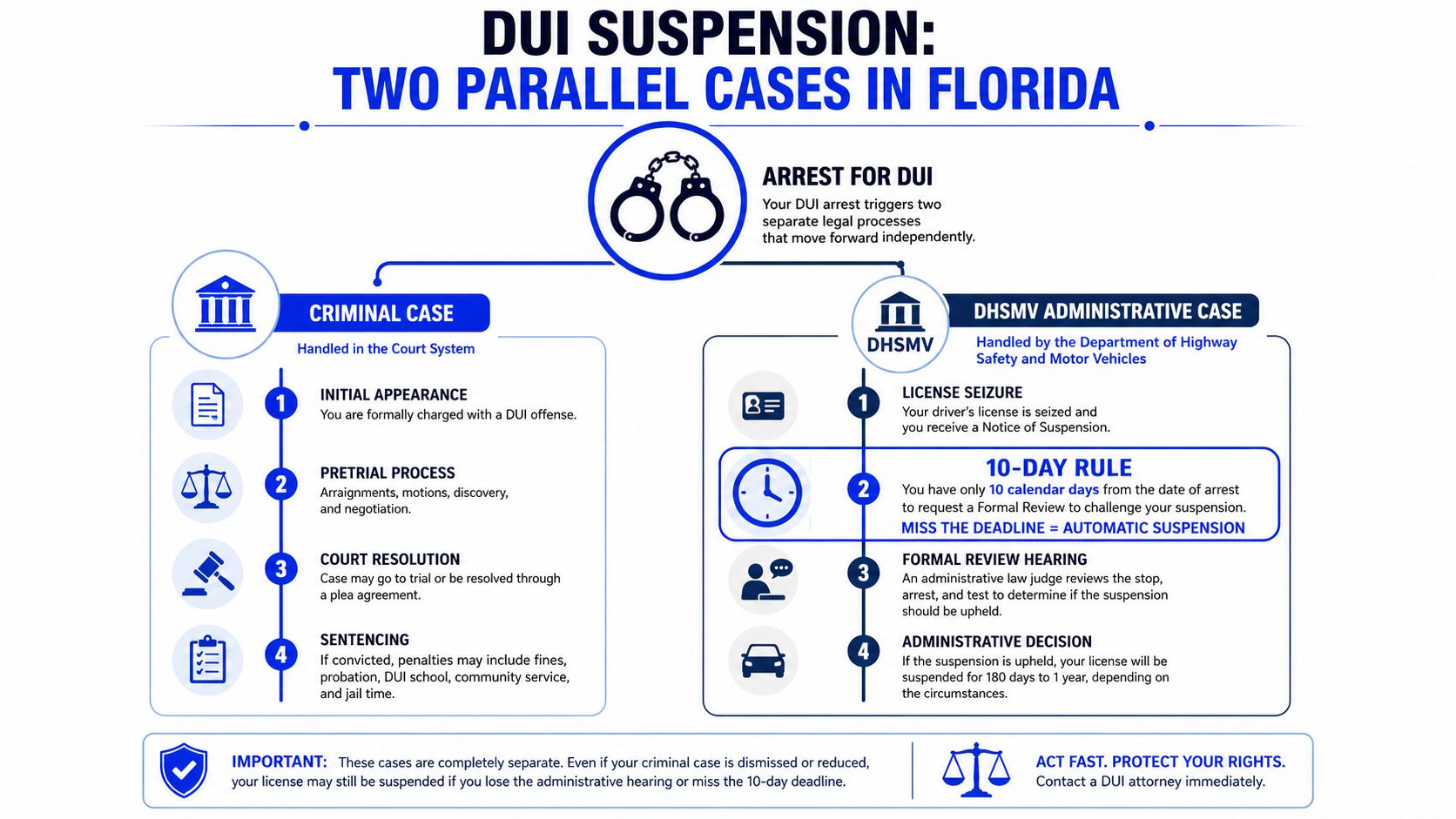
A Florida DUI creates two separate tracks. The criminal case proceeds through the court system, while the administrative license action proceeds through the licensing authority. One can continue even when the other is delayed, negotiated, or dismissed.
The administrative action can arise from an unlawful alcohol level or a refusal to submit to breath, urine, or blood testing. For a driver with a first unlawful alcohol-level suspension, the commonly applicable period is 6 months. A first refusal commonly carries 1 year, while some repeat refusal cases carry 18 months, according to Florida DUI suspension information.
What the 10-day deadline means
Florida gives you only 10 days after arrest to request review of the administrative suspension before it takes effect, as described in the Florida DUI law reference. That deadline is separate from your criminal court date. Waiting for an arraignment or assuming your lawyer will receive a later notice can cost you the administrative opportunity.
The basic sequence is:
The arrest occurs. The administrative action may begin even though the criminal charge hasn't been resolved.
You identify the deadline. Count from the arrest date and confirm the applicable review procedure.
You request review promptly. A formal review can allow the suspension to be challenged through the administrative process.
You prepare the evidence. The legality of the stop, testing procedure, refusal circumstances, and officer paperwork may matter.
You continue defending the criminal case. A hearing result doesn't automatically decide guilt or innocence in court.
Read what an administrative license suspension is before treating the DMV matter as a minor paperwork issue. If your BAC was 0.15 or higher, or a minor was in the vehicle, additional DUI consequences may apply, so the exact facts need immediate legal review.
Criminal DUI Revocations and Repeat Offense Escalation
An administrative suspension is not the same as a criminal DUI revocation. The administrative action can follow the arrest. The criminal revocation follows the court outcome and can produce a much longer loss of driving privileges.
Florida's escalation is severe. A second DUI within 5 years can carry a 5-year revocation, a third DUI within 10 years can carry a 10-year revocation, and a fourth DUI can lead to permanent revocation under the governing statute. A serious-injury or fatality DUI can also create permanent revocation exposure. Florida Statutes Section 322.28 sets out these major revocation consequences.
Offense Number | Lookback Period | Minimum Revocation | Hard Time Before Hardship | Hardship Eligible |
|---|---|---|---|---|
First DUI conviction | Applicable criminal record | At least 180 days under the applicable rule | Depends on the governing circumstances | May be available under Florida law |
Second DUI | Within 5 years | 5 years | Depends on the applicable statutory restriction | Potentially, after required restrictions |
Third DUI | Within 10 years | 10 years | Depends on the applicable statutory restriction | Potentially, after required restrictions |
Fourth DUI | Overall DUI history | Permanent revocation | No ordinary short waiting period restores the privilege | Permanent revocation can eliminate ordinary hardship relief |
The second and third rows are not technical details. Prior convictions can change a case from a temporary licensing problem into a long-term revocation. A person charged with a repeat DUI needs counsel to examine the prior judgment, timing, plea language, and record accuracy.
Review Florida DUI penalties and offense consequences, but don't confuse a general penalty chart with an individualized analysis. Administrative compliance can't erase a criminal revocation. The defense must address the criminal charge and the licensing consequences together.
Non-DUI Suspensions Including Points and Habitual Offenders
A suspension can start with points, insurance problems, or an unresolved court matter, even when no DUI is involved. Florida's points system sets specific timelines: 12 points within 12 months causes a 30-day suspension, 18 points within 18 months causes 3 months, and 24 points within 36 months causes 1 year, according to Florida's official points-suspension guidance.
Violation Type | Trigger Threshold | Suspension Length | Reinstatement Requirement |
|---|---|---|---|
Points suspension | 12 points within 12 months | 30 days | Confirm the period and clear any remaining holds |
Points suspension | 18 points within 18 months | 3 months | Confirm eligibility and satisfy Department requirements |
Points suspension | 24 points within 36 months | 1 year | Complete the applicable reinstatement process |
Insurance-related action | Lack of required proof or coverage issue | May remain active until the underlying issue is corrected | Provide acceptable proof and resolve the Department hold |
Court-related suspension | Unresolved court obligation | May continue until clearance | Obtain court or clerk clearance and update the record |
Habitual traffic offender revocation | Statutory designation | 5 years | Meet revocation and reinstatement requirements |
The general rule limits many non-DUI suspensions to no more than 1 year, unless another statute applies. That limit does not predict every result. DUI and habitual-offender rules can impose different consequences.
A habitual traffic offender designation carries a mandatory 5-year revocation. Review Florida's habitual traffic offender rules and defense options, along with Florida habitual traffic offender guidance, before assuming the five-year period is the only issue. If the Department counted the wrong conviction, misclassified an offense, or ignored timing, challenge the record promptly.
The stated period is only part of the answer. You still must satisfy reinstatement requirements, clear holds, and confirm that Florida has restored your driving privilege before getting behind the wheel.
Indefinite Suspensions and Debt-Based Barriers
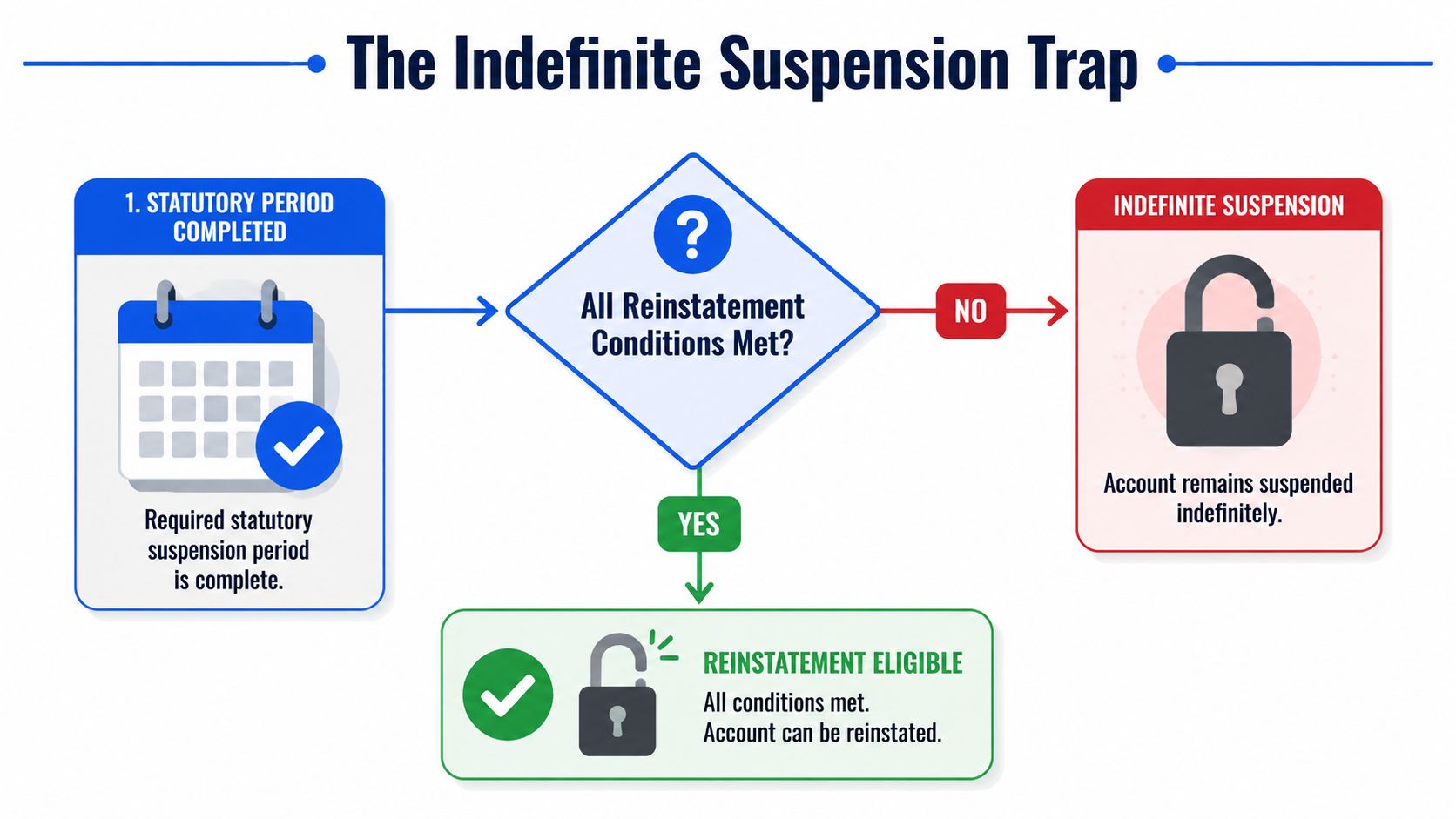
The most misleading answer to “how long does a license suspension last” is a single number. For many Florida drivers, the answer is until the underlying hold is cleared.
A statutory period can end while the license remains suspended in practice. Unresolved court obligations, missing insurance documentation, required education, or Department processing can prevent reinstatement. Florida's official guidance includes suspension examples ranging from 30 days and 90 days to 1 year or more, depending on the cause, and emphasizes that reinstatement requirements can remain after the stated period. Florida suspension and revocation guidance is the place to start checking the reason for the hold.
Why financial barriers matter
A driver may be suspended for a non-driving reason, such as unpaid obligations or a missed appearance, rather than conduct showing dangerous driving. Policy developments elsewhere demonstrate the issue. A 2025 Ohio law ended suspensions for failure to pay fines and fees and required automatic reinstatement of nearly 430,000 suspensions affecting more than 170,000 people, while a North Carolina settlement reportedly allowed up to 185,000 residents to seek restoration by proving inability to pay. The Fines and Fees Justice Center's legislative roundup discusses those developments.
Those figures aren't Florida outcomes, but they expose a practical truth. The length of a suspension can be controlled by a person's ability to satisfy administrative demands, not only by the seriousness of the original conduct. Check every county hold and ask whether a hardship, waiver, payment, or clearance process applies.
Reinstatement Requirements and Step-by-Step Checklist
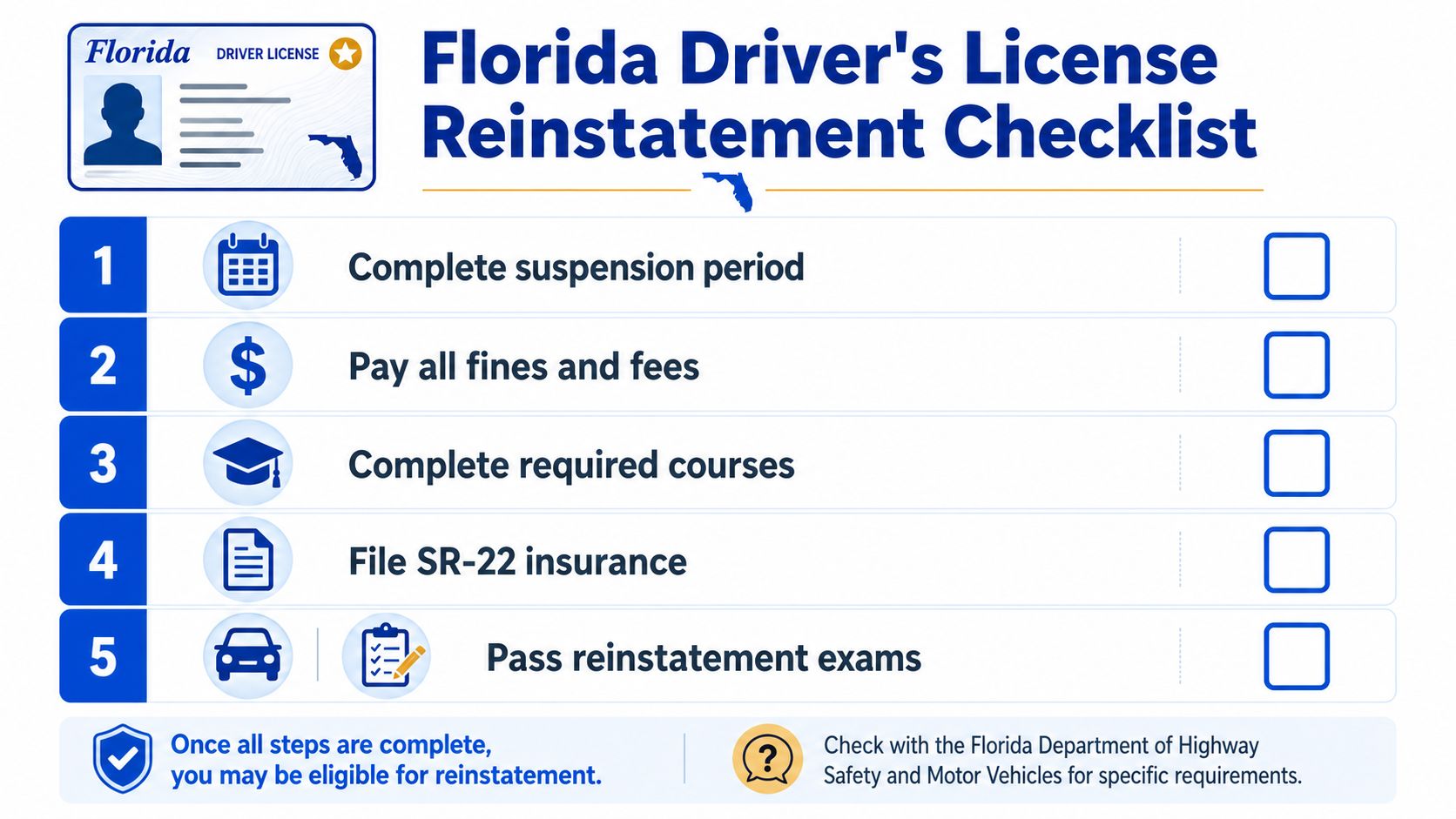
A Florida license isn't automatically safe to use because the suspension period has passed. First, obtain your current status and the exact reason for the hold. Then resolve each requirement in the order the Department or court demands.
A practical reinstatement sequence
Verify the record. Use the Florida licensing system or contact the appropriate office to identify active suspensions, revocations, cancellations, and county holds. Save the status information.
Complete the underlying obligation. This may involve court clearance, a required course, insurance documentation, or another condition tied to the specific action.
Address required insurance. If Florida requires an SR-22 or other proof of financial responsibility in your case, ask your insurer to file it correctly and confirm that the filing reached the Department.
Pay the applicable fees. The amount depends on the suspension or revocation. Don't assume paying one court balance resolves a separate licensing fee.
Confirm final reinstatement. Check that the status changed before driving. Ask for written confirmation when possible.
The order matters because a payment made before a course, filing, or court update may not release the hold. If another Florida county has an unresolved case, the licensing office may continue to show an active block even after your local matter is finished.
For a more detailed practical checklist, see how to reinstate a suspended Florida license. If the record is confusing, a Florida traffic-crime lawyer can compare the Department record with the court docket and identify what remains.
Hardship Hearings and Limited Driving Privileges
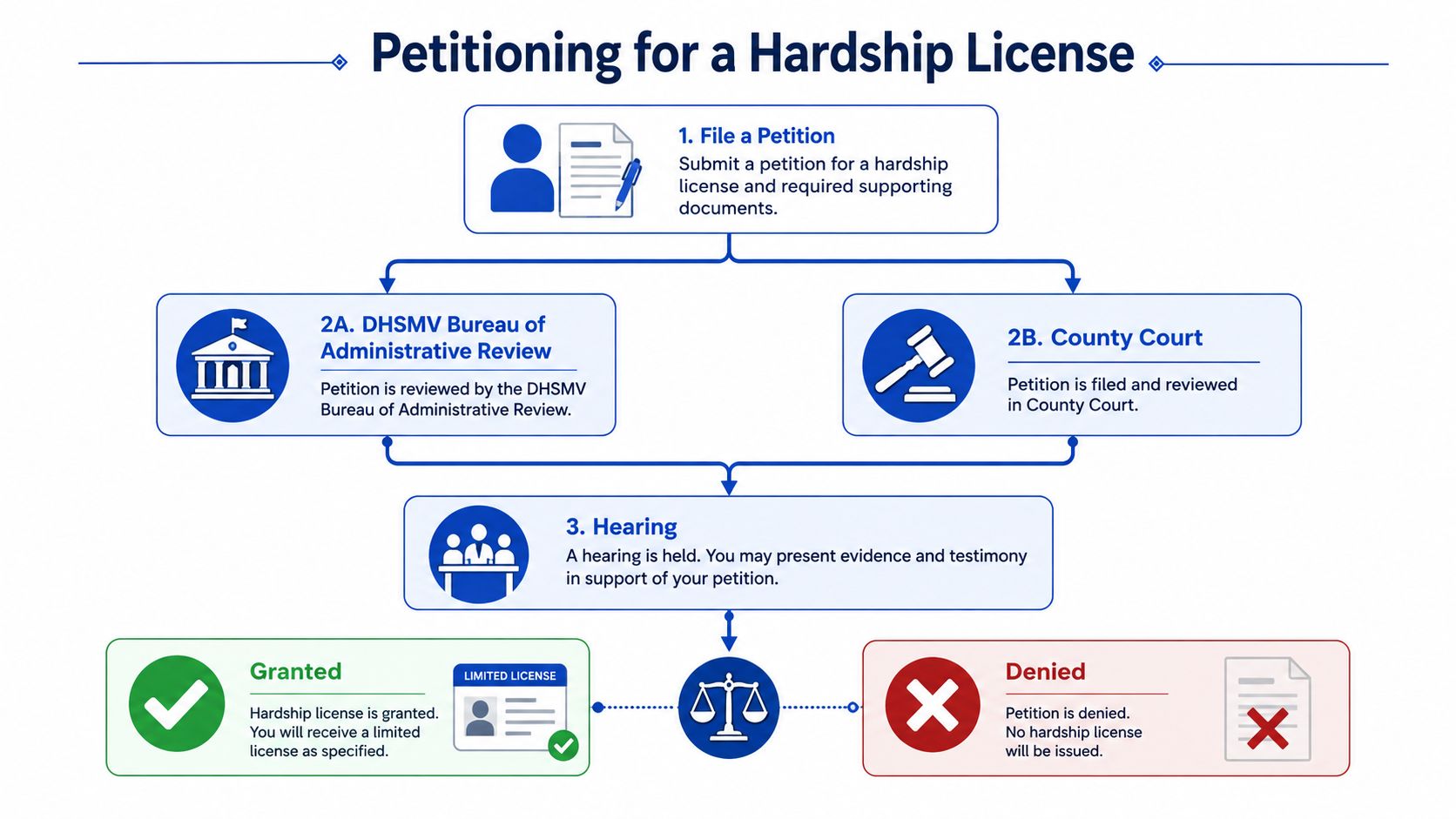
Florida law allows a person with a suspended, canceled, or revoked license to request a hardship hearing by showing serious hardship and that driving is necessary for the proper support of the person or family. Florida Statutes Section 322.271 provides the statutory basis for this type of request.
A hardship license isn't a general permission to drive whenever you need transportation. The approval may restrict driving to business, employment, school, medical care, or other approved purposes. A hearing officer will expect organized proof, not a general statement that driving is inconvenient.
Bring documents that show:
Employment necessity: Work schedule, employer information, and the consequences of losing transportation.
Family support: Evidence that your household depends on your ability to drive.
Compliance: Course enrollment or completion, insurance documentation, and court clearance.
Transportation limits: Specific facts showing why available alternatives don't solve the hardship.
Driving history: A complete and accurate record, including prior suspensions and revocations.
A hardship petition succeeds or fails on proof. Build the file before the hearing, not while sitting in the waiting room.
Repeat DUI histories can impose waiting restrictions before hardship eligibility. Habitual traffic offender cases are especially serious. The mandatory 5-year revocation generally doesn't open its statute-based hardship pathway until 1 year after the revocation date, according to Florida habitual traffic offender revocation guidance.
Driving outside the approved limits can create a new violation. If you receive a hardship license, read every restriction and follow it exactly.
Defense Strategies to Protect Your Driving Privileges
The best suspension strategy is often preventing the action from taking effect. In a DUI case, the 10-day administrative review deadline is the first urgent issue. Counsel can examine the arrest paperwork, testing records, refusal documentation, and the legal basis for the stop before the deadline expires.
A useful defense review asks:
Was the traffic stop legally justified?
Did the officer have a lawful basis to extend the detention?
Did the testing procedure comply with Florida requirements?
Do the records accurately identify the driver and prior history?
Did the Department calculate the suspension from the correct event?
Does the criminal charge support a reduction or dismissal strategy?
A formal administrative hearing can expose weaknesses in the State's paperwork and evidence. It doesn't replace the criminal defense, but the hearing can preserve an opportunity to challenge the licensing action while the court case continues.
Protecting the criminal record
The criminal outcome can control the long-term revocation. In an appropriate case, counsel may evaluate whether a reckless-driving resolution is legally and factually available instead of a DUI conviction. That decision depends on the evidence, prior record, prosecutor, court, and specific facts. No attorney should promise that a reduction is available.
Early preparation also matters. Completing an approved DUI education requirement when appropriate may demonstrate responsibility, but it won't erase evidence or guarantee a favorable resolution. The attorney should decide how that step fits into the defense rather than treating course enrollment as a substitute for challenging the State's case.
Ticket Shield, PLLC reviews Florida suspension reasons, reinstatement requirements, and administrative hearing options as part of a broader defense strategy. A Fort Lauderdale DUI lawyer or South Florida traffic-crimes attorney should be contacted immediately when a license issue involves a deadline, prior DUI, habitual-offender designation, or active criminal charge.
Frequently Asked Questions About Suspension Timelines
Does moving out of Florida erase a suspension?
No. Leaving Florida does not clear a Florida suspension or revocation. The problem may continue affecting your ability to obtain a license in another state until Florida's requirements are satisfied.
Will a suspended license appear on an employment background check?
A driving-record search can show a suspended or revoked status. That differs from a general criminal background check, but employers requiring driving may review your motor-vehicle record and ask whether you are currently eligible.
What's the difference between suspension and revocation?
A suspension withdraws your driving privilege for a period or until a condition is met. A revocation is more severe. You may have to wait, satisfy additional conditions, and apply for a new license instead of reactivating the old one.
What happens if I drive while suspended?
You can face a separate traffic-crime case. The consequences can increase when the suspension involves certain prior history or habitual traffic offender status. Do not drive to work and hope the record is overlooked. Confirm your status first and pursue a lawful hardship option if Florida permits one.
Does the license restore automatically when the period ends?
Usually, you must confirm that every hold is cleared before driving. A statutory period may end while a court order, compliance issue, or agency record still blocks reinstatement. Ask the clerk or Department to identify the specific unresolved item, then obtain proof of clearance. Do not rely on an expiration date printed in old paperwork.
Does hardship-license driving reduce the suspension?
A limited driving privilege generally permits only the trips and purposes stated in the authorization. It does not, by itself, shorten the underlying suspension or revocation. Read the order carefully, because unauthorized driving can create a new violation and complicate reinstatement.
If a DUI, drug, theft, domestic-violence, weapons, probation, or other criminal charge accompanies the license problem, address both matters together. The suspension can affect employment and court compliance, while a conviction can create longer licensing consequences. No attorney should promise a reduction is available.
Ticket Shield, PLLC helps Florida drivers review suspension records, meet reinstatement requirements, and respond to time-sensitive administrative hearing deadlines. Visit Ticket Shield, PLLC for a confidential consultation about protecting your driving privilege in Broward County, Fort Lauderdale, Miami-Dade, Palm Beach, or elsewhere in South Florida.