What Is a Parole Violation in Florida
Jason Goldsmith, Esq
A parole violation in Florida is any breach of release conditions or any new crime committed while on parole, and it can trigger arrest and revocation even if the conduct would normally be handled differently in a new case. In the United States, parole supervision has been large enough to shape prison admissions for decades, with about 312 adults per 100,000 under parole supervision in 2000, up from 121 per 100,000 in 1980 and 271 per 100,000 in 1990 (Pew).
If you just got a call from a parole officer, a notice of violation, or a surprise arrest, you're probably trying to figure out one thing first, how bad is this really? The answer depends on whether the allegation is technical or tied to a new crime, what proof the State has, and how fast a defense lawyer gets involved.
Table of Contents
What Parole Means and What a Parole Violation Really Is
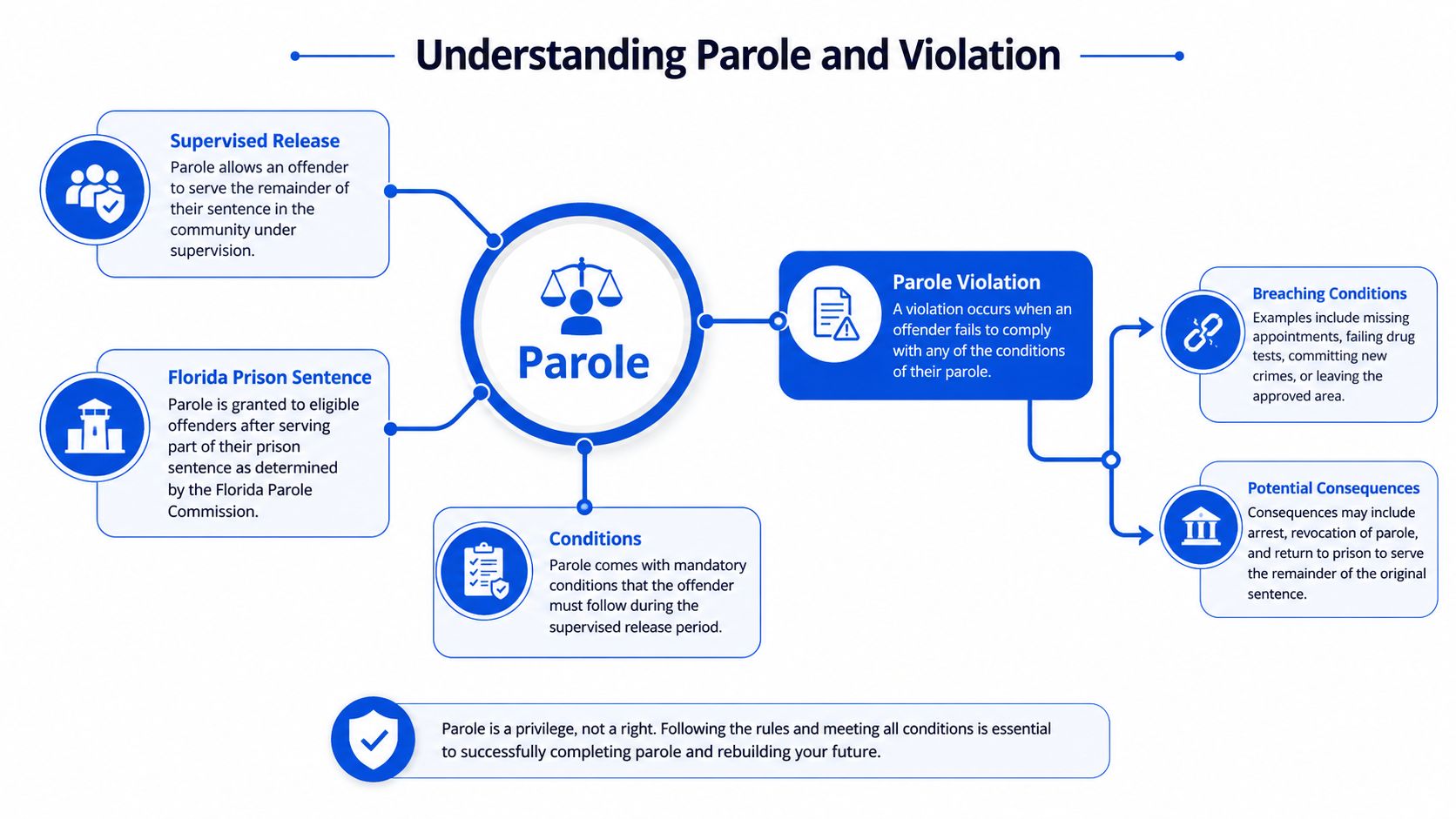
You get out of prison, but you do not get a clean slate. Parole is supervised release after prison, and the person released is still serving the sentence under conditions set by the supervising authority. In Florida, that means a parole officer keeps watch on compliance and can turn a routine mistake into a serious enforcement problem.
A parole violation happens when someone breaks those release conditions or picks up a new criminal case while on parole. Missing a meeting, ignoring curfew, leaving the approved area, or contacting someone off-limits can all become violation allegations once the parole officer documents them as noncompliance. Florida supervision rules can also cover reporting, travel limits, drug testing, treatment, work, and contact restrictions, and breaking those terms can lead to consequences ranging from warnings to a return to prison (Roth Legal).
For more detail see our guide on violation of probation, because the way supervision cases are built follows the same basic playbook.
Why the system treats violations so seriously
Parole officers look past the new arrest paper and focus on whether the person stayed inside the conditions that justified release in the first place. That is how these cases get built, one missed appointment, one failed test, one unauthorized contact at a time.
Pew reported that supervision systems place millions of adults under probation or parole at any given time (Pew). The CSG Justice Center has also reported that states still send large numbers of people back to prison for supervision violations, including technical violations alone (CSG Justice Center). That is why a parole violation is not a paperwork issue. It is a liberty issue.
Practical rule: if the parole officer says a condition was broken, treat it as serious immediately and assume the State will try to build a record around it.
For Florida clients, the first move is to identify the exact condition at issue and the exact date of the alleged breach. The next move is to stop explaining it casually to anyone. That is how a manageable supervision problem turns into a revocation case, and that is where defense counsel starts looking for weak spots in the officer's report, the proof, and the alleged violation itself.
Technical Violations vs New Crime Violations
A technical parole violation is a broken supervision rule, not a new offense. A new-crime violation is an arrest or conviction for a fresh offense while the person is on parole. That distinction drives everything that follows, because the State will frame the case differently, the proof will look different, and the defense should attack it differently.
Technical violations are the ones people shrug off at first. Missed reporting, a failed drug test, curfew violations, leaving the approved area, contacting forbidden people, or skipping required treatment may not sound criminal in ordinary life, but parole officers treat them as compliance failures. New-crime allegations usually hit harder because they suggest the person did more than break a rule, they picked up fresh criminal exposure.
Category | Common Examples | Typical Florida Response | Burden of Proof |
|---|---|---|---|
Technical parole violations | Missed meetings, failed drug or alcohol test, curfew breach, unauthorized travel, prohibited contact, employment or treatment noncompliance | Warning, tighter supervision, added conditions, short custody sanction, or revocation in serious or repeated cases | Preponderance of the evidence at the revocation stage (FindLaw) |
New-crime violations | Arrest, charge, or conviction for a new offense while on parole | More aggressive revocation path, possible reincarceration | Same lower revocation standard applies in the hearing process, even though the new case may also proceed separately |
Florida practice draws a hard line between a technical violation and a new offense, because the sanction options change once criminal conduct is involved (Pennsylvania Parole process materials). If the allegation is technical, defense counsel usually attacks the paper trail, the timing, and whether the officer can prove the breach. If the allegation involves a new offense, the defense has to fight two battles at once, the revocation case and the new criminal case.
Learn more about technical violations here (technical parole violation defense).
The hard part for clients is that noncriminal noncompliance can still lead to custody. A parole officer can turn repeated missed appointments or other technical misconduct into a pattern argument, and that is how a small lapse becomes a detention problem. Under one state framework, the first two sustained technical violations do not automatically trigger reincarceration, but later sustained violations can lead to short jail terms of up to 7, 15, and 30 days respectively (Rennalawoffice). The lesson is plain. The system reacts less to the label and more to the risk signal.
How the Florida Revocation Process Works
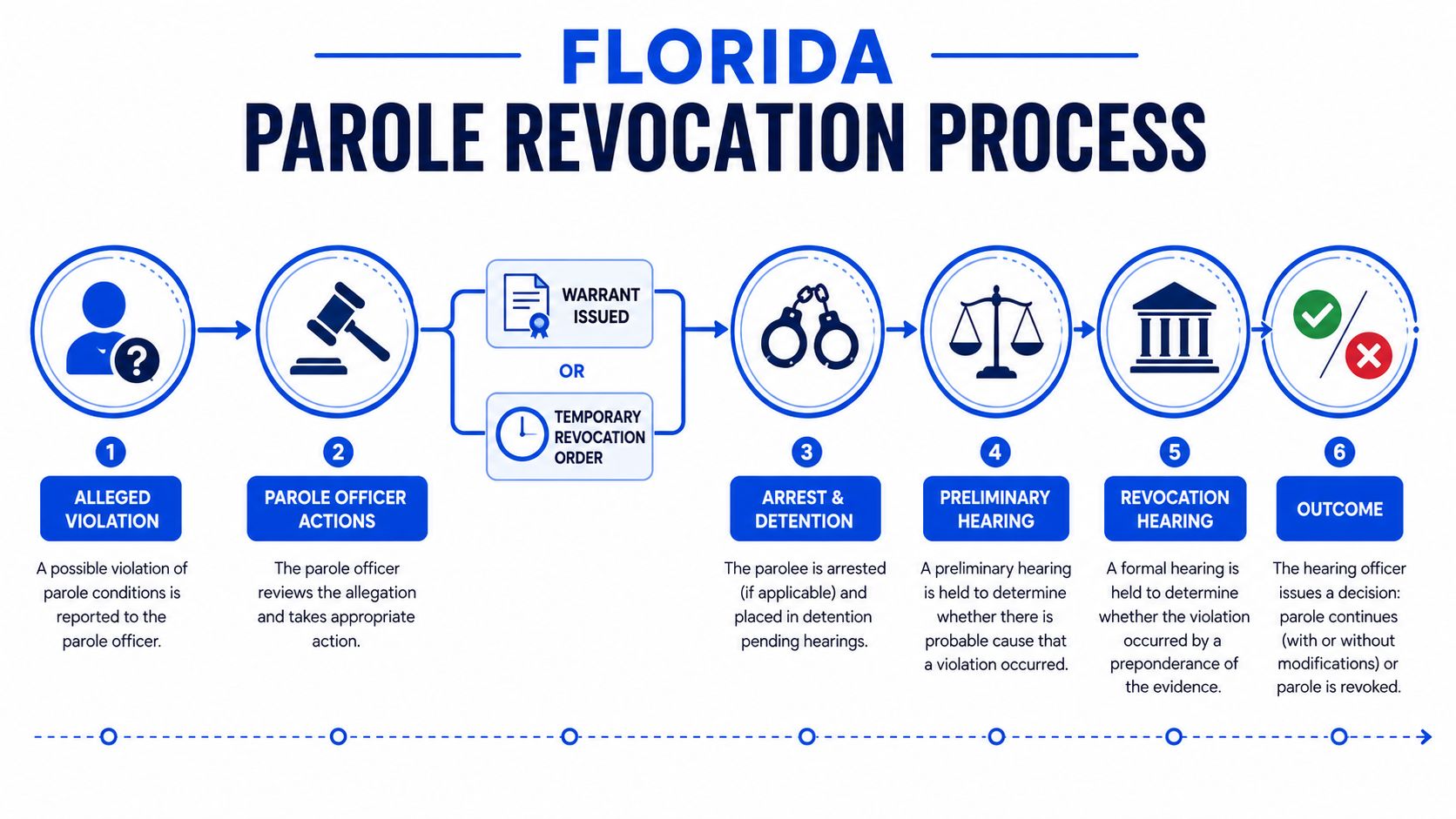
The process usually starts with an allegation, not a conviction. A parole officer can seek a warrant or a temporary revocation order, and once that happens the person may be taken into custody and held in county jail while the case moves forward. New York's DOCCS says a parole officer may obtain a warrant after probable cause and that a Notice of Violation and Violation of Release Report must be served, which matches the basic procedural reality clients face when supervision turns into a formal revocation case (DOCCS).
The two hearings that matter most
The first hearing is a preliminary hearing. Its job is to decide whether there is probable cause to believe a violation happened. That lower screening function matters because it determines whether the case keeps moving.
The second is the final revocation hearing, where the decision-maker considers the alleged violation, the evidence, and the appropriate response. Florida revocation hearings use a preponderance of the evidence standard, meaning the State only has to show it is more likely than not that the violation occurred (FindLaw). That is much lower than the beyond a reasonable doubt standard used in a criminal trial, and clients get burned when they assume the State needs a trial-level case to win.
The hearing is not about whether the police would win a brand-new criminal trial. It's about whether the parole system can justify taking liberty back under a lower proof standard.
A parolee can usually be represented, can present evidence, and can challenge what the officer says happened. That's why documentation matters so much. Attendance records, treatment logs, work records, and witness statements can change the hearing posture fast if they show the alleged violation is incomplete, mistaken, or blown out of proportion.
Penalties, Detention, and Possible Outcomes
A parole violation can end with a warning, tighter reporting, treatment, electronic monitoring, a short jail sanction, or full revocation and a return to custody to finish the original sentence. Florida does not treat every violation the same. The response turns on the conduct itself, the person's record on supervision, and whether the parole system believes the person can still be managed in the community.
The hard truth is that the case gets more serious as the facts look more like a public-safety problem. Missing a meeting, testing positive, or falling behind on paperwork leaves room for a corrective response. Absconding, a new felony, or repeated refusal to follow directions pushes the case toward detention and revocation. Some jurisdictions define absconding as being unknown for 60 days or more, which is one reason supervision failures can escalate so fast (Rennalawoffice).
What decision-makers usually weigh
Severity of the violation. Missing one appointment is not the same as picking up a new violent charge.
Compliance history. A clean record helps. Repeated noncompliance hurts.
Risk to the community. The more danger the conduct suggests, the less room there is for leniency.
Need for structure. Treatment, reporting changes, or monitoring may be used when custody is not the only answer.
Florida clients need to hear this plainly. Repeated technical violations are not brushed off as harmless. Officers and the Commission see a pattern, and once they do, the response gets tougher. A person who keeps missing curfew or check-ins can end up in a much worse position than someone who fixed the problem right away.
Courts and supervision agencies also pay close attention to custody exposure in these cases. For a plain explanation of how jail time can enter the picture after a supervision violation, see probation violation jail time. That is the part many people miss. Once the file starts showing repeated noncompliance, the system stops looking for excuses and starts looking for the safest way to control risk.
What to Do Right Now If You Have Been Accused of a Parole Violation
You do not get points for explaining yourself fast. If a parole officer, police officer, or jail staff member starts asking questions, stop and protect yourself. Stop talking. Anything you say can be written into the violation file and later used at the hearing, even if you meant it to help.
Your first moves should be simple and disciplined
Stay calm. Panic leads to bad decisions, missed deadlines, and statements that are easy to use against you.
Do not make statements. If an officer wants answers, say you want a lawyer before you discuss anything.
Gather proof. Collect attendance records, treatment logs, employer letters, pay stubs, travel permissions, and texts or emails that show compliance or a real effort to comply.
Secure the paperwork. Have a family member or trusted person find any warrant, notice of violation, summons, or release paperwork right away.
If a surprise home visit turns into an arrest, do not argue your case on the spot. Ask for counsel and end the conversation. If a hearing is already on the calendar, your lawyer can ask for more time when records still need to be collected, witnesses still need to be lined up, or the State's evidence is still weak.
That is not stalling. It is damage control.
For a searchable Florida-specific checklist on related supervision matters, see probation violation lawyer near me. The same practical instinct applies here, move fast, preserve documents, and stop the State from locking in its story before you get a chance to challenge it.
Best move: treat every parole contact like it may end up in a hearing packet.
Common Defenses and Mitigation Strategies
A defense lawyer does not have to prove perfection. The job is to show the allegation is weak, incomplete, or not serious enough to justify revocation. That starts with the proof itself. A failed drug test can be challenged if the result is unreliable, the chain of custody is shaky, or the alleged violation is not as clear as the officer claims.
The pressure points that matter
Probable cause can be attacked. If the officer's account is thin, inconsistent, or based on hearsay, the case can lose force early.
The condition may be unclear. A person cannot fairly be punished for a term that was vague, impossible to follow, or never properly explained.
Substantial compliance helps. If the client was mostly complying, had stable work, and was making treatment progress, that context matters.
Mitigation can change the outcome. Employment, caregiving, medical issues, and documented recovery efforts can support a lesser sanction.
Florida parole systems are built to distinguish between a slip and a refusal. That means the defense should show the difference clearly and quickly. If the allegation is technical, the lawyer should push hard on whether the conduct was a condition breach or just a temporary problem that has already been corrected.
Repeated technical misconduct can also be framed differently when the client has a concrete plan. Treatment enrollment, schedule changes, verified housing, or better reporting habits can persuade a decision-maker to modify conditions instead of revoking parole. The same is true when the underlying issue is a support problem, not a public-safety threat.
You should not walk into a revocation hearing and hope the officer “understands.” Bring records, proof, and a clean explanation. If the State wants custody, make it prove why lesser supervision won't work first.
How a Florida Parole Violation Attorney Can Help
A parole violation case gets harder to beat once the record hardens. The right lawyer gets involved before that happens. Counsel should contact the parole officer, demand the paperwork, request the hearing, and test whether the file supports the accusation. These cases often turn on what was written down, what was assumed, and what never happened at all.
A former prosecutor sees the pattern fast. Attorney Jason S. Goldsmith brings that perspective to revocation matters, which helps identify weak witness accounts, unsupported conclusions, and reports that stretch the facts beyond what the evidence shows. If you want a clear example of that approach, read this guide on finding a probation violation lawyer near you.

What strong representation actually does
Good defense work starts with the file, not a speech. Counsel subpoenas records, tracks down witnesses, prepares mitigation, and pushes back on detention when the allegation does not justify holding the client. It also keeps the client from making damaging statements while the case is still being built.
That record work matters because parole officers often file violations from incomplete notes, missed follow-up, or one-sided reports. A lawyer who knows how these files are assembled can press on the gaps, challenge the supervision narrative, and force the State to prove more than suspicion. If the paperwork is thin, the hearing should expose it.
Ticket Shield, PLLC provides statewide criminal defense help with 24/7 availability, and that matters when someone is arrested on a weekend, during a holiday, or after hours. The approach is straightforward. Protect the record, attack the weak points, and stop the client from trying to fix the situation alone.
If you're in Broward County, Fort Lauderdale, Miami-Dade, Palm Beach, or anywhere else in South Florida, speed matters. The first conversation should focus on the allegation, the paperwork, the hearing timeline, and what proof can be gathered before the State settles on its version of events.
Key Takeaways and Next Steps
A parole violation in Florida can be a technical rule break or a new crime, and either one can lead to arrest and revocation. The proof standard is lower than a criminal trial, which means the State does not need the same level of proof it would need for a conviction. The Commission has broad discretion, and the difference between a warning and a return to prison often comes down to timing, documentation, and defense strategy.
If you are under supervision in Fort Lauderdale, Broward County, Miami-Dade, Palm Beach, or anywhere in South Florida, don't try to handle this casually. Get the paperwork, stop talking, and line up counsel before the hearing or the next contact with your parole officer. The sooner the defense starts, the more options you usually have.
If you're facing a parole violation in Florida, Ticket Shield, PLLC can step in quickly, review the violation paperwork, and help you build a defense before the hearing gets away from you. Contact Ticket Shield, PLLC for a confidential consultation if you need immediate help in Broward County, Fort Lauderdale, Miami-Dade, Palm Beach, or another South Florida court.