Felony Probation Violation in Florida: What Happens Next
Jason Goldsmith, Esq
A felony probation violation in Florida is usually not a new criminal charge. It is a hearing where a judge decides whether to revoke, modify, or continue supervision, and if probation is revoked, the original sentence can come back into play.
That is why these cases feel like a sentencing do-over. A person who thought probation was the finish line can be hauled back into court, often after a call from a probation officer, and the judge may still have the full punishment tied to the original felony on the table.
A probation officer walks into a warehouse, a supervisor points across the floor, and a worker gets pulled aside in front of everyone. That kind of moment is jarring, but it is also typical of how quickly a felony probation violation can turn into a custody problem, a warrant problem, and a sentencing problem all at once. The legal issue is not whether the person likes probation or meant well, it is whether the court believes a condition was breached and what to do next under Chapter 948. If you want the baseline definition of the underlying charge that probation grew out of, this overview of a felony charge helps frame the stakes.
Table of Contents
What a Felony Probation Violation Really Means in Florida
Probation in Florida is a deal. A person keeps freedom in the community, but only by giving up some liberty, following conditions, and staying available to supervision. When that deal breaks, the court can reopen the punishment question, and in a felony case that can mean the full statutory maximum tied to the original offense is back on the table.
Probation, community control, and drug offender probation
The labels matter less than the practical reality. Regular probation usually means reporting, testing, classes, fees, and no new law violations. Community control is tighter, more like house arrest with supervision attached. Drug offender probation tends to add treatment, testing, and compliance obligations that are easy to document and easy to miss.
A felony probation violation is not the same thing as a new arrest report, even when one is involved. It is a court process under which the judge decides whether the person stayed within the rules of release. The point is simple, probation is a conditional sentence, not a reset button.
Practical rule: if the probation order says it and the person signed it, the court usually treats it as a real condition worth enforcing.
Florida judges do not need a jury to sort that out, and they do not need criminal-trial proof to act. In practice, that means the system can move on a lower evidentiary showing while still threatening a harsher outcome than the original conviction sometimes carried at the sentencing table. That is the tension in nearly every felony VOP case.
Technical Violations vs New Offense Violations
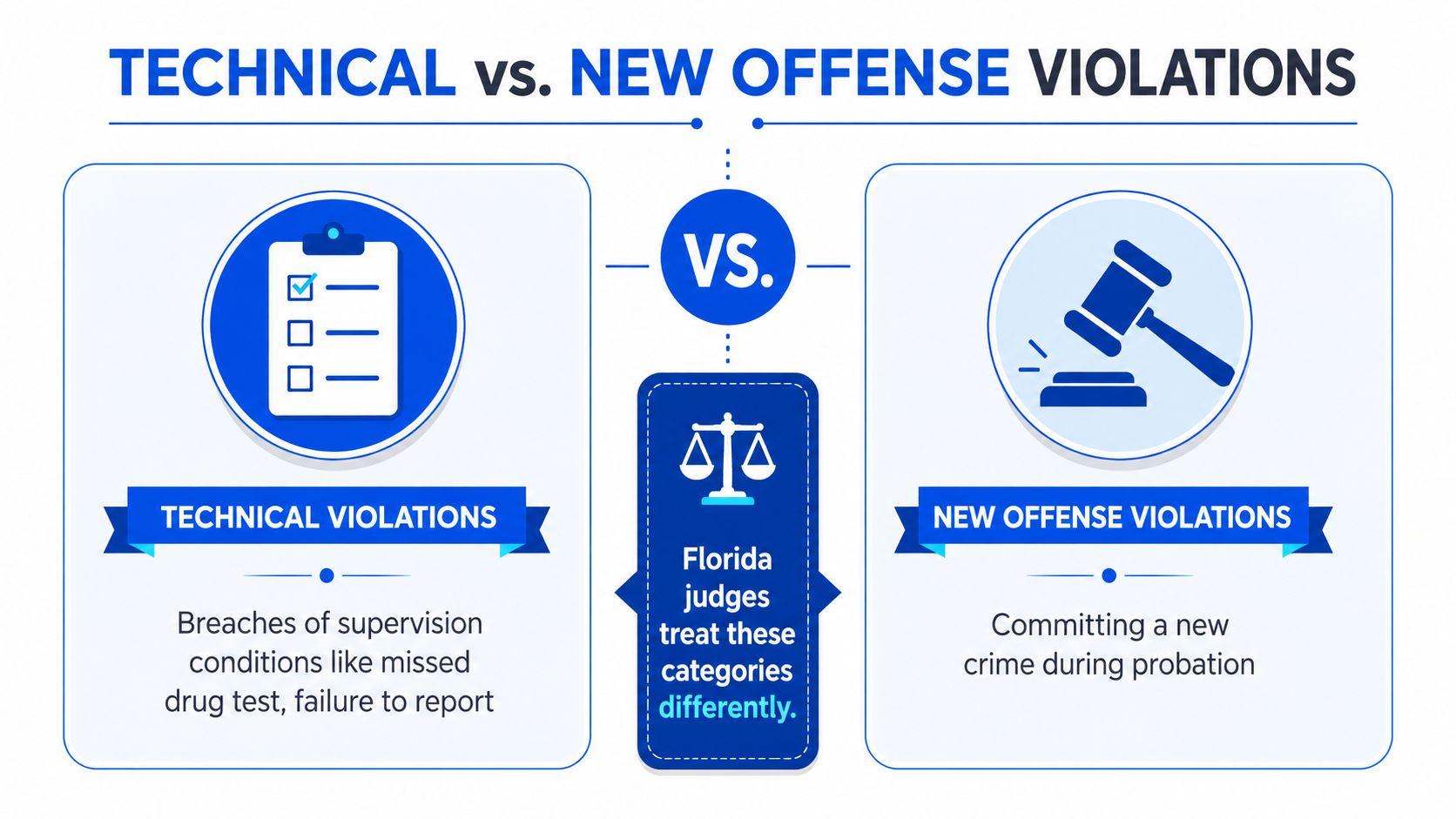
Florida judges usually see two very different kinds of alleged violations. One is a technical violation, meaning the person broke a supervision rule. The other is a new-offense violation, meaning the person is accused of fresh criminal conduct while on probation.
Three examples that show the difference
A positive urine test is usually handled as a technical issue first. The question becomes whether the sample is reliable, whether the test was administered properly, and whether the probationer can show a treatment or medical explanation. If the record is clean otherwise, the court may lean toward modified conditions instead of revocation.
Driving to Georgia without permission is also technical, but it lands differently because travel restrictions are easy to verify and hard to explain away. A judge may view that as disrespect for supervision, especially if the person knew the rule and crossed the line anyway. Still, the defense can matter if there was confusion, emergency travel, or written permission that was later disputed.
A new retail theft arrest is different. Even if the case is not yet resolved, the VOP hearing can treat the arrest report as the basis for revocation. That is why new-offense allegations often move probation cases straight toward more serious consequences.
The split is practical, not philosophical. Technical violations often invite added conditions, brief jail exposure, or a warning from the bench. New-offense allegations usually push the case toward full revocation and a sentencing fight.
If you want a Florida-focused overview of technical cases, this guide on technical violation of probation fits the same playbook.
A violation hearing is often less about labels than leverage, one clean document can matter more than a long argument.
How the Florida Probation Violation Process Unfolds
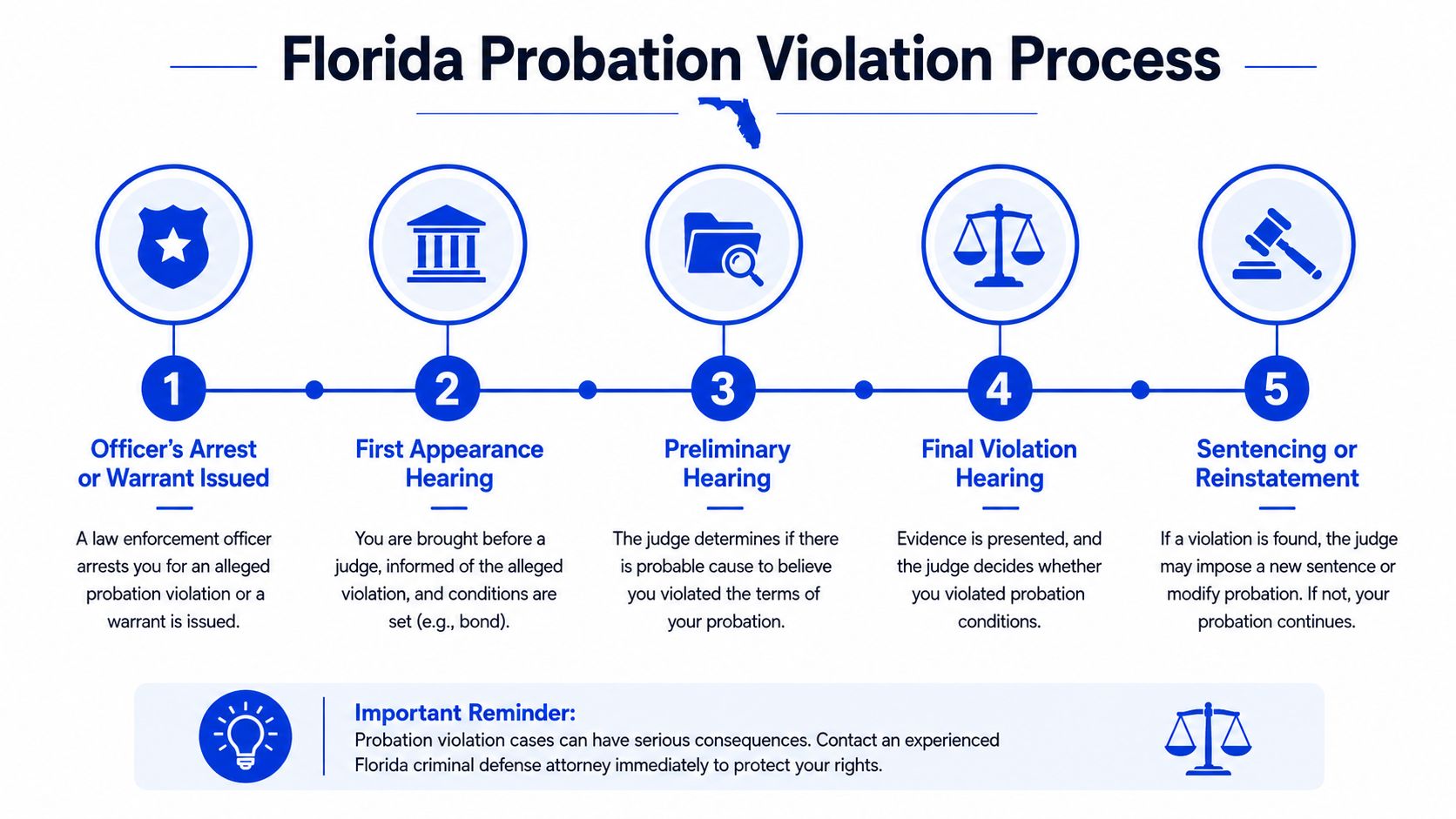
A probation violation in Florida usually starts one of two ways. A probation officer arrests the person on the spot, or the officer files an affidavit of violation and the court issues a warrant. Either way, the case stops feeling routine fast. What used to look like supervision turns into a sentencing do-over, and the original penalty range comes back into play.
What happens after the arrest or warrant
Timing becomes the first pressure point. In custody cases, Florida's juvenile materials reflect a 24-hour probable-cause hearing concept for children, while adult cases follow their own path once the person is detained. If the alleged violation happened in another county, compact and jurisdiction questions can also affect where the hearing happens and how quickly it moves.
The next stop is the first appearance. Bond is not automatic, and many VOP cases stay in custody while the judge sorts out the allegation, the probation history, and whether release makes sense. After that comes the arraignment on the violation and, later, the final hearing before the sentencing judge.
The difference between winning a VOP case and losing one often comes down to a single document rather than a lengthy argument. A clean report, a missing signature, a disputed condition, or a weak paper trail can matter more than courtroom noise.
The final hearing is not a jury trial. The judge hears the witnesses, reviews the violation report, and decides whether the violation happened and what the result should be. In many cases, the matter moves faster than a new felony case, but serious allegations can still move with real speed.
Here is a visual overview of the same process.
If you want a courtroom-oriented explanation of motion practice and hearing prep, this page on a motion hearing in court gives useful context.
Penalties a Judge Can Impose After Revocation
Florida law gives the judge three immediate choices after a violation hearing, revoke probation, modify probation, or continue it. If probation is revoked, the court can sentence the person to any punishment that was available at the original sentencing, which is why a VOP can become a sentencing do-over instead of a small side issue.
The stakes by felony degree
The maximum exposure depends on the underlying felony. A third-degree felony can carry up to 5 years, a second-degree felony up to 15 years, and a first-degree felony up to 30 years. For some cases, life felony exposure can be even more severe, which is why revocation scares people who thought the case was long behind them.
Felony Degree | Maximum Prison Sentence | Statute Reference |
|---|---|---|
Third-degree felony | Up to 5 years | Florida sentencing structure under §948.06 and the original felony level |
Second-degree felony | Up to 15 years | Florida sentencing structure under §948.06 and the original felony level |
First-degree felony | Up to 30 years | Florida sentencing structure under §948.06 and the original felony level |
Life felony | Potentially life exposure | Florida sentencing structure under §948.06 and the original felony level |
The judge also looks at the violation scoresheet, the person's prior record, whether there is a new offense, and whether the probationer absconded or missed court. A first technical slip may draw modification, especially where the person shows treatment, work, or housing stability. A new felony arrest or repeated failures usually push the court toward revocation.
If the court revokes probation, credit for time already served becomes important, and sentencing credit issues are usually handled right there in the hearing. That is why lawyers fight the hearing itself and the sentence that might follow.
For a plain-English explanation of jail time exposure after a violation, this page on probation violation jail time tracks the same risk.
Common Defenses That Hold Up at a VOP Hearing
The burden in a violation hearing is lower than at trial. In Florida, a judge can act on a preponderance of the evidence, which means the question is whether the alleged violation is more likely than not, not whether the State can prove a new crime beyond a reasonable doubt. That lower standard makes documentation and procedure matter a lot.
Documentation and nonpayment defenses
Clean records win more cases than speeches. Pay stubs, treatment sign-ins, GPS records, text messages with the officer, and job-site logs can undercut an alleged technical violation fast. If the allegation is missed payment, the issue usually turns to whether the person had the ability to pay, not whether they were in trouble financially.
The defense gets stronger when the file shows effort, not excuses.
Florida courts and related probation-revocation decisions recognize that a person's poverty is not, by itself, a fair reason to revoke. Once the State shows nonpayment, the person should be ready to show what happened with income, bills, treatment costs, or job loss, then force the State to prove the failure was inexcusable.
Search, timing, and procedure issues
Unlawful searches, shady stop procedures, and home visits without a real legal basis can undermine the violation. So can missed testing opportunities caused by officer unavailability or a bad reporting instruction. If the affidavit was filed late or the warrant was defective, the defense may have a deadline problem to raise before the judge reaches the merits.
A lawyer should also look for anything that shows the violation was not willful and substantial. That argument matters when the slip is minor, ambiguous, or caused by confusion rather than defiance. The mitigation package then becomes part of the defense, stable work, treatment enrollment, family support, and a clear compliance plan can turn a likely revocation into continued supervision.
For misdemeanor-level comparison, this misdemeanor probation violation page helps show why the felony stakes are heavier even when the facts look similar.
What to Do in the First 72 Hours After a Violation
A missed random UA can spiral fast, especially if the officer says a retest failed and an affidavit is coming. The first 72 hours matter because people often make their worst decisions right then, usually by calling the officer alone and talking themselves into a worse record.
The first six hours
Write down everything. Note the date, time, who called, what was said, where you were, and whether you had any medical reason, work conflict, or transportation problem. Gather proof of employment, treatment attendance, prescriptions, and any texts or emails that support your version.
The next day
Hire counsel quickly and let the lawyer make the contact. Do not argue with the probation officer in the hallway or by text, and do not guess about facts you do not fully remember. Bring every document to the consultation, because small details often decide whether the case becomes a revocation fight or a modification discussion.
Day two and day three
If a meeting is scheduled, go with your lawyer, not alone. Then build a mitigation packet that includes pay stubs, character letters, treatment progress, and a realistic compliance plan the State can use. Quick, organized action often changes the recommendation before the warrant is even signed.
Practical rule: the sooner the lawyer sees the paperwork, the more options usually stay alive.
Ticket Shield, PLLC is one example of a Florida defense firm that handles probation violation situations by reviewing the allegation, sorting out the documents, and stepping in before a technical issue hardens into a warrant. The key is not the label on the firm, it is whether someone moves fast enough to protect the record.
Choosing the Right Florida Probation Violation Attorney
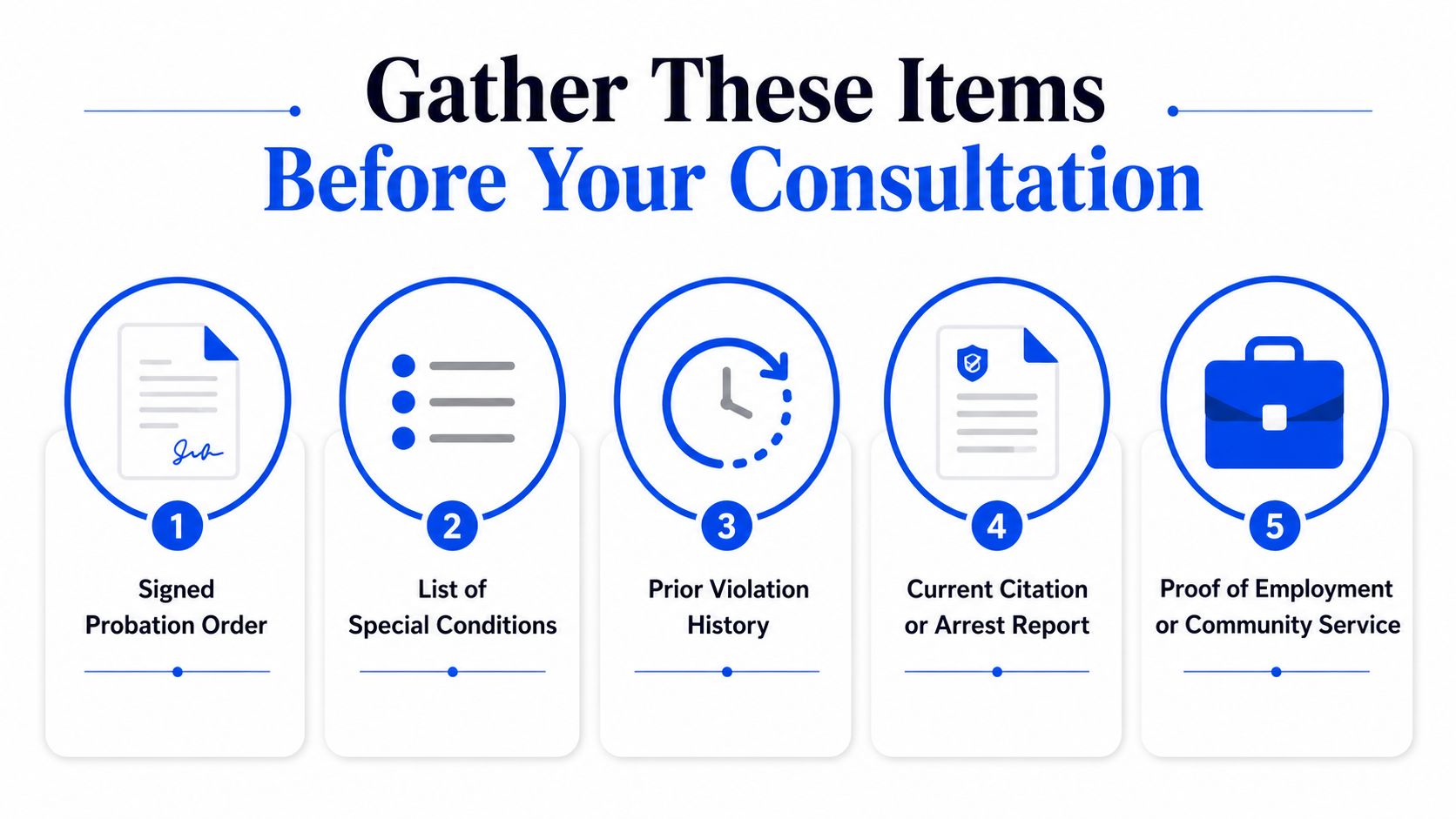
Bring the paper trail first. A lawyer cannot assess a probation case without the signed probation order, the special conditions, prior violation history, the current citation or arrest report, and proof of employment or treatment. If those documents are scattered, the first meeting turns into detective work instead of strategy.
Questions that actually matter
Ask how the lawyer handles bond motions, sentencing memoranda, and violation-hearing preparation. Ask who will appear in court and whether the office knows the local circuit's revocation culture, because the same argument lands differently from one courtroom to the next. Ask about billing too, flat fee or hourly, so there are no surprises when the hearing gets set.
A few red flags are easy to spot. Guarantees of dismissal are nonsense, and any lawyer who refuses to discuss the worst-case sentencing exposure is not giving you the whole picture. So is a vague promise that ignores the probation officer, the judge, and the underlying felony level.
What a strong intake should produce
Signed probation order: The exact conditions control the case, not memory or guesswork.
Violation history: Past slips help explain what the court is likely to do next.
Current report or arrest paperwork: The alleged facts have to be checked line by line.
Employment and treatment proof: Real-world stability supports modification instead of revocation.
Questions about courtroom strategy: The defense should sound like a plan, not a pep talk.
A careful lawyer is not trying to sell comfort. The job is to narrow the exposure, challenge the weak points, and preserve the chance of continued supervision.
Key Takeaways and Frequently Asked Questions
Early action matters more than panic. Preserve the documents, keep the timeline straight, get counsel involved quickly, and push for bond review or a mitigation plan before the file hardens into a full revocation problem. In these cases, the paper trail often speaks louder than the accusation.

Frequently asked questions
Can you get bond after a probation violation warrant? Sometimes, but not automatically. The judge will look at the allegation, custody status, and risk before deciding.
Can a probationer waive the hearing? In some cases, yes, but that choice should be made with counsel after the record and exposure are reviewed.
How is credit for time served handled if probation is revoked? The judge addresses that at sentencing, along with any remaining jail or prison exposure.
What is the difference between an administrative violation and a judicial violation? Administrative issues are often handled through the probation system first, while judicial violations go before the court for a formal ruling.
Can a technical violation be resolved without a revocation hearing? Often, yes. That is where quick documentation, treatment proof, and a sensible compliance plan matter most.
If you're dealing with a felony probation violation in Broward County, Fort Lauderdale, Miami-Dade, Palm Beach, or anywhere in South Florida, Ticket Shield, PLLC can review the allegation, organize the records, and build a defense plan around the facts that move the court. Visit Ticket Shield, PLLC to request a confidential consultation and get help before the case turns into a sentencing problem.