
Bond Schedule Florida Guide to Bail Amounts
Jason Goldsmith, Esq
You get a call late at night. A family member has been arrested, and the jail won't give you a clear answer about when they can come home or how much release will cost. The charge may be unfamiliar, the county may have its own procedures, and the next court hearing may happen before your family has time to understand what's going on.
Florida's bond schedule provides a starting point for some arrests. It can allow police, jail personnel, or pretrial-release staff to authorize release before a person appears before a judge. But the scheduled amount isn't the final word. A judge at first appearance can set a different bond, reduce it, increase it, or impose nonmonetary conditions after reviewing the individual case.
Table of Contents
Introduction to Florida Bond Schedules and How They Work
A bond schedule is a list of preset amounts connected to the classification and circumstances of a criminal charge. It's designed to answer a practical question during the first hours after an arrest: can the person be released before first appearance, and if so, what amount applies?
For example, jail staff may look at whether an allegation is a felony or misdemeanor, which degree is listed, and whether the charge involves force or a threat of force against a person. That information can point staff toward the applicable pre-first-appearance amount. The schedule helps create a predictable process, but it doesn't determine whether the person is guilty, whether the charge is supported by reliable evidence, or how the case will ultimately end.
What happens after an arrest
After an arrest, law enforcement processes the person into the county jail. Staff review the booking information, the charges, and any restrictions that may prevent release before a judge sees the case. If the charge qualifies for scheduled release, the person may be able to post the required bond or complete another approved release process.
If the charge is excluded, or if another legal restriction applies, the person may remain in custody until first appearance or a bail-determination hearing. The exact timeline depends on the arrest, the charge, the county, and the court's procedures. Families can review the general process in this guide to what happens after arrest in Florida.
Practical rule: A bond schedule answers whether preset release may be available before first appearance. It doesn't replace a lawyer's review of the charging documents, arrest facts, or release restrictions.
Why the first hours matter
A scheduled bond can affect whether a person spends additional time in jail, but posting it doesn't resolve the criminal case. The accused still faces court proceedings, possible conditions of release, and the need to protect constitutional rights from the beginning.
Families should avoid guessing based on a schedule from another county or an older online document. A local circuit may publish a higher amount or require separate bonds for separate charges. A defense attorney can verify the controlling information, identify exclusions, and prepare for the hearing where a judge may decide whether release should continue and under what conditions.
Statewide Uniform Bond Schedule Under Florida Law
Florida's statewide framework changed materially on January 1, 2024, when Florida Statute 903.011 required the Florida Supreme Court to adopt a uniform statewide bond schedule each year for offenses eligible for release before first appearance. The change replaced a patchwork of local practices for that early-release stage.

The statute creates a statewide baseline for most offenses that aren't excluded under subsection 903.011(6). The schedule must be made available to every judicial circuit, so law enforcement and jail personnel have a common framework to use when considering release before first appearance.
What the statute controls
The statewide schedule applies at the pre-first-appearance stage. It helps police, county jails, and pretrial-release staff determine whether an eligible person can be released and what preset amount may apply.
The law also limits how a circuit can depart downward from the statewide baseline. A chief judge generally can't set a lower local bond for that early-release purpose without approval from the Florida Supreme Court. Local schedules may increase amounts, however, which is why the statewide number may not be the amount used in practice in every arresting circuit.
What the statute doesn't control
The statewide schedule doesn't bind a judge at first appearance or at a bail-determination hearing. A judge can consider the facts of the arrest, the person's history, the alleged risk to the community, ties to Florida, and proposed conditions of release.
That distinction matters. A person may post a scheduled bond and still appear before a judge, or the judge may review the person's release status and impose different terms. In other cases, the scheduled amount may not be available because the charge falls within a statutory exclusion.
For a broader explanation of release conditions and the difference between monetary and nonmonetary release, review what pretrial release means in Florida. The central point is simple: the statewide schedule creates consistency at the earliest release stage, while the judge retains individualized authority when the case reaches court.
Typical Bond Amounts by Offense Level and Severity
Florida bond schedules generally increase as the offense classification becomes more serious. They may also distinguish between conduct involving force or threat of force against a person and conduct without that feature.
A 2025 Florida circuit order listed $10,000 for a third-degree felony involving force or threat of force against a person. A separate published circuit schedule listed $20,000 for first-degree felonies, $7,500 for second-degree felonies, $1,500 for third-degree felonies, $500 for first-degree misdemeanors, and $120 for second-degree misdemeanors or ordinance violations. These examples appear in the published Florida circuit bond order.
Reading the classification
The offense degree is only one part of the analysis. A third-degree felony involving force may appear in a different category from a third-degree felony without force. The same principle can apply to misdemeanors.
Offense Classification | Example Preset Bond Amount | Notes |
|---|---|---|
First-degree felony | $20,000 | Example from a published circuit schedule |
Second-degree felony | $7,500 | Example from a published circuit schedule |
Third-degree felony | $1,500 | Example from a published circuit schedule |
Third-degree felony involving force or threat of force | $10,000 | Listed in a 2025 circuit implementation order |
First-degree misdemeanor | $500 | Example from a published circuit schedule |
Second-degree misdemeanor or ordinance violation | $120 | Example from a published circuit schedule |
These figures illustrate how schedules can vary by source and application. They aren't a promise that the jail will use the same amount in every county, and they aren't a final judicial ruling.
Why force changes the analysis
A schedule may treat an allegation involving force or a threat of force more seriously than an otherwise comparable offense. That distinction can affect the preset amount, whether pre-first-appearance release is available, and what conditions a judge considers appropriate.
A family should confirm the exact statutory charge rather than rely on a short description from a booking page. The difference between an ordinary misdemeanor, a misdemeanor involving force, and a felony can change the release path. For background on the difference between felony and misdemeanor allegations, see Florida misdemeanor charges.
The schedule is useful because it makes the initial process more structured. It's limited because a booking classification may change, multiple counts may be treated separately, and a judge can later exercise independent discretion.
County and Circuit Variations Across Florida
Florida has a statewide baseline, but families still need to identify the arresting judicial circuit. A circuit can publish a local schedule with higher amounts, and local administrative orders may impose procedures that affect how much must be posted or what conditions accompany release.
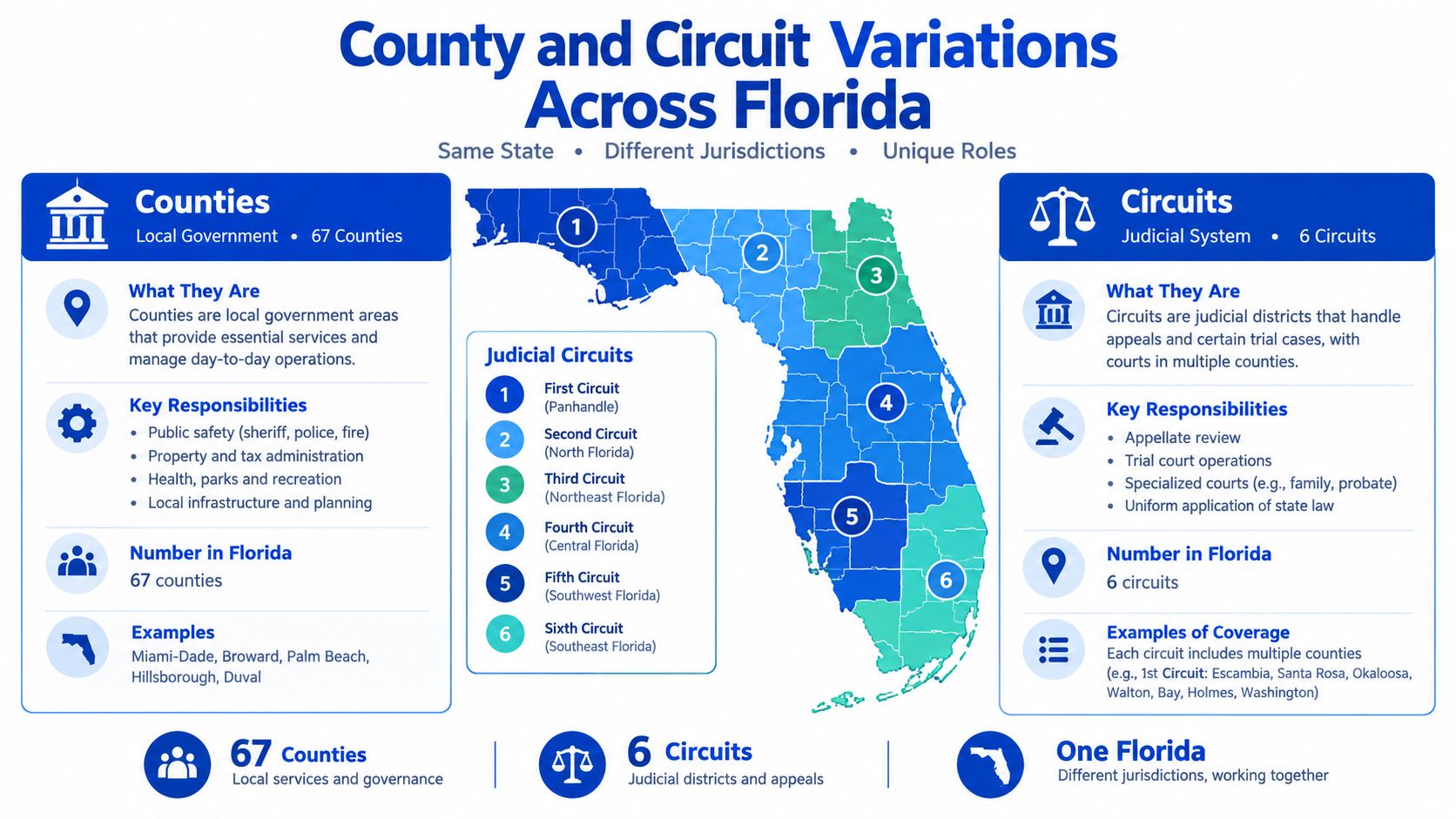
A published circuit order, for example, lists $20,000 for first-degree felonies, $7,500 for second-degree felonies, $1,500 for third-degree felonies, $500 for first-degree misdemeanors, and $120 for second-degree misdemeanors or ordinance violations. The figures come from the local circuit administrative order.
Why the arresting location matters
Broward County, Miami-Dade County, Palm Beach County, and other South Florida locations operate within their applicable judicial circuits. A schedule posted for one circuit may not be the controlling administrative order for another.
The local order may also explain how staff handle multiple charges. Some orders require a separate bond for each arrest charge. If that rule applies, the total amount needed for release may not equal the largest single scheduled amount.
Money isn't the only issue
Local orders can attach operational conditions to release. Examples include requirements that the released person avoid new criminal activity or have no contact with an alleged victim. Those conditions can affect daily life even when the person posts the monetary bond.
A family should ask two separate questions: “What amount applies?” and “What conditions apply after release?”
For Broward County arrests, a lawyer familiar with the local process can verify the controlling order and prepare for the hearing. Families can learn more about Broward criminal defense, but they should still obtain case-specific advice rather than assume a schedule from another jurisdiction controls.
Offenses Excluded From Standard Bond Schedules
Not every criminal charge receives a preset bond before first appearance. Florida law requires the annual statewide schedule for offenses not excluded under section 903.011(6), and the schedule must be available to every judicial circuit. The statutory framework is set out in Florida's criminal bond statute.
When an offense is excluded, the absence of a dollar amount usually isn't a clerical mistake. It may mean that the person must appear before a judge before release can be considered, or that a no-bond hold applies at the pre-first-appearance stage.
What an exclusion means
An excluded charge doesn't automatically mean the person will never be released. It means the ordinary preset process doesn't control the immediate release decision. A judge may need to address detention, bail, and conditions after reviewing the allegations and legally relevant circumstances.
The process becomes especially important when the allegation involves serious violence, certain repeat-offender circumstances, or another category identified by statute. The exact exclusion depends on the charged offense and the person's status at the time of arrest.
Why families should act quickly
A family shouldn't try to solve an excluded-charge issue by paying an amount found on an unrelated schedule. Posting the wrong amount may not secure release, and attempting to contact an alleged victim or discuss the facts with witnesses can create additional legal problems.
A defense lawyer can review the booking paperwork, identify whether the charge falls within the statutory exclusions, and prepare for first appearance or a detention-related hearing. Counsel can also challenge unsupported allegations, seek appropriate release conditions, and protect the accused from making statements that could later be used against them.
The most important distinction is between no preset bond before first appearance and no possibility of release at all. Those are not interchangeable conclusions, and only the court can make the individualized decision when the matter comes before a judge.
Factors That Can Raise Lower or Change Your Bond Amount
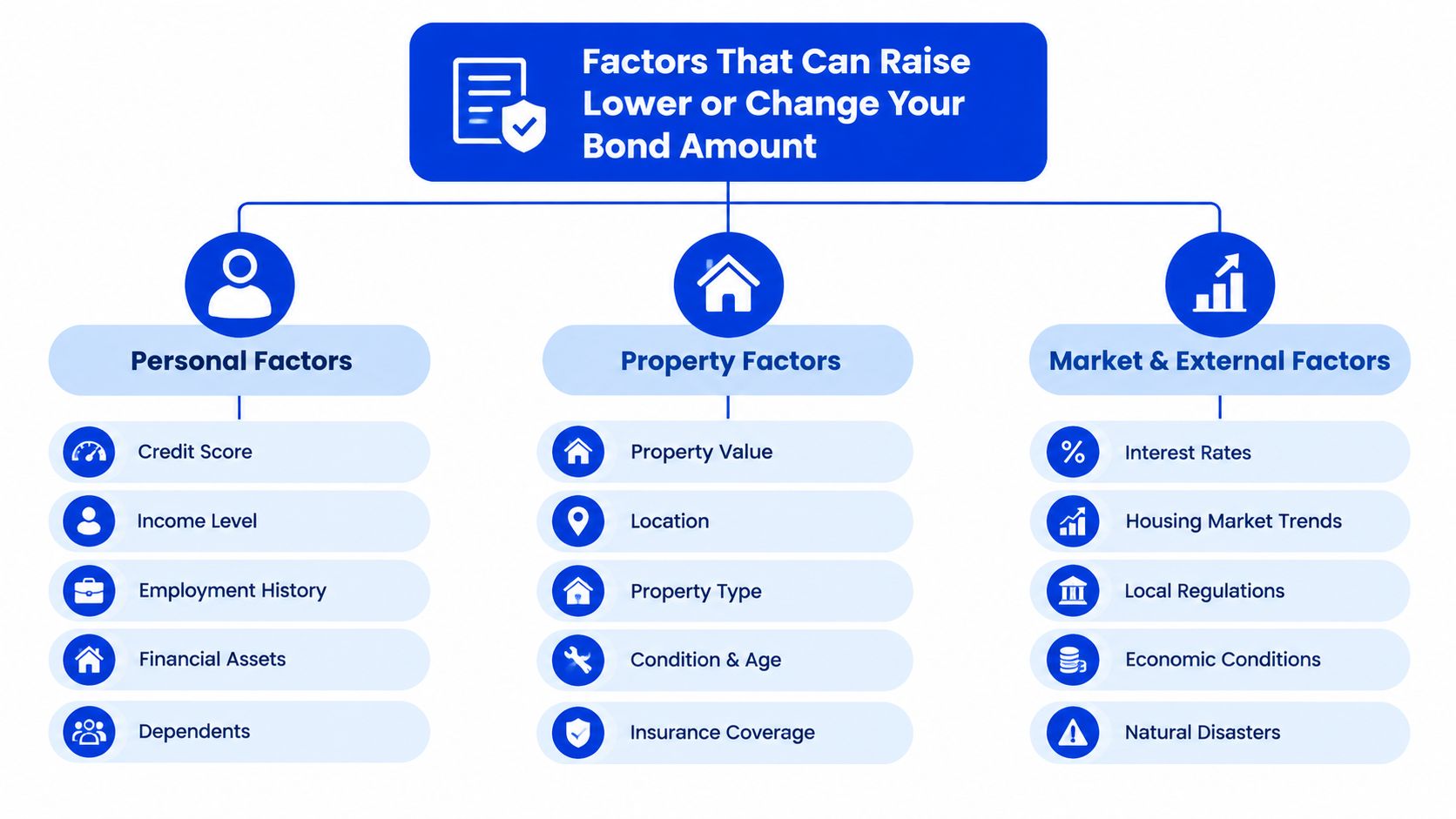
A scheduled amount is only the starting point when a judge reviews release. The court may keep it, lower it, raise it, or use conditions that don't depend entirely on money.
The judge's analysis often turns on the alleged conduct and the person's circumstances. Relevant information can include:
Nature of the charge: The classification, alleged conduct, and whether force or a threat of force is involved can affect the court's concern.
Criminal history: Prior cases, convictions, supervision, and unresolved matters may influence the judge's view of risk.
Court appearance history: A record of missed hearings can make a judge less willing to rely on a simple promise to appear.
Community and personal ties: Stable residence, employment, family support, and other local connections may help explain why the person is likely to return to court.
Safety concerns: The judge may consider alleged threats, potential victim contact, and the risk of new criminal activity.
Proposed safeguards: Supervision, reporting, geographic limits, treatment, or communication restrictions may address concerns without relying only on a higher monetary amount.
The parties present different pictures
The prosecution may argue that the allegations, history, or safety concerns justify detention, a higher bond, or strict conditions. Defense counsel can respond with verified information about residence, work, caregiving responsibilities, medical needs, and a workable release plan.
A lawyer should also examine whether the booking information accurately reflects the charge. A mistaken degree, duplicate count, or incorrect description of force can change the starting point.
Schedules can contain offense-specific rules
Some local schedules carve out particular offenses from ordinary misdemeanor amounts. One 2026 circuit order sets separate amounts for DUI and BUI offenses, including $500 for first offenses classified as second-degree misdemeanors, $1,000 for second offenses, and $1,000 for DUI or BUI first-degree misdemeanors, as shown in the published circuit order.
Those offense-specific figures demonstrate why a family shouldn't treat a general misdemeanor amount as universal. The applicable charge, local order, and statutory restrictions all matter.
Conditions can matter as much as the amount. A local order may require no new criminal activity or no contact with an alleged victim, and violating those conditions can lead to renewed detention or other consequences.
How to Find the Correct Schedule and Prepare for First Appearance
Families can reduce confusion by verifying the release information in a specific order. Start with the county where the arrest occurred, then identify the judicial circuit that handles that case.
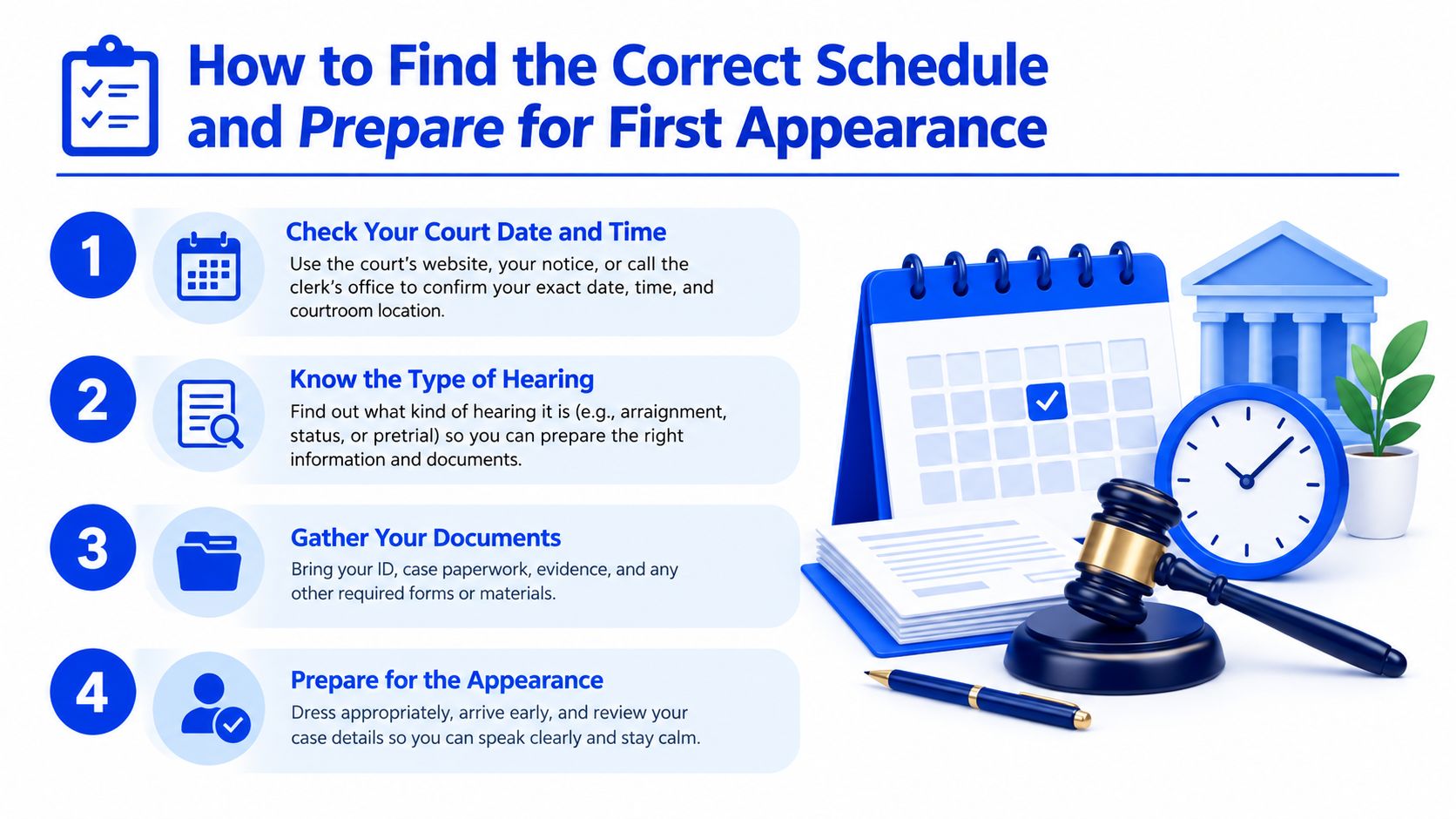
Four checks that prevent common mistakes
Confirm the exact charge. Read the booking paperwork or probable-cause information. Identify the felony or misdemeanor degree and whether the allegation includes force or a threat of force.
Check the current statewide schedule. Florida's framework requires an annual statewide schedule for eligible offenses. Don't rely on an undated image or a schedule copied from a different year.
Find the local administrative order. Review the order for the arresting circuit. The local schedule may increase the statewide amount or explain separate bonds, conditions, and exceptions.
Check for exclusions. Determine whether the charge or the person's status prevents release before first appearance. A no-bond designation requires a different strategy from ordinary scheduled release.
Statewide guidance materials show the offense-severity structure through fixed pre-first-appearance benchmarks. They list $5,000 for a third-degree felony involving force or threat of force, $2,500 for a third-degree felony without force, $1,000 for a first-degree misdemeanor involving force, $500 for a first-degree misdemeanor without force, $250 for a second-degree misdemeanor involving force, and $150 for a second-degree misdemeanor without force. The figures appear in the Florida courts first-appearance benchcard.
Information to gather before the hearing
A family can collect identification, proof of residence, employment information, and details about family or community support. Those materials may help defense counsel present a practical release plan.
The accused should avoid discussing the facts of the case with anyone except the defense lawyer. Calls from jail may be recorded, and messages to an alleged victim can violate a no-contact condition or create evidence for the prosecution.
If someone else will post the bond, that person should understand the payment process and any conditions before committing funds. Families can review general information about how to bail someone out, but the jail and court should confirm the current procedure for the specific arrest.
Quick Reference Lookup and Related Resources
Use the table below as a starting reference, not as a substitute for checking the current statewide schedule and local circuit order.
Situation | What to verify | Where to look |
|---|---|---|
Third-degree felony | Whether force or threat of force is alleged | The charge paperwork and applicable schedule |
First-degree misdemeanor | Whether the conduct falls within an offense-specific exception | The local order and statewide guidance |
Second-degree misdemeanor | Whether force, threat of force, or another exception applies | The current schedule |
Multiple charges | Whether a separate bond is required for each charge | The local administrative order |
Excluded offense | Whether release must wait for first appearance or a detention hearing | Section 903.011(6) and court records |
Any arrest | Whether the judge may alter the scheduled amount or conditions | First-appearance hearing information |
Terms families often hear
Bond: A monetary amount or financial undertaking connected to release from custody.
Bail: A broader term often used for the financial or court-approved process that permits release.
First appearance: The early court hearing where a judge reviews the arrest and addresses release, bond, and conditions.
Pretrial release: The legal status of remaining outside custody while the criminal case continues, subject to court-ordered terms.
Administrative order: A court directive that explains local procedures, schedules, or operating requirements.
No-bond hold: A designation indicating that preset release isn't available before the required judicial review.
Keep the schedule current
Florida's statewide schedule is updated annually, and local circuits may issue their own orders. A family searching “bond schedule Florida” should verify the year, the arresting circuit, the exact offense classification, and any exclusion before relying on a dollar amount.
Questions about detention, conditions, or violations require prompt legal attention. A person who violates pretrial release conditions may face additional restrictions, so the accused should understand every requirement before leaving custody.
Ticket Shield, PLLC helps people in Broward County, Fort Lauderdale, Miami-Dade, Palm Beach, and throughout Florida understand bond schedules, prepare for first appearance, and protect their rights after an arrest. Visit Ticket Shield, PLLC to request a case review and speak with a defense attorney about the release options and next steps in your specific case.