Technical Probation Violations in Florida
Jason Goldsmith, Esq
You miss one probation appointment after your car breaks down on I-95. Before you can explain, a deputy arrives at your Broward County home with a warrant. That is how quickly a routine supervision problem can become an arrest, a jail stay, and a violation hearing.
Technical probation violations are often treated like minor paperwork mistakes. In Florida, that's a dangerous assumption. Missed reporting, failed testing, unpaid court obligations, unauthorized travel, and incomplete treatment can place your freedom at risk even when nobody accuses you of committing a new crime.
The practical questions are straightforward. What counts as a technical violation? What happens after an affidavit or warrant? What penalties can a Florida judge impose? What can a probation violation lawyer do before the situation gets worse? This guide answers those questions for people under supervision in Broward County, Fort Lauderdale, Miami-Dade, Palm Beach, and throughout South Florida.
Table of Contents
What a Technical Probation Violation Really Means
A technical probation violation is a failure to follow a condition of supervision rather than an allegation that you committed a new criminal offense. Your sentencing order may require regular reporting, drug or alcohol testing, payment of court-ordered obligations, participation in treatment, completion of community service, or permission before traveling. Missing one of those conditions can generate an allegation even if you're working, caring for family, and otherwise trying to comply.
The stakes are larger than most online explanations suggest. In the federal system, the Department of Justice reported that technical violations accounted for 66% of revocations in fiscal year 2021 and 68% in fiscal year 2022. Those figures come from the U.S. Department of Justice report on federal probation resources and demographic data%20-%20DOJ%20Report%20on%20Resources%20and%20Demographic%20Data%20for%20Individuals%20on%20Federal%20Probation.pdf). Federal data isn't Florida data, but it demonstrates the broader enforcement reality. Supervision failures, not only new crimes, drive a large share of revocation activity.
Why one missed obligation can matter
Probation gives you freedom subject to conditions. The court expects you to follow those conditions exactly, and the probation officer documents what happens when you don't. A car breakdown, work conflict, transportation problem, relapse, financial hardship, or misunderstanding may explain the event, but an explanation doesn't automatically prevent an affidavit.
Historical court research reached a similar conclusion. A United States Courts report found that almost half of felony revocations in one jurisdiction during fiscal year 2013 involved technical violations. Legal scholarship cited in that report also described jurisdictions where technical violations represented a substantial share of revocation petitions.
Practical rule: Treat every probation condition as enforceable. If a problem arises, document it and communicate before the deadline whenever possible.
If you're already facing a warrant, don't assume the officer will accept a late explanation. Read your original order, preserve messages and receipts, and speak with counsel before making admissions or signing a violation report. The Florida violation of probation guide provides additional context, but an active allegation requires case-specific review.
Technical vs Substantive Violations in Florida
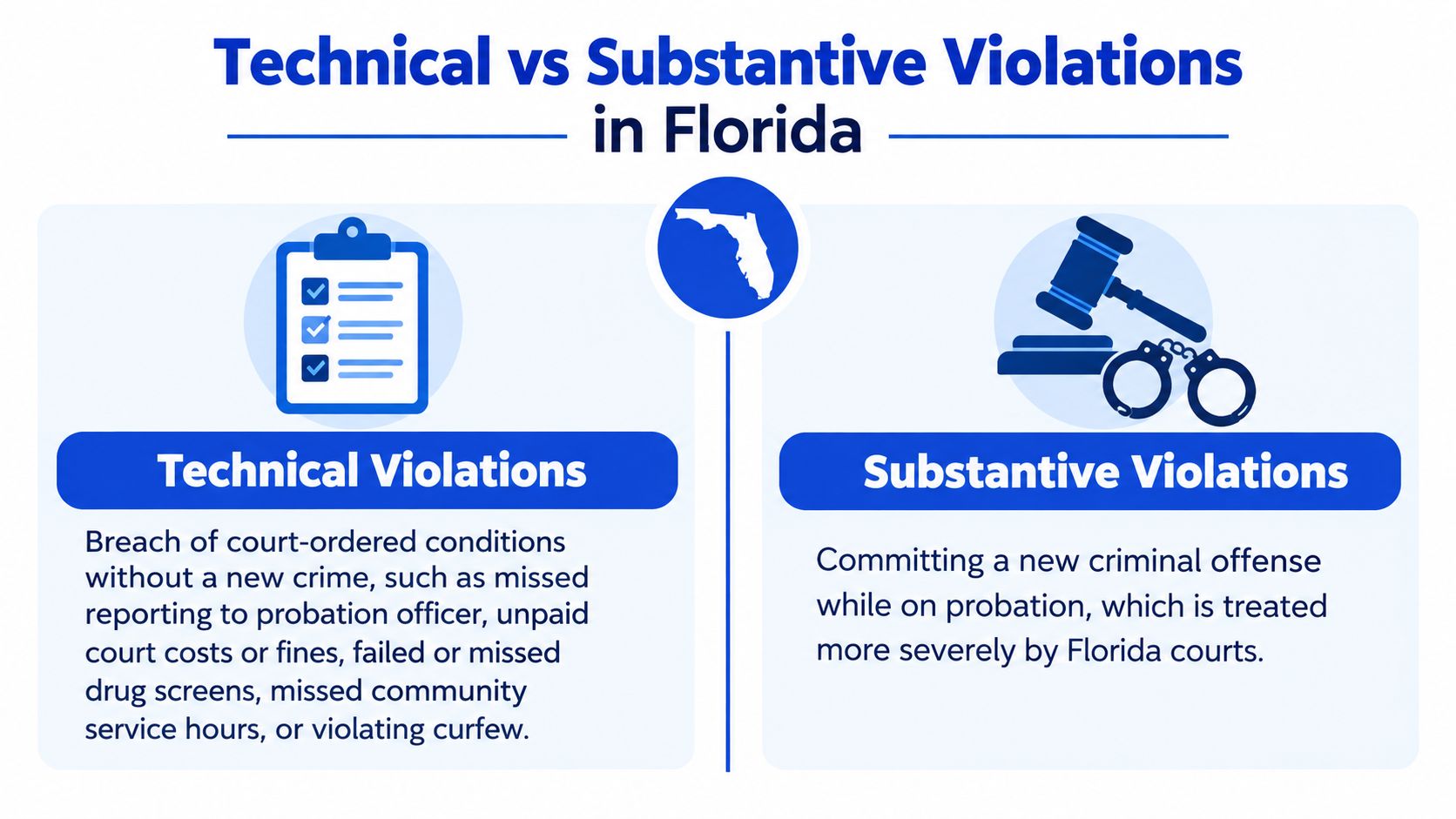
Florida probation violations generally fall into two practical categories.
A technical violation involves breaking a supervision condition without a new criminal act. Examples include missing a meeting, failing to complete a required class, missing or failing a drug screen, traveling without approval, or failing to make a required payment.
A substantive violation involves an alleged new criminal offense while you're on probation. That new case may create separate criminal exposure and may also become the basis for a probation violation proceeding. The distinction matters because a new-law allegation usually presents greater sentencing concern, while a technical allegation focuses on whether you followed the court's conditions.
Think of probation like a lease. A substantive violation is closer to illegally subletting the property. A technical violation is like paying rent late or ignoring a lease requirement. The second problem may not be as severe, but the landlord can still enforce the agreement. In probation court, the judge retains authority over the suspended sentence and supervision terms.
The burden is lower than at trial
Under Florida Statutes Section 948.06 and Florida Rule of Criminal Procedure 3.790, a violation can lead to an affidavit, summons, or warrant. At the evidentiary hearing, the State generally must prove the alleged violation by the greater weight of the evidence, commonly described as more likely than not. That's materially different from the beyond-a-reasonable-doubt standard used at a criminal trial.
The lower burden changes how you should respond. You can't assume that the State needs a criminal conviction or proof of a new offense. A probation officer's records, testimony, attendance documentation, testing results, or payment history may become important evidence.
The Florida felony probation violation resource explains why a technical allegation can still threaten a felony sentence. Don't plead guilty or agree to a stipulated violation merely because the allegation sounds minor. Counsel should first examine the order, the wording of the affidavit, the dates, the records, and the legal sufficiency of the claim.
Most Common Examples That Trigger Action
Probation officers in Broward, Miami-Dade, and Palm Beach commonly focus on whether supervision is becoming a pattern of noncompliance. One isolated problem may be manageable, but repeated or combined problems create a more persuasive argument for stricter sanctions.
The violations officers document most often
Missed reporting: Failing to attend an appointment, respond to required communication, or complete a scheduled check-in can prompt a warning, a rescheduled appointment, or an affidavit if the conduct repeats.
Unpaid fees and costs: Late or unpaid supervision costs, court fees, or other financial obligations may be documented. Financial hardship should be supported with records rather than ignored.
Drug and alcohol testing: Missing a screen, refusing to test, or producing a positive result can produce immediate scrutiny, especially when combined with a missed meeting or treatment failure.
Unauthorized travel: Leaving Florida, the county, or an approved travel area without written authorization can be treated seriously. Verbal permission is difficult to prove later.
Incomplete programs: Failing to finish community service, counseling, treatment, or other court-ordered requirements can support a violation filing.
Unreported law-enforcement contact: Even contact that doesn't result in a new charge may need to be reported under the supervision order.
Research summarized by the University of Minnesota's Robina Institute report found that missed appointments and positive drug tests were among the strongest predictors discussed in that research, with reported odds ratios of 2.21 for missed appointments and 2.45 for positive drug tests. The same report found technical violations had 31% to 51% lower odds of revocation than violations based on a new crime, but technical violations still increased enforcement risk.
Violation Type | Typical Officer Response | Revocation Risk |
|---|---|---|
Missed check-in | Contact, warning, rescheduling, or affidavit | Higher when repeated |
Failed or missed screen | Additional testing, treatment referral, or affidavit | Higher, particularly with other noncompliance |
Unpaid obligation | Payment review, documentation request, or violation filing | Depends on ability to pay and pattern |
Unauthorized travel | Inquiry, written warning, or affidavit | Higher when unsupervised or repeated |
Incomplete treatment or service | New deadline, referral, or affidavit | Increases with continued failure |
Unreported police contact | Investigation and possible violation filing | Depends on the underlying contact |
Assume that anything your officer documents can appear in an affidavit, including a polite voicemail asking you to call back. If your issue involves impaired driving supervision, the DUI probation violation resource may help you identify the records counsel should review.
How Florida Violation Hearings Actually Work
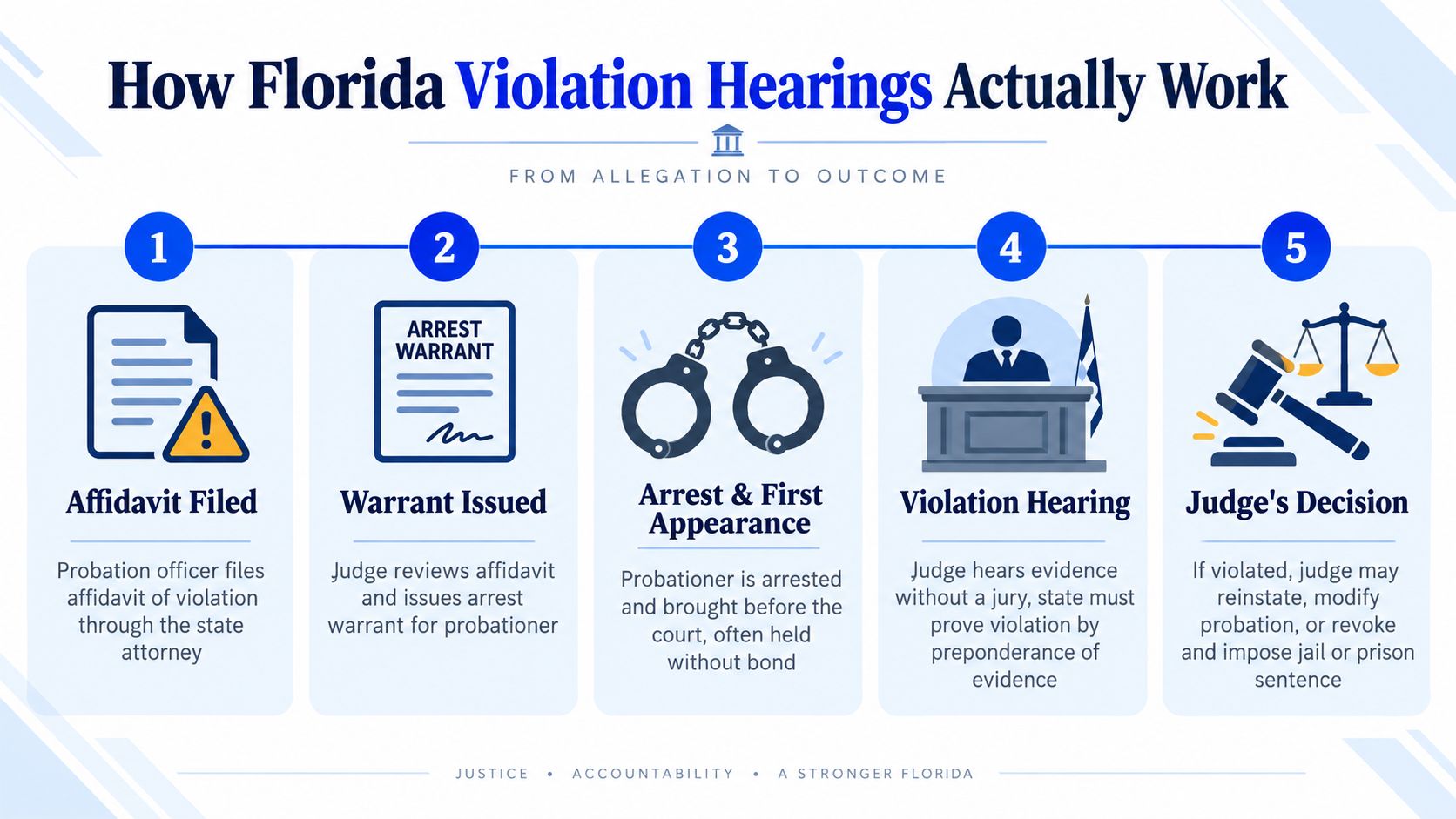
The process usually begins with a probation officer documenting an alleged breach and submitting a violation affidavit through the State Attorney's Office. A judge may then issue a warrant or a summons. A warrant can result in arrest and detention, while a summons gives you notice to appear without the same immediate custody consequence.
From allegation to first appearance
If arrested, you may be held without bond or face limited release options depending on the case, the order, the alleged conduct, and the judge. Don't wait in jail hoping the issue will resolve itself. Counsel can review the warrant, seek appropriate relief, request records, and address whether a bond or release argument is available.
Florida law requires a violation hearing to occur “as soon as may be practicable” after arrest or detention. Section 948.06 also authorizes the court, after the hearing, to revoke, modify, or continue probation or community control. That language doesn't guarantee an immediate hearing, but it creates an important procedural issue when someone remains detained.
The hearing has two distinct questions
First, the judge decides whether the State proved the violation by the greater weight of the evidence. There's no jury deciding this issue. The court may consider testimony, supervision records, testing documentation, attendance records, and other admissible evidence.
Second, if the court finds a violation, the case moves to disposition. The judge may continue probation, modify conditions, impose additional requirements, or revoke supervision and impose a sentence authorized by law and the original case.
Florida created an administrative alternative-sanctions pathway for certain low-risk technical violations in 2019. The available options can include up to 5 days in county jail, up to 50 additional community service hours, counseling or treatment, support group attendance, drug testing, loss of travel or other privileges, curfew for up to 30 days, or house arrest for up to 30 days, subject to the governing process and local administrative orders. The Florida Senate analysis of the low-risk sanctions legislation describes that pathway.
A low-risk administrative process isn't the same as immunity. Judicial hearings, administrative reviews, and local scheduling practices can differ across Broward, Miami-Dade, and Palm Beach. A lawyer can also use a motion hearing explanation to help you understand why a separate request for relief may be necessary before the violation hearing.
Penalties Florida Courts Can Impose
A technical violation doesn't produce one automatic sentence. The judge looks at the condition, the evidence, your supervision history, the seriousness of the conduct, and the available alternatives. A first isolated problem may call for modified reporting or treatment. A repeated pattern can move the court toward custody and revocation.
Administrative options for eligible cases
Florida's low-risk technical-violation pathway can provide alternatives to a full revocation hearing in appropriate circumstances. Possible sanctions include additional reporting, community service, counseling, treatment, support-group attendance, drug testing, travel restrictions, curfew, house arrest, and a short county-jail commitment. Eligibility and implementation depend on the applicable law, administrative order, and case facts.
That pathway is valuable because it gives the defense a concrete alternative to argue for. It's not a promise that the officer or judge will select the least restrictive result.
Traditional judicial dispositions
After a violation is established, the judge may:
Continue probation: Keep supervision in place without major changes.
Modify conditions: Add testing, treatment, reporting, curfew, travel restrictions, or other requirements.
Extend supervision: Continue probation for a lawful period when the court has authority to do so.
Revoke probation: End community supervision and impose a sentence authorized by the original case.
Impose custody: Order county jail or prison when the applicable sentencing authority permits it.
Disposition Type | When Used | Custody Risk |
|---|---|---|
Warning or continued supervision | Isolated or explainable noncompliance | Lower, but not eliminated |
Modified probation | Court wants stricter oversight | Possible |
Treatment or testing conditions | Substance-use or program concerns | Possible |
Administrative sanction | Eligible low-risk technical allegation | May include short custody |
Revocation and sentencing | Serious, repeated, or proven violation | Can include substantial custody |
The risk increases when allegations stack. A missed appointment followed by a positive screen, or incomplete treatment followed by additional missed reporting, gives the State a stronger narrative than one documented scheduling problem. Florida's process doesn't require a new criminal conviction before the court can consider revocation.
Recent Florida legislative analysis states that a court must hold a hearing on a low-risk violation within 30 days after arrest or release the probationer without bail unless the delay is attributable to the probationer. The Florida Senate analysis of CS/CS/HB 1241 describes that concrete timing rule. Your lawyer should determine whether it applies to your allegation and procedural posture.
Defense Strategies and Procedural Protections
The strongest defense often begins before the hearing. A lawyer should compare the violation affidavit with the exact probation order, not rely on a summary from an officer or family member. The wording matters. So do the dates, notice, records, and proof of what the court required.
Attack the allegation, not just the punishment
A defense lawyer may challenge whether the affidavit identifies a real condition, whether the alleged conduct occurred, whether the State can prove the relevant date, and whether the evidence is reliable. Under Ashley v. State, Florida courts analyze whether a violation is willful and substantial. That makes circumstances such as transportation failure, medical issues, work conflicts, treatment participation, and financial hardship potentially important.
Counsel can cross-examine the probation officer, challenge incomplete records, subpoena witnesses, and present documents showing substantial compliance. Useful records may include appointment confirmations, payment receipts, employer schedules, treatment attendance, transportation records, medical documentation, and messages showing that you tried to report a problem.
Do not sign a stipulated violation or written officer report before you understand the admission and its sentencing consequences.
You have the right to counsel through the proceeding, the right to present evidence, and the right to challenge the State's proof. You also have the right to a hearing as soon as practicable when detained, subject to the governing procedural rules.
Build a credible alternative
Winning is not the only objective. If the evidence supports a violation, the defense should still present a practical plan that addresses the court's concern. That may include modified reporting, upgraded treatment, verified testing, completed service, a payment arrangement supported by financial records, or a structured travel request.
A lawyer for a violation of probation can also negotiate with the State and probation department before the hearing. Early action gives counsel a chance to preserve favorable evidence, identify undocumented claims, and argue for continued supervision instead of revocation.
How Ticket Shield Can Help and What to Do Next
Ticket Shield, PLLC can review a Florida technical probation violation from the first call through the violation hearing. The initial work should include obtaining the original probation order, reviewing the affidavit or warrant, identifying allegations that lack documentation, and organizing records that show compliance or explain the problem.
The firm is based in Broward County and serves clients in Fort Lauderdale, Broward County, Miami-Dade, Palm Beach, and surrounding South Florida communities. For warrant situations, its stated availability is 24/7, allowing a probationer or family member to seek guidance before making avoidable statements or delaying a response.
Questions worried probationers ask
Should I call my probation officer first? If there's no active warrant and the issue is administrative, prompt communication may help. If an affidavit, warrant, failed test, or possible admission is involved, speak with a lawyer before providing a detailed statement.
How quickly should I act? Immediately. Delay can make records harder to obtain and can leave you exposed to arrest or detention.
What will representation cost? Fees depend on the county, allegation, custody status, and amount of work required. Ask for the fee structure during a confidential consultation rather than guessing from another case.
Don't delete messages, discard receipts, miss another appointment, or travel without written approval. Preserve everything and get legal advice before the allegation becomes a finding.
Ticket Shield, PLLC offers confidential Florida defense for technical probation violations, including missed reporting, failed testing, and incomplete treatment or classes. Visit Ticket Shield, PLLC to request a consultation and discuss the affidavit, warrant, or supervision problem before it escalates.