Violation of Probation in Florida: What You Need to Know
Jason Goldsmith, Esq
You just got the notice, and now everything feels different. Maybe it came from your probation officer, maybe your lawyer called, or maybe a deputy showed up where you live. Either way, a violation of probation in Florida is not a casual warning, and it's not something to shrug off and hope goes away.
I've been on both sides of these cases, first as a prosecutor and now as a defense lawyer. What I tell people straight away is this, the State and the probation office build these cases fast, and the worst thing you can do is talk yourself deeper into trouble. If you're in Broward County, Fort Lauderdale, Miami-Dade, Palm Beach, or anywhere in South Florida, the next moves matter more than the allegation itself.
Table of Contents
What Happens the Moment a Violation Allegation Starts
The call usually comes at the worst time. A probation officer says there's a problem, a letter shows up at your door, or someone knocks and starts asking questions about missed reporting, a failed screen, or a new arrest. In Florida, that first contact is where a routine compliance issue can become a court case with arrest exposure.
The first move is usually paper, then a warrant
Probation violations don't stay informal for long. Once the officer believes there's a problem, the matter can move into a formal violation process, and that can lead to a warrant. That's the point where the situation stops being a conversation and starts being a custody risk.
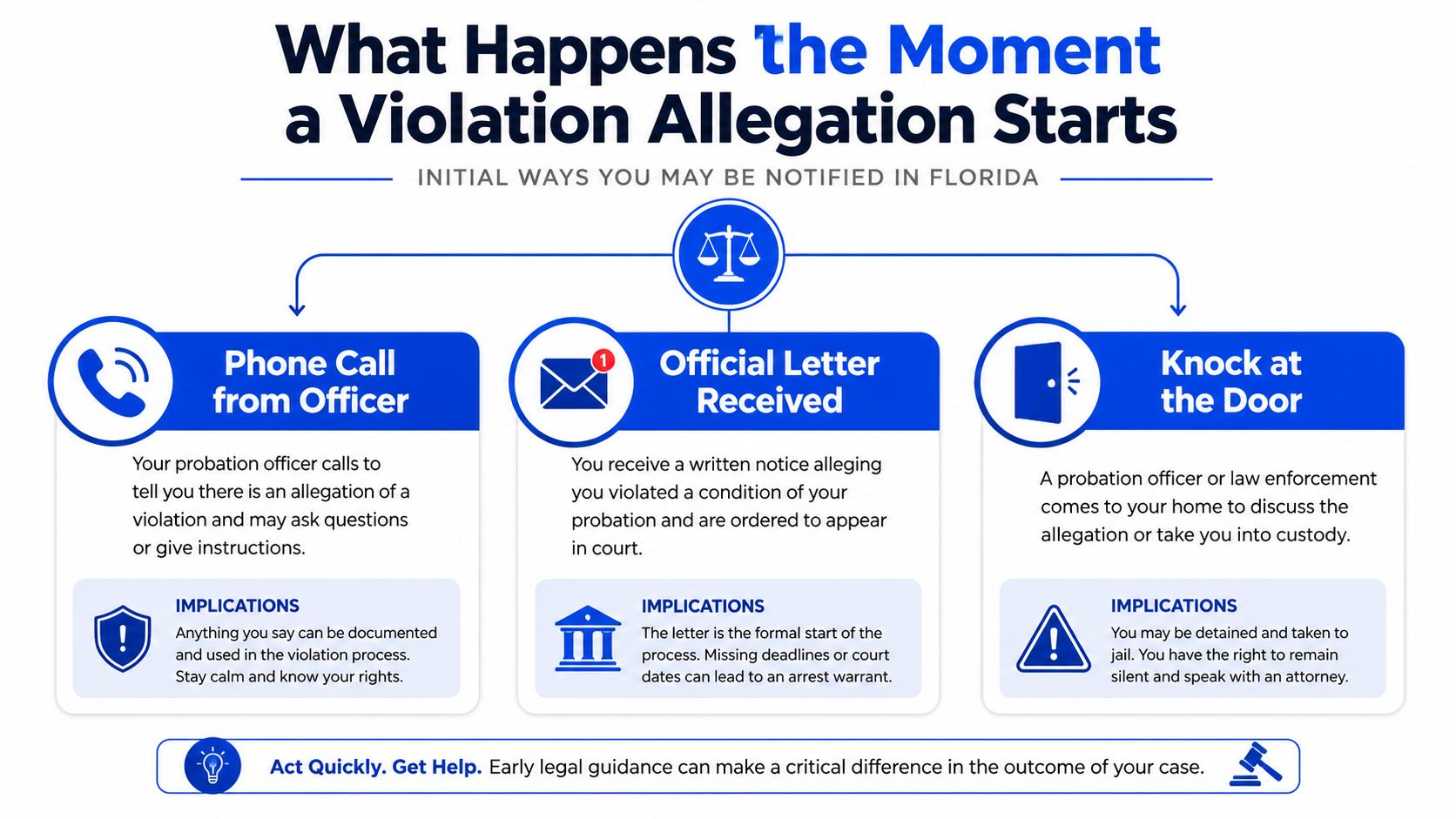
A lot of people make the same mistake here, they try to explain everything immediately. That's dangerous. Probation officers document what you say, and those statements can become part of the violation file that follows you into court.
Practical rule: once you know there's an allegation, stop improvising answers. Get the facts together, then get legal advice before you make the next call.
The moment matters because probationers often still think they have the same runway they had in the original case. They usually don't. The allegation can trigger a fast-moving enforcement path, and if you wait until the warrant is served, you may already have lost the chance to shape the story.
Technical Violations and Substantive Violations Explained
Florida law draws a real line between a technical violation and a violation tied to a new offense. A technical violation is an alleged supervision violation that is not a new felony, misdemeanor, or criminal traffic offense under Florida's probation statute, and that classification matters because it affects what the court thinks happened and what sanctions are on the table. The statutory definition is spelled out in Florida law, which is why the label matters so much in practice. Florida Statutes section 948.06
Why the label changes the whole case
Missed reporting, curfew breaches, unauthorized travel, positive drug or alcohol screens, and failure to maintain contact are typically handled as technical violations when they don't involve a new crime. A new felony, misdemeanor, or criminal traffic offense puts the case into a much harsher lane because it looks less like noncompliance and more like fresh criminal conduct.
Category | Examples | Burden of Proof | Typical Stakes |
|---|---|---|---|
Technical Violations | Missed reporting, curfew issues, travel problems, failed screens | Lower than a criminal trial, the judge decides the factual issue in violation court | Sanctions can include modified conditions, jail, or revocation |
Substantive Violations | New felony, misdemeanor, or criminal traffic offense | The State still has to prove the alleged violation in court | Higher custody exposure and a harder path to reinstatement |
Here's the part people miss. A technical violation is not “just paperwork.” It can still lead to real jail exposure, court control, and probation revocation. In many cases, the classification is the entire fight, because a defense lawyer can often argue that the conduct is being overstated or that it never crossed the line into a provable violation.
If you want a closer look at how Florida firms frame technical cases, this resource is directly on point, Florida technical violation of probation.
Common Conditions That Lead to Probation Violations
Most probation cases don't blow up because of one dramatic event. They fall apart because ordinary life collides with strict supervision rules. A work schedule changes, a ride falls through, a travel request gets ignored, or someone takes a prescribed medication that turns up on a screen, and suddenly the officer is writing a violation report.
The usual tripwires in South Florida cases
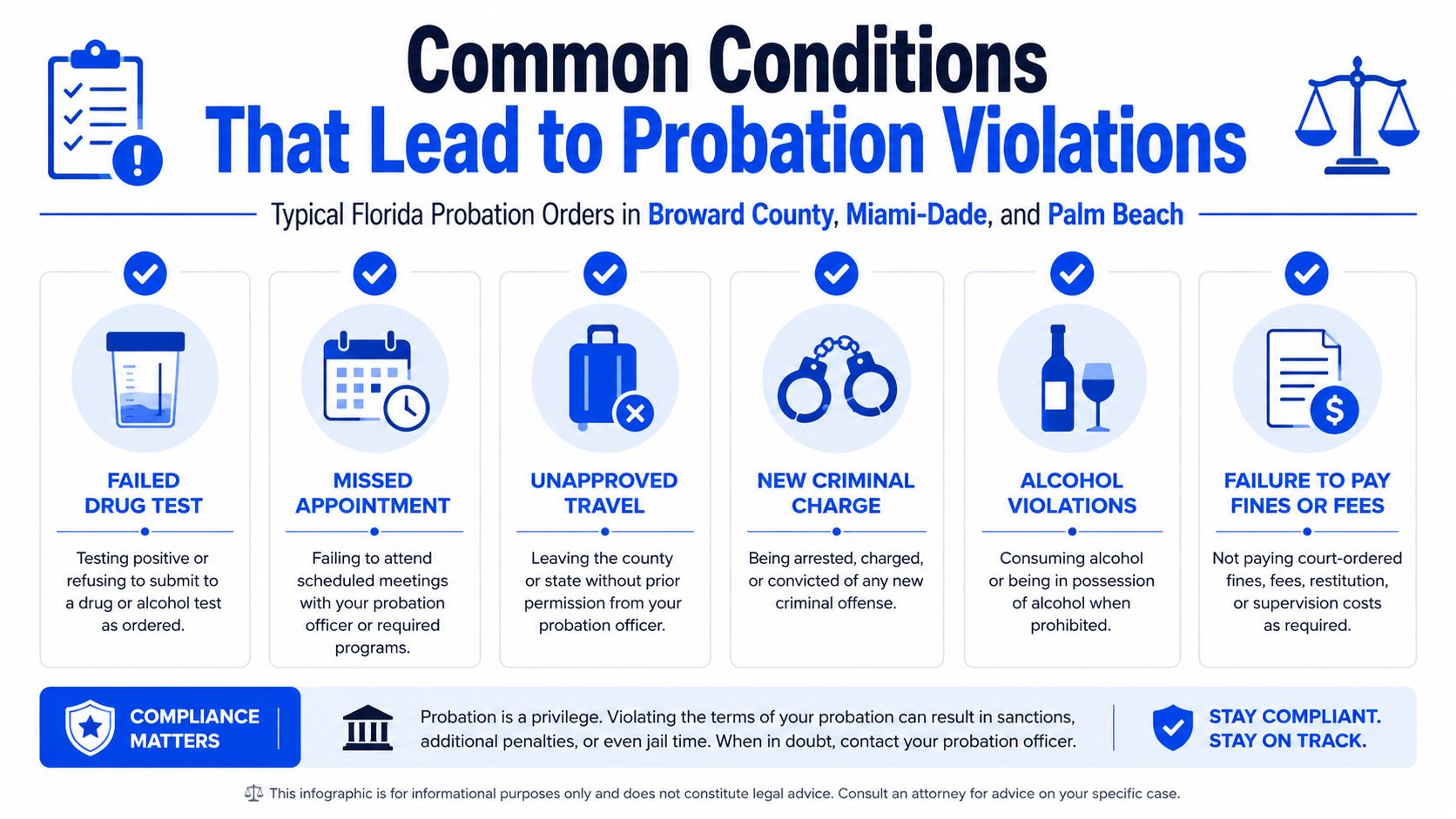
In Broward County, Miami-Dade, and Palm Beach cases, the same conditions come up again and again. Reporting dates, drug and alcohol testing, curfews, association restrictions, employment or school requirements, restitution, and travel approvals are the ones that get people into trouble most often. If you're juggling jobs, family obligations, and transportation problems, those rules can feel unforgiving.
Reporting schedules: missing an in-person or phone check-in can become a violation fast, especially if the officer reads silence as noncompliance.
Drug and alcohol testing: a positive result can trigger an allegation even when the explanation is medication, illness, or testing error.
Curfews and travel limits: getting home late or crossing county lines without permission can turn an ordinary day into a court issue.
Restitution and fees: falling behind on payments can create pressure that turns into a formal report.
Employment and school conditions: losing a job or missing school can be treated as a failure to comply if you don't document the reason.
That's why probation can feel like it criminalizes normal life. The rule may look simple on paper, but the world is messy. A missed bus, a family emergency, or a temporary housing problem can be enough to create an allegation if the paperwork isn't handled correctly.
If your violation started with a DUI-related condition, this guide can help you understand how those cases are usually alleged, DUI probation violation.
How the Florida Court Process Unfolds Step by Step
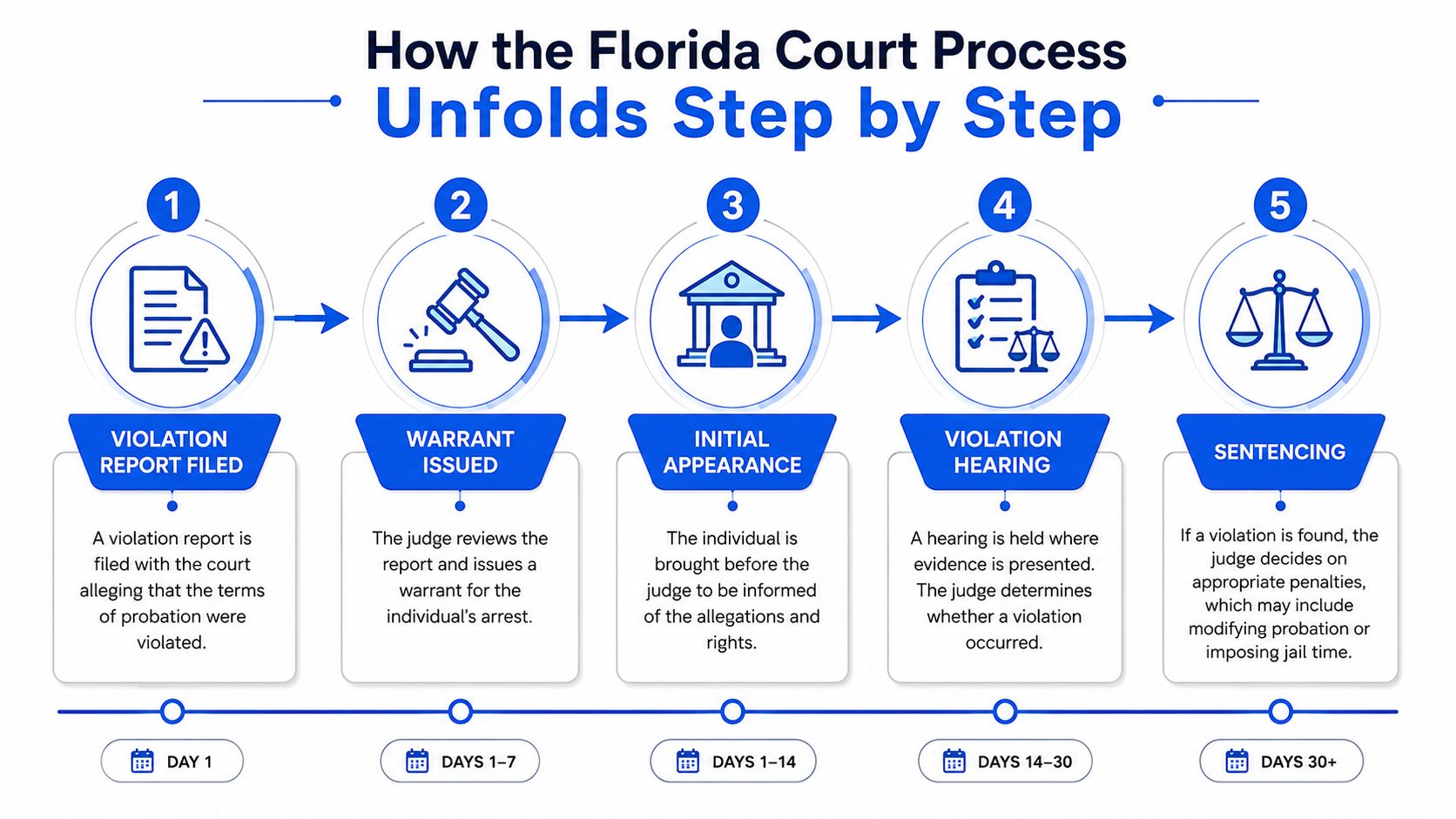
A violation case has its own rhythm, and it moves faster than the original criminal case. Once the probation officer files the violation paperwork, a judge can issue a warrant, and the case shifts into arrest and hearing mode. You are no longer dealing with an informal supervisor, you're dealing with a court process that can end in renewed probation, extra jail, or revocation.
From affidavit to hearing
The probation officer typically drafts the violation affidavit or report, and the judge decides whether to issue a warrant. After arrest, you'll have an initial appearance, then the case moves toward a violation hearing where the State tries to prove the alleged breach by the greater weight of the evidence. That hearing is where the defense strategy matters most.
The first hearing is not the end of the case. It's the start of the pressure point.
At that stage, the judge can look at the record and choose from several outcomes. The court may reinstate probation, add conditions, extend supervision, order jail time, or revoke probation in the most serious cases. Those outcomes are not theoretical. They are the crucial points in a violation case.
The federal system shows why revocation is such a serious outcome. The U.S. Sentencing Commission reported that the violation-hearing rate for people on federal supervision was relatively stable over five years, ranging from 16.2% to 18.4%, with an overall rate of 16.9%. In a separate federal dataset, the Department of Justice reported that for nearly 60,000 federal cases closed in fiscal year 2021, almost 28% ended in revocation, and in fiscal year 2022 that figure rose to just over 30% of about 57,000 cases. U.S. Sentencing Commission federal probation and supervised release violations
The key point is simple. The earlier a lawyer gets involved, the more options are still on the table.
Immediate Steps to Take After a Violation Allegation
The first 24 to 72 hours after you learn about a violation are about damage control. Don't argue your way through it. Don't text the officer a long explanation. Don't assume it's being handled because nobody has arrested you yet.
What to do right now
Stop giving statements: anything you say can be written into the violation file and used later to box you in.
Save every document: keep texts, emails, work schedules, medical records, receipts, travel approvals, and test results that support your side.
Write down dates and names: build your own timeline while the details are fresh, including who said what and when.
Identify witnesses: if someone can confirm your compliance, get their information now.
Call a lawyer before the next reporting date: don't walk into another meeting blind if a violation is already being discussed.
The reason I push so hard on this is simple. Violation cases often turn on documentation, not speeches. If you can show you complied, tried to comply, or had a legitimate explanation, that evidence needs to be organized before the State frames the story its own way.
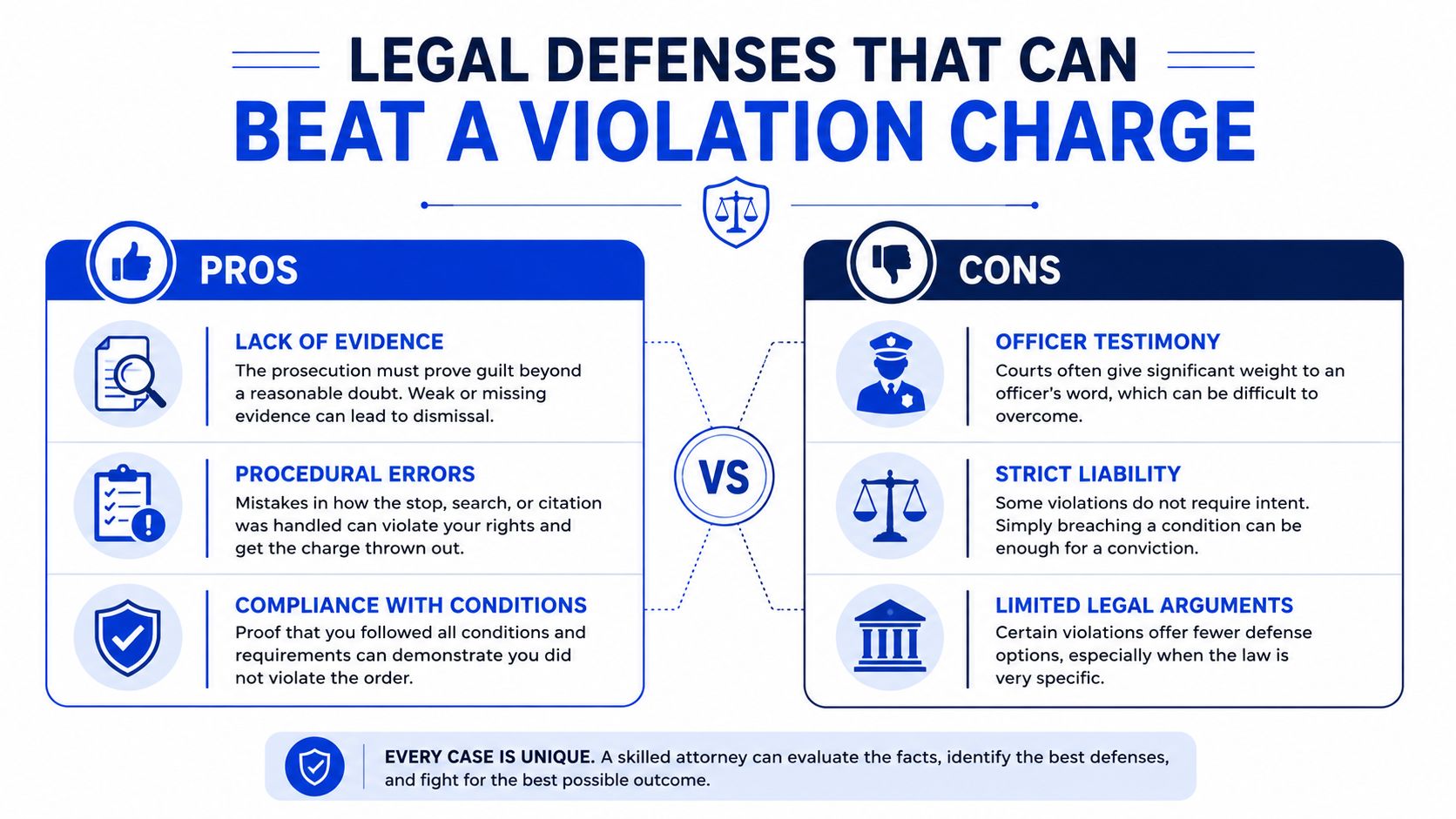
Legal Defenses That Can Beat a Violation Charge
A violation of probation is not the same thing as a conviction. The judge still has to be persuaded, and the State still has to prove the alleged violation in court. That leaves room for real defense work, especially when the allegation is based on a weak test result, a sloppy report, or an encounter that never should have happened.
The defense is usually about proof and willfulness
The biggest issue in many cases is whether the violation was willful. If you missed a condition because of something outside your control, that matters. A reliable defense also attacks the quality of the evidence, because probation cases often rely on officer testimony, lab paperwork, or a report that leaves out important context.
Defense lawyers win by making the court slow down. A rushed violation file often looks stronger than it is.
There are also cases where the violation traces back to a bad search, an unlawful stop, or contact that would be suspect in any other criminal case. If the underlying police action was illegal, the violation case can weaken fast. And even where the court does not dismiss outright, mitigation can change the result, proof of treatment, employment, counseling, or other compliance efforts can push the judge toward reinstatement instead of revocation.
For people on misdemeanor supervision, this kind of issue still matters. This overview of Florida misdemeanor probation violation cases shows how quickly even lower-level cases can turn serious if the defense is slow.
The practical defense takeaway is direct. Don't accept the officer's version as final. Make the State prove it, challenge the paperwork, and put your compliance story in front of the judge early.
How a Skilled Defense Attorney Changes the Case
A former prosecutor sees a violation case differently. I know how these files get assembled, what officers emphasize, and where the State usually takes shortcuts. That matters because a probation violation case is often won or lost before the hearing even starts.
Early intervention changes leverage
In some situations, a lawyer can step in before a warrant is issued and try to correct the narrative, provide documentation, or push for continued supervision instead of custody. If a warrant is already out, the next fight is bond, surrender strategy, and how to frame the violation affidavit's weaknesses for the court. Those details matter, especially when the client is being held far from home.
Ticket Shield, PLLC handles probation violation matters with direct attorney contact by phone, text, or email, which helps when a client needs fast guidance after an arrest or a warrant hit. The firm also works statewide, so a probationer in one county isn't left stranded just because the case started somewhere else. For people trying to understand representation costs, this probation violation lawyer cost guide is a useful starting point.
What the lawyer actually does
Reviews the affidavit fast: weak spots show up early if someone knows what to look for.
Builds the compliance file: receipts, records, treatment proof, and witness statements matter.
Presses negotiation points: prosecutors are more flexible when the file has holes.
Prepares for hearing: if the State won't budge, the defense should be ready to fight.
The earlier you call, the more room there is to work. Once the court has already leaned toward revocation, the options get thinner.
Questions Probationers Ask Most About Florida Violations
Can I get a bond after a probation violation warrant
Sometimes, but don't assume it's automatic. Violation warrants are treated seriously, and the judge's decision depends on the case, the underlying offense, and the allegation itself. A lawyer can argue for release, but you need a strategy, not wishful thinking.
Will a revocation wipe out my record
No. A revocation does not erase the original case, and it can make the case harder to explain later because the court record will reflect the violation outcome. That's one reason people fight these cases hard instead of treating them like an administrative annoyance.
Should I talk to my probation officer before calling a lawyer
No. Call a lawyer first. Anything you say can become part of the violation file, and if the officer is already documenting noncompliance, casual explanations can backfire.
How long does a violation case take in Broward, Miami-Dade, or Palm Beach
There's no fixed timeline, because it depends on the warrant, the arrest status, the court's calendar, and whether the State is willing to negotiate. Some cases move quickly, others sit longer than they should, but waiting usually helps the State more than it helps you.
If you're facing a violation of probation in Fort Lauderdale, Broward County, Miami-Dade, Palm Beach, or anywhere in South Florida, Ticket Shield, PLLC can step in quickly, review the violation, and build a defense around the facts that matter. Visit Ticket Shield, PLLC for a confidential consultation, and get a lawyer involved before the court process hardens into a bad outcome.