
Felony DUI Charges in Florida: Penalties and Defense Options
Jason Goldsmith, Esq
You're in Broward County after a late-night collision, your car has been impounded, and the arrest paperwork says felony DUI instead of the misdemeanor you expected. Maybe the crash caused only a minor fender-bender. Maybe the breath result is disputed. Then the prosecutor finds an older DUI conviction and says this new case crosses the felony line.
That transition isn't automatic just because you drank, failed a roadside exercise, or registered a particular BAC. In Florida, felony DUI charges are usually built from prior convictions, injury allegations, or a death, and the State still has to prove every required element beyond a reasonable doubt. The first job is to identify exactly which fact is supposedly elevating your case, then attack that fact before it hardens into a felony information.
Table of Contents
When a DUI Becomes a Felony in Florida
A driver stopped near I-95 after a minor crash may believe the case is a routine first or second DUI. The license check can change that within minutes. If the clerk's records show qualifying prior DUI convictions, the State may treat the new arrest as a felony rather than a misdemeanor.
Florida's clearest repeat-offender trigger is a third DUI conviction within 10 years of a prior DUI conviction. The timing matters. Prosecutors don't just count every old arrest. Defense counsel must examine the dates of the prior convictions, the exact offenses, the jurisdictions involved, and whether each record legally qualifies.
A fourth or subsequent DUI can also carry felony treatment based on the driver's prior record. The practical question is not whether the arrest affidavit says “repeat offender.” The question is whether the State can prove the required conviction history with admissible, legally sufficient records.
Practical rule: An arrest is not a conviction, and a prior case that appears in a database still has to be verified.
The ten-year lookback is often where the first serious defense work occurs. Counsel should obtain certified judgments, plea documents, docket entries, and disposition records from Broward, Palm Beach, Miami-Dade, or any out-of-state court involved. Older pleas that a client believed were sealed may still matter, while a record that looks similar may fail to satisfy Florida's statutory requirements.
Immediate conduct matters too. Follow every bond condition, preserve paperwork from the impound lot, and avoid discussing the facts with anyone except counsel. A Florida DUI arrest also creates a separate driver's-license problem, so criminal defense and administrative license strategy must begin together. A plain-English overview of the underlying offense is available in this guide to DUI law in Florida.
How Florida DUI Law Defines Impairment
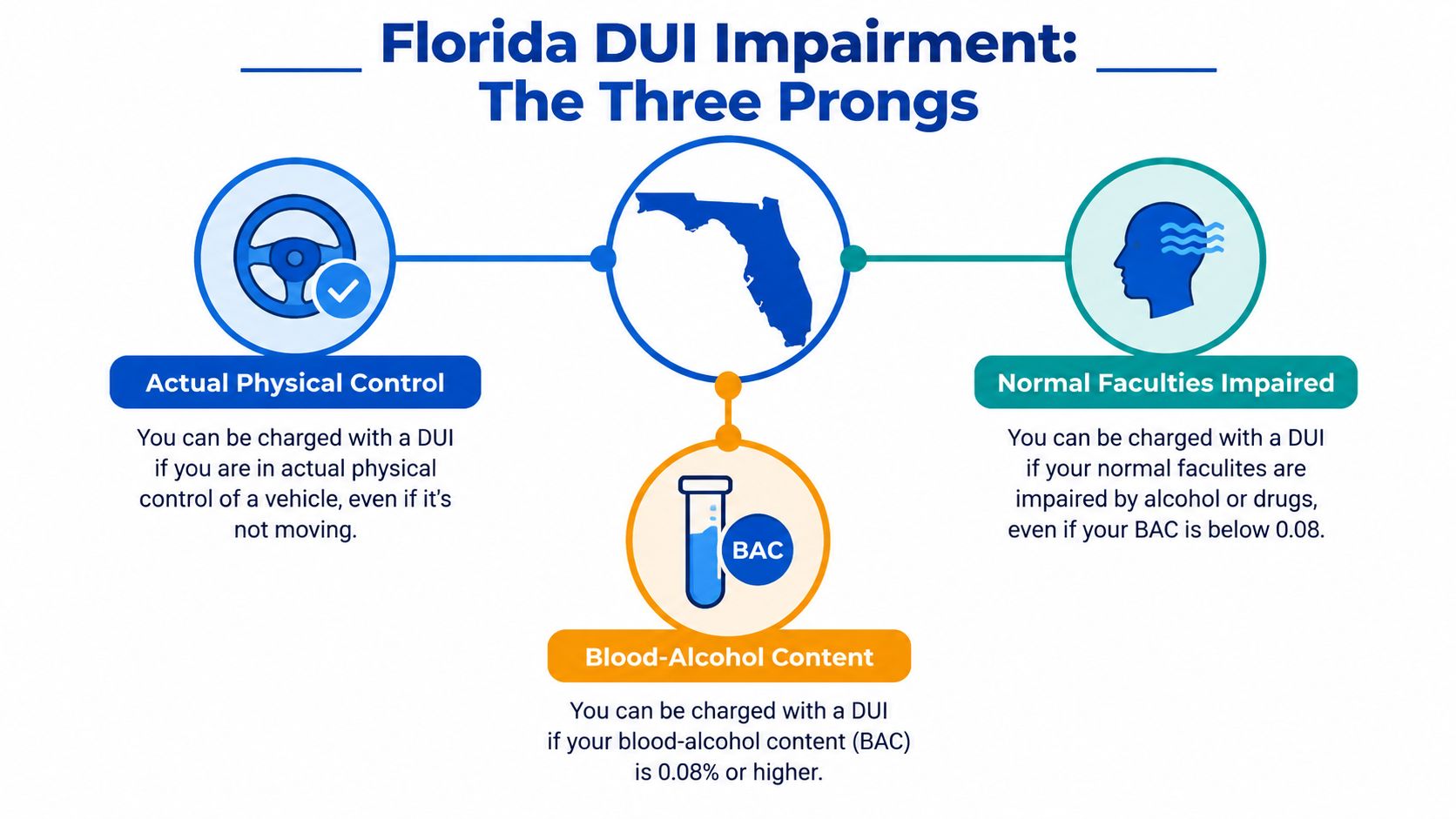
Florida Statute 316.193 gives prosecutors more than one way to prove DUI. The State may rely on evidence that the person was in actual physical control of a vehicle, that alcohol or drugs impaired the person's normal faculties, or that the person's blood- or breath-alcohol level reached the statutory threshold.
Actual physical control can include more than driving down the road. A person sitting behind the wheel with the ability to operate the vehicle may face the same legal issue, depending on the surrounding facts. The State then looks at impairment evidence, such as driving behavior, speech, balance, divided attention, field sobriety performance, admissions, and chemical-test results.
The normal-faculties theory is not the same as proving that someone consumed alcohol. Drinking at dinner is not, by itself, proof that a person couldn't see, walk, judge distance, react, or operate a vehicle normally. The legal question resembles comparing a person walking a straight line with eyes closed to someone who had a few drinks and remained coordinated. Prosecutors need evidence connecting the substance to impaired functioning.
Florida also recognizes a blood-alcohol level of 0.08 or more per 100 milliliters of blood, or a breath-alcohol level of 0.08 or more per 210 liters of breath, as an independent statutory theory. Prosecutors don't need to prove all three theories. One legally sufficient theory may support the charge, but the evidence supporting that theory must still survive constitutional and scientific scrutiny.
A result of 0.15 or higher can trigger enhanced punishment under Florida law, as can having a person under 18 in the vehicle. That enhancement doesn't erase the need to examine the stop, observation period, testing procedure, and chain of custody. For a deeper explanation of the threshold, review the discussion of the legal blood-alcohol limit in Florida.
Main Pathways That Escalate a DUI to a Felony
Florida prosecutors generally build felony DUI charges through four routes. Each route requires a different factual showing, which means the defense investigation must match the alleged pathway.
A third DUI conviction within the statutory lookback period can become a third-degree felony. A fourth or subsequent DUI is treated more severely because the State alleges a broader pattern of repeated convictions. A DUI that causes serious bodily injury creates a separate felony theory based on the harm to another person. DUI manslaughter adds a death allegation and carries the most serious exposure among these pathways.
The State's theory also affects the Criminal Punishment Code scoresheet. A prior-record felony and an injury-based felony don't score the same way. The prosecutor's charging choice can therefore influence not only the formal degree of the offense, but also the sentencing range, mandatory terms, and negotiation posture.
Pathway | Statute | Key Element | Max Prison Time |
|---|---|---|---|
Third DUI within the lookback period | Fla. Stat. § 316.193 | Qualifying prior DUI convictions within the statutory period | Up to 5 years |
Fourth or subsequent DUI | Fla. Stat. § 316.193 | Required prior DUI conviction history | Felony-level exposure under the applicable sentencing framework |
DUI causing serious bodily injury | Fla. Stat. § 316.193 | Impaired driving that causes serious bodily injury to another person | Up to 5 years |
DUI manslaughter | Fla. Stat. § 316.193 | Impaired driving that causes the death of another person | Up to 15 years |
The State typically obtains prior-record proof through court clerks, certified dispositions, driving records, and records from other jurisdictions. A Florida prosecutor may also rely on an out-of-state conviction if it qualifies as an equivalent offense. That's why an accurate chronology matters more than a quick database printout.
If the injury allegation is central, review the medical records, witness accounts, photographs, vehicle damage, and crash reconstruction. A person may have been injured, but the State still has to prove causation and the statutory level of harm. People facing an injury allegation should review the specific issues involved in DUI with serious bodily injury in Florida.
Penalties, Prison Time, and License Consequences
Felony DUI penalties consist of more than a prison number. The final exposure depends on the charged pathway, prior record, scoresheet calculation, mandatory minimums, negotiated terms, and the judge's lawful sentencing options.
For a third DUI within 10 years, Florida materials identify a third-degree felony with exposure of up to 5 years in prison and a maximum $5,000 fine. The same materials identify a 10-year license revocation and ignition-interlock requirements among the post-conviction consequences. Those are statutory problems, not inconveniences that disappear because a person needs a car for work.
The penalty structure changes when the case involves serious injury or death. DUI manslaughter can carry up to 15 years in prison, while a serious-bodily-injury theory can carry up to 5 years, subject to the charged statute and sentencing calculation. A court may also impose probation, treatment, community control, restitution, and other conditions.
Felony Tier | Max Prison | Fine Range | License Action | Interlock |
|---|---|---|---|---|
Third DUI within the statutory lookback | Up to 5 years | Up to $5,000 | 10-year revocation may apply | Required as provided by law |
Fourth or subsequent DUI | Felony-level exposure | Statutory fine applies | Long-term revocation consequences | Required as provided by law |
DUI with serious bodily injury | Up to 5 years | Statutory fine applies | Revocation and reinstatement conditions | May be required |
DUI manslaughter | Up to 15 years | Statutory fine applies | Severe revocation consequences | May be required |
The collateral consequences can last beyond the sentence. A revocation can disrupt employment, childcare, medical appointments, and housing. Probation can limit travel and affect work schedules. Professional licensing boards may require disclosure of the arrest or conviction, and insurance requirements can become substantially more difficult to manage.
A DUI manslaughter conviction can also result in lifetime firearm loss under applicable law. That consequence deserves separate attention because it can affect employment, hunting, ownership, and possession rights long after the court case ends. Review the broader penalty structure in this explanation of DUI penalties in Florida.
What the Data Says About Repeat DUI Offenders
Repeat offending is a major reason prosecutors treat felony DUI cases as public-safety matters. But the available data don't support treating every repeat allegation as proof that the current case deserves the harshest result.
A North Dakota recidivism summary found that 25.7% of drivers with DUI convictions in 2021 were repeat offenders, according to the North Dakota DUI recidivism summary. California reported that 68.9% of DUI arrests in 2019 resulted in DUI convictions, and 74.1% of convicted DUI offenders were sentenced to jail, showing how frequently courts impose sanctions once cases reach adjudication.
The national picture is more complicated. Alcohol-impaired driving deaths fell from 26,173 in 1982 to 10,142 in 2019, according to that same summary. That decline doesn't make an individual felony case less serious, but it does show why lawmakers continue focusing on repeat conduct, prevention, monitoring, and treatment rather than BAC alone.
Ignition interlock evidence gives defense lawyers a practical compliance issue to document. A systematic review found a relative risk of 0.36 during installation, about a 64% reduction in rearrest risk, while post-removal risk rose to 1.33, according to the CDC-hosted systematic review. The device can control driving behavior while installed, but it isn't a permanent treatment solution.
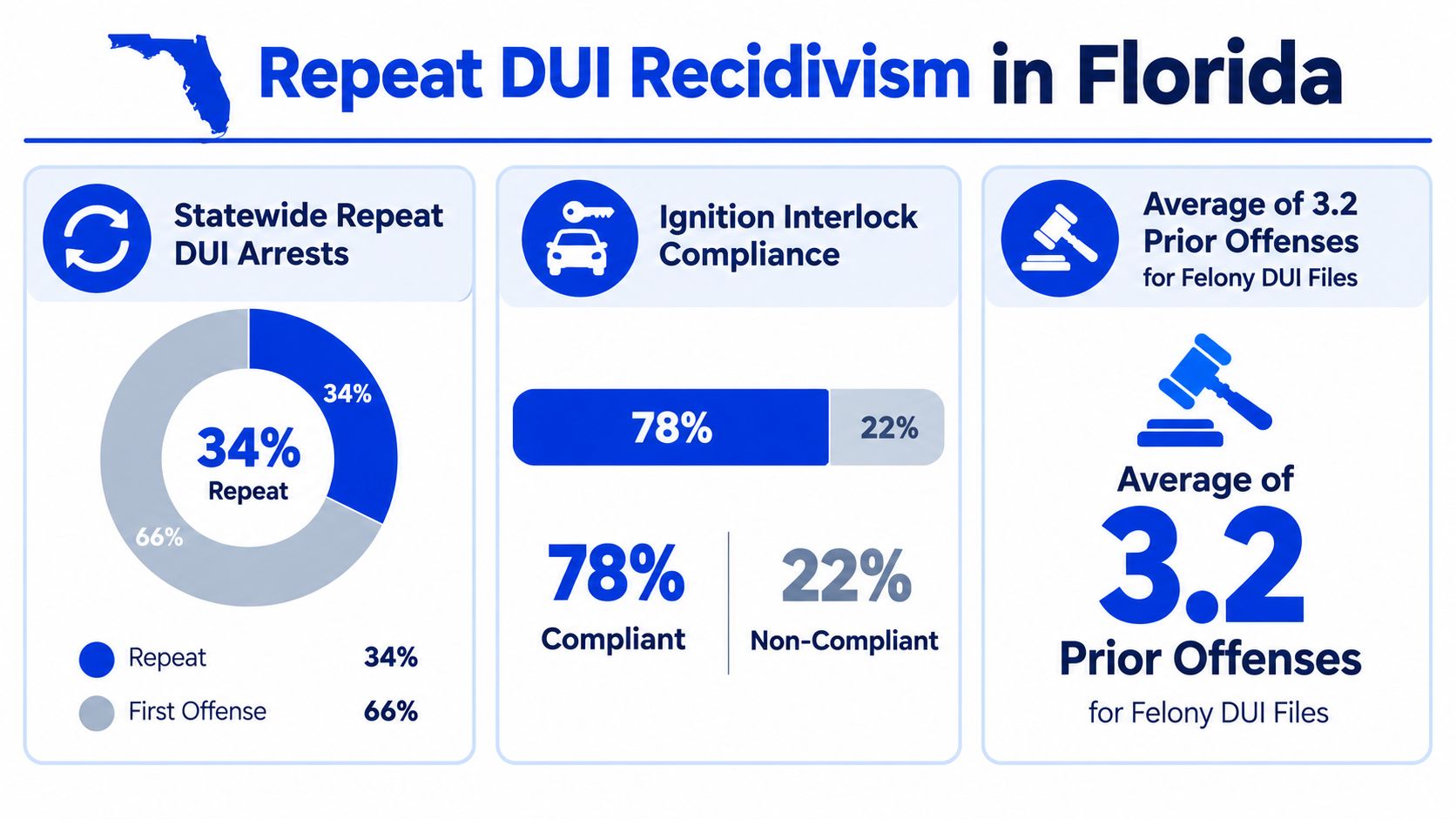
That distinction matters in Broward, Miami-Dade, and Palm Beach cases. Save interlock reports, lockout explanations, treatment attendance records, and proof of abstinence. A documented compliance history can give counsel something concrete to present when the prosecutor evaluates risk or when a judge considers sentencing.
Defense Strategies That Attack Felony DUI Cases
A felony label is a charging decision supported by evidence. Defense counsel should test each part of that evidence rather than treating the label as a conclusion.
Start with the prior convictions
The first audit concerns the records used to enhance the offense. Counsel should compare certified judgments with the State's chronology, check whether a prior plea was counseled, and determine whether the conviction falls within the statutory period. A defective judgment, an uncounseled plea, or a conviction outside the lookback can change the legal classification.
For example, a prosecutor may count an older case based on an arrest date while the statute turns on the conviction date. That difference can matter. Out-of-state records also require careful comparison because a similar label doesn't automatically establish an equivalent Florida offense.
Test the stop and roadside evidence
The Fourth Amendment protects against unreasonable stops and searches. If the officer lacked a lawful basis to stop the vehicle, later observations and testing may face suppression litigation. A checkpoint raises its own constitutional and operational questions, including whether the checkpoint was properly administered and whether the driver has standing to challenge the evidence.
Field sobriety evidence also deserves scrutiny. The defense should examine the video, lighting, surface conditions, footwear, weather, medical limitations, instructions, scoring, and the officer's training. A roadside test performed on uneven pavement isn't the same evidence as a controlled scientific measurement.
Challenge the chemical test
Breath and blood evidence can be attacked through maintenance records, calibration documentation, operator compliance, observation-period gaps, contamination issues, and chain-of-custody problems. A high result doesn't eliminate the need to prove that the machine was properly maintained and the test was properly administered.
A rising-BAC defense may apply when testing occurred well after the stop. The relevant question is whether the result accurately reflects the driver's alcohol level while operating, not merely the level measured later. That issue requires facts, timing, expert analysis, and careful review of all statements.
Separate injury from causation
In an injury case, review alternative causes of trauma, independent witnesses, medical records, vehicle damage, and crash reconstruction. The State must connect the alleged impairment to the required injury. A medical condition, road defect, another vehicle, or a separate collision mechanism may create reasonable doubt about causation.
A focused review of these issues is also discussed in how to fight a DUI. The strategy should be customized to the actual evidence, not copied from a generic checklist.
Plea Options and Charge Reduction Strategies
Plea negotiations work best when defense counsel identifies weaknesses before the prosecutor files a formal felony information. Once the State commits to a felony theory, the prosecutor may become less willing to retreat, especially after an injury allegation or a claimed repeat-offender history has been presented to the court.
Misdemeanor diversion under Florida Statute §316.193(5) is generally limited. It's typically considered for a first-time misdemeanor DUI with no prior convictions and no crash. A person facing a felony repeat-offender or injury theory shouldn't assume diversion is available just because the evidence has problems.
The negotiation targets depend on the facts:
Prior-record challenge: If the State can't prove a qualifying conviction or the lookback calculation is wrong, counsel may seek a misdemeanor resolution.
Evidence-based reduction: Weak field sobriety evidence, unreliable breath procedures, or missing calibration records can support a reckless-driving negotiation.
Injury reassessment: A serious injury allegation may change if medical records or reconstruction don't support the required level of harm.
Death-case negotiation: In an appropriate case, counsel may discuss reducing DUI manslaughter to vehicular homicide, but the evidence and statutory elements control that decision.
Sentencing mitigation: Interlock installation, treatment enrollment, restitution, and strict bond compliance can improve the presentation even when the charge remains serious.

Withhold of adjudication may be considered in some cases, but felony DUI restrictions and the specific offense often limit that option. A guilty or nolo contendere plea can become strategic when it caps exposure through a negotiated sentence, avoids trial risk, or secures a charge reduction. It should never be entered without understanding the license, immigration, employment, firearm, registration, and future-record consequences.
What to Do Right Now If You Are Facing Felony DUI Charges
Act in sequence. Early mistakes can affect both the administrative license case and the felony prosecution.
Protect the license deadline. Ask counsel immediately about requesting a formal review hearing with the Florida Department of Highway Safety and Motor Vehicles within the applicable 10-day window. That step can protect the possibility of a hardship or business-purpose license while the administrative case proceeds.
Collect the arrest file. Obtain the breath-test refusal or result paperwork, criminal citation, sworn complaint, booking documents, and any crash materials. Preserve videos, medical records, vehicle photographs, and communications about the stop.
Audit every prior DUI. Gather judgments, plea paperwork, docket sheets, and disposition records from Florida and other states. Don't rely on memory or a driver-history summary. The felony classification may depend on dates and legal details hidden in the court file.
Consider an evaluation early. A licensed DUI substance-abuse evaluation and treatment program can demonstrate responsible action and create useful mitigation. It doesn't erase the charge, but documented participation may matter during negotiations and sentencing.
Follow bond conditions exactly. Don't violate no-contact orders, ignore testing requirements, drive when prohibited, or delay required ignition-interlock installation. The State will use violations to argue that stronger supervision or punishment is necessary.
Retain counsel before the first substantive hearing. Choose a lawyer with felony DUI courtroom experience in the assigned South Florida circuit. A Fort Lauderdale DUI lawyer handling a Broward case needs to understand the local filing process, clerk records, prosecutors, judges, and license procedures.
If you're facing felony DUI charges, Ticket Shield, PLLC can review the charging pathway, prior-record chronology, chemical-test evidence, and license exposure in a confidential consultation. Visit Ticket Shield, PLLC to request help protecting your driving privileges and building a defense before the State's felony theory becomes harder to challenge.