DUI Probation Violation in Florida: What Comes Next
Jason Goldsmith, Esq
You just got the call or the letter nobody wants. Your probation officer says a DUI probation violation has been filed, and now your mind is racing about jail, a warrant, and whether one mistake just blew up everything you had left on probation. Take a breath and deal with this like it matters, because it does.
In Florida, DUI probation is not some loose promise to stay out of trouble. A first-time DUI case can carry up to 3 years of probation, and multiple DUI offenses can mean up to 5 years. If the probation officer asks the judge to revoke probation, the court can act fast, and it does not need a new DUI conviction to do it.
Table of Contents
What a DUI Probation Violation Means in Florida
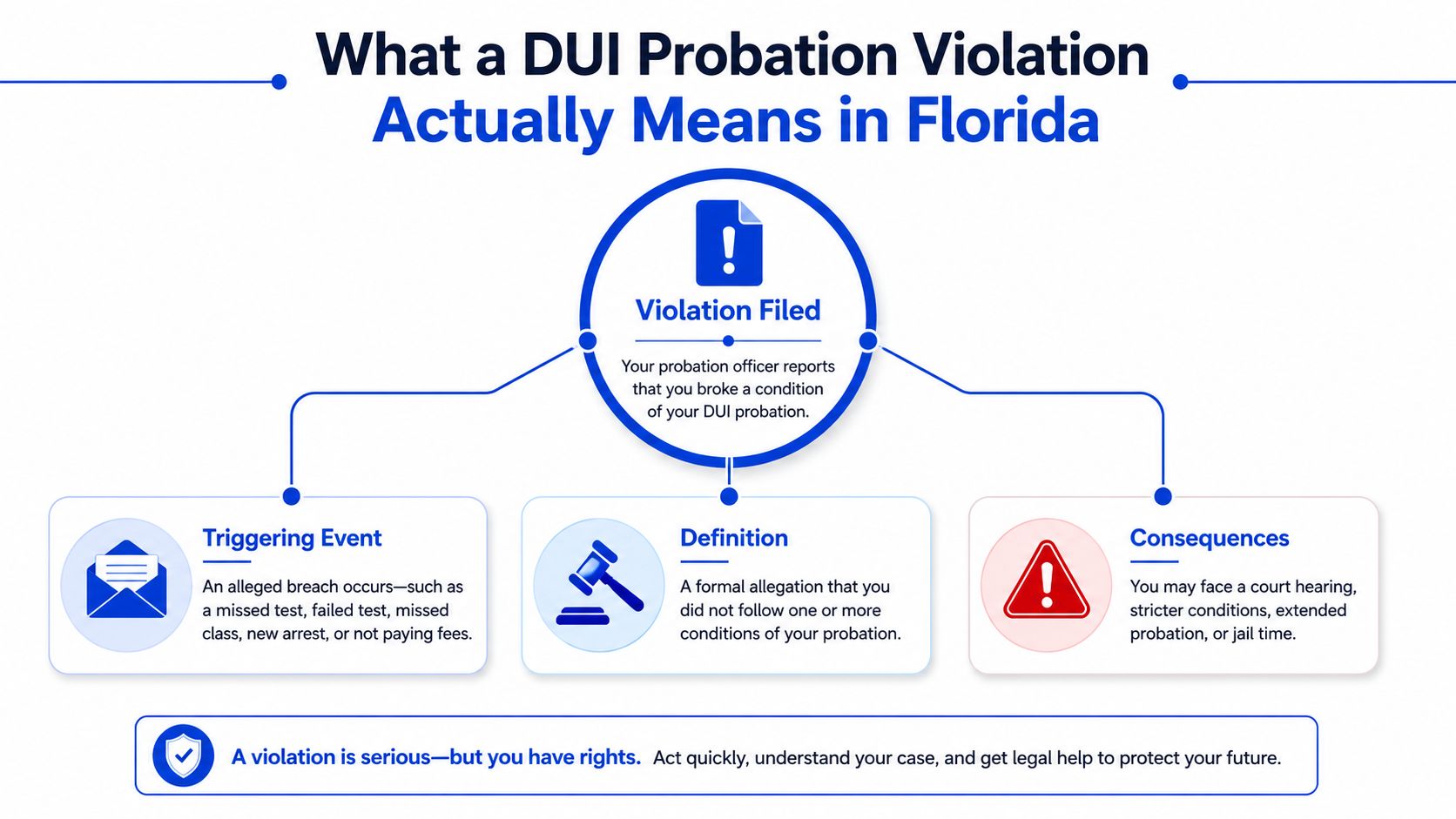
A DUI probation case can turn ugly without a new DUI conviction. If the State says you missed a condition, that allegation can become a probation violation proceeding on its own, and the judge can treat it as a supervision problem right away instead of waiting for the new criminal case to play out. Missed reporting, a failed alcohol test, a missed class, or a new arrest can all move the case fast.
Florida DUI probation gives you little room for error. A first-time offender may face up to 3 years of probation, while multiple DUI offenses may bring up to 5 years, and the probation officer can ask the original sentencing judge to revoke probation if a condition is violated (Kelly, Farrish). The core question is simple: did you break a condition the judge already ordered?
The two buckets that matter
Florida courts usually sort a DUI probation violation into two buckets. A technical violation is failure to follow the rules, like missing a class, missing an appointment, or failing to update an address. A substantive or new-law violation means the State claims you picked up a new arrest while still on probation.
A violation filing is not the same thing as a new DUI conviction. It can still bring jail, tighter supervision, or revocation if the judge finds the State proved the violation by a preponderance of the evidence, which is a lower standard than proof beyond a reasonable doubt. In practice, that means the court only has to decide that a violation is more likely than not.
The process usually starts when the probation officer files the affidavit and the judge reviews it. From there, the case can shift from a paperwork problem to custody exposure very quickly. Florida courts also use graduated sanctions in some cases before they jump straight to a warrant, so the first move may be a warning, a sanction, or a short-term consequence instead of immediate revocation.
If you are in Broward County, Fort Lauderdale, Miami-Dade, Palm Beach, or anywhere in South Florida, treat this like a court issue that can affect your freedom, not a minor scheduling mistake.
Typical DUI Probation Conditions You Must Follow
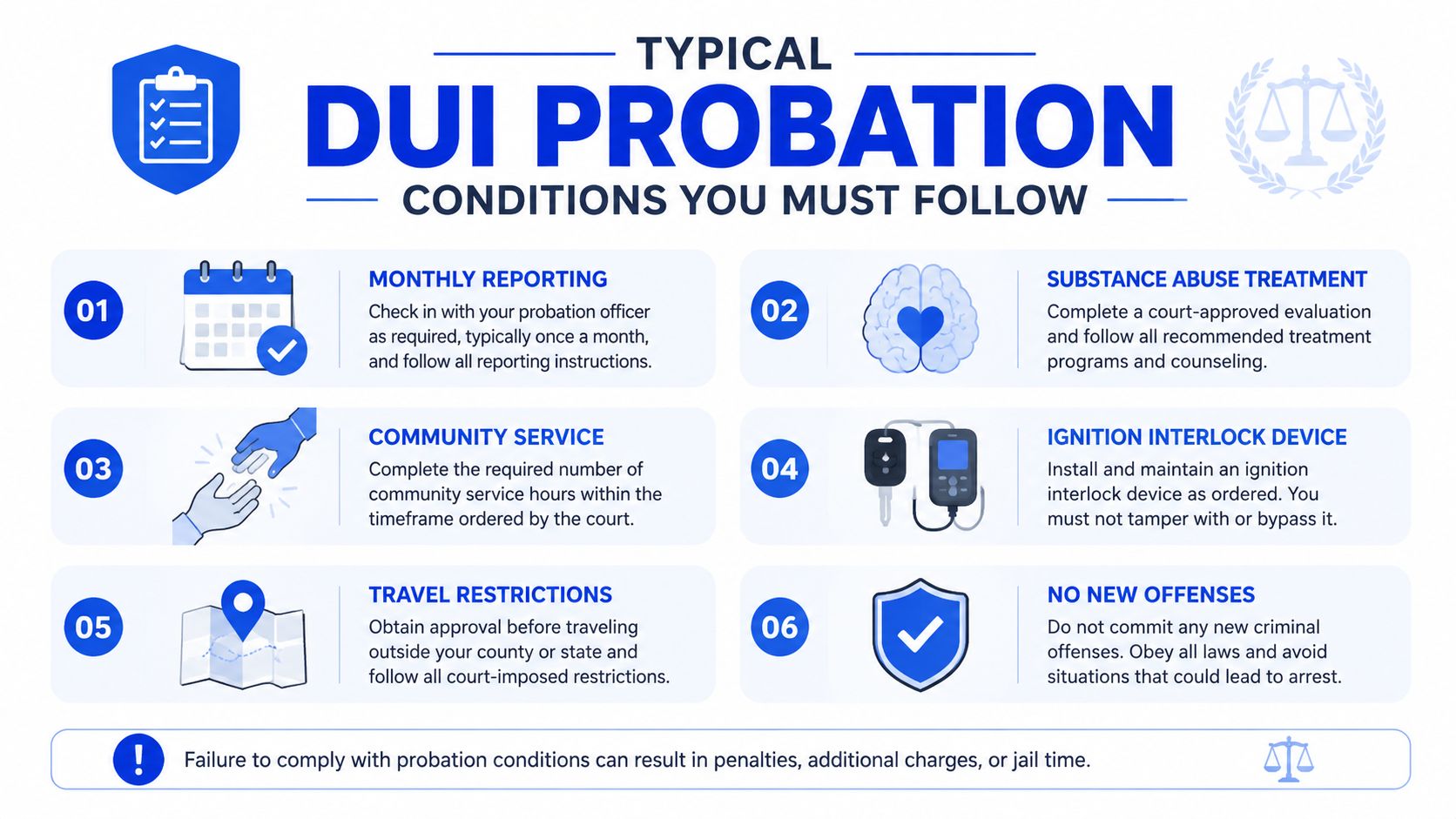
Florida DUI probation comes with rules that sound simple until you miss one. A judge does not care that you were busy, confused, or thought a small slip would slide. If the order says report, test, pay, or complete treatment, you need proof that you did it.
The usual conditions include monthly in-person reporting, a state-certified substance abuse course, and a psychosocial evaluation. If the evaluation says treatment is needed, then treatment becomes part of the order too (Moses and Rooth). That is the floor, not the finish line.
The rules that trip people up
The conditions that cause real trouble are usually the ones probationers treat as minor. Missed reporting, missed classes, alcohol use, and a new arrest are the obvious problems, but testing rules can also turn into a violation if you assume a little alcohol will not matter.
Keep every receipt, appointment notice, class certificate, and test result. If it is not documented, expect the probation officer or the court to act like it never happened.
A 1995 national probation survey found that DUI-related supervision was already a major part of probation systems, with more than 20% of probationers on probation for driving under the influence of drugs or alcohol, and 44% committing their offense under the influence of alcohol (BJS satap95). By 2005, the National Highway Traffic Safety Administration reported over 4 million people on probation in the U.S., and 15% of those probation sentences were for driving while impaired or intoxicated. That history explains the attitude you will get from probation officers and judges. They see these cases as routine, and they expect strict compliance.
If your order includes reporting, treatment, or travel limits, read the written judgment line by line. Do not trust your memory. If the paperwork is unclear, or if you are already behind, review the court file and talk to counsel before the next reporting date. If the issue is a technical problem with supervision requirements, review a Florida technical violation of probation explanation before you assume the court will treat it lightly.
Technical Violations vs New Offense Violations
The label on the violation matters because it changes the court's options. A technical violation is about compliance, not a fresh criminal act. A substantive violation or new-law violation means the State says you committed a new offense while on probation, which raises the stakes and usually changes the strategy.
Florida courts and probation officers often start with the facts, then sort the conduct into the right bucket. Missing classes, failing to pay fines, missing appointments, or failing to update an address fit the technical side, while a new DUI arrest or any other arrest during probation fits the substantive side (Chesley Lawyers). That distinction is not academic. It affects how quickly the court may move, what sanctions are on the table, and what your lawyer should attack first.
Element | Technical Violation | Substantive or New-Law Violation |
|---|---|---|
Core issue | Broken supervision rule | New arrest or new offense allegation |
Common examples | Missing classes, failing to pay fines, missing probation appointments, failing to update address | New DUI arrest, any other arrest during probation |
Court focus | Compliance and documentation | The new case facts and alleged conduct |
Defense emphasis | Notices, records, ability to comply, test reliability | Stop the State from turning an arrest into automatic revocation |
Risk level | Can still lead to jail or stricter conditions | Often much more serious because it adds a new criminal exposure |
If your only problem is one missed report, your position is different from somebody who got arrested on a new charge. Do not let anyone blur those two situations together. The defense plan should match the bucket, and you can read more about that distinction at Florida technical violation of probation.
How the Violation Process Works From Warrant to Hearing
Once the probation officer files the affidavit, the judge reviews it and decides whether the case moves forward by summons or warrant. If a warrant issues, arrest can follow fast. If a summons is used, you still have to show up and deal with the accusation head-on.
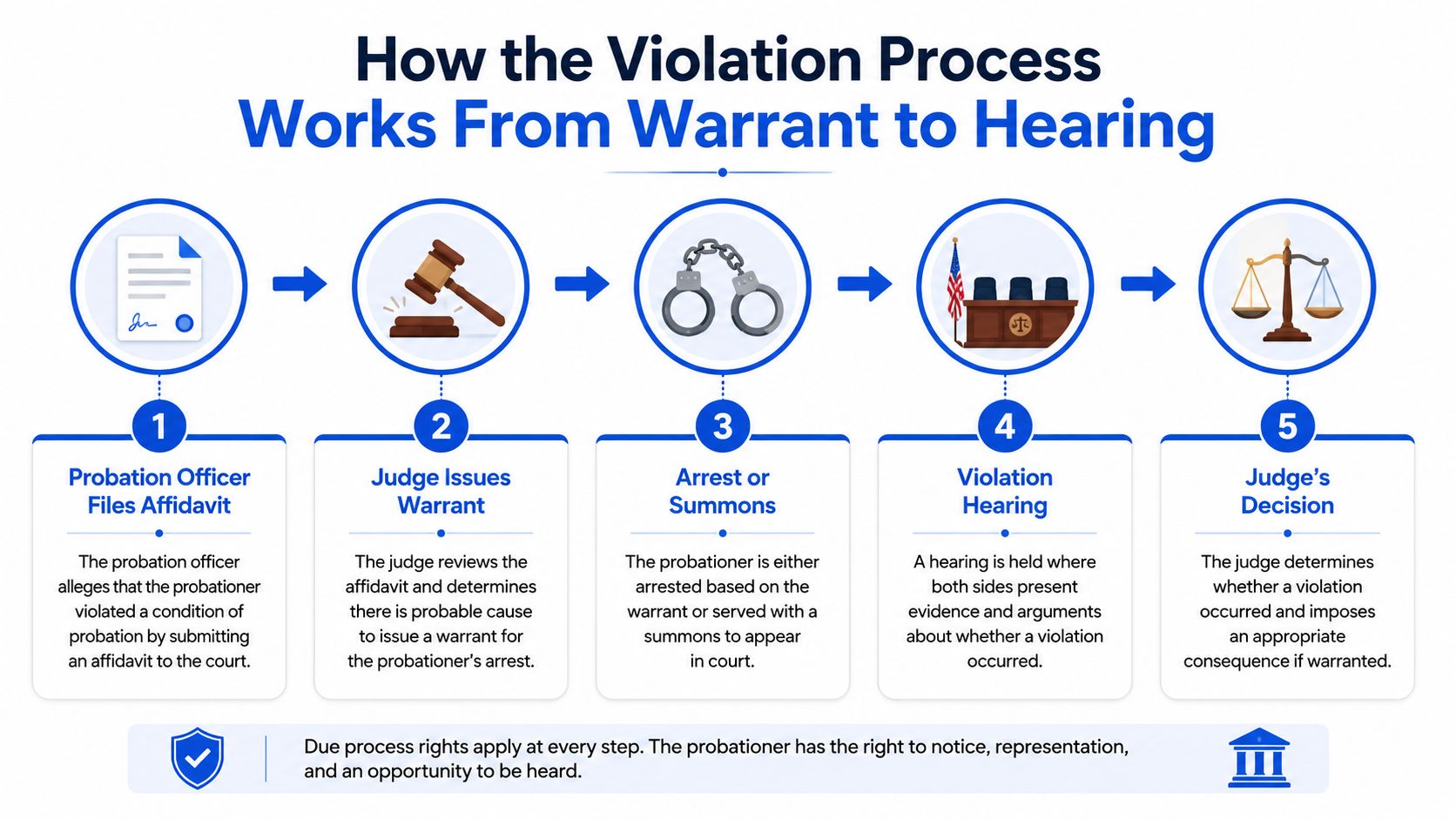
The hearing is not a new DUI trial. It is usually a preponderance-of-the-evidence hearing, meaning the judge can find a violation if it is more likely than not that a condition was broken (DUI Guru). That lower standard is exactly why probation violation cases can move faster and feel harsher than the original DUI case.
The steps, in order
Affidavit filed. The probation officer says what condition was broken.
Judge reviews it. The judge decides whether to issue a warrant or set court.
Arrest or surrender. You may be picked up or ordered to appear.
Violation hearing. The court hears the evidence and arguments.
Decision. The judge chooses the response, from continued probation to revocation.
If your case starts with a warrant, do not assume it will “work itself out.” A warrant can turn a manageable problem into a custody problem. If the State's proof is weak, your attorney needs to challenge it early, before the hearing locks in a bad outcome.
Penalties and Sanctions a Judge Can Impose
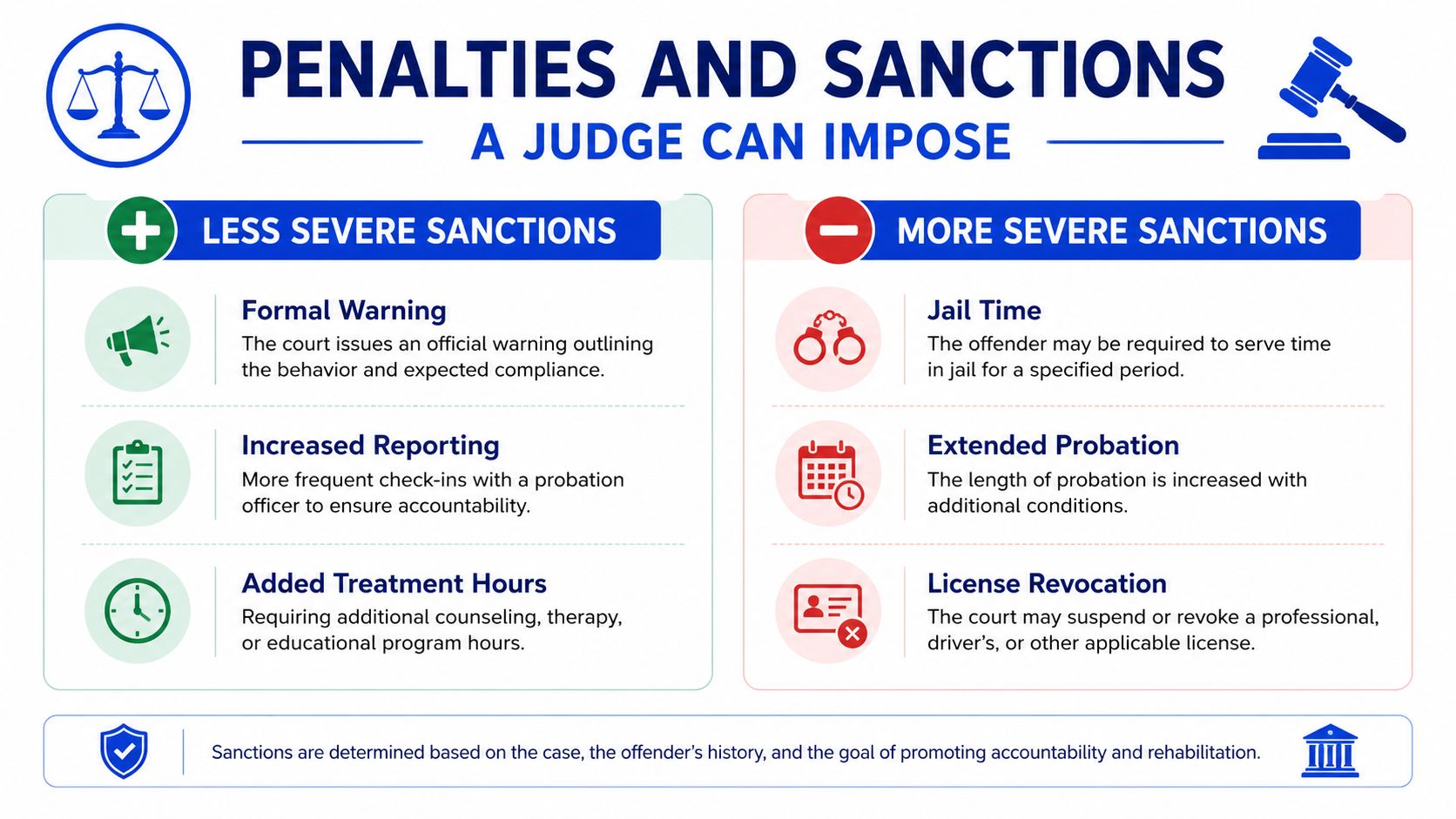
A judge does not have to jump straight to the harshest result. In many Florida probation cases, the response starts with a warning, added reporting, or more treatment, especially when the violation looks technical and the person has otherwise complied. Once noncompliance repeats, the court gets less patient.
Florida judges often use graduated sanctions first. That can mean a tighter check-in schedule, extra testing, more counseling, community service, or a short jail stay before the court moves to revocation. The point is simple, the judge can escalate the response step by step when the violation does not stop.
What judges can do
Less severe responses often include:
Formal warning. The judge keeps the case on probation and puts you on notice.
Increased reporting. You may have to appear more often or check in more closely.
Added treatment. The court can order more classes, counseling, or testing.
More severe responses can include:
Jail time. Even short custody can interrupt work, family obligations, and treatment.
Extended probation. The court can keep you under supervision longer.
Revocation. The judge can end probation and impose the underlying sentence if the violation is serious enough.
Florida does not use a one-size-fits-all technical-violation system like some other states, but the practical pressure is the same. Judges often start with a sanction that fits the missed requirement, then move up if the same problem keeps happening. If you are facing custody exposure, review probation violation jail time so you understand what can happen when the court treats the violation as serious.
That warning matters because the hearing is not theoretical. A violation can lead to jail, longer supervision, or a revoked probation sentence, and the court can choose the harsher response once it decides your conduct crossed the line.
Nationally, the stakes are not theoretical. In 2023, nearly 200,000 people were admitted to prison for violating probation or parole, including over 110,000 for technical violations such as missing appointments or failing to comply with supervision conditions (CSG Justice Center via Robina Institute). That is why even a “small” violation should be treated like a real court threat, not a scheduling mistake.
Defenses and Mitigation Strategies That Can Help
A violation allegation is not the same thing as proof. You still get a hearing before a judge to contest it, and the court can respond anywhere from a warning and reinstated probation to revocation and jail time (Driving Laws). That gives your lawyer room to attack the State's case and, when needed, reduce the damage.
One angle is proof. If the test was unreliable, the stop was unlawful, the residence search was illegal, or the probation condition was never clearly communicated, the State may not have what it needs. A second angle is mitigation, which means showing the judge you are not spiraling, you are working, sober, and trying to fix the problem.
Common defenses and mitigation themes
Unlawful search or seizure. If officers or probation staff searched without legal authority, the evidence may be vulnerable.
Bad testing evidence. Urine or breath results can be challenged if the testing was mishandled, contaminated, or interpreted incorrectly.
Lack of notice. If you never got a clear condition, the State has a harder time blaming you for missing it.
Ability to pay. If fines or costs were impossible to pay, the court should hear that context instead of treating poverty like defiance.
Documented progress. Clean later tests, treatment completion, steady work, and family support matter.
Bring proof, not excuses. Judges listen differently when you can show attendance records, pay stubs, treatment notes, and clean tests.
If you are already building a defense file, keep it organized and keep it honest. Your attorney may also coordinate the probation issue with the rest of the DUI defense through Florida DUI defense resources, especially when a new arrest and a violation are moving at the same time. The goal is not to sound sorry. The goal is to give the judge a reason to reinstate probation instead of cutting it off.
Immediate Steps to Take If You Have Been Accused
Act like the hearing is real, because it is. The first 24 to 72 hours matter a lot more than people think, and bad decisions during that window can make the violation harder to defend.
Do not call your probation officer and freestyle an explanation. Say less, not more.
Gather every paper. Grab the probation order, class records, payment receipts, test results, and any notices you received.
Write down dates while they are fresh. Missing appointment dates, class dates, travel dates, and any contact with the officer matter.
Stop any new risk. No drinking, no new arrests, no side conversations that can become new evidence.
Call a Florida criminal defense lawyer. A probation violation lawyer can start reviewing the order, the filing, and the hearing timeline right away.
If your case may affect your driving privileges, review license reinstatement after DUI so you understand how one court problem can spill into another.
Do not delete texts, skip a hearing, or try to talk your way out of the issue with the officer alone. If you have already missed something, own the fact pattern with your lawyer and build the defense around the records, not panic.
How Ticket Shield PLLC Can Help Your Florida DUI Case
Ticket Shield, PLLC handles DUI probation violation cases with the same hard focus it brings to DUI defense, license issues, and other Florida criminal charges. Attorney Jason S. Goldsmith is a former prosecutor, so the firm knows how the State builds these filings and where the weak spots usually are.
The practical work matters. That means reviewing the affidavit, challenging weak test evidence, pushing for modified conditions instead of revocation when the facts support it, and showing up in Broward County, Fort Lauderdale, Miami-Dade, Palm Beach, and surrounding South Florida courts with a plan. Clients can also reach the firm by phone, text, or email, which helps when a warrant, hearing date, or reporting problem is already hanging over them.
If you're dealing with a violation now, get legal help before the court makes the next move.
Ticket Shield, PLLC can review your DUI probation violation, explain your options, and step in before a technical problem turns into jail time or revocation. If you need a Florida defense lawyer who understands probation, DUI, and local South Florida courts, visit Ticket Shield, PLLC for a confidential consultation and clear next steps.