Criminal Defense Attorney for Juvenile Cases in Florida
Jason Goldsmith, Esq
Your phone rings after school, or maybe at 11 p.m. after a patrol car stop, and the message is the same. Your child is in trouble, the police want to ask questions, and you're being told this is “just juvenile court,” as if that makes it minor. It doesn't.
In Florida, the first decisions in a youth case often matter more than the charge label itself. Whether a child is detained, whether the state files a petition, whether counsel gets involved before a statement is taken, those choices can shape the whole case. A criminal defense attorney for juvenile matters is not just arguing about guilt, they're fighting over the process that decides how much damage this case can do.
Table of Contents
When Your Child Is Charged in Florida
The call usually comes from a school resource officer, a detective, or a deputy who says they just want to “hear your side.” That's when a lot of families make their first mistake, they try to explain, calm things down, or let the child talk without counsel because everyone hopes it will go away. In juvenile court, that can be the moment the case hardens.
Florida parents also underestimate how quickly a youth matter can move. The system isn't built around one dramatic trial date. It starts with intake, detention decisions, and a petition decision, and those early moves can change whether the case stays informal or becomes a formal court file.
Practical rule: if police are asking questions, stop the conversation and call a lawyer before anyone “just clears things up.”
The safest move is simple, don't treat juvenile charges as a lighter version of adult charges. I've seen parents lose good options because they assumed a school fight, a theft allegation, or a drug case would be handled with a warning. Sometimes it is. Sometimes it isn't. The difference often comes down to whether defense counsel gets involved before the intake officer, prosecutor, or judge locks in the first version of the facts.
If your child was questioned at school, read this first, what Miranda rights actually mean in a Florida case. That issue comes up fast when officers are talking to minors without a lawyer in the room.
How Florida Juvenile Court Works
Florida juvenile court is a sequence of decisions, not a single hearing. That matters because a lawyer can shape the case at several points, especially before the state turns a school incident or neighborhood dispute into a formal delinquency file. National juvenile court data show how busy this system is, in 2023, U.S. juvenile courts handled an estimated 653,800 delinquency cases, which was 61% higher than in 1960, and 52% of those cases were formally petitioned rather than handled informally at intake OJP juvenile court statistics for 2023.
The stages that matter
The first stop is usually intake, sometimes through a juvenile assessment center or a similar local screening process. That is where officials decide whether the child goes home, gets a diversion offer, or stays in custody while the case is reviewed. A lawyer's job here is to argue against unnecessary detention and push for release, supervision, or a nonjudicial outcome.
Next comes the petition decision. If the state files a delinquency petition, the case becomes formal, and the child is now dealing with a court file that can affect school, licensing, and future record issues. If the facts are weak or the child is a poor fit for prosecution, counsel can push for diversion or a consent decree instead of a full adjudication track.
The adjudicatory hearing is the juvenile equivalent of a trial. If the state cannot prove its case, the child should not be found delinquent. The disposition hearing comes after that, and it is the juvenile version of sentencing, except the court is supposed to think about treatment, supervision, and rehabilitation, not just punishment.
A juvenile case is won or lost in small rooms long before the hearing everyone worries about.
Florida courts in Broward, Miami-Dade, and Palm Beach each have their own rhythms. Some judges push faster, some intake units are more willing to screen for diversion, and some prosecutors are more willing to resolve first-time cases without a formal adjudication. A lawyer who knows the local culture can use those differences instead of fighting blind.
Stage | Typical Decision | Defense Counsel's Role |
|---|---|---|
Intake | Release, detention, or diversion review | Argue for release and keep the case informal |
Petition | File formal charges or screen out | Challenge weak facts and push for nonjudicial resolution |
Arraignment | Admit, deny, or negotiate | Protect the record and preserve defenses |
Adjudicatory hearing | Court decides whether allegations are proven | Contest evidence and cross-examine witnesses |
Disposition | Supervision, counseling, or placement | Argue for the least restrictive outcome |
Probation review | Continue, modify, or close supervision | Document compliance and seek early termination |
Families who want a diversion path need counsel who knows how Florida programs work, not just what the statute says. A good starting point is Florida pretrial diversion options, because in juvenile court, the first move often matters more than the last hearing.
Rights Your Child Has in Juvenile Court
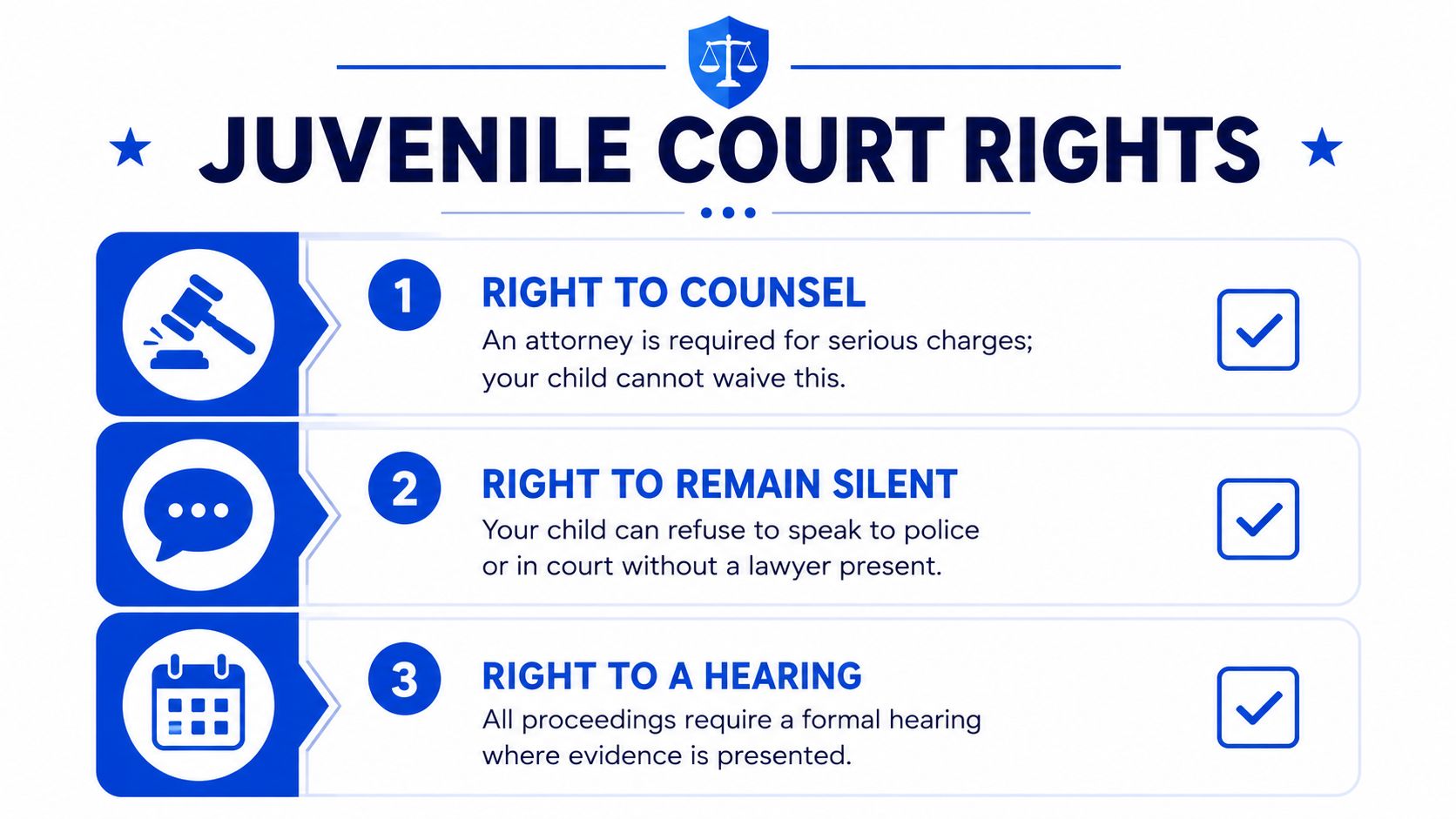
A child doesn't lose constitutional rights because the case is in family or juvenile court. The problem is that minors often don't understand those rights, and adults around them sometimes think a parent's presence is enough to make a statement “safe.” It isn't.
The rights that matter right away
The right to counsel is the most important one in practice. In serious juvenile cases, a child should not be left to face police, intake, or court alone. Access to counsel changes outcomes, and a California juvenile-justice report found that in 2024, 97.7% (16,153 of 16,541) of known defense representations involved a juvenile being represented by counsel, showing how central legal representation is in major systems California juvenile justice report.
The right to remain silent matters at school as much as at a police station. Parents often think they can “clear it up” by answering questions with an officer or school administrator, but that can turn a defendable situation into a recorded statement. Youth cases also raise serious competence concerns, because formal juvenile-defense guidance emphasizes adolescent development, competence evaluation, and the use of mental-health or chemical-dependency records when evaluating whether a child can really participate in the process Nebraska juvenile defense guidance.
What parents should do
Ask for counsel immediately: Don't wait to see how serious it gets. Early representation can affect detention, questioning, and the petition decision.
Stop school interviews without a lawyer: A child can say things in a school setting that later get used in court.
Save every record: Attendance notes, IEPs, counseling history, and treatment records can become part of the defense strategy.
Do not coach a story: Give the lawyer the facts, then let counsel decide what matters and what doesn't.
If your child is asked to talk, the better answer is usually, “My lawyer will handle that.”
The point isn't to be confrontational. It's to prevent a hurried statement from becoming the State's best evidence.
Common Juvenile Charges and What They Mean in Florida
Not every juvenile charge carries the same risk. A shoplifting allegation, a school fight, a drug possession case, a weapons case, and a violent felony can all move through Florida juvenile court differently. The practical question isn't just “What was charged?”, it's “How much room does this case leave for diversion, detention, or transfer?”
Lower-level cases
Misdemeanor theft, simple battery, minor drug possession, and some school-related conduct often start with the best chance of an informal resolution. That doesn't mean the child walks away untouched. It means the defense should be focused on keeping the matter out of a formal adjudication track, especially if the child has no serious history and the facts are not aggravated.
For parents dealing with theft allegations, Florida retail theft law basics can help frame why a quick statement to store security or police can make things worse. The same holds for minor possession cases, because the way the stop happened can matter as much as what was found.
Higher-risk cases
Weapons possession, burglary, aggravated assault, and sex-related allegations are different. These cases can trigger secure detention, more intense probation conditions, and in some situations a move toward adult court handling. In Florida, “direct file” and waiver concepts matter because they describe the process of moving a youth out of the juvenile system and into adult prosecution.
Florida also uses a separate juvenile sequence for people under 18 at the time of the offense, which means intake, consent decree, adjudicatory hearing, disposition, and probation review all remain possible decision points Florida juvenile court sequence overview. That's why a strong defense has to think several steps ahead, not just react to the charging document.
A single allegation can also ripple beyond court. Families should think about school discipline, records, and future applications, because the courtroom result is only part of the story.
Bottom line: the charge matters, but the case path matters more.
How a Juvenile Defense Attorney Builds the Case
A juvenile defense case starts with more than the arrest report. A lawyer who knows juvenile court looks first at the child's school history, behavioral supports, mental-health treatment, family instability, and anything else that explains how the child got here. That is not an excuse. It is the factual record that can change how intake, detention, and later court decisions play out.
In Florida, those early choices matter more than many parents expect. I saw this on the prosecution side too. Once intake screens the case, once detention locks in, and once someone starts talking about transfer or waiver, the field narrows fast. A defense lawyer who gets involved early can still shape the path before the file hardens into a more damaging outcome.
What competent counsel should gather early
School records can show attendance problems, special education needs, discipline issues, or signs that the child was already struggling before the arrest. Medical and counseling records can support arguments about impulse control, trauma, or capacity. Family documents can show the court what supervision, structure, or treatment is already available at home.
Those records matter because juvenile representation is not just about attacking the charge. It is also about litigating adolescent competence and capacity, especially when a child's age, development, or condition makes a statement less reliable or participation less meaningful. Training materials from Nebraska juvenile defense guidance make the same practical point, lawyers often do not develop these issues consistently, and a generic adult-defense approach misses them.
Florida counsel should also look at the first contact with police, the school, or intake. If a child spoke without a parent, was questioned in a pressured setting, or gave a statement before anyone explained the consequences, that can affect suppression strategy and detention arguments. If the child has an IEP, prior counseling, or a documented disability, those facts can matter at secure detention review and later disposition.
What the defense should press
Suppression issues: If police questioned the child without counsel, or if the statement was pressured, that can become a suppression fight.
Detention arguments: The lawyer should challenge unnecessary secure detention and push for the least restrictive setting.
Mitigation narrative: Trauma, disability, family stress, and treatment history can change how the judge views the case.
Outcome planning: The goal is not only acquittal. It can also be diversion, a consent decree, or a result that keeps the record manageable.
A juvenile defense case also rises or falls on who is doing the work. A juvenile defense study found that juveniles represented by public defenders were less likely to be convicted, less likely to be incarcerated in prison, and served shorter prison sentences than those with assigned counsel. That lines up with what experienced defense lawyers see in practice, a lawyer who knows how to build mitigation, challenge detention, and press the right hearing at the right time changes the result.
Ticket Shield, PLLC is one Florida firm that handles criminal defense consultations for charges that include juvenile matters, and it approaches the case by reviewing the facts, potential defenses, and next procedural move before the file hardens.
Diversion, Plea, Trial, and Sealing in Florida
Once the defense theory is in place, the next question is which path fits the case. Florida juvenile matters often turn on whether the child can stay out of a formal adjudication, whether the court will accept a negotiated resolution, or whether the case needs to be fought at hearing.

The practical pathways
Diversion and civil citation are often the cleanest outcomes for lower-level conduct, especially when the child is a first-time offender and the facts aren't violent. A consent decree can also keep the case in a supervised track without a full adjudication if the child completes the court's conditions. The separate juvenile sequence used by states like Florida means the case can still be shaped after the first filing, not just at one final hearing Florida juvenile process sequence.
A withhold of adjudication is important because it can avoid a formal finding that tends to carry more long-term baggage than families expect. But dismissal and sealing are not the same thing. A dismissed juvenile case doesn't automatically disappear, and sealing is not automatic at age 18.
Why sealing needs planning
Florida record sealing and expungement issues should be handled early, not as an afterthought. A case disposition can still affect college, military, and professional licensing questions even after the court matter is over. The more serious the offense, the more careful the record strategy has to be.
If your child's case is already on a court track, read how Florida record sealing works before agreeing to a plea or a disposition you don't fully understand. A juvenile result that looks minor today can still create paperwork problems later if nobody planned for the endgame.
Questions to Ask in a Juvenile Defense Consultation
The first consultation should feel like an interview, not a sales pitch. You're trying to find out whether the lawyer handles juvenile work, knows the local court, and understands how to protect a child's record, not just how to quote statutes. A general criminal lawyer can be decent and still miss the details that matter in juvenile court.
Ask these questions directly
How many juvenile cases do you handle regularly? You want someone who knows the rhythm of detention hearings, intake, and juvenile negotiation.
Who appears in court on my child's case? If another lawyer or paralegal does the heavy lifting, you should know that now.
How do you approach detention and release? The first custody decision can shape everything else.
What's your approach to diversion and consent decrees? The lawyer should explain how they identify cases that can stay out of formal adjudication.
Do you look for competency or mitigation issues? If the answer is no, that's a problem in a youth case.
How do you communicate with parents and the child? Juvenile defense works best when the family knows what's happening and why.
A few red flags should make you pause. Promises of a specific result are a bad sign. So is any lawyer who sounds unfamiliar with Florida juvenile procedure or talks about the case like it's just a smaller adult matter. The child's age, school records, home life, and ability to participate all matter here, and a lawyer who ignores those facts is missing the case theory.
A good consultation should leave you with a plan, not just reassurance.
If the lawyer can't explain what happens at intake, detention, petition, and disposition in plain English, keep looking.
Protecting Your Child's Future Starts Now
What families usually care about isn't legal jargon. It's whether their child will have a record, whether school gets involved, whether the case follows them into college or a job application, and whether this one bad day becomes a permanent label. Those concerns are real, and Florida juvenile law gives defense counsel multiple chances to limit the damage.
The three decisions that usually matter most are simple. Will the child be detained, will the state petition the case, and will the court end up making a formal adjudication finding. If a lawyer gets in early enough, there's often room to change at least one of those outcomes.
A juvenile charge is not the same thing as a future conviction. It's a process, and the process can still be influenced by fast action, careful records, and a lawyer who knows how Florida juvenile court really works. If your child was arrested or questioned in Broward County, Fort Lauderdale, Miami-Dade, Palm Beach, or anywhere in South Florida, get help before the first hearing closes the good options.
Ticket Shield, PLLC represents Florida clients in criminal defense matters, including juvenile charges, and the firm offers consultations to review the facts, the court path, and the immediate steps that protect a child's future. If your family needs a Florida juvenile defense lawyer who understands how early decisions shape the whole case, visit Ticket Shield, PLLC and ask for a confidential consultation today.