Petit Theft in Florida: Guide to Penalties & Defenses
Jason Goldsmith, Esq
You're standing outside a store while a loss-prevention employee asks you to wait for the police. You're embarrassed, worried about your job, and convinced that the low price of the item means the situation can't become serious. That assumption can create problems. In Florida, the item's value matters, but so do intent, prior theft convictions, the evidence collected, and the consequences attached to a conviction.
A petit theft accusation can affect your criminal record, driving privileges, employment, professional licensing, and immigration status. If you're facing a theft investigation or arrest in Broward County, Fort Lauderdale, Miami-Dade, Palm Beach, or elsewhere in South Florida, don't explain the situation to police or store personnel before speaking with a criminal defense attorney. The first version of events often shapes charging decisions and plea negotiations.
Table of Contents
Understanding Petit Theft in Florida
Florida petit theft generally involves knowingly obtaining or using another person's property with the intent to deprive the owner of it, either temporarily or permanently. That definition can apply to familiar situations such as alleged shoplifting, taking property from a workplace, keeping an item after borrowing it, or removing property from a vehicle. The State still has to prove the required mental state. A mistake, misunderstanding about permission, or ownership dispute can matter.
Consider a common scenario. A customer places merchandise in a bag while shopping, forgets to pay at a self-checkout station, and leaves the store. Loss prevention reviews surveillance footage and stops the customer outside. The customer immediately tries to explain, signs a store document, and agrees with an employee's description of what happened. By the time police arrive, the evidence may include the merchandise, surveillance video, employee statements, and the customer's own words.
That doesn't mean an arrest proves guilt. It means the accused person needs to treat the matter as a criminal case from the beginning. Florida's statutory framework distinguishes between levels of petit theft based on value and prior record, rather than treating every low-value incident as interchangeable. The Florida theft statute is the starting point, but the facts surrounding intent and proof remain central.
Value is only one part of the analysis
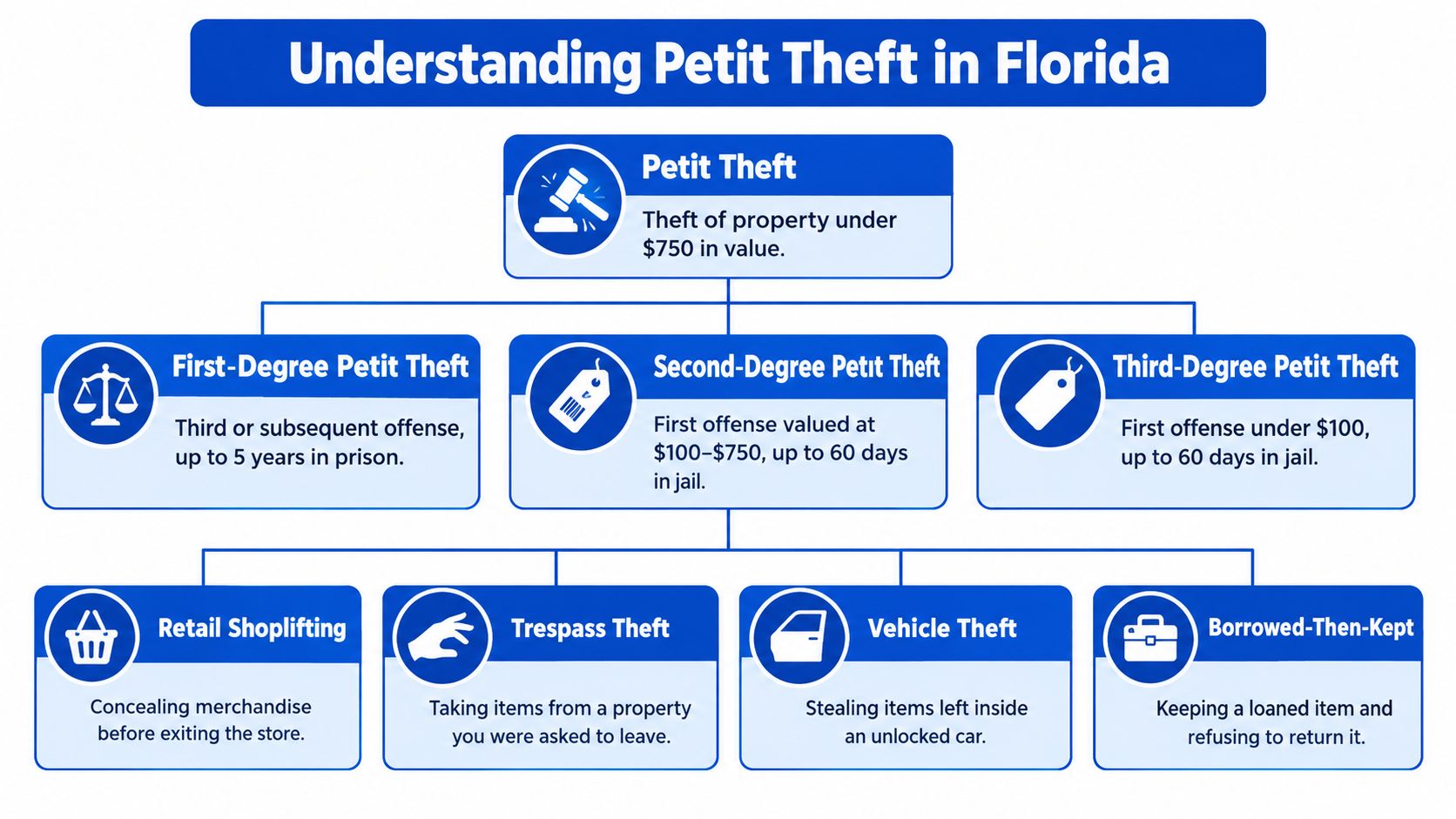
Under current Florida law, property valued at less than $100 is generally second-degree petit theft. Property valued at $100 to under $750 is generally first-degree petit theft. Those classifications describe the usual value-based structure for a single case, but prior convictions can change the charge dramatically.
The State may also examine whether the incident involved a retail business, whether multiple items were taken, whether the accused had permission to possess the property, and whether the evidence accurately identifies the person involved. A receipt, text message, ownership record, employee statement, or surveillance clip can either support the prosecution or expose weaknesses in it.
Practical rule: Don't assume that returning property ends the criminal case. Return of the item may help negotiations, but it doesn't automatically erase an allegation of intent.
The Evolution of Theft Thresholds and Statutes
Florida's theft thresholds haven't always looked the way they do today. Historical statutes from 1998 and 2000 tied first-degree petit theft to property valued at $100 or more but less than $300, with lower-value property generally treated as second-degree petit theft. The same $100 to under-$300 structure remained in the 2002 statutes. The historical Florida theft statute shows how the framework developed over time.
The current 2026 statute uses a first-degree petit theft range of $100 to under $750, expanding the value range that can support the higher misdemeanor classification. That change matters when reviewing older legal information online. A page that accurately described Florida law years ago may now understate the level of charge associated with property in the upper part of that range.
Why the threshold matters in a real case
The value question isn't always as simple as reading a price tag. Lawyers examine what property was allegedly taken, how the State calculated its value, whether items were grouped together, and whether the evidence supports the claimed amount. A disagreement over valuation can affect whether the case remains a misdemeanor or crosses into a felony category under other theft provisions.
That doesn't mean every valuation challenge succeeds. A defense lawyer needs a factual basis, such as purchase records, condition evidence, ownership documents, or inconsistencies in the loss calculation. The useful question isn't whether the value feels high or low. It's whether the prosecution can prove the legally relevant value with admissible evidence.
Florida's Office of Program Policy Analysis and Government Accountability has also noted that inflation has eroded the state's $750 felony theft threshold since it was set in 2019, estimating that the threshold would need to reach about $916 to match June 2024 CPI data. That analysis appears in the Florida statutory policy materials. The policy debate doesn't change the current charge by itself, but it explains why threshold disputes remain important.
The practical lesson is straightforward. Don't rely on an old blog post, a store employee's estimate, or an informal statement that the item is “only worth a few dollars.” Current statutory language, admissible valuation evidence, and the defendant's record determine the legal exposure.
Penalties - Misdemeanor vs. Felony Charges
A low-dollar theft charge is still a criminal charge. Under Florida's current framework, second-degree petit theft generally applies when the property is valued at less than $100. It can carry up to 60 days in jail and a $500 fine. First-degree petit theft generally applies when the property is valued at $100 to under $750, and it can carry up to 1 year in jail and a $1,000 fine. These statutory maximums are summarized in the Florida petit theft reference guide.
Charge level | General value range | Maximum statutory exposure |
|---|---|---|
Second-degree petit theft | Less than $100 | Up to 60 days in jail and a $500 fine |
First-degree petit theft | $100 to under $750 | Up to 1 year in jail and a $1,000 fine |
Third-degree felony petit theft based on prior theft convictions | Depends on the new property value and record | Up to 5 years in prison and a $5,000 fine |
The table describes maximum exposure, not a guaranteed sentence. A prosecutor may consider the strength of the evidence, the accused person's record, restitution, the circumstances of the incident, and available resolutions. A judge may impose a sentence below the statutory maximum, and some cases may qualify for dismissal, diversion, a reduction, or another negotiated outcome. None of those possibilities should be treated as automatic.
The felony change is the critical dividing line
Florida law allows petit theft to be charged as a third-degree felony when the defendant has two or more prior theft convictions. The felony exposure can reach 5 years in prison and a $5,000 fine, according to the current Florida theft statute. The new item can be low in value. The prior record can do the work of elevating the case.
That distinction affects far more than the potential sentence. A felony allegation can change bond conditions, employment screening, professional licensing concerns, plea strategy, and the long-term consequences of a conviction. It can also reduce the room for an informal resolution because the prosecutor is evaluating a more serious charge.
A practical defense assessment therefore asks two questions at the beginning:
What happened in the current incident? Review intent, ownership, permission, identification, surveillance, statements, and valuation.
What does the record show? Confirm whether prior matters were theft convictions, how they were resolved, and whether the State is using them for enhancement.
For a broader explanation of Florida misdemeanor classifications, review the firm's guide to Florida misdemeanor charges. The important point is that “misdemeanor” doesn't mean harmless, and “low value” doesn't prevent felony treatment when the statutory record enhancement applies.
The Hidden Risk of Prior Convictions
Many people focus exclusively on the current item. They ask whether the merchandise was worth $20, $50, or $200, then assume the answer determines the entire case. That approach misses the prior-record analysis that can turn a new petit theft allegation into a felony prosecution.
Florida's statute allows elevation to a third-degree felony when the defendant has at least two prior theft convictions. The new accusation may involve property that would otherwise fall within a misdemeanor category. The State may therefore review docket records, judgments, plea paperwork, and the precise offense involved before making an offer or filing an enhancement.
The record must be examined carefully
Not every prior contact with the criminal justice system has the same legal effect. An arrest isn't a conviction. A dismissed case isn't the same as an adjudication of guilt. A prior case may involve a different offense, an incomplete record, or a resolution that requires closer legal analysis.
That's why a defense attorney should obtain and review the actual court records rather than rely on a client's memory or a database entry. The review can affect charge negotiations, eligibility for certain resolutions, and the decision whether to contest the enhancement. The accused person should also avoid volunteering details about unrelated incidents to police or loss-prevention personnel.
One Florida guide reports that 66.9% of 146,973 cases in its dataset ended in guilty findings, while emphasizing that repeat-history screening is a decisive issue in petit theft cases. That information appears in the Florida petit theft case guide. It isn't a prediction of what will happen in an individual case. It does show why treating a repeat allegation as a routine low-level matter can be a serious strategic mistake.
The most useful early question isn't only “How much was the item worth?” It's “What exactly happened in the prior cases, and how will the State use them now?”
A prior conviction can also affect negotiations even when it doesn't legally trigger the felony provision. Prosecutors may view a record as evidence of repeated conduct, while the defense may emphasize age, factual differences, completed obligations, or weaknesses in the current proof. The right argument depends on the documents and facts, not a generic promise that a first offer will be available.
A negotiated resolution involving withheld adjudication may have different record consequences from a formal conviction, but eligibility and future record-clearing options depend on the facts and legal history. Learn more about withheld adjudication in Florida, and ask counsel to explain the risks before accepting any plea.
Collateral Consequences Beyond Jail
The sentence is only one part of a petit theft case. Florida also authorizes driver license consequences for petit-theft convictions. A first adjudication can result in a 6-month driver license suspension, and a second adjudication can result in a suspension of up to 1 year, as provided in the statute cited earlier.
For someone who drives to work, attends school, cares for children, or travels between South Florida communities, losing a license can create immediate practical problems. A fine may be difficult. A suspension can affect the ability to earn the money needed to pay it. These consequences can apply even when the court does not impose jail.
Steps to take after an accusation
Stop discussing the facts. Don't give police, store personnel, or another witness a detailed explanation before receiving legal advice. Statements intended to clarify a misunderstanding can be interpreted as admissions about possession, knowledge, or intent.
Preserve the evidence. Keep receipts, account records, messages about permission, photographs, delivery information, and documents showing ownership. Don't delete texts or alter digital files. Tell counsel about surveillance, witnesses, and any physical condition of the property that affects value.
Review every document before signing. A store may present a civil demand, incident report, trespass notice, or written statement. A civil dispute and a criminal prosecution are separate matters. Paying or signing something may not end the criminal case and may create evidence the prosecutor later uses.
Track court and license obligations. Keep copies of release conditions, notices, hearing dates, and correspondence from the clerk or licensing authority. Missing a court requirement can create a new problem unrelated to whether the original theft allegation is provable.
Defenses can affect the collateral result
A defense may challenge intent, ownership, permission, identification, valuation, or the way evidence was obtained. Counsel can also examine whether police questioning, a search, or the detention process violated legal protections. If the charge is dismissed or resolved without an adjudication, record-clearing options may be different from those available after a conviction.
Record relief isn't automatic, and the outcome of the criminal case matters. The firm's overview of record sealing in Florida explains why the final disposition should be considered before accepting a plea. A short-term resolution that creates a permanent conviction may be worse than an option that takes more negotiation and preparation.
Defense Strategies and Legal Representation
A petit theft defense starts with the evidence the State must present in court. The accusation may look simple, yet the outcome can depend on intent, ownership or permission, identification, valuation, and the reliability of the investigation. A strong strategy addresses each issue separately rather than treating the dollar amount as the whole case.
An accidental failure to pay does not automatically prove a knowing effort to deprive a merchant of property. Messages, receipts, prior permission, or shared access may support a different explanation when a roommate, coworker, or friend reports an alleged theft. In a retail case, incomplete surveillance may fail to establish who took the item, what happened afterward, or whether the conduct was intentional.
Testing the State's case
Counsel should examine whether the evidence proves the required elements:
Intent: Possession alone is not enough. Statements, conduct, and the surrounding circumstances may support or weaken the State's theory.
Permission and ownership: A genuine dispute about ownership or authorization can undermine the allegation that the property was taken unlawfully.
Value: The defense can review how the amount was calculated, whether the property's condition was considered, and whether separate items were improperly grouped.
Identification: Video, witness accounts, and business records should be checked for gaps, inconsistencies, and mistaken identification.
Law enforcement conduct: Unlawful searches, coercive questioning, or improper seizures may provide grounds to challenge evidence.
The defense should also assess the practical stakes. A prior theft conviction can change a later petit theft allegation into a felony-level problem, while a conviction may affect a driver's license, employment, immigration status, or eligibility for record relief. Those consequences can make the choice of resolution as important as the immediate sentence.
Early action changes the available choices
Early legal work may preserve video, obtain records, identify witnesses, and give the prosecutor a documented explanation before the State commits to its theory. Clients should consult an experienced criminal defense attorney for theft charges to evaluate whether diversion, suppression, or negotiation offers the strongest available path. No lawyer can promise dismissal or a particular plea.
Ask what charge is filed, whether the prior record is accurate, how value was determined, and whether a conviction could trigger a license suspension. The final disposition can also affect future employment and record-clearing options.
Ticket Shield, PLLC handles Florida petit theft defense matters by reviewing the charge, evidence, value, intent, prior convictions, and available strategies. The firm is based in Broward County, serves clients across South Florida and other Florida jurisdictions, and offers direct attorney communication and confidential consultations.
If you are accused of petit theft in Florida, contact Ticket Shield, PLLC for a confidential evaluation of the evidence, prior-record issues, license consequences, and possible defenses. Early guidance can protect your rights before an avoidable statement or plea narrows the available choices.