Florida Theft Statute Explained Penalties and Defenses
Jason Goldsmith, Esq
You're standing outside a Broward County store after a loss-prevention employee has stopped you, or you've just learned that a police report may lead to a theft charge. You may be wondering whether the allegation is a misdemeanor or felony, whether the merchandise value is being calculated correctly, and what you should say next. Those questions matter immediately because Florida does not treat every theft allegation the same way.
The Florida theft statute uses a degree-based structure. Property value, intent, permission, the type of property, prior theft convictions, and the circumstances of the alleged conduct can all affect the charge. A calm review of the facts can reveal issues that aren't obvious from an arrest form or a store report.
Table of Contents
Introduction to the Florida Theft Statute and Why It Matters
Petit Theft Versus Grand Theft Degrees and Dollar Thresholds
Common Theft Examples From Shoplifting to Retail and Organized Theft
Defenses Court Process and Protecting Your Rights in South Florida
Introduction to the Florida Theft Statute and Why It Matters
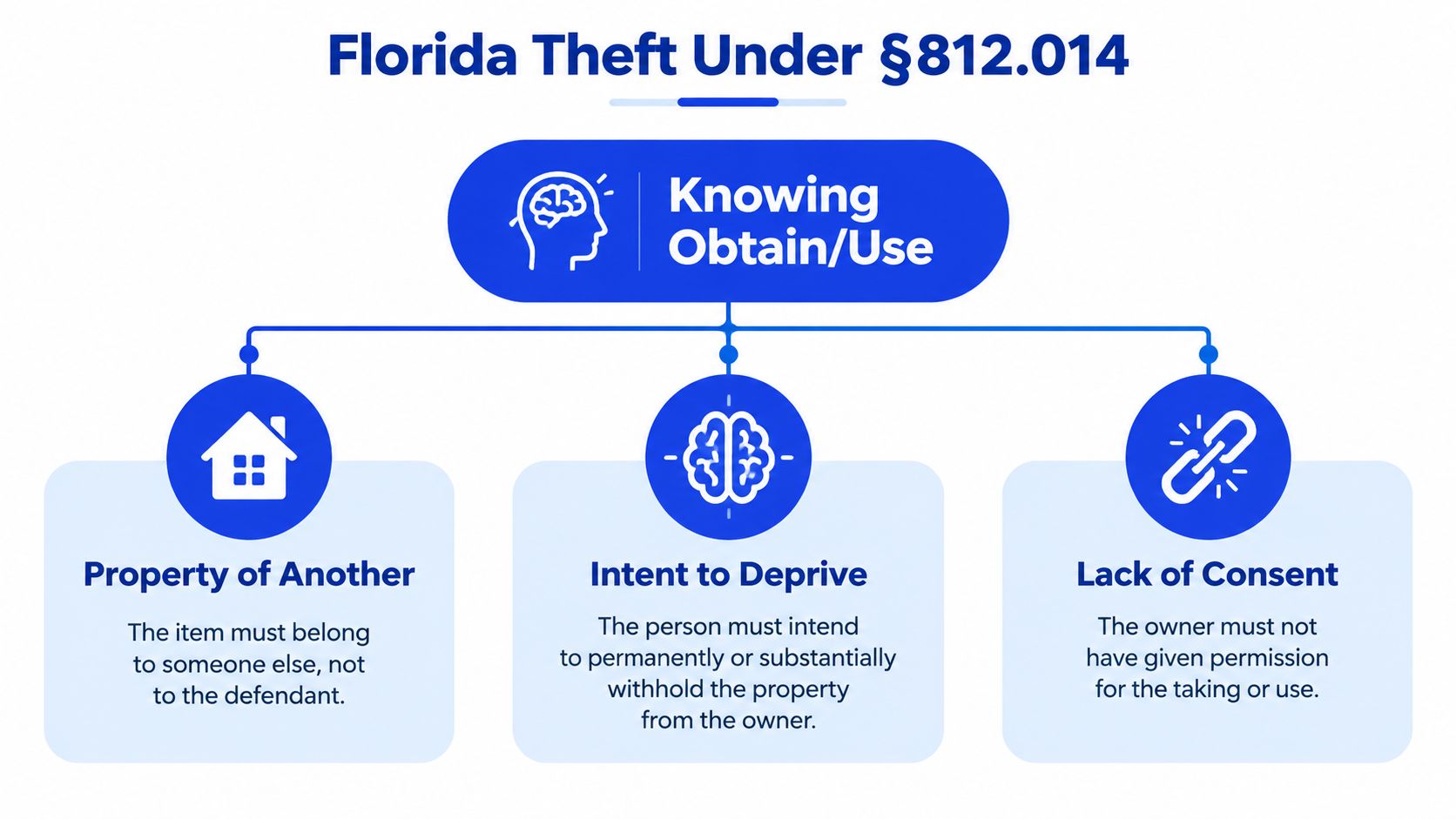
Florida Statute §812.014 controls the basic theft offense. In plain English, the State generally must prove that a person knowingly obtained or used property belonging to someone else, without permission, with an intent to deprive the owner of the property or its value. The allegation might involve merchandise, money, equipment, a vehicle, or another type of property.
The charge filed in a Fort Lauderdale, Miami-Dade, Palm Beach, or other South Florida court depends on more than the word “theft.” A lower-value allegation may be treated as petit theft, while a higher-value allegation may be charged as grand theft. Circumstances can also change the analysis, including the alleged handling of retail merchandise, the participation of other people, or the presence of property receiving special statutory treatment.
Practical rule: Don't assume the police report determines the final charge. The State still has to prove every required element, and the offense date can affect which version of the law applies.
After an arrest or notice to appear, the process can include an initial appearance, release conditions, discovery, negotiations, motion practice, and trial if necessary. The State may rely on surveillance video, employee statements, receipts, inventory records, admissions, or identification evidence. Each item should be examined rather than accepted at face value.
A theft allegation can affect employment, professional licensing, immigration concerns, family obligations, and future record-sealing options. Understanding Florida's broader criminal-law framework can help families place a theft case in context, as explained in this guide to Florida criminal laws.
What Florida Law Considers Theft Under Section 812.014
The statute's language becomes easier to understand if you treat the case as a series of questions. A prosecutor must connect the evidence to each question, and the defense can challenge any missing link.
Did the person knowingly obtain or use property
The first issue is knowledge. The State must show more than an accidental movement of an item or an innocent mistake. “Obtaining” can involve taking possession, while “using” can involve exercising control over property without the owner's permission.
For example, a customer who accidentally leaves a store with a product under personal belongings may have a different fact pattern from someone who conceals merchandise, passes the checkout area, and leaves. The surrounding evidence matters. Store video, statements, payment records, and what happened before and after the incident may all affect whether the conduct appears knowing.
Did the property belong to someone else
The State must identify the property and establish that the accused didn't own it or have a lawful right to control it. Ownership disputes can arise when people share belongings, borrow equipment, use workplace property, or disagree about whether permission was given.
A person may also have a claim of right, meaning they believed they were entitled to possess or use the property. That belief doesn't automatically end a prosecution, but it can directly affect the required intent.
Was there an intent to deprive
Intent is often the central dispute. The State may argue that conduct shows an intent to keep the property, prevent the owner from receiving its value, or use it without permission even if the deprivation was temporary. The defense may argue that the evidence shows mistake, permission, misunderstanding, or another innocent explanation.
The State's theory must fit the actual facts, not just the conclusion written in a report. A defense lawyer may examine whether the accused knew the item belonged to another person, whether permission existed, and whether the evidence proves an intent to deprive.
For more detail about theft-related allegations and property offenses, review this Florida theft and property crimes resource. Don't give a detailed statement to law enforcement or store investigators before speaking with counsel. A quick explanation that feels harmless can later be presented as evidence of knowledge or intent.
Petit Theft Versus Grand Theft Degrees and Dollar Thresholds
A South Florida shoplifting allegation can turn on the value assigned to one item. Under the 2026 statute, property worth less than $100 is petit theft of the second degree. Property valued at $100 to under $750 is petit theft of the first degree. The grand-theft levels begin at $750, with third-degree grand theft covering $750 to under $20,000, second-degree grand theft covering $20,000 to under $100,000, and first-degree grand theft beginning at $100,000. These rules appear in Florida Statute §812.014.
Degree | Property Value Range | Classification |
|---|---|---|
Petit theft, second degree | Less than $100 | Misdemeanor |
Petit theft, first degree | $100 to under $750 | Misdemeanor |
Grand theft, third degree | $750 to under $20,000 | Felony |
Grand theft, second degree | $20,000 to under $100,000 | Felony |
Grand theft, first degree | $100,000 or more | Felony |
These misdemeanor vs felony theft thresholds provide the starting classification, not the final charging decision. Prosecutors may also examine the type of property, prior theft history, and any retail-theft allegations. In Broward and other South Florida courts, the defense should test the value itself. A price tag, receipt, inventory record, replacement-cost figure, or employee estimate may not establish the legally relevant amount, especially if the item was used, discounted, damaged, or valued by assumption.
Why the offense date matters
Florida changed the boundary between petit and grand theft on October 1, 2019, raising it from $300 to $750. As a result, some lower-dollar allegations that would previously have been filed as felonies became misdemeanor cases under the newer threshold. The offense date can therefore affect filing decisions, sentencing exposure, and the defense's negotiating position.
Historical comparisons require care. Under the 1999 Florida Statutes, third-degree grand theft covered property valued at $300 or more but less than $5,000. Second-degree grand theft covered $20,000 to under $100,000, while first-degree grand theft began at $100,000 or more. The older statute also treated first-degree grand theft as a first-degree felony when the offender caused more than $1,000 in damage during the offense. The 1999 Florida theft-law archive preserves that earlier framework.
That distinction matters when an investigation, arrest, or prosecution concerns older conduct. Counsel should identify the offense date, apply the statute then in effect, and examine how the alleged value was calculated. In a retail case, those questions can determine whether the State pursues a misdemeanor or felony and whether a reduced charge is a realistic resolution.
How Penalties and Enhancements Work in Florida Theft Cases
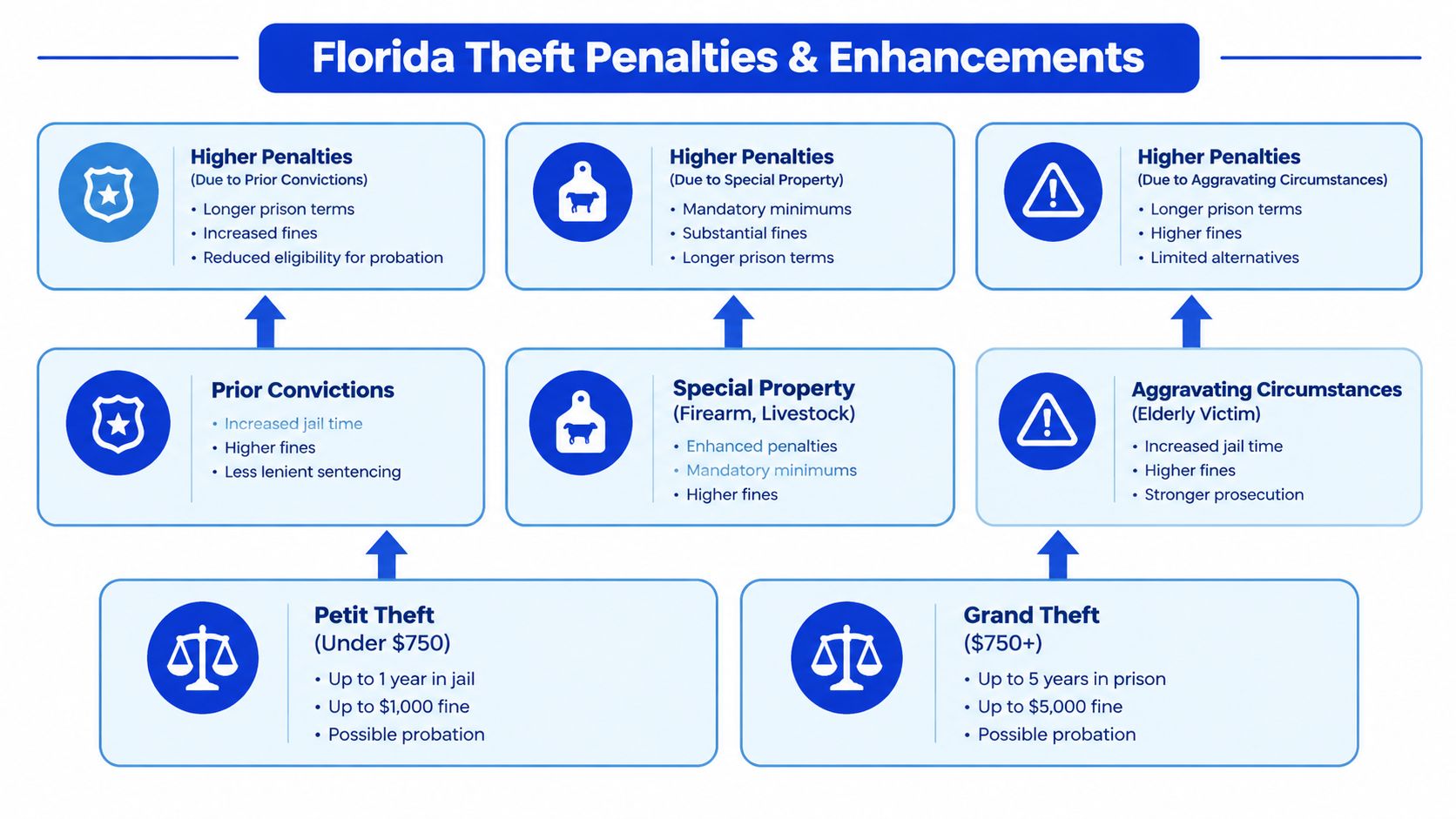
A theft case in Broward or another South Florida court can change direction based on more than the alleged price. The dollar amount provides the starting line, while prior theft convictions, the property involved, the location, the offense date, and claimed damage can affect the charge and available resolutions.
Two people accused of taking similarly valued property may face different filing decisions. A person with no qualifying history may be considered for a lower charge or diversion. Someone with prior theft convictions may face a more serious petit-theft allegation or reduced negotiating room. Prosecutors should rely on certified court records and the actual language of prior dispositions. An arrest is not a conviction, and an incomplete record can give the defense a concrete issue to challenge.
Circumstances that can change the charge
Some facts can raise the stakes even when the property value points toward a lower classification:
Prior theft convictions: Repeat petit-theft allegations may receive harsher treatment. The defense should confirm what each prior case ended in, rather than accept a criminal-history summary.
Special property: Firearms, motor vehicles, wills or testamentary instruments, stop signs, and anhydrous ammonia require separate statutory analysis.
Location and circumstances: Conduct involving a dwelling or another specially described setting may create additional charging questions that a price comparison does not answer.
Damage during the offense: Under the historical framework, causing more than $1,000 in damage could support first-degree grand-theft treatment as a first-degree felony. That older rule should be applied only after confirming the offense date and the statute in effect at that time.
The filed charge is not always the final charge. A receipt may weaken an inflated value claim. Store video may contradict a report about where a person went or what they handled. A witness may have misunderstood the sequence of events. In a Broward retail case, those details can support a misdemeanor resolution, a reduced felony, diversion, a withhold, or a trial defense.
Defense focus: The same price tag does not produce the same exposure. Prior convictions, property type, location, intent evidence, damage, and the offense date can change the analysis.
County-jail and prison exposure represent different levels of risk, but confinement is only part of the problem. A felony accusation can affect employment and professional licensing. A misdemeanor can still appear on background checks and strain personal relationships. Defense counsel should review the charging document, value evidence, records, video, and witness accounts before recommending a plea or trial strategy.
Common Theft Examples From Shoplifting to Retail and Organized Theft
A South Florida retail case may begin with conduct that looks ordinary to a customer but is described very differently in a loss-prevention report. Florida's retail-theft statute separately addresses conduct connected to depriving a merchant of merchandise or its full retail value.

Everyday retail allegations
The statute expressly covers more than walking out with unpaid merchandise. Possible allegations include:
Altering a label: Changing a price label can be treated as conduct intended to deprive the merchant of full retail value.
Switching containers: Moving merchandise from one container to another may become relevant if the State claims the act concealed the item or reduced its price.
Removing a shopping cart: Taking a cart can create a separate retail-theft issue even though the cart isn't ordinary merchandise.
Concealing merchandise: Store employees may interpret concealment as evidence of intent, but concealment alone doesn't eliminate the need to prove every element.
Employee access: An employee's ability to handle products doesn't automatically establish permission to remove or keep them. The scope of authorization matters.
The property's value can affect whether the allegation fits petit or grand theft, but a defense lawyer should also examine the store's procedures. Was the video complete? Did employees preserve the relevant footage? Did the report accurately identify the item and price? Was the accused stopped before or after passing the point the store considers a completed sale?
When group conduct changes the theory
Florida's statute now defines retail theft separately and includes a distinct trafficking provision and scheme-based treatment for theft and dealing in stolen property. Those pathways reflect a more specialized approach to merchant losses and stolen-property networks, rather than treating every event as an isolated taking. The statutory language can be reviewed in the Florida retail theft statute.
A person who appears to have a minor role may still be questioned about other participants, communications, transportation, resale, or repeated activity. That doesn't mean the State has automatically proved an organized theory. Prosecutors still need evidence connecting the individual to the required conduct and intent.
For a focused discussion of shoplifting allegations and related charges, see this explanation of the Florida retail theft statute. Don't assume that paying a store or signing a civil document resolves the criminal case. Those are separate issues that should be reviewed with counsel first.
Defenses Court Process and Protecting Your Rights in South Florida
A defense begins with facts, not labels. In Fort Lauderdale, Broward County, Palm Beach, and Miami-Dade courts, counsel may start by obtaining the charging document, arrest affidavit, video, witness statements, receipts, inventory records, and any statements attributed to the accused.
Common defense questions
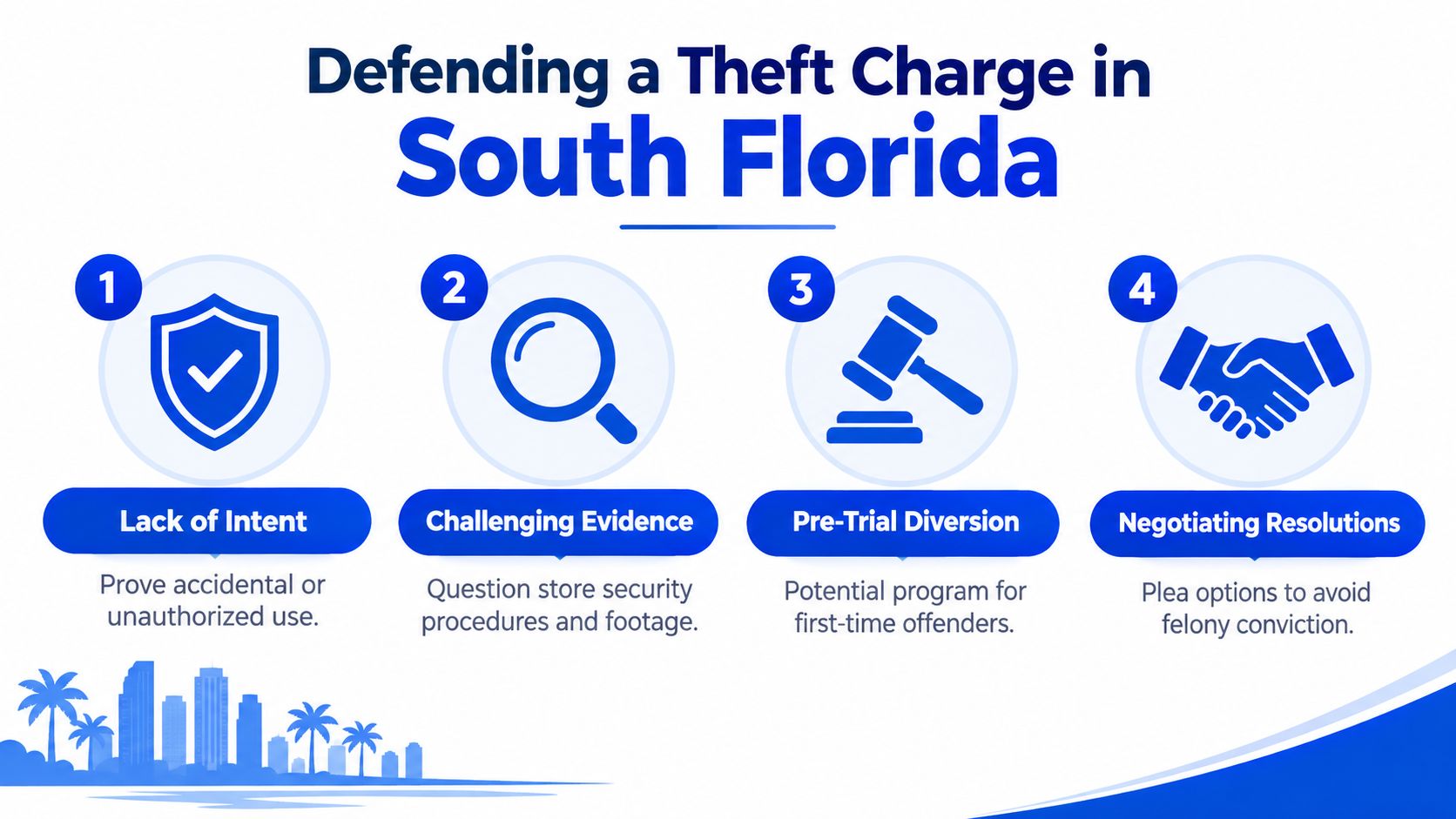
Lack of intent can be central when the conduct resulted from an accident, misunderstanding, or belief that permission existed. The defense may also assert a claim of right when the person believed they owned the property or had authorization to use it.
Valuation deserves close review. If the State's number is unsupported, the alleged degree may be incorrect. The defense may also investigate whether multiple items were improperly combined, whether the identified product matches the item in the video, or whether the record reflects the actual property involved.
Mistaken identity can arise when video quality is poor, witnesses saw only part of the event, or the report contains inconsistent descriptions. A lawyer may compare timestamps, clothing descriptions, store layout, entry and exit records, and witness accounts.
Search and seizure issues may matter when police obtained statements, phones, bags, or other evidence through an unlawful search or without respecting constitutional protections. Suppression is fact-specific, so the circumstances of consent, warrants, detention, and questioning must be examined carefully.
What the process may look like
The case commonly moves through an initial court appearance, release conditions, formal charging, discovery, negotiations, motions, and trial if no resolution is reached. Early legal review can help identify whether a reduction, diversion opportunity, dismissal request, or trial defense is appropriate. None of those outcomes is guaranteed, and the decision should account for the evidence and the client's priorities.
A former prosecutor turned defense attorney can assess how the State may present the evidence while testing weaknesses in its proof. The goal is to protect constitutional rights, avoid an unnecessary conviction, and pursue a lawful resolution that considers employment, family responsibilities, and possible record-sealing consequences.
This video offers additional context about defending criminal accusations:
Don't discuss the facts on social media, delete messages, contact alleged witnesses, or sign store paperwork without advice. Preserve receipts, messages, photographs, location information, and names of people who may have relevant knowledge.
Next Steps and Getting Help With a Florida Theft Charge
Start by preserving the facts while they're fresh. Save the citation, release paperwork, charging document, store correspondence, receipts, payment records, photographs, messages, and any notice of a court date. Don't alter or delete potential evidence.
During a consultation, be ready to explain:
The offense date: The law in effect on that date may control the value threshold.
The alleged property: Identify each item and any dispute about ownership, permission, condition, or price.
The police contact: Describe what officers, employees, or investigators asked and what you said.
Your record: Provide accurate information about prior cases, including outcomes rather than only arrests.
Your goals: Explain concerns about jail, employment, licensing, family obligations, immigration, or your record.
A theft defense lawyer can review the charge, evaluate valuation and intent, investigate search issues, and discuss possible resolutions without promising a particular result. Clients seeking a focused overview of representation can also review this guide to a criminal defense attorney for theft charges.
If you're in Fort Lauderdale, Broward County, Palm Beach, Miami-Dade, or another South Florida jurisdiction, prompt advice can help you avoid preventable mistakes before the first court event. Don't explain the case to investigators or negotiate with a store alone when a criminal charge may be involved.
Ticket Shield, PLLC reviews Florida theft allegations, including value disputes, intent issues, retail-theft theories, search questions, and potential misdemeanor or felony consequences. Visit Ticket Shield, PLLC to request a confidential consultation and discuss the next practical step in protecting your rights.