No Contact Order Florida: What It Means and How to Respond
Jason Goldsmith, Esq
You sign the bond papers, get out of jail, and try to do the right thing. Then you get a text from a co-parent, a message forwarded by a friend, or a call from a relative who says the other side is “fine with it now.” One reply, one reaction, or one accidental drive-by at the wrong place can turn a stressful release condition into a new arrest.
A Florida no contact order is not a polite request. It is a court order that controls what you can say, who can say it for you, and where you can go while your criminal case is pending. Ignoring it because the other person reached out, or because the situation feels minor, can create serious consequences that have nothing to do with the original charge.
Table of Contents
What Happens When You Violate a No Contact Order
A person comes home from jail, tries to keep life moving, and assumes a short text about rent or children won't matter. Then the message gets screenshotted, forwarded, or seen by someone who knows about the order, and the next call is from law enforcement. That is how a simple exchange turns into an allegation of violating a judicial condition of release.
A violation is not treated like a casual misunderstanding. Under Florida's pretrial-release framework, the order is immediately enforceable and stays in place until the court changes it or the case ends. That means the State can treat the contact itself as a release problem, even when the communication seemed harmless in the moment. See the broader discussion in this overview of a no-contact order violation.
The hardest part for many people is that the protected person's wishes do not control the order. If the judge entered the restriction, only the judge can change it. That is why a message through a friend, a quick social-media reply, or a run-in at a store can become evidence against you even if nobody felt threatened at the time.
Practical rule: if the court ordered no contact, treat every direct reply, indirect message, and “just this once” exception as off-limits until the judge says otherwise.
A violation can also affect your release status. In practice, that can mean a new arrest, stricter conditions, or a bond problem while the underlying case is still pending. The original charge and the alleged violation often become two separate fights, and both matter.
Understanding the Scope of a Pretrial No Contact Order
A lot of people think no contact means only “don't call the person.” Florida's pretrial rule is broader than that. It reaches oral or written communication, in person, by phone, electronically, or through another person, and it also bars physical or violent contact with the victim or named person under the court's written order.
The everyday traps people miss
Texts are the obvious risk, but they are not the only one. Social-media messages, comments, emails, relayed statements through relatives, and casual check-ins through a mutual friend can all fall within the prohibited conduct if the order does not specifically allow them. Even co-parenting conversations can become a problem when they happen outside a court-approved channel.
The other common mistake is assuming distance rules only apply to the person's home or workplace. Florida's statute is written broadly enough to cover proximity issues, including the 500-foot restriction described in the law when the order is entered in that form. If you share a residence, or if you routinely cross paths in a neighborhood, you need to know the exact written language before you move, text, or stop by anywhere near that person.
A narrow statutory exception exists for communication through pretrial discovery under the Florida Rules of Criminal Procedure. Outside that, the order remains in force until pretrial release ends or a judge modifies it. A victim's willingness to talk, or a family member's belief that things have cooled off, does not change the court's command.
For a plain-English breakdown of how these restrictions overlap with stalking and related contact issues, see this Florida stalking resource.
Courts care about the written order, not the social story around it. If the language is broad, act as if the safest reading controls.
A defendant should read the order line by line and ask what the court prohibited. That matters because a case can turn on one forwarded message, one accidental reply, or one person acting as a messenger without realizing they just created evidence.
Pretrial Orders vs Civil Injunctions for Protection
A pretrial no contact order and a civil injunction both limit communication, but they come from different courts and carry different practical consequences. One is tied to a criminal case and release conditions. The other is a separate civil order, often used in family or domestic situations, and it can remain in place independently of what happens in the criminal case.
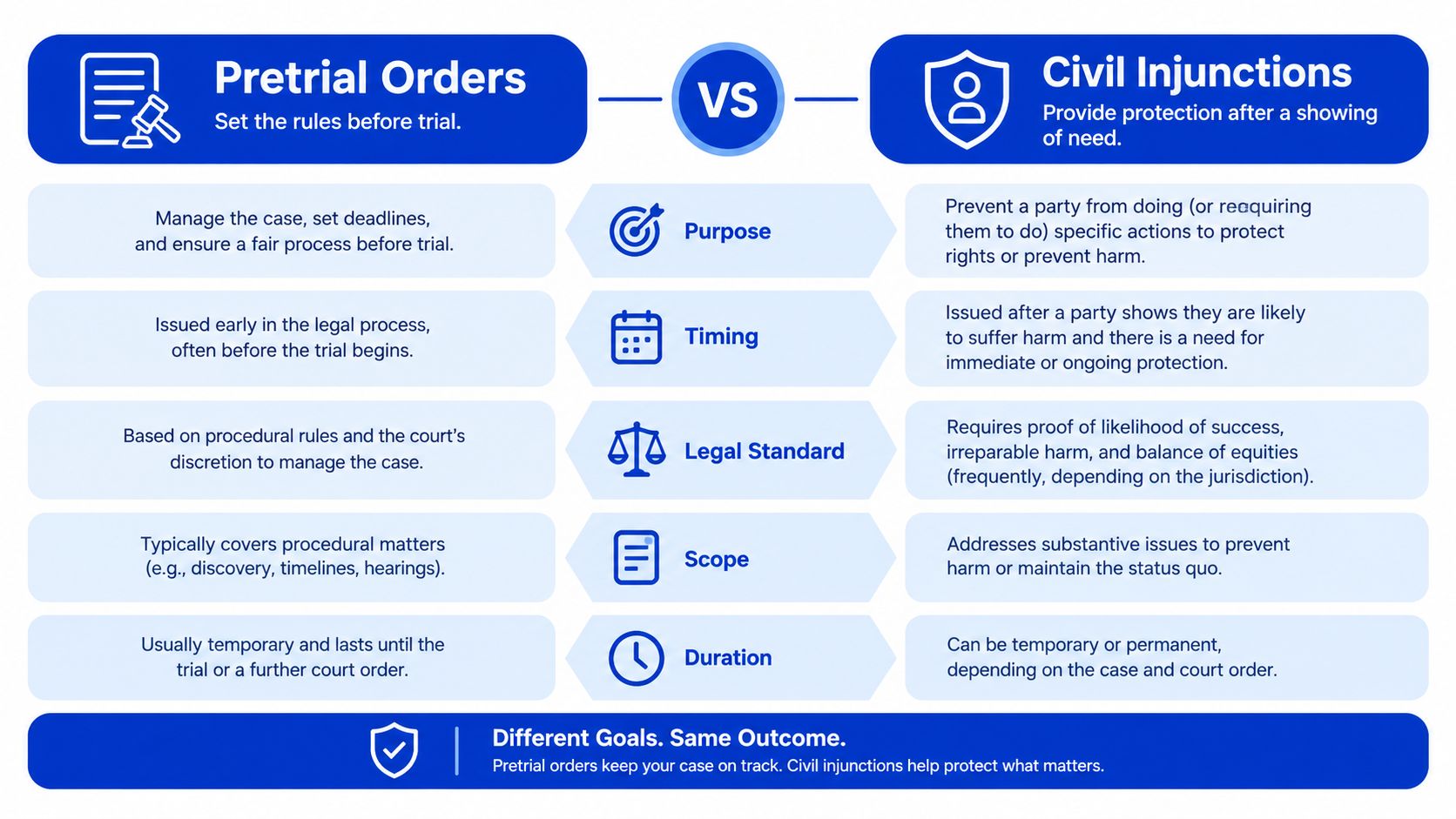
A criminal no-contact order is imposed by the judge handling the pending charge. It is part of the bond or other release decision, so compliance is tied to whether you stay free while the case is open. By contrast, a civil injunction for protection is filed in civil court and can cover broader family-law style issues, including stay-away terms and other protections discussed by the Florida courts in their injunction materials. The Florida Courts' explanation of injunctions in criminal and domestic violence settings makes that distinction clear.
Why the difference matters in real life
If you only know that “there's a no-contact order,” you can miss the fact that there may be two separate orders at once. A criminal case can be pending while a civil injunction is also active, and each one has its own rules for modification, violation, and duration. That is where people get into trouble by following one order but ignoring the other.
The practical consequences also differ. A criminal release violation can jeopardize bond and trigger new criminal exposure depending on the facts. An injunction violation can lead to arrest and court sanctions, and the Florida courts warn that contact may be prohibited even when invited unless the order says otherwise.
Video guidance on the civil side is here:
For a separate discussion of injunction practice, see this Florida injunction resource.
If you are trying to figure out which order controls, start with the caption and the court that entered it. That one detail often decides whether you are dealing with a criminal release condition, a civil restraining order, or both.
Felony Penalties for Violating Post-Conviction Orders
Florida treats some post-conviction no-contact orders very differently from pretrial release conditions. Section 921.244 requires sentencing courts to prohibit direct or indirect contact with the victim for the duration of the sentence after convictions for specified sexual offenses, unlawful sexual conduct involving minors, certain child-exploitation offenses, and listed serious felony offenses. The statute also reaches contact through a third person, so using someone else as a messenger does not get around it.
That matters because a violation is not just a courtroom problem. It is classified as a third-degree felony, and the punishment runs consecutively to the sentence for the underlying qualifying offense under the statute. In plain terms, the contact violation can become a separate felony prosecution on top of the original sentence.
Why that distinction is so important
A pretrial no-contact order can affect release. A post-conviction order can create new felony exposure. Those are different risks, and the gap between them is where people make bad assumptions. If you think the order is only a condition of supervision, you can miss the fact that the law allows a separate criminal case for the violation itself.
The statute also shows how seriously Florida treats these restrictions over time. The order can last for the full sentence, and the law allows a victim who has reached 18 to ask the court to reconsider, but only after an evidentiary hearing on changed circumstances and best interests. That hearing requirement matters because nothing about the change is automatic.
When the statute makes the violation a new felony, the safest assumption is simple, no contact means no contact until the court says otherwise.
For a person accused of violating one of these orders, the practical issue is not only what happened, but what the court order said and whether the State can prove the contact was prohibited under the sentence structure in place. That is a very different analysis from an informal apology, a family compromise, or a private agreement to talk again.
For the statutory text and history, see Florida Statute section 921.244.
How to Legally Modify a No Contact Order
A defendant cannot cancel a no-contact order by agreement, and the protected person cannot do it alone by saying yes to contact. The legal fix runs through the court. Florida law allows a defendant to seek modification by motion, but the court must find good cause and determine that the change serves the interests of justice.
The process is formal for a reason. The state attorney has to receive notice, the protected person must be allowed to be heard, and the judge decides whether the existing restriction should be narrowed. Until a new order is entered, the original one still controls.
What usually helps and what usually does not
A strong motion identifies the exact relief requested. Limited written communication through counsel, child-exchange logistics, or a narrow third-party channel may be easier for a judge to evaluate than a vague request to “lift the order.” The court wants a concrete proposal, not a promise that everyone will stay calm.
Good cause is easier to show when the requested contact solves a practical problem without creating a safety issue. Shared children, housing logistics, and necessary financial coordination are common examples. A private agreement among relatives, a casual text from the other side, or advice from a non-lawyer does not change the legal effect of the current order.
For courtroom process basics, see this motion hearing resource.
Practical rule: do not test the boundary before the judge rules. If the order says no contact, keep treating it as active during the entire motion process.
The safest approach is to file the motion, give proper notice, prepare for the hearing, and avoid any communication until the amended order is signed. That keeps the defense focused on the judge's authority instead of risking a new violation while trying to fix the original problem.
Why Experienced Defense Representation Matters
No-contact cases turn on details that are often overlooked. The exact wording of the order, the type of communication, whether the message was direct or indirect, and whether the order was pretrial or post-conviction all change the analysis. A defense lawyer can sort out those differences quickly and push back when the State overreads conduct that was never prohibited.
That work matters even more when constitutional issues are in the background. Evidence can be weak, witness accounts can conflict, and the State still has to prove what happened. A former prosecutor usually looks at the case the same way the State does, then checks where the proof breaks down. Ticket Shield, PLLC handles Florida criminal defense matters with that kind of issue spotting in mind, including no-contact order allegations and modification requests.
What a defense lawyer can actually do
Review the order language: A lawyer checks whether the written order really covered the contact the State is alleging.
Test the proof: A lawyer can challenge screenshots, call logs, third-party messages, and the story the State says they prove.
Seek lawful modification: A lawyer can file the motion, give notice, and argue for a narrower order when the facts justify it.
Protect the release case: A lawyer can work to reduce the chance that one disputed message turns into a bond problem.
For a broader overview of criminal defense representation in Florida, see this Florida criminal defense resource.
A stressed defendant should not guess at the rules, and should not rely on the other person's consent or a friend's interpretation of the order. The safest move is to get legal help as soon as the order is entered or as soon as an alleged violation is raised, because timing can shape the entire case.
Ticket Shield, PLLC helps people facing Florida no-contact order issues understand what the court ordered, what conduct is prohibited, and how to seek a lawful modification when appropriate. If you've been accused of violating a release condition or need immediate guidance on a criminal case in South Florida, visit Ticket Shield, PLLC to discuss your situation and protect your rights before the problem gets bigger.