Negligent Homicide Sentences in Florida: A Practical Guide
Jason Goldsmith, Esq
The call often comes without warning. A family member has been arrested after a fatal crash, or investigators are asking questions about a death that everyone thought was a tragic accident. The charging document may use the word manslaughter, while relatives search online for “negligent homicide sentences” and find penalty tables that don't match Florida law.
Florida doesn't generally use negligent homicide as the formal name of the offense. The charge most closely associated with that phrase is usually manslaughter based on culpable negligence under Florida Statutes § 782.07(1). The difference matters because the exact charge, degree, alleged facts, criminal history, and sentencing score can change the entire case.
Table of Contents
Why Florida Does Not Have a Standalone Negligent Homicide Statute
Aggravators That Push Sentences Up and Mitigators That Pull Them Down
What This Guide Covers and Who It Is For
This guide is for a person accused of causing a death through allegedly criminally negligent conduct, and for the family member trying to understand what happens next. It focuses on Florida law, including the elements prosecutors must prove, felony classifications, sentencing calculations, aggravating and mitigating facts, possible dispositions, and immediate defense steps.
You won't find a promise that a particular sentence is guaranteed. No responsible lawyer can predict the outcome from the phrase “negligent homicide” alone. Florida's court system looks at the charging document, evidence, victim-related facts, prior record, causation, and the specific sentencing provisions that apply.
The first practical step: Find the exact statute and degree listed in the arrest paperwork, information, or indictment. Don't rely on a news report, a police description, or a generic internet search.
The information here can help you prepare for a first consultation, but it can't replace a review of the evidence in your case. If police or prosecutors are already involved, don't give a recorded statement or try to explain the incident before speaking with a criminal defense lawyer. Early advice can protect evidence, prevent avoidable statements, and identify weaknesses while the investigation is still developing.
Why Florida Does Not Have a Standalone Negligent Homicide Statute
The public often uses negligent homicide to describe an unintentional death allegedly caused by serious carelessness. Florida generally charges that conduct as manslaughter through culpable negligence, not under a separate statute carrying that popular label. Florida Statutes § 782.07(1) defines manslaughter to include an unlawful killing caused by the culpable negligence of another person. The offense is a second-degree felony, with a statutory maximum of 15 years' imprisonment and a fine of up to $10,000 under the cited penalty provisions. Read Florida's manslaughter statute before assuming an internet penalty summary applies.
Culpable negligence isn't ordinary carelessness. Florida courts and prosecutors look for conduct showing reckless disregard for human life, an entire want of care, or grossly careless disregard for public safety. The alleged conduct must involve a foreseeable risk of death or great bodily harm that the accused knew, or reasonably should have known, existed. This Florida homicide explanation describes the threshold in those terms.
Consider two drivers. One briefly glances at a phone and causes a sudden collision. Another repeatedly texts while driving at dangerous speed through a crowded intersection. Both incidents may involve negligence, but the State still must prove that the conduct rose above ordinary carelessness and met Florida's culpable-negligence standard. A death by itself doesn't establish the required mental state.
For a plain-language overview of the statute and related charging issues, review Florida manslaughter statutes and penalties. The label printed on the charging document controls the legal analysis. “Negligent homicide sentence” is a useful search phrase, but it isn't a substitute for identifying the actual Florida offense.
The Three Elements the Prosecution Must Prove
A Florida manslaughter prosecution based on culpable negligence generally turns on three working questions:
Did a human being die?
Did the defendant's conduct legally cause that death?
Did the conduct amount to culpable negligence rather than ordinary carelessness or a simple mistake?

The death must be legally connected to the conduct
The first element usually appears straightforward, but the defense still examines medical records, autopsy findings, injury patterns, and the timing of death. A person may die after an incident without the State proving that the accused's conduct caused the fatal injury. Medical complications, an unrelated condition, another person's conduct, or an intervening event may matter.
Causation is often a battle between experts. Accident reconstruction, vehicle data, physical evidence, surveillance footage, and medical testimony can show whether the alleged conduct produced the fatal result.
Culpable negligence is the central dispute
The State must prove more than a bad decision. Prosecutors need evidence that the accused's conduct displayed the legally required disregard for a serious risk to human life. The defense may challenge the alleged behavior, the reliability of witnesses, the reconstruction of events, or the inference that the accused knew or should have known about the risk.
A fatal outcome doesn't automatically transform ordinary negligence into criminal negligence.
For example, if a vehicle leaves the roadway, the prosecution still must prove what the driver did, what risk that conduct created, and why the conduct qualifies as culpable negligence. If the evidence supports only a momentary error or an unavoidable event, the mental-state element may fail even though the result was devastating.
Felony Degrees and the Statutory Maximums
Florida's sentencing framework doesn't provide one universal negligent homicide sentence. The classification depends on the victim, the alleged conduct, and the facts prosecutors can prove. Ordinary manslaughter based on culpable negligence is generally a second-degree felony, while specified aggravated forms can be first-degree felonies.
Aggravated manslaughter may involve a death affecting protected victim categories, including children, elderly adults, disabled adults, or on-duty public-safety personnel. The exact statute and charging language must be checked because prosecutors must prove the facts supporting the enhanced classification.
Offense | Statute | Degree | Max Prison | Max Fine |
|---|---|---|---|---|
Manslaughter based on culpable negligence | Fla. Stat. § 782.07(1) | Second-degree felony | Up to 15 years | Up to $10,000 |
Aggravated manslaughter involving specified protected victims | Applicable Florida aggravated-manslaughter provisions | First-degree felony | Up to 30 years | Depends on applicable penalty provision |
The ordinary second-degree felony ceiling is up to 15 years, while a first-degree felony can carry up to 30 years under Florida's felony-penalty structure. Florida's felony penalty statute supplies the broader sentencing framework.
Those figures are ceilings, not forecasts. A maximum tells you what the law permits in the highest-end situation. It doesn't tell you the sentence a judge will impose after reviewing the scoresheet, evidence, criminal history, mitigation, plea terms, and applicable enhancements.
How Florida Calculates the Actual Sentence
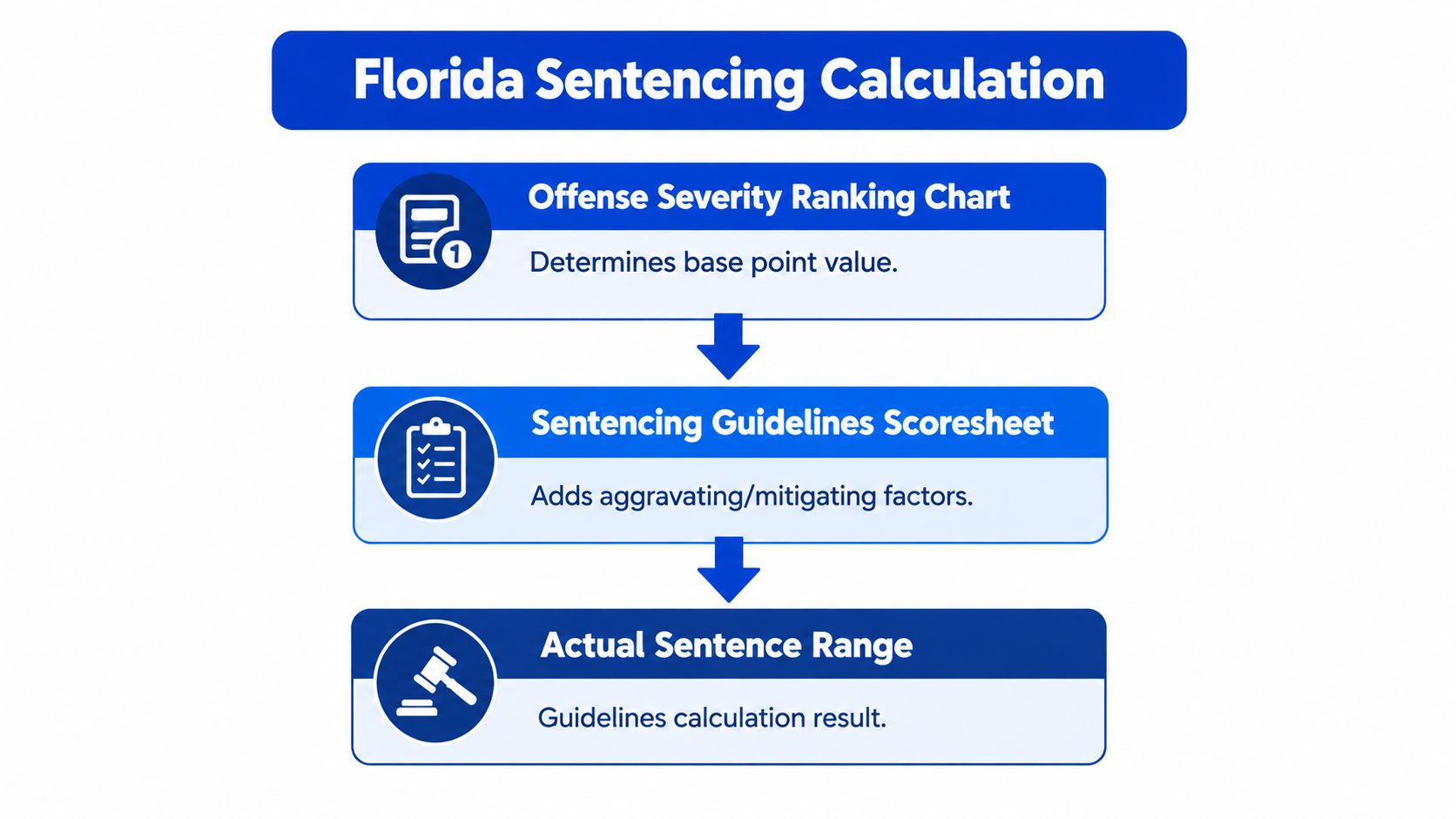
Florida felony sentencing can involve more than a judge choosing a number between zero and the statutory maximum. The court uses an offense-severity ranking chart and a sentencing-guidelines scoresheet to calculate a lowest permissible sentence. The offense level supplies the base scoring structure, while other factors can affect the result.
The scoresheet may account for the offense classification, prior convictions, victim-related points, additional offenses, and other legally recognized circumstances. That means two people charged under the same statute can face different sentencing positions. A person with no criminal history may not stand in the same place as someone with qualifying prior convictions or additional scored conduct.
Where defense counsel can challenge the calculation
The scoresheet isn't untouchable. Counsel should examine whether the State selected the correct offense level, scored prior record accurately, added victim injury points lawfully, and included related offenses under the correct rules. A single disputed entry can affect the calculated sentence.
Florida law also requires written reasons when a court imposes a sentence below the lowest permissible sentence. Florida's sentencing departure framework makes the sentencing record important. Defense counsel should present mitigation before sentencing and preserve objections to the classification, scoresheet, factual findings, and any proposed departure.
The practical recommendation is simple. Don't ask only, “What's the maximum?” Ask, “What is the correctly calculated sentencing position, what facts increase it, and what evidence supports a lawful reduction?”
Aggravators That Push Sentences Up and Mitigators That Pull Them Down
The sentence depends heavily on the story the evidence tells. Prosecutors emphasize facts that make the conduct appear more dangerous and the accused less responsive to legal limits. Defense counsel must test those facts and present the complete context without minimizing the death.
Potential aggravating facts may include:
Dangerous conduct: Evidence of intoxication, extreme speed, or reckless operation can increase perceived culpability. This article doesn't assume those facts exist in every case.
Multiple victims: Separate injuries or deaths can create additional counts or sentencing exposure.
Vulnerable victims: A child, elderly person, disabled adult, or on-duty public-safety worker may trigger an aggravated classification when the statute's requirements are met.
Criminal history: Qualifying prior convictions can affect the scoresheet and the court's view of public-safety risk.
Related conduct: Allegations such as leaving the scene or committing another crime may alter both charging and sentencing posture.
Mitigation starts with proof, not promises. A clean record, cooperation through counsel, acceptance of responsibility, a demonstrated momentary lapse rather than a continuing pattern, and genuine remediation may help the defense ask for a reduced disposition. Remediation could include documented counseling, safety training, treatment when appropriate, or other steps tied directly to the conduct.
Practical rule: Mitigation work should begin before the sentencing hearing, because a lawyer can't build a credible record overnight.
Take two defendants with the same statutory charge. One arrives with an accurate timeline, no prior record, documented corrective steps, and witnesses who explain the event. The other makes inconsistent statements, violates release conditions, and offers no reliable mitigation. The law gives the judge discretion within the applicable framework, but the defense presentation can materially change how the court evaluates risk, responsibility, and punishment.
Straight Prison, Split Sentences, and Probation in Practice
A statutory maximum describes the outer boundary. It doesn't answer whether a court will impose straight incarceration, a split sentence, probation, or another lawful disposition. The decision depends on the offense, the scoresheet, the facts surrounding the death, the defendant's record, and the mitigation presented.
A historical Massachusetts study illustrates the gap between statutory exposure and actual outcomes. Nearly 95% of the offenders studied were charged with the misdemeanor form of motor-vehicle homicide, while slightly more than 5% faced the felony classification. More than 80% were found guilty, and 53% of those found guilty received incarceration. The study reported a median incarceration length exceeding two years. Review the Massachusetts motor-vehicle homicide study for its methodology and historical findings.
How split sentences work
A split sentence combines incarceration with a period of supervision or probation. The defendant may serve a defined prison term and then remain subject to court-ordered conditions. Those conditions can include reporting, travel restrictions, employment requirements, treatment, testing, no-contact provisions, and compliance with all laws. A violation can return the person to court and expose them to additional consequences.
The same Massachusetts study found that 86.6%, or 33 of 38 cases, involving split sentences had dispositions of at least 24 months, with a median split-sentence disposition of 34 months. Among 33 defendants receiving straight incarceration, the median disposition was 24 months. These historical figures aren't a Florida prediction, but they show why the form of the sentence matters as much as the headline maximum.
For a practical explanation of supervision conditions, review terms of probation in Florida.
The following video provides additional general context about sentencing concepts. It isn't a substitute for advice based on the Florida charging document and evidence.
Why Lack of Intent Does Not Guarantee a Light Sentence
Many families hear “unintentional” and assume the case must lead to a light punishment. That assumption is dangerous. Manslaughter based on culpable negligence doesn't require proof that the accused intended to kill, but Florida can still impose severe punishment when the alleged conduct and surrounding facts support a higher classification, additional counts, or a strong aggravation argument.
A Colorado Supreme Court opinion analyzed a 24-year sentence for vehicular homicide involving intoxication, imposed consecutively with a five-year vehicular-assault sentence, and considered whether the punishment was grossly disproportionate. The Colorado opinion illustrates the point without controlling Florida courts. Lack of intent may reduce culpability, but it doesn't automatically defeat a lengthy sentence when multiple victims, aggravating facts, or consecutive counts are involved.
Florida's aggravated-manslaughter framework creates a similar risk. If the alleged victim and conduct satisfy the applicable statutory requirements, the charge can move beyond ordinary second-degree felony manslaughter and expose the accused to first-degree felony punishment.
Proportionality is not the main defense plan
A constitutional proportionality challenge exists, but courts apply it narrowly. A defense lawyer usually has more practical influence earlier, by challenging the charge, disputing causation, contesting culpable negligence, correcting the scoresheet, negotiating concurrent rather than consecutive treatment when legally available, and presenting mitigation.
For Florida-specific information about a related offense, see DUI manslaughter in Florida. The strategy in any particular case must follow the actual allegations and evidence. A defense should not concede culpable negligence merely because the death was tragic, and it shouldn't rely on lack of intent as the only argument.
The First 72 Hours After a Charge or Arrest
The first three days can shape the defense. Investigators are gathering statements, preserving or losing evidence, and deciding how to frame the conduct. Your actions should be deliberate.
Invoke silence clearly. Say that you want a lawyer and won't answer questions without counsel. Don't fill the silence with an explanation, apology, or theory about what happened.
Don't contact the victim's family. Even a sincere message can be misunderstood, recorded, or presented as an admission. Let counsel advise you about any communication.
Preserve evidence immediately. Keep phones, vehicles, clothing, photographs, location data, messages, repair records, and medical information. Don't delete, edit, reset, or discard anything.
Identify witnesses privately. Write down names and contact details, but don't pressure anyone to change an account or coordinate stories.
Avoid social media. Don't post about the incident, the victim, police, court, or your defense. Ask friends and relatives not to post for you.
Don't consent to additional searches without advice. Tell officers you want counsel before agreeing to a search or providing a statement.
If police obtained evidence through an unlawful search, seizure, interrogation, or other constitutional violation, counsel may examine what a motion to suppress evidence does. Suppression isn't automatic, but an early review can identify evidence the State may not be allowed to use.
The defense team should also create a protected timeline, inspect the scene, locate video before it disappears, review medical and forensic evidence, and determine whether another cause contributed to the death. Waiting for the State's version gives the investigation an unnecessary head start.
Where Defense Strategy Actually Wins Cases
A serious defense isn't one dramatic courtroom event. It is a sequence of decisions made before filing, during negotiations, and at trial.
Charging decision
Before a charge becomes fixed, counsel may present evidence showing that the conduct was ordinary negligence, that causation is uncertain, or that a more serious classification doesn't fit the facts. Prosecutors evaluate the strength of physical evidence, witness accounts, expert conclusions, and the likely proof at trial. A credible defense investigation can expose gaps before those gaps become the State's formal theory.
Plea negotiation
A plea offer isn't the end of the analysis. Counsel should compare the proposed charge and sentence with the evidence, scoresheet, collateral consequences, and trial risks. Possible negotiation goals may include a lesser offense, removal of an enhancement, dismissal of an unsupported related count, a non-prison disposition where legally available, or concurrent treatment of multiple sentences.
Read more about plea bargaining in criminal cases. A negotiated resolution should be based on informed consent, not panic. The accused needs to understand the immigration, employment, licensing, firearm, probation, and family consequences before accepting any offer.
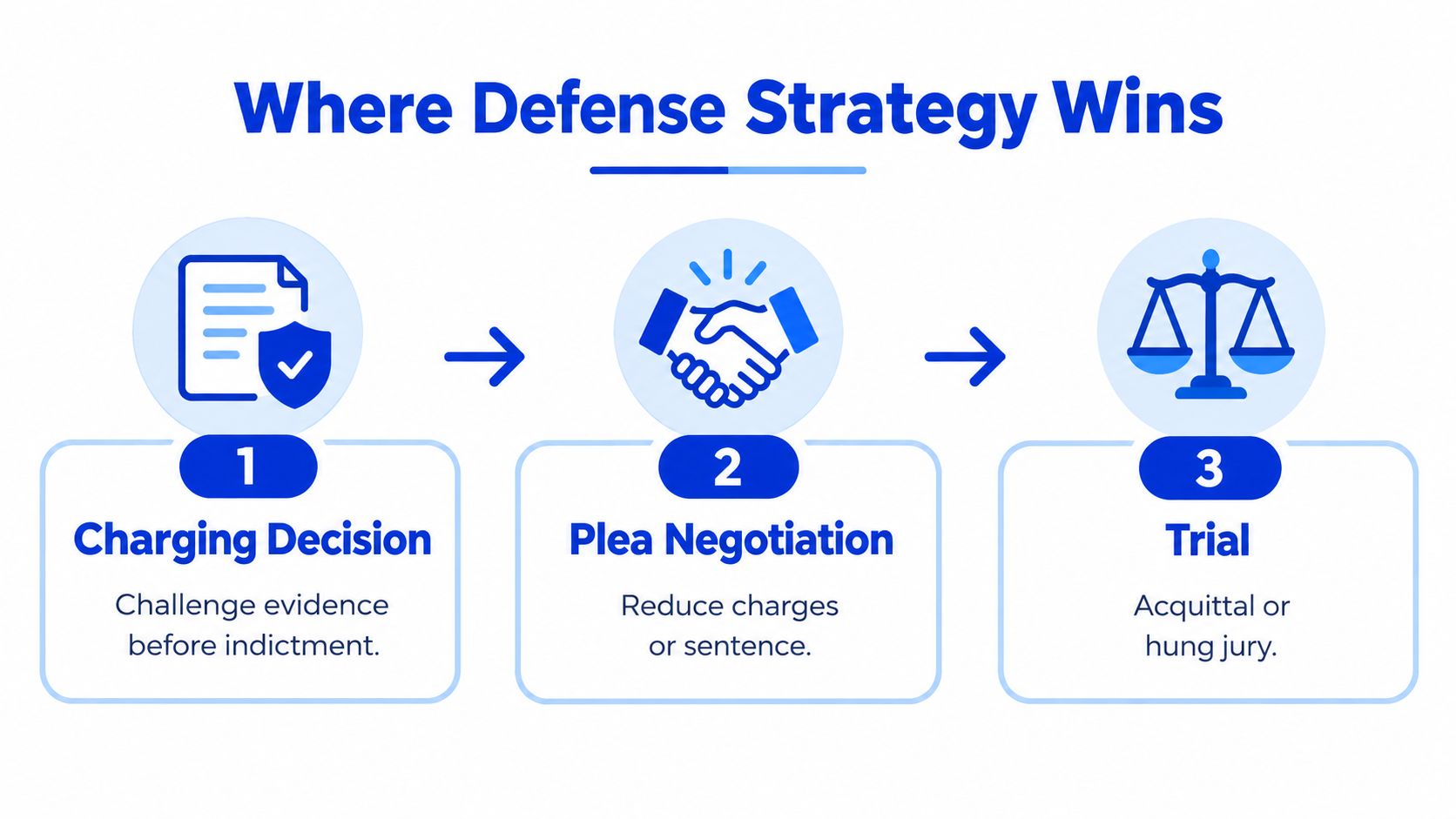
Trial
At trial, the State must prove every required element beyond a reasonable doubt. The defense may attack the reliability of witnesses, challenge reconstruction testimony, dispute medical causation, object to improperly admitted evidence, and show that the alleged conduct doesn't meet the culpable-negligence threshold. Ticket Shield, PLLC's former-prosecutor perspective can inform how charging decisions and plea bargaining power are evaluated, while the defense still must be adapted to the individual evidence.
A strong mitigation presentation can also matter when conviction risk is high. The lawyer's work includes building a record that separates the person from the worst interpretation of the event and gives the judge lawful reasons to impose a lower sentence.
Quick Reference and Key Takeaways
Keep these points in front of you:
Florida's label: Florida generally treats the conduct commonly called negligent homicide as manslaughter based on culpable negligence under § 782.07(1).
The ordinary ceiling: Second-degree felony manslaughter can expose an accused person to up to 15 years' imprisonment and a fine of up to $10,000, as provided by the cited statutes.
The enhanced risk: Specified victim categories and facts can support aggravated manslaughter as a first-degree felony, with up to 30 years under Florida's felony-penalty structure.
The proof problem: A death alone isn't enough. The State must prove the death, legal causation, and culpable negligence.
The sentence calculation: The scoresheet, offense ranking, prior record, victim-related points, related offenses, and lawful mitigation can change the sentencing position.
The immediate protection: Don't give investigators a statement, don't contact the victim's family, don't delete evidence, and don't post online.
Historically, negligent-homicide statutes developed in the United States because traditional murder and manslaughter laws often didn't fit fatal automobile crashes. Michigan enacted the first such statute in 1921, reinforcing why the phrase doesn't identify one standardized punishment across jurisdictions. This historical legal survey documents that variation.
This article is general information, not case-specific legal advice. The charging document, discovery, scoresheet, and evidence must be reviewed before anyone can responsibly assess exposure or defense options.
Questions Families Commonly Ask
Can the accused get bond or pretrial release?
Possibly, but release conditions depend on the charge, alleged facts, criminal history, community ties, safety concerns, and the judge's order. Counsel should address appropriate conditions early and make sure the accused understands every restriction. Violating release conditions can damage both liberty and negotiating position.
How long will the case take?
There isn't one reliable timeline. A homicide-related prosecution may involve forensic review, expert analysis, depositions, motion litigation, negotiations, and trial preparation. The case can move through several court appearances before the parties have enough evidence to evaluate a resolution responsibly. Early counsel helps preserve evidence and prevents rushed decisions.
What happens to firearms, employment, and licensing after conviction?
A felony conviction can create long-term consequences involving firearms rights, employment, housing, and professional licensing. The precise effect depends on the conviction, governing law, licensing rules, and personal circumstances. Families should ask about collateral consequences before any plea is entered, not after sentencing.
Should the accused speak with investigators or the victim's family?
No, not without legal advice. The accused should invoke the right to remain silent and request counsel before answering questions. A well-intended conversation with the victim's family can create emotional, evidentiary, and legal problems. Counsel can evaluate whether any communication is appropriate and how it should occur.
If you're facing a Florida manslaughter investigation or charge in Broward County, Fort Lauderdale, Miami-Dade, Palm Beach, or elsewhere in South Florida, contact Ticket Shield, PLLC for a case-specific review. The firm can evaluate the charging document, investigate causation and culpable negligence, challenge unlawful evidence, and develop a strategy focused on protecting your rights and reducing unnecessary exposure.