No Contact Order Violation: Florida Defense 2026
Jason Goldsmith, Esq
Your phone lights up with a text from the protected person. Or you walk into a Publix in Broward County and suddenly see them two aisles over. Or a friend tells you, “They want to talk. Just call once and clear this up.”
That's how a lot of no contact order violation cases start. Not with a dramatic confrontation. With one reply, one appearance in the wrong place, one bad decision made under stress.
If you're reading this after an arrest, a police call, or a warning that you've violated a court order, the fear is real. You're probably worried about going back to jail, losing bond, making your underlying case worse, and whether the other person can “fix” this by telling the judge they wanted contact. In many cases, they can't.
These orders are common, and the courts treat them seriously. In a single year, U.S. courts issued an estimated 1.7 million domestic-violence restraining orders, and the FBI received 600,000 to 700,000 records of permanent protective orders annually for entry into the NCIC registry, according to Across Walls' restraining order statistics. That matters because it shows this isn't some rare technicality. It's a routine part of the criminal justice system, and violations get charged every day.
In South Florida, judges in Fort Lauderdale, Broward County, Miami-Dade, and Palm Beach expect strict compliance. A former prosecutor's perspective helps here. Prosecutors don't usually see these allegations as “just a misunderstanding.” They look for proof that you knew about the order and chose to ignore it.
Table of Contents
An Accusation That Can Change Everything
A no contact order allegation can turn a manageable case into a much more dangerous one overnight.
A person gets released after a domestic violence arrest in Fort Lauderdale. The bond conditions say no contact. A few days later, the protected person sends a message saying they want to talk. He answers. From his point of view, the situation is mutual. From the court's point of view, he may have just committed a new offense and violated a release condition at the same time.
That's the part many people don't understand until it's too late. The court order controls your behavior, not the emotions between the two people involved.
Why this accusation hits so hard
The allegation can affect more than one case at once:
Your current release status: A judge can revisit bond and decide you shouldn't remain out of custody.
Your pending criminal charge: The State may argue the alleged violation shows you won't follow court orders.
Your record and future: Even a brief exchange can create a separate criminal issue that follows you.
Practical rule: A no contact order is never something to “work out privately” with the protected person.
In South Florida courtrooms, these cases often move quickly. Police may arrest first and leave the legal details for later. Prosecutors may assume the communication was intentional unless the defense can show otherwise. If there are texts, calls, location data, or witnesses, the State will use them to frame the contact as deliberate.
What scared clients usually get wrong
People often believe one of these things:
“They contacted me first.” That usually doesn't end the risk.
“It was only one message.” One message can still be enough.
“I didn't mean any harm.” Lack of bad motive isn't the same as lack of willfulness.
“We were just discussing the kids.” Unless the order allows that, the court may still treat it as prohibited contact.
If you've been accused of violating a no contact order in Broward County or anywhere in South Florida, the first priority is damage control. The second is building a defense before the facts get locked into a police report and prosecutor narrative.
What Legally Counts as a Violation in Florida
Many believe a violation means showing up at someone's house. Florida cases are usually broader than that.

Contact is broader than most people think
A no contact order can prohibit direct and indirect communication. Public summaries of these orders explain that a violation can include calls, texts, emails, face-to-face encounters, third-party messages, social media posts, gifts, and other electronic communication, and that prosecutors may use digital records to prove a willful violation, as described in this explanation of no contact order rules and evidence.
That broad definition creates problems for people who think they stayed “technically compliant.”
Common examples include:
Direct communication: Calling, texting, emailing, DMing, or speaking in person.
Indirect communication: Asking a sibling, friend, or child to relay a message.
Digital interaction: Social media posts aimed at the protected person, payment app notes, or repeated online messaging.
Physical presence: Going to a place you know the protected person is likely to be, especially if the order bars proximity.
Digital evidence changes these cases
As a former prosecutor, I can tell you that these cases are often built piece by piece. One screenshot may not look like much to you. To the State, it can become part of a timeline.
The evidence often comes from:
Evidence type | How it gets used |
|---|---|
Text messages | To show communication and timing |
Call logs | To show repeated attempts to connect |
Social media activity | To argue intentional outreach or monitoring |
Witness statements | To support who started the contact and what happened |
Location or proximity evidence | To argue the encounter wasn't accidental |
Courts don't need a dramatic event to take a no contact order violation seriously. A short digital trail can be enough to start the case.
What usually doesn't work is trying to explain away a message after you've already deleted part of the thread, switched phones, or continued communicating. That often makes the State's case stronger, not weaker.
Understanding the Different Types of Florida No Contact Orders
Not every no contact order comes from the same place. That matters because the source of the order often determines how the judge treats an alleged violation and what other consequences follow.
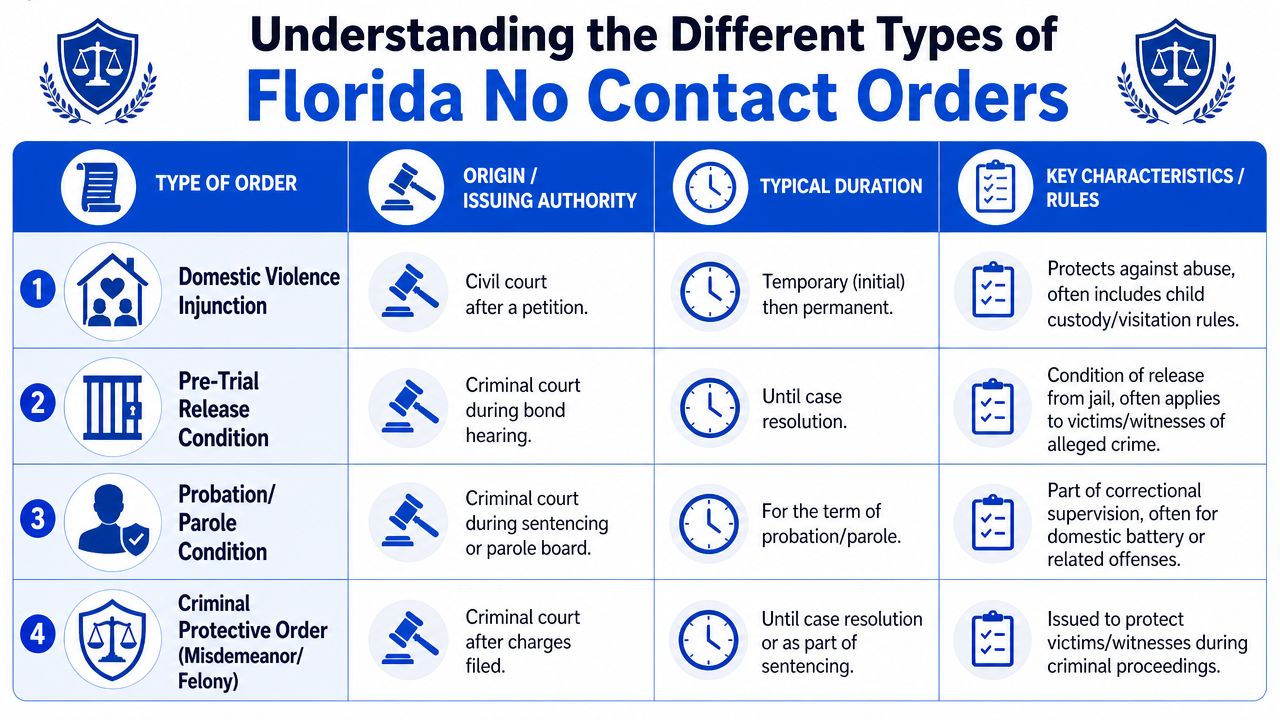
Why the source of the order matters
In Florida, people usually encounter one of these situations:
Type of order | Where it comes from | Why it matters |
|---|---|---|
Pretrial no contact order | Criminal court after arrest or at first appearance | Violating it can affect bond and the pending criminal case |
Injunction for protection | Civil court after a petition | A civil order can still create criminal consequences if violated |
No contact as a probation condition | Sentencing court | A violation can trigger a probation violation on top of new charges |
No contact tied to bond conditions | Release order in a criminal case | Even brief contact can send you back before trial |
A practical comparison
A pretrial no contact order is common after a domestic violence related arrest in South Florida. A judge may impose it at first appearance as a condition of release. It usually stays in place unless the court modifies it. The protected person doesn't get to cancel it on their own.
An injunction for protection is different. It begins in civil court, not criminal court. But violating it can still create criminal exposure. People often underestimate these because they think “civil” means less serious. It doesn't.
A probation condition creates another layer of danger. If you're already on probation and then allegedly contact a protected person, the court may treat the issue as both a new offense and a supervision violation. If probation is part of your case, it's worth reviewing how Florida courts handle probation violations because the stakes change quickly when a judge believes you ignored a specific condition.
There's also overlap. One person can be dealing with a criminal case, a civil injunction, and release conditions at the same time.
The first question in any defense strategy is simple. What exact order was in effect, who issued it, and what did it actually say?
That sounds basic, but it's where many good defenses begin. I've seen cases where people were accused based on assumptions about the order's terms, not the language the judge entered. If your situation started with a domestic dispute, it may also help to understand the broader court dynamics in a Florida domestic violence case.
Penalties and Consequences of a Violation
One accusation can turn a manageable case into a custody fight, a bond problem, and time in jail.
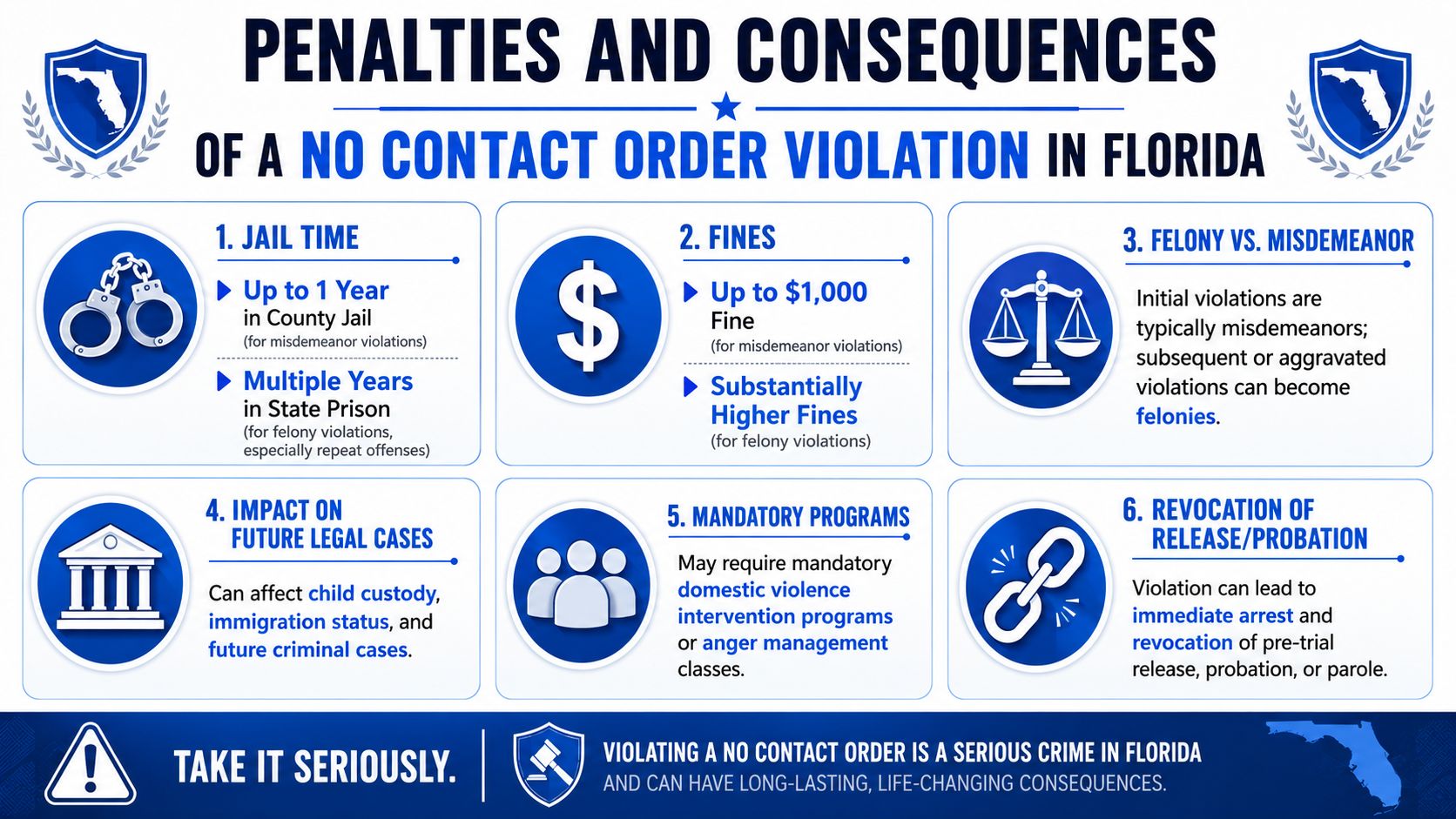
A violation can create a new criminal problem overnight
In Florida, an alleged no contact violation is often prosecuted as more than bad judgment. It can become a separate offense, and judges in South Florida usually treat it as a direct challenge to the court's authority.
That matters because the facts people find comforting are often the ones that help them least. The protected person called first. The meeting was peaceful. There was no argument. You only replied once. I have seen people arrested in exactly those situations. If the order barred contact, the State may still argue the violation was knowing and willful.
The penalty depends on what kind of order was in place, what the order said, your record, and how the alleged contact happened. Risk usually rises when the State claims there were repeated messages, in-person contact, threats, stalking-type behavior, or proof that you clearly knew the restriction was still active.
Situation | What it can trigger |
|---|---|
One text, call, or social media message | A new charge or a violation hearing if the order plainly barred contact |
Repeated contact or showing up in person | Stronger evidence for arrest, detention, and aggressive prosecution |
Alleged violation while out on bond | Bond revocation and return to jail on the underlying case |
Alleged violation while on probation | A new case plus separate supervision exposure |
Conduct the State labels threatening or repeated | Higher risk of enhanced charges and harsher sentencing arguments |
A short explainer on related court consequences is below.
The punishment is not limited to the new allegation
The biggest mistake I see is treating the violation as a side issue. Courts usually do the opposite.
A no contact allegation can affect almost every part of the underlying case:
Bond revocation. A judge may take you back into custody even before the new allegation is fully litigated.
Stricter release terms. If the court releases you again, expect tighter conditions and less room for error.
Harder negotiations. Prosecutors are less inclined to offer favorable resolutions when they believe a defendant ignored a direct court order.
Family court damage. Allegations often surface in injunction, custody, and timesharing disputes.
Work and licensing problems. Employers, schools, and licensing boards may react to the accusation itself, even before conviction.
The protected person's consent usually does not fix the problem. That point confuses many people. In real cases, the protected party often reopens contact, asks to meet, or tells law enforcement they did not want an arrest. The court may still treat the contact as a violation because the order controlled your conduct, not theirs.
For anyone already under supervision, the overlap can get dangerous fast. A single allegation may expose you to both a new prosecution and a separate probation violation proceeding in Florida.
Judges also look at these cases through a practical lens. They want to know whether you followed the order as written. They usually care less about whether the contact felt harmless in the moment.
The Court Process in South Florida After an Allegation
Once someone reports an alleged violation in Broward County, Miami-Dade, or Palm Beach, the system usually moves fast.
What usually happens first
The process often begins with a complaint to police. That complaint may come from the protected person, a witness, a school, an employer, or an officer who responds to a call and learns an order exists.
From there, the sequence often looks like this:
Police review the allegation and try to verify the order.
An arrest may happen quickly, especially if officers believe there was direct communication or physical proximity.
First appearance follows, where the judge reviews release conditions.
The State Attorney's Office decides how to proceed, including whether to file or maintain formal charges.
Public court guidance from California notes an important reality that applies practically in Florida too. Enforcement depends in part on whether officers can verify the order and document the alleged conduct, and orders may not always be instantly available in a database, as explained in Orange County court guidance on criminal restraining order enforcement.
How prosecutors build these cases
As a former prosecutor, I can tell you these cases often turn on ordinary evidence, not dramatic evidence.
Prosecutors typically look for:
Screenshots and phone extractions
Witness accounts
Body camera statements
Jail calls
Location details and timeline consistency
Proof you knew the order existed
A weak no contact order case often starts as a strong-looking arrest affidavit. The difference is what survives scrutiny later.
That's why early defense work matters. If the order language is vague, if the report leaves out who initiated the exchange, if the screenshot thread is incomplete, or if officers couldn't clearly verify the order at the scene, those details can become central.
In some cases, the defense goal is dismissal. In others, it's preventing the State from filing the charge aggressively or creating enough doubt to improve the outcome. If you're unfamiliar with Florida case resolutions, it can help to understand what a nolle prosequi in Florida means and how prosecutors decide not to proceed.
Strategic Defenses to a No Contact Order Violation Charge
An accusation is not a conviction. These cases can be defended, but the defense has to focus on key pressure points in the State's proof.
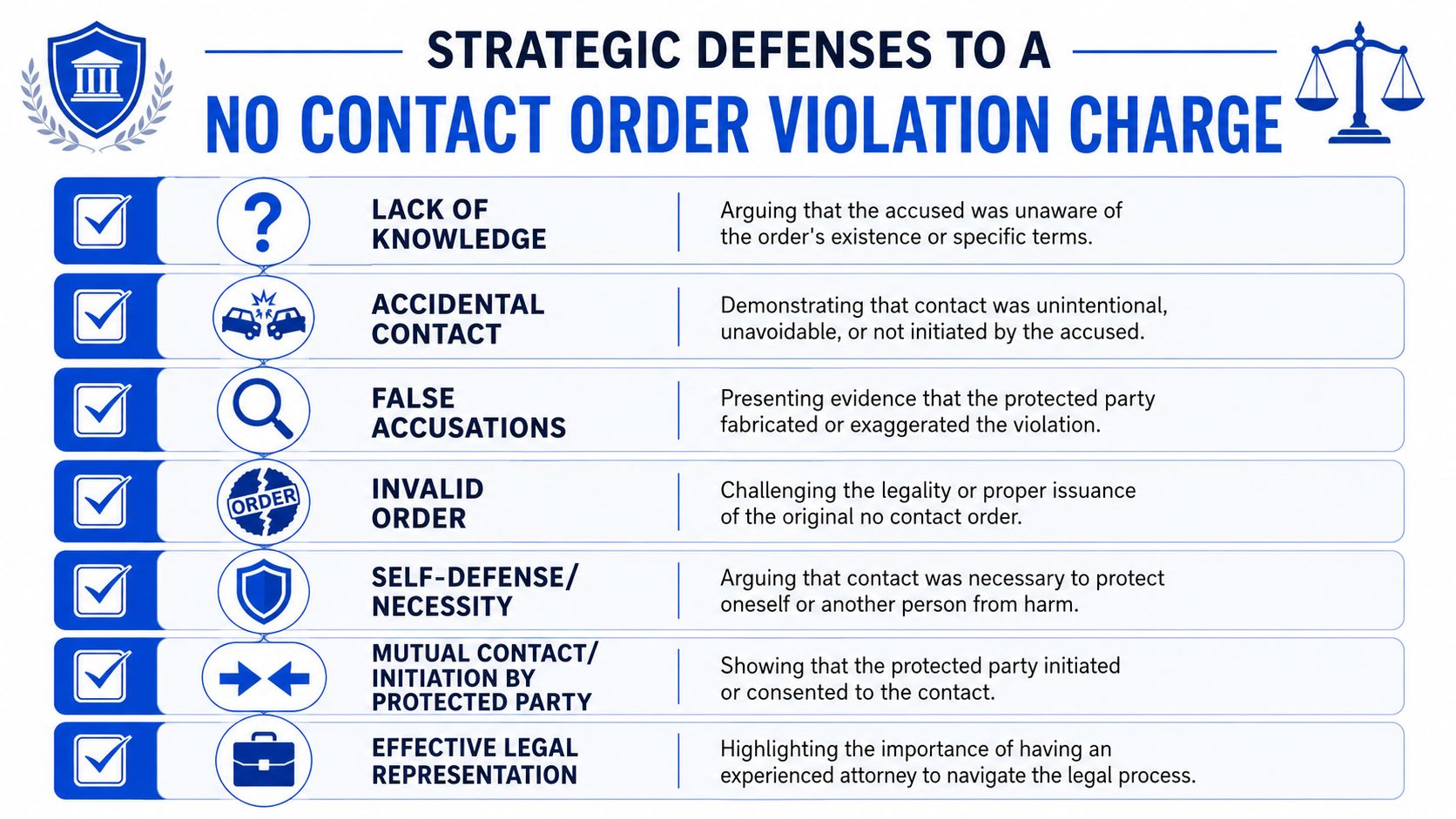
Willfulness is often the real fight
A practical defense often starts with one question. Did the State prove this contact was knowing and willful?
That can open several avenues:
You didn't know the order was in effect. Service, notice, and courtroom wording matter.
The contact was accidental. Running into someone in a public place isn't the same as seeking them out.
The evidence is incomplete. Partial screenshots and one-sided message threads can distort context.
The allegation is false or exaggerated. That happens more often than people think in emotionally charged cases.
The original order is legally defective. In some cases, the order itself or its scope deserves challenge.
These defenses don't all fit every case. The point is that the prosecutor still has to prove the violation, not just accuse you of it.
When the protected person contacted you first
This is the most common area of confusion.
Public guidance on no contact orders explains that the restriction applies to the accused person, not the protected person. If the protected person initiates contact, the accused can still violate the order by responding, as described in this discussion of who can violate a no contact order.
That doesn't mean the protected person's behavior is irrelevant. It can still matter a lot in the defense.
For example:
It may undercut fear claims. If they repeatedly reached out, that may affect credibility.
It may help challenge willfulness. A confused, reflexive, or minimal response can be different from deliberate pursuit.
It may support a modification request. In the right case, their conduct can help show the order isn't functioning as expected.
Save every message. Don't answer it. The incoming contact may become defense evidence, but your reply may become the charge.
What usually fails is the emotional explanation. “We were trying to work things out” doesn't beat the order. “They asked me to respond” doesn't beat the order either. The better defense is built around evidence, sequence, language, notice, and intent.
In cases involving children, shared property, or repeated mutual communication, the defense may also include a push to clarify or modify the order prospectively rather than keep stepping into avoidable risk.
Immediate Steps to Protect Yourself and How We Can Help
The hours after an allegation matter. So do the mistakes you avoid.
What to do right now
If you're accused of a no contact order violation in Fort Lauderdale or anywhere in South Florida, take these steps immediately:
Stop all communication at once. No texts, calls, DMs, apologies, explanations, or “just one last message.”
Preserve your evidence. Keep screenshots, call logs, voicemails, social media records, and anything showing timing or who initiated contact.
Leave digital records alone. Don't delete messages, wipe your phone, uninstall apps, or edit posts.
Write down the facts privately. Note dates, times, locations, witnesses, and exactly what happened while your memory is fresh.
Use your right to remain silent. Don't try to talk your way out of it with police.
What usually makes things worse
Clients often damage their own case before a lawyer sees it.
Avoid these mistakes:
Contacting the protected person to “fix it”
Asking friends or family to relay your side
Posting about the case online
Handing police a casual statement without counsel
Assuming the protected person can cancel the order for you
If you need legal help quickly, one option is to submit your case for review so counsel can evaluate the order, the allegation, and the immediate risk to your bond, record, and pending charges. Ticket Shield, PLLC handles Florida criminal defense matters statewide, including domestic violence related allegations and release condition issues.
A strong early response can focus the court on the core issues. Was there a valid order, clear notice, actual willful contact, reliable evidence, and proof that the accusation matches what really happened?
If you're facing a no contact order allegation in Broward County, Fort Lauderdale, Miami-Dade, Palm Beach, or anywhere in Florida, contact Ticket Shield, PLLC for a confidential consultation. Early intervention can protect your bond, preserve evidence, and put a defense strategy in place before the State defines the story for you.
Violating a no contact order in Florida can mean new charges and revoked bond. Learn the defenses that can protect you in 2026.