Injunction in Florida: Guide to Protection Orders
Jason Goldsmith, Esq
A Florida injunction is a civil court order that can restrict contact with another person, and obtaining temporary protection requires a finding of an immediate and present danger of violence. Violating a final injunction can lead to arrest, a first-degree misdemeanor charge, and up to one year in jail.
You may have received papers from a sheriff's deputy, discovered that someone petitioned for protection, or learned that a civil order is affecting a related arrest, bond condition, or probation matter. That situation is frightening, but an injunction isn't a criminal conviction. It is a court order with strict requirements, a fast hearing schedule, and potentially serious criminal consequences if you violate it.
Florida law gives courts several ways to restrict contact and protect people from alleged violence, stalking, harassment, or other conduct covered by a particular statute. If you're the respondent, follow the order immediately, preserve your evidence, and avoid discussing the allegations with the petitioner. If an alleged violation has already resulted in police contact, speak with a criminal defense attorney before giving a statement.
Table of Contents
What Happens When You Receive Injunction Papers in Florida
You're leaving for work when a deputy arrives with papers stating that someone has asked a Florida court to prohibit you from contacting them. The documents may require you to stay away from a home, vehicle, workplace, or other location. They may also prohibit calls, texts, emails, letters, in-person contact, or messages sent through another person.
A Florida injunction is a civil-court order, not a criminal prosecution. Florida recognizes four main protection categories, domestic violence, sexual violence, dating violence, and repeat violence, as described by the Florida Courts explanation of protection injunctions. The petitioner asks the court for protection, and a judge may issue a temporary order without first hearing from the respondent when the court finds an immediate and present danger of violence.
Read every term before taking action
The order controls your conduct even if you believe the petition is false or exaggerated. Don't assume that a friendly text, a response to a message, or contact through a relative is harmless. If the order says no contact, treat that restriction exactly as written unless a court changes it.
The order may also restrict access to your shared home, car, or workplace. Those restrictions can create practical problems involving personal property, employment, children, and housing. Ask your lawyer about a lawful process for retrieving belongings instead of returning to a restricted location on your own.
Immediate rule: Follow the written order first. Challenge it through the court process, not by testing its limits.
The next 15 days matter
A temporary order may remain effective for up to 15 days, and the court must set the final hearing within that period unless it continues the matter for good cause, including time needed to complete service. The hearing gives both sides an opportunity to present evidence and arguments about whether a final injunction should issue.
A final injunction violation can result in arrest and a first-degree misdemeanor charge carrying up to one year in jail under Florida law. If you're also facing domestic-violence allegations, the civil and criminal matters can affect one another, so review the injunction and any related release paperwork with counsel promptly. The Florida domestic-violence charges resource may help you understand the separate criminal allegations, but an attorney should evaluate how the cases interact.
Understanding the Different Types of Injunctions Available
Florida doesn't apply one universal test to every injunction. The statutory category affects who may petition, what proof matters, and what relief a judge can order. A respondent should identify the category before deciding how to challenge the allegations, because an argument that matters in a domestic-violence case may not address the legal requirements for another type of proceeding.
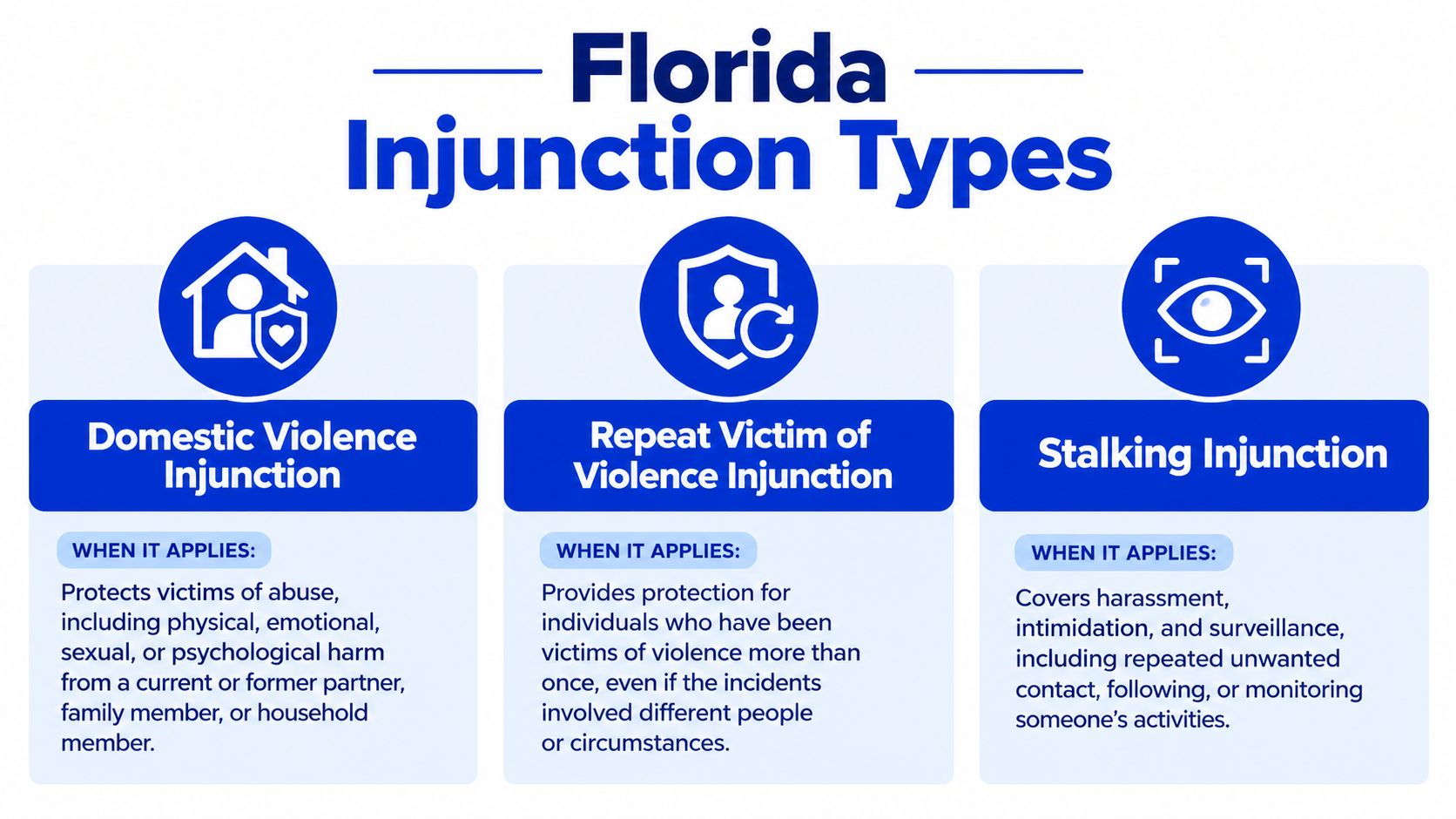
Protection categories and practical differences
Domestic violence injunctions generally arise from allegations involving violence or an imminent danger of violence within the relationship context covered by the governing statute. The process relies on sworn factual allegations and a prompt evidentiary hearing. The court's immediate-danger analysis is central at the temporary stage, while the final hearing requires evidence supporting continued protection.
Dating violence injunctions address violence allegations involving a qualifying dating relationship. The relationship facts matter, so communications, living arrangements, and the parties' history may become important to whether this category fits.
Repeat violence injunctions focus on alleged repeated violence rather than requiring the same relationship circumstances as a domestic-violence petition. Police records, photographs, messages, surveillance, and witness accounts may help establish or challenge the alleged pattern.
Sexual violence injunctions involve allegations within Florida's sexual-violence protection framework. These cases can overlap with a criminal investigation, making it important to preserve constitutional protections and avoid giving investigators an unplanned statement.
Stalking-related proceedings raise different evidentiary questions involving alleged harassment, surveillance, or repeated unwanted conduct. Digital evidence may be central, but a respondent should preserve complete conversations rather than isolated screenshots. For background on the criminal side of alleged harassment, review the discussion of harassment under Florida law.
Civil injunctions outside protection categories
Some civil injunctions arise outside the protection-order categories. Florida's Chapter 60 nuisance provisions state that a single act can be enough to authorize an injunction, while a state-seeking injunction under section 60.08 issues without bond. By contrast, Chapter 741 domestic-violence injunctions require sworn factual allegations and a prompt evidentiary hearing, as reflected in the Florida statutory contents for Chapter 60.
That difference has a direct defense consequence. One case may turn on whether one statutory violation occurred. Another may require proof of imminent danger or past violence through corroborated and admissible evidence. Don't assume that a petition's label tells you whether the allegations satisfy the applicable legal standard.
The Injunction Process From Filing Through Final Hearing
The process often begins when a petitioner files a sworn petition with the clerk. A judge reviews the allegations, and the respondent may not be present for that initial decision. If the judge finds an immediate and present danger under the applicable protection statute, the court may issue a temporary ex parte injunction.
That order becomes important as soon as it is issued and served. For domestic-violence injunctions, the clerk must electronically transmit the petition, affidavits, hearing notice, and temporary injunction to law enforcement within 24 hours after issuance, and law enforcement must serve the respondent as soon as possible. Similar 24-hour transmission requirements apply to repeat-violence, sexual-violence, dating-violence, and stalking injunctions under the relevant procedures described in the Florida domestic-violence injunction statute.
The compressed preparation period
A temporary injunction can remain effective for up to 15 days, and the final hearing must be set during that period unless the court continues the case for good cause, including time required for service, according to the Florida temporary-care statute. This isn't a comfortable preparation schedule. You may need to locate witnesses, collect records, organize communications, and identify contradictions before appearing in court.
Start with the paperwork. Mark every prohibited location and form of contact. Then preserve texts, emails, call logs, photographs, medical records, recordings, and other material in its original form. Don't delete unfavorable messages or edit files, because incomplete preservation can damage credibility.
What the final hearing decides
At the final hearing, the petitioner must prove entitlement to relief by a preponderance of the evidence. In plain language, the judge asks whether the evidence makes the petitioner's position more likely than not. That is a civil standard, not the criminal standard requiring proof beyond a reasonable doubt.
Both sides may present testimony and documents, subject to courtroom rules and objections. The judge may enter a final injunction, deny the requested relief, or modify the restrictions. If the petition involves alleged stalking, the related Florida stalking statute may also matter in a separate criminal case, but a civil injunction hearing and a criminal prosecution remain distinct proceedings.
Common Misconceptions About Florida Injunctions
A prior criminal record doesn't automatically justify an injunction. The petitioner still has to satisfy the requirements of the specific statutory category, and the respondent can challenge whether the alleged conduct, relationship, and evidence meet that standard.
Fear alone also isn't always enough. In a domestic-violence injunction proceeding, the temporary stage requires a finding of an immediate and present danger, while the final stage requires proof by a preponderance of the evidence. A general accusation without specific, admissible facts may be vulnerable, although every allegation should be taken seriously and addressed carefully.
A temporary order isn't a finding of guilt
A judge may issue a temporary ex parte order before hearing your side. That procedure reflects the urgency of some safety allegations, but it doesn't decide the final case. The respondent remains entitled to participate in the evidentiary hearing, present relevant evidence, question opposing testimony through counsel, and make legal arguments.
The short schedule affects strategy. Texts, photos, medical records, and call logs created close to the alleged event may carry greater practical value than a later general denial because they can help establish timing, context, and what occurred. Preserve the entire conversation or record, not only the portion that supports your position.
The following video may provide additional general context, but it isn't a substitute for advice about your order, hearing date, or related criminal case.
An injunction isn't the same as a criminal no-contact order
A civil injunction comes from a civil court proceeding. A no-contact condition may also arise from a criminal arrest, bond decision, plea agreement, probation order, or sentence. If both exist, comply with the more restrictive practical requirement and ask counsel to compare the documents.
Do not assume that the petitioner can cancel the order by text or tell police that contact is acceptable. Only the court can change or dissolve a court order. Similarly, changing your phone number, moving, or using a new social-media account won't remove an existing restriction.
Why Legal Representation Matters in Injunction Cases
An injunction hearing may occur in civil court, but it can function like a focused evidentiary trial. Sworn testimony, exhibits, objections, credibility disputes, and cross-examination can determine whether the court enters an order that later creates criminal exposure.
A lawyer can begin by separating the issues. Did the petition use the correct statutory category? Does it describe specific conduct? Do the dates, messages, photographs, and witness accounts support the allegations? Are there contradictions between the petition, police reports, recorded statements, and later testimony?
Counsel protects more than the hearing date
Representation can help you avoid mistakes that feel reasonable under stress. A respondent may contact the petitioner to explain, apologize, recover property, discuss children, or ask whether the case can be dropped. If the order prohibits contact, that attempt can create a new alleged violation and complicate both the civil hearing and any criminal investigation.
Counsel can also help with practical questions:
Evidence preservation: Organize original messages, call logs, photographs, recordings, and documents without deleting or altering them.
Witness preparation: Identify people with firsthand knowledge and address what they can testify about.
Order interpretation: Clarify restrictions involving shared housing, employment, children, property, and communication.
Hearing strategy: Present relevant evidence and challenge allegations that are unsupported, inconsistent, or outside the applicable legal standard.
Related criminal exposure: Coordinate the injunction defense with arrest, bond, no-contact, or probation issues.
A useful boundary: Don't use the injunction hearing to make an unplanned confession about a related criminal case. Civil testimony can affect a criminal defense.
An attorney can also seek a lawful modification or dissolution when facts support that request. Florida's civil-injunction rules require specific written reasons and a detailed description of restrained conduct for temporary injunctions in ordinary civil practice, and they allow a motion to dissolve or modify to be heard within 5 days after a hearing is requested, as explained in Florida Rule of Civil Procedure 1.610. The precise procedure depends on the type of injunction, so don't assume that rule applies identically to every protection category.
For questions to raise during a consultation, use this resource on questions to ask a criminal defense lawyer. The right lawyer should understand both the civil order and the criminal consequences that may follow an alleged violation.
Consequences of Violating a Florida Injunction
An alleged violation can move quickly from a civil dispute to a criminal investigation. Police may review the order, speak with the petitioner or witnesses, collect messages or recordings, and decide whether probable cause supports an arrest. The respondent's explanation may then become evidence, which is why speaking with counsel before answering detailed questions is important.
A violation may involve direct contact, a prohibited visit, a message sent through another person, or conduct that the order expressly forbids. The exact charge depends on the order, the alleged conduct, and the applicable statute. A final injunction violation can lead to arrest and a first-degree misdemeanor charge carrying up to one year in jail under Florida law.
The criminal and supervision consequences overlap
An injunction allegation can affect more than the new charge. If you're on probation, the alleged conduct may raise a separate compliance issue. If you're released on bond in another criminal case, the court may review whether the alleged contact violated a no-contact condition or other release term.
Florida's civil protection system is also increasingly connected to criminal enforcement. The Legislature expanded injunction-related protections in 2025 to cover serious violence, according to the Florida Senate's HB 285 materials. That development makes it especially important to determine whether the petition concerns a civil protection issue, a new criminal allegation, or both.
Violation Type | Charge Level | Maximum Penalty | Collateral Impact |
|---|---|---|---|
Violation of a final Florida injunction | First-degree misdemeanor | Up to one year in jail | Arrest, a criminal case, and possible effects on bond or probation |
Alleged contact while another criminal case is pending | Depends on the alleged conduct and applicable order | Depends on the charge filed | Possible dispute over no-contact conditions and defense strategy |
Alleged conduct by a person on probation | Depends on the new allegation and supervision terms | Depends on the charge and court action | Potential probation-compliance consequences in addition to the new case |
The table doesn't replace the order or the charging document. A judge or prosecutor may treat the same event differently depending on whether it is alleged as a civil-order violation, a new criminal offense, a bond violation, or a probation issue. Review Florida no-contact order violations alongside the actual paperwork before deciding what to say or do.
Frequently Asked Questions About Florida Injunctions
What should I do immediately after being served?
Read the entire order, note the hearing date, and obey every restriction. Don't contact the petitioner, even to deny the allegations or ask them to withdraw the petition. Preserve relevant evidence and contact counsel quickly because the hearing schedule can leave little time to prepare.
Can I change my phone number to avoid the injunction?
Changing your number doesn't cancel or modify the order. If the order prohibits contact, using a new number to reach the petitioner can still be treated as prohibited conduct. If you need communication about children, property, work, or another unavoidable issue, ask the court or your lawyer about a lawful method instead of creating your own workaround.
How long does a final injunction last?
The duration depends on the order and the legal category. Don't rely on an assumption that it will expire soon or that the petitioner can end it informally. Read the expiration language carefully, and ask counsel about a motion to modify or dissolve if circumstances change.
Will an injunction appear on a background check?
It may affect how courts, agencies, employers, landlords, or licensing bodies view your records, but the result depends on the type of record searched and the circumstances. A temporary order and a final injunction aren't the same procedural event, and an injunction isn't itself a criminal conviction. Ask a lawyer to assess the likely record implications in your situation rather than assuming either complete privacy or permanent disclosure.
What if the petition was filed in bad faith?
Don't retaliate, post about the petitioner, or send messages accusing them of lying. Gather objective evidence, including complete communications, location records that you lawfully possess, photographs, and witness information. Your attorney can test whether the petition satisfies the applicable statutory requirements and present contradictions at the final hearing.
What if the petitioner contacts me first?
Don't assume that their message gives you permission to respond. Preserve the message without engaging, and show it to counsel. The court order controls unless a judge changes it, even when the other person initiates contact.
What should I do if police ask about an alleged violation?
Stay calm, don't obstruct officers, and don't volunteer a detailed narrative before speaking with criminal defense counsel. Tell officers that you want to consult an attorney before answering substantive questions. Then provide counsel with the order, service information, messages, recordings, and any related bond or probation paperwork.
If you're in Broward County, Fort Lauderdale, Miami-Dade, Palm Beach, or another South Florida community, early legal review can help separate the civil injunction from any criminal charge and identify urgent deadlines. Ticket Shield, PLLC offers confidential consultations to review injunction allegations, related criminal charges, bond conditions, and probation concerns. Visit Ticket Shield, PLLC to discuss the order and your available defense options before the next court date.