
Motion to Suppress Evidence Template and Filing Guide
Jason Goldsmith, Esq
You're sitting in a Florida courtroom, watching the prosecutor prepare to use evidence taken from your car, home, phone, or person. You may know the search felt wrong, but knowing something was unfair isn't enough. The court needs a properly supported legal challenge filed at the right time and in the right form.
A motion to suppress evidence template can give a defense lawyer a useful starting structure. It can't replace the case-specific work required to identify the exact constitutional violation, establish the defendant's right to challenge the search, attach the relevant records, and comply with Florida's filing rules. In many cases, the procedural details determine whether a judge ever reaches the constitutional argument.
Table of Contents
Understanding the Power of a Motion to Suppress

A common example starts with a traffic stop. An officer approaches, asks questions, searches the vehicle, and finds an item the State later identifies as evidence of a crime. The officer's report may describe the search as consensual, incident to an arrest, based on probable cause, or justified by another exception. The label doesn't settle the issue. The court must examine what happened, when the detention began, what the officer knew, and whether the search stayed within lawful limits.
A motion to suppress is a formal pretrial request to exclude evidence obtained in violation of the United States Constitution, a state constitution, or an exclusionary statute. Federal criminal practice treats suppression as a pretrial issue and requires objections to illegally obtained evidence to be raised before trial under Rule 12(b)(3)(C), as explained in the Cornell Legal Information Institute's overview of motions to suppress. Florida practice likewise makes timing and factual support central to the defense.
Practical rule: A suppression motion must identify the evidence and explain why the State shouldn't be allowed to use it. Saying that the police acted illegally, without connecting that claim to specific facts, usually isn't enough.
The motion can challenge a warrantless search, an invalid warrant, an unlawful detention, an involuntary statement, or evidence derived from an earlier constitutional violation. For example, a defense may argue that an officer extended a traffic stop without lawful justification, searched a residence without a valid warrant or exception, or obtained statements after an unlawful seizure. A separate claim may address evidence discovered only because of the first violation.
That's why a person facing drug, theft, weapons, or other criminal charges shouldn't treat a template as a complete defense. A court may reject an argument because the defendant lacks standing, filed too late, failed to provide sworn factual allegations, or challenged the wrong item. The constitutional right matters, but the court still expects the defense to preserve it through a procedurally valid filing.
Clients often ask whether they should first read a general explanation of illegal search and seizure. That can help identify questions for counsel, but the motion itself must be built from discovery, recordings, reports, warrants, photographs, and witness accounts from the particular case.
Building a Modular Motion to Suppress Evidence Template
A strong template works as a modular litigation document, not as a fill-in-the-blank accusation. Each module should correspond to a distinct item of evidence, police action, legal theory, and requested remedy. That structure prevents a common problem, where a motion makes broad constitutional claims but never tells the judge exactly what should be excluded.
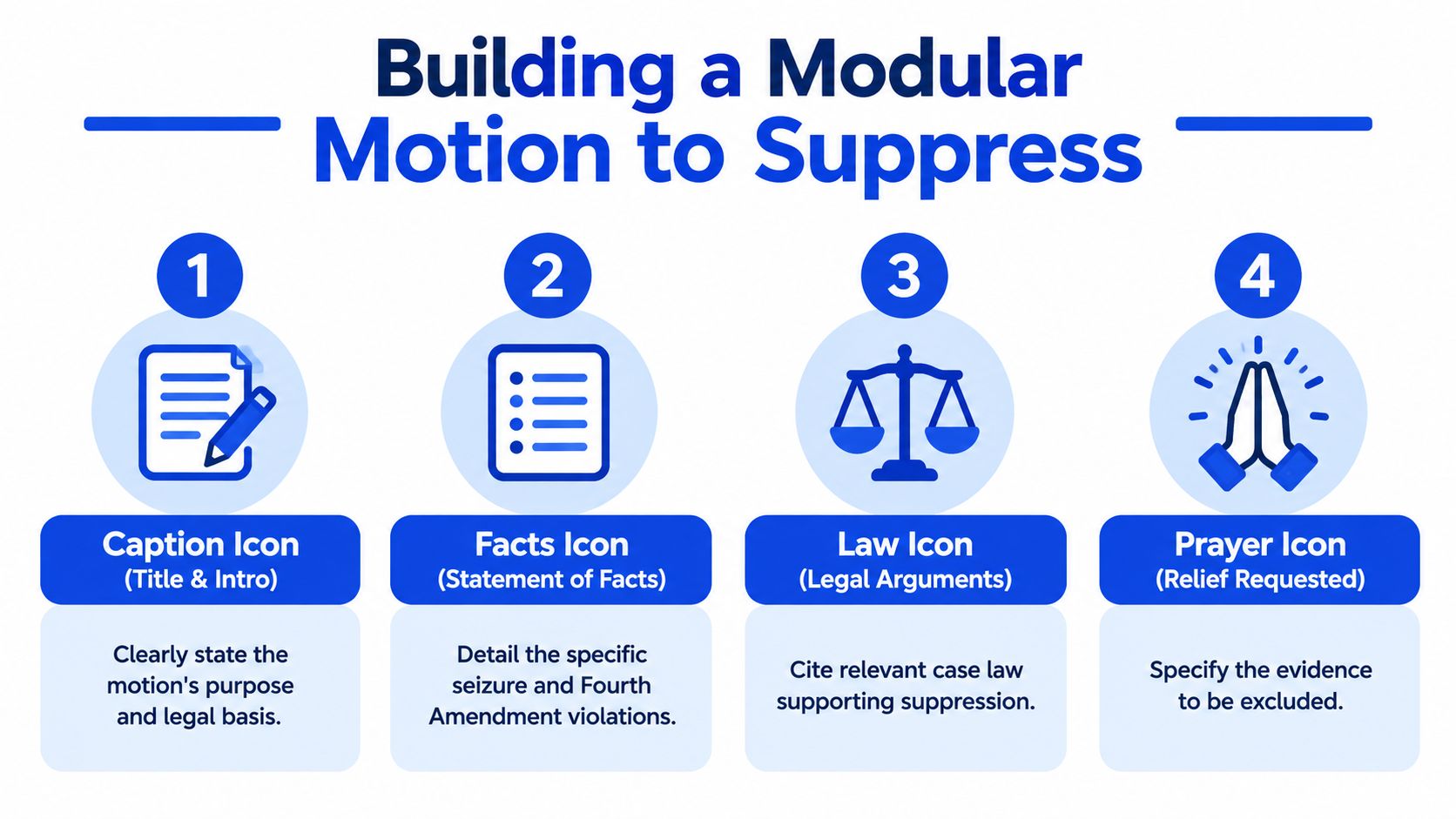
A practical template should contain these components:
Caption and procedural posture. Use the correct Florida court, county, case number, defendant's name, charging document, and filing designation. State whether the motion challenges evidence from a vehicle, residence, person, digital device, or another location.
Exact evidence at issue. Identify the controlled substance, weapon, photograph, recording, physical object, statement, or derivative evidence the defense seeks to exclude. “All evidence” is often too vague. The judge should be able to match each requested exclusion to an item in discovery.
Specific factual account. Set out the date, location, officers involved, reason for contact, timing of the detention, claimed basis for the search, and manner of seizure. Use reports and recordings carefully. If the body-camera video contradicts the report, the motion should identify the contradiction rather than merely accuse the officer of lying.
Legal grounds. Match the facts to the theory. Possible modules include a warrantless search, an invalid warrant, an unlawful detention, lack of consent, an overbroad search, an improper search incident to arrest, or derivative evidence under the fruit-of-the-poisonous-tree doctrine.
Standing and supporting materials. Explain the defendant's connection to the place or item searched. Attach or identify the challenged warrant, affidavit, police report, photographs, video, transcript, or sworn declaration when appropriate. A defendant generally can't suppress evidence based only on a violation of someone else's privacy rights.
Hearing request and proposed relief. Ask for an evidentiary hearing when disputed facts require testimony. Specify whether the defense seeks exclusion of physical evidence, statements, derivative evidence, observations, or testimony connected to the challenged conduct.
The value of this structure is precision. The Alabama court motion example addressing illegally seized evidence reflects the importance of identifying the challenged conduct, legal authority, hearing request, and supporting materials. The same drafting discipline helps in Florida, even though Florida law and local filing requirements control the actual motion.
A template also shouldn't be confused with a motion to return property. Suppression asks the court to prevent the State from using evidence. A motion to return property addresses a different remedy and may require different factual and procedural treatment.
Navigating Florida Filing Deadlines and Procedural Rules
A technically persuasive motion can fail before the judge considers the search itself. Florida Rule of Criminal Procedure 3.190 governs pretrial motions, and local court orders may impose deadlines that arrive well before trial. The defense must check the governing rule, the assigned judge's procedures, the circuit's administrative orders, and the case docket.
One Florida circuit court order illustrates how demanding local deadlines can be. It requires suppression motions no later than 200 days after the charging document in capital or life-punishable felony cases, 120 days in other felony cases, and 90 days after a stayed case returns to the active docket. Those deadlines come from the Florida circuit court's criminal case management and pretrial motion order, and they shouldn't be assumed to apply identically in every Florida circuit.
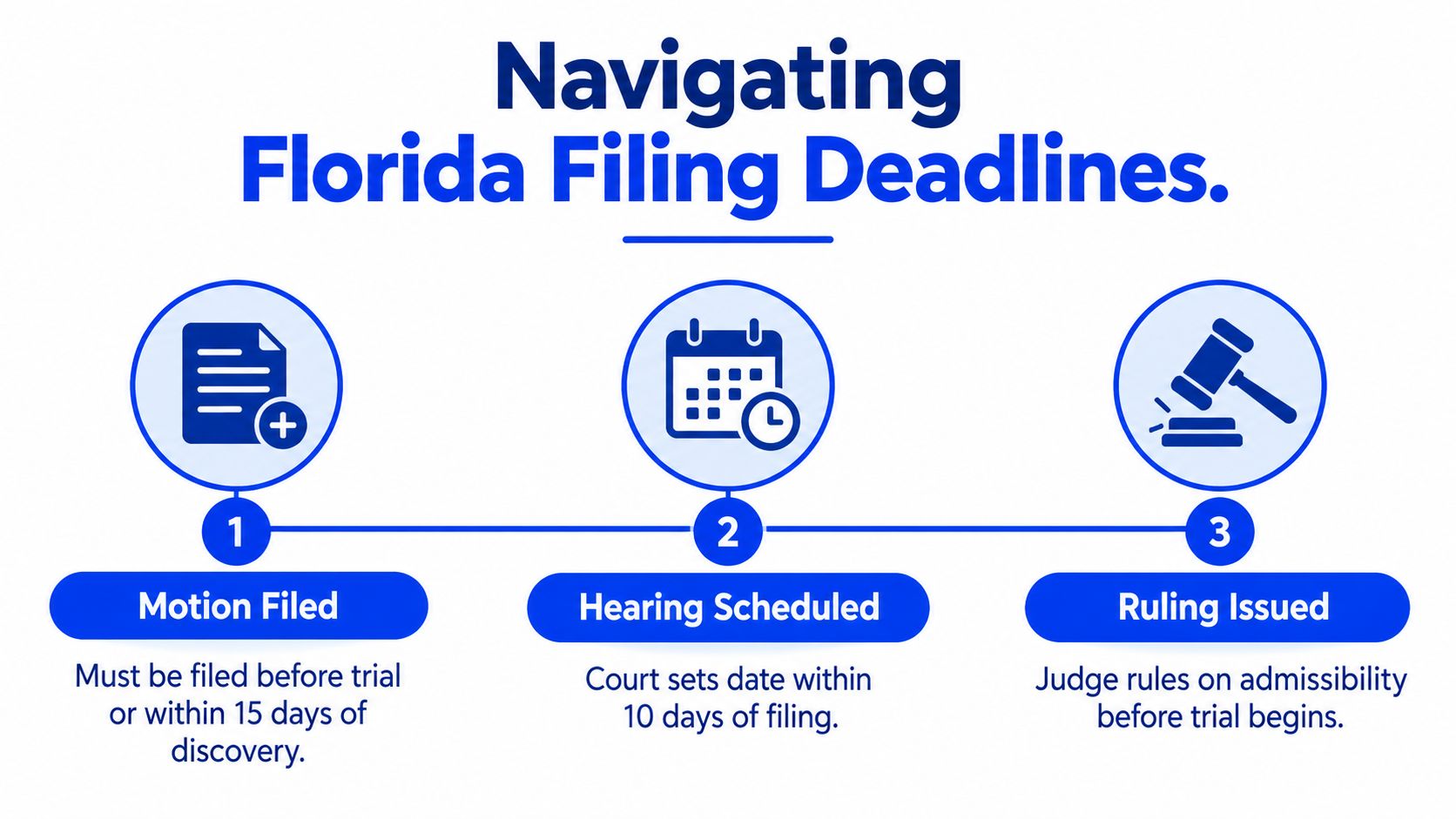
The filing review should be mechanical before it becomes argumentative. Counsel should verify:
Case information: The court, division, defendant's name, case number, charges, and assigned judge must match the official record.
Signature and verification: Required signatures, sworn statements, declarations, and dates must be completed in the form the court accepts.
Service: The prosecutor must receive the motion through the method required by the court or electronic filing system.
Attachments: The defense should include or properly identify the warrant, affidavit, reports, recordings, photographs, and other materials supporting the factual allegations.
Hearing logistics: The motion should request an evidentiary hearing when testimony or contested facts matter, while complying with local procedures for setting that hearing.
The hidden danger is waiver. Florida's rule generally requires a suppression motion before trial, subject to exceptions when the opportunity to raise the issue didn't exist or the defendant wasn't aware of the grounds. A late filing may leave the defense arguing not only that the search was unlawful, but also why the court should excuse the delay. That is a weaker position than preserving the issue promptly.
Incomplete municipal forms create a similar problem. A 2026 municipal court form warns that incomplete or improperly signed filings may be rejected, and practical filing guidance commonly requires pretrial submission by the applicable deadline and service on the prosecutor. The 2026 Spokane municipal court suppression form illustrates why missing signatures, case numbers, and declaration fields deserve the same attention as the legal argument.
A suppression claim should be calendared when discovery arrives, not when trial is approaching.
A lawyer should also preserve the record after filing. If the court denies the motion, the defense may need a clear transcript, exhibits, factual findings, and legal ruling for later review. Clients who want to understand the purpose of an evidentiary hearing can review this explanation of what a motion hearing is in court, but the case-specific deadline and local order remain decisive.
Tailoring Arguments for Physical Evidence Versus Statements
Physical evidence and statements may arise from the same police encounter, but they don't present identical suppression questions. A vehicle search may raise Fourth Amendment issues involving reasonable suspicion, probable cause, consent, a warrant, or an exception to the warrant requirement. A statement may instead involve Miranda warnings, custodial interrogation, coercion, voluntariness, or the effect of an earlier unlawful detention.
A one-size-fits-all template tends to blur those distinctions. The better approach uses separate modules that identify the evidence, the constitutional protection involved, and the causal path between the police conduct and the requested exclusion.
Evidence category | Questions the motion should address |
|---|---|
Physical evidence | Where was it found? Who owned or controlled the location? Was there a warrant? If not, which exception did the State rely on? Did officers exceed the authorized scope? |
Statements | Was the person in custody? Was questioning designed to obtain an incriminating response? Were warnings given? Was the statement voluntary? |
Derivative evidence | Did the challenged search or detention lead officers to a statement, witness, identification, laboratory result, or later search? What connection does the State claim breaks the causal chain? |
The distinction matters in a home-search case involving both seized property and statements at the station. Suppressing the property may require proving that officers lacked lawful authority to search. Suppressing the statements may require a different analysis of custody, interrogation, warnings, and whether the prior illegality tainted the later questioning.
Drafting insight: Don't ask the court to suppress “the case.” Identify each item and give the judge a separate reason to exclude it.
Derivative evidence deserves its own paragraph or section. If officers discover a phone during an unlawful search, then use information from that phone to locate another item, the defense should identify the later evidence and explain the connection. The State may argue that an independent source, inevitable discovery, attenuation, consent, or another doctrine permits admission. A motion that ignores the later evidence leaves part of the prosecution's proof unchallenged.
Evidence handling can also create separate issues that aren't suppression claims. Questions about testing, possession, transfers, seals, and documentation may affect admissibility or reliability. Those issues should be distinguished from the constitutional search question, much as a lawyer would distinguish a suppression motion from a chain of custody evidence challenge.
Recent template materials reflect this more nuanced practice by separating requests for physical evidence, statements, and derivative evidence rather than treating every case as a general Fourth Amendment dispute. The federal criminal motion to suppress template is an example of that modular approach, although a Florida lawyer must adapt the document to Florida rules, local practice, and the facts of the case.
The Reality of Suppression Success Rates and Legal Strategy
Suppression motions are important, but they're not routine wins. Empirical criminal-court data reports that motions to suppress physical evidence are filed in fewer than 5% of cases, with drug and weapons cases accounting for most filings. The same research reports suppression of physical evidence in 0.69% of cases, as described in the American Bar Foundation Research Journal's empirical assessment of the exclusionary rule.
Those figures don't mean a valid claim should be abandoned. They show why filing a generic form and hoping the judge recognizes the problem is a poor strategy. The defense must identify the strongest factual point, anticipate the State's justification, preserve standing, address timing, and present evidence that can survive cross-examination.
A former prosecutor often approaches the motion by asking what the State will argue next. Was the encounter consensual? Did the officer already have probable cause? Did the defendant consent? Would officers have found the evidence anyway? Does the State claim the warrant was supported by an affidavit? Was the detention brief and tied to an identifiable investigation? Those questions help expose the central dispute before the hearing.
The courtroom strategy may also extend beyond an all-or-nothing request. A successful challenge to one item can weaken the State's theory, while a ruling admitting physical evidence may leave a separate statement or derivative-evidence argument available. Counsel may use the litigation position to seek a more favorable resolution, but no responsible lawyer should promise dismissal, acquittal, or a particular negotiation result.
Ticket Shield, PLLC represents Florida clients in criminal cases and evaluates whether discovery, recordings, warrants, reports, and officer conduct support a suppression challenge. The practical value of counsel lies in tailoring the motion to the record and protecting the issue through the hearing, not in downloading a form and inserting a defendant's name.
Frequently Asked Questions About Suppressing Evidence
What happens at a suppression hearing
The judge may hear testimony from officers and other witnesses, review reports and recordings, examine a warrant or affidavit, and consider legal arguments from both sides. The defense should know which facts are disputed and what evidence supports each factual position.
Who presents evidence first
Under Florida Rule of Criminal Procedure 3.190, a suppression motion generally must be made before trial unless the opportunity to raise it didn't exist or the defendant was unaware of the grounds. If the court hears the motion on its merits, the defendant presents evidence first and the State may rebut, as stated in the Florida Rules of Criminal Procedure.
Can the State still use the evidence if the motion is denied
Usually, a denial permits the State to use the challenged evidence subject to other rulings and objections. The defense should ensure the motion, exhibits, testimony, and ruling are preserved clearly, particularly when the judge's decision depends on disputed facts.
What if only part of the evidence is suppressed
The court may address different evidence separately. A ruling might exclude an item, a statement, or derivative evidence while allowing other proof. That's why the motion should list each requested exclusion rather than treating the evidence as one undifferentiated group.
What should a client do after an arrest
Tell the lawyer every detail you remember, preserve messages and recordings, avoid discussing the facts publicly, and provide every document received from the court or prosecutor. Florida clients can also review general answers in the firm's criminal defense FAQs, but online information can't determine whether a particular search or statement is legally challengeable.
Ticket Shield, PLLC reviews Florida criminal cases for potential suppression issues involving searches, seizures, statements, and derivative evidence. Visit Ticket Shield, PLLC to request a consultation and discuss the deadlines, records, and constitutional questions that may affect your defense.