Florida Statute 790.06 Explained by a Defense Lawyer
Jason Goldsmith, Esq
A lot of people in South Florida are in the same position right now. They thought Florida's permitless carry change meant the rules got simpler. Then a routine stop, a courthouse visit, a school pickup, or an airport mistake turned into handcuffs, a notice to appear, or a criminal charge tied to Florida Statute 790.06.
That confusion is real. It also creates cases every day in Fort Lauderdale, Broward County, Miami-Dade, Palm Beach, and across the state. As a defense lawyer and former prosecutor, I can tell you many otherwise law-abiding people often find themselves blindsided in these circumstances. They assume they were legal because they didn't need a permit. The State looks at the same situation and asks a different question. Were you authorized to carry under Florida law, and were you in a place where carrying was still prohibited?
If you're worried about a 790.06 charge, the first thing to know is that an arrest doesn't decide the case. The statute is broader, more technical, and more fact-specific than commonly understood. That also means there are often real defenses.
Table of Contents
A Simple Mistake a Serious Gun Charge
A driver gets stopped in Fort Lauderdale for something minor. Maybe a tag light is out. Maybe the officer says the driver rolled through a stop sign. The driver wants to be respectful, so they mention there's a firearm in the car.
That moment often changes the entire stop.
Sometimes the firearm is in a place the officer believes was unlawful. Sometimes the stop happens near a location that creates separate problems. Sometimes the person honestly believes permitless carry means they no longer have to worry about licensing rules, eligibility, or where they can lawfully carry. By the end of the encounter, what started as a traffic matter becomes a weapons investigation.
Why these arrests happen
Florida gun laws are easy to oversimplify. People hear one phrase, usually "permitless carry," and assume the rest of the legal framework faded away. It didn't. Prosecutors still look closely at authorization, location, concealment, access, and the officer's basis for the search.
In practice, many 790.06 cases grow out of ordinary life:
A traffic stop turns into a vehicle search. The officer says your statements, movements, or the visibility of the weapon justified further investigation.
A lawful errand becomes a location-based charge. You walked into a restricted place without realizing the statute still applies there.
A disclosure meant to help gets used against you. People often talk too much before they understand what the officer is trying to prove.
Practical rule: The facts that seem harmless to you are often the facts the State uses to build probable cause, knowledge, and access.
What worried clients need to hear first
If you've been arrested or cited under Florida Statute 790.06, don't assume the charge is airtight. Officers make mistakes. Reports leave out details. Searches go beyond lawful limits. The government still has to prove its case.
A strong defense starts by slowing everything down and examining each decision the officer made. In Broward County and surrounding courts, that often means reviewing body camera footage, dispatch history, the basis for the stop, the exact location involved, and whether the State can prove you were carrying in a way the law prohibits.
What Florida Statute 790.06 Actually Governs Today
A client comes into my office after a gun arrest in Broward and says the same thing: “I thought Florida was permitless now.” That belief causes real damage. In court, the State does not treat 790.06 like a relic. Prosecutors still use it to measure who was legally allowed to carry, who was not, and whether a later disqualifier put someone back in criminal exposure.
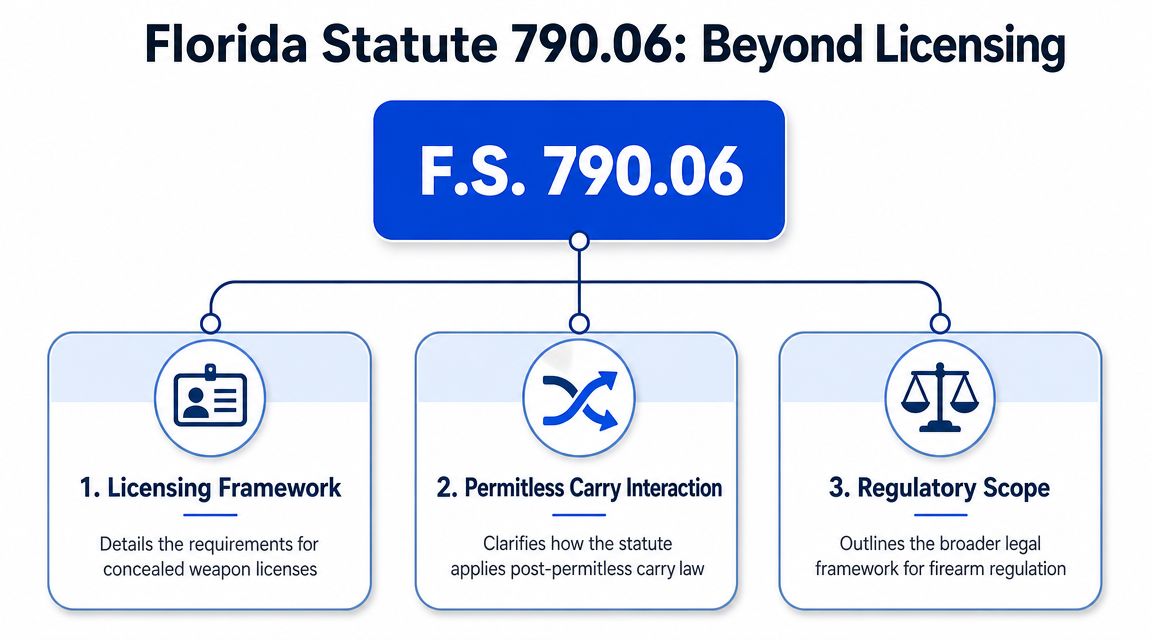
Florida's 2023 permitless-carry change did not erase 790.06. It changed one part of the carry system. The statute still governs concealed weapon and concealed firearm licensing, sets out who qualifies, identifies disqualifying conditions, and gives the State a framework for suspension or revocation when a person loses eligibility.
Why the statute still matters
The practical confusion is simple. People hear “no permit required” and assume legal analysis stops there. It does not. A Fort Lauderdale prosecutor looking at a weapons case still asks whether you met the same underlying eligibility standards that would apply to a licensed carrier.
That matters in real cases. A person may lawfully own a firearm and still face a concealed-carry problem if the State claims he was not legally authorized to carry it in that setting. Those are different questions, and the prosecution knows the difference.
Here is where 790.06 still shows up fast:
Eligibility disputes. If the State claims a prior record, substance-related issue, or other disqualifier made you ineligible, permitless carry does not fix that problem.
License suspension or revocation issues. If someone had a concealed weapons license and later became disqualified, 790.06 still controls what happens next.
Authorization arguments in court. If the prosecution needs to prove you were carrying concealed without lawful authority, this statute remains part of the analysis.
For a broader look at related charges, defenses, and firearm allegations, review our Florida weapons and firearm offenses hub.
What the law covers
This statute is still the rulebook for lawful concealed carry status in Florida. It covers the license process, the categories of weapons addressed by the statute, eligibility standards, and the circumstances that can lead to suspension or revocation.
In practice, that means 790.06 continues to matter even for people who never apply for a license. The legal question is often whether the person could lawfully carry under the statute's standards, not whether he had a card in his wallet.
I often tell clients to focus on the prosecutor's proof problem. The State must tie your status, your knowledge, and the surrounding facts together. If the arrest report skips steps, if the officer misunderstood your legal status, or if the State cannot prove a disqualifier the way it claims, the case becomes much more defensible.
Many defense cases turn on a narrower question than clients expect: whether the State can prove lawful authorization to carry was missing at that moment, under those facts.
A clearer way to read the statute is this:
Issue | What people assume | What prosecutors examine |
|---|---|---|
Permitless carry | No permit means carry is broadly legal | Whether you still met the statute's eligibility standards |
Licensing | Only matters to people who applied | Defines lawful status and remains relevant in contested cases |
Prior disqualifiers | Old issues no longer matter | Whether a disqualifier barred lawful concealed carry |
Revocation or suspension | Only an administrative problem | Evidence the State may use to argue you were not authorized to carry |
That is why 790.06 still drives modern gun cases in South Florida. The permit requirement changed. The legal limits, disqualifiers, and prosecutor's burden did not disappear.
Prohibited Places A Common Trap for Gun Owners
A large number of 790.06 cases do not come from violent conduct. They come from location mistakes. The person may be calm, cooperative, and otherwise eligible to carry. The problem is where they went.
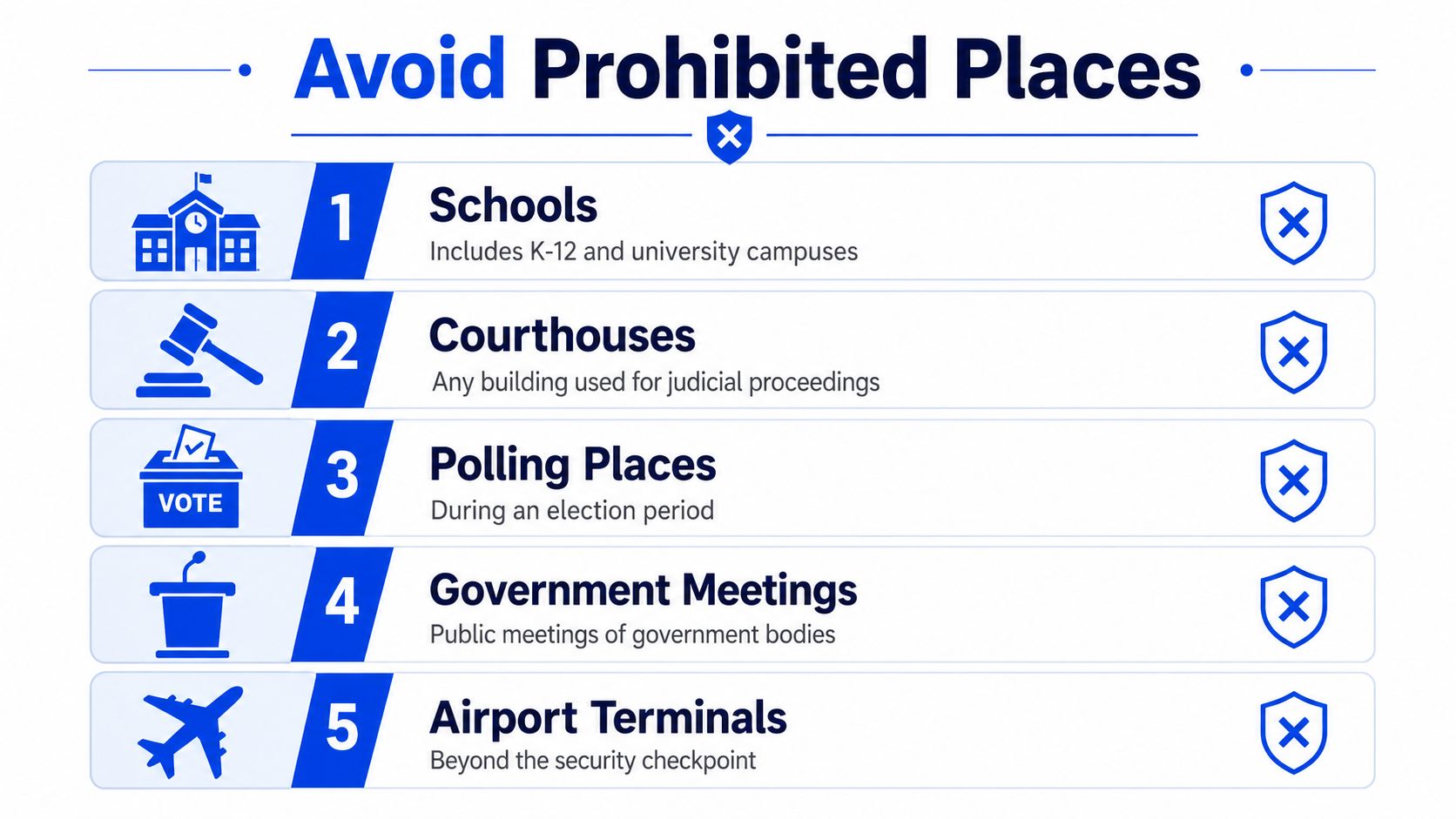
Independent summaries of the law note that carrying in restricted places such as courthouses, police stations, schools, bars or areas primarily dispensing alcohol, airports after security, and other listed locations can be charged as a second-degree misdemeanor under 790.06(12), as explained in this discussion of Florida Statute 790.06 restrictions.
Locations that trigger charges
These are the places that commonly create criminal exposure:
Courthouses and court facilities. Many people think the rule applies only inside a courtroom. It can apply more broadly to the facility, and courtroom authorization can be judge-specific and limited.
Police stations and similar secure government spaces. Walking in to handle an unrelated matter can still trigger a weapons issue.
Schools. School-related property is one of the most common places where people make serious mistakes during drop-off, pickup, or events.
Bars or areas primarily dispensing alcohol. The usual trap is assuming a restaurant that serves alcohol is all treated the same. The exact area matters.
Airport sterile areas. People often discover the problem at the checkpoint, after a lawful drive to the airport turned into an arrest or citation.
If you're dealing with that kind of allegation, this page on carrying a concealed firearm in Florida addresses related defense issues.
Mistake is not always a complete defense
One of the hardest conversations I have with clients is this: being otherwise eligible to carry does not automatically protect you once you enter a prohibited place. The law can still expose you to a criminal charge.
That matters because people often ask, “What if I didn't mean to bring it in?” Intent can matter in how a case is investigated, negotiated, and defended. It can matter when challenging what the officer observed or how the State characterizes the event. But a mistake does not guarantee immunity.
The strongest prevention advice is simple. Before you enter a courthouse, school, airport checkpoint area, or alcohol-focused venue, stop and ask whether the location itself creates the problem.
A useful way to think about it is this:
Situation | Common belief | Real legal risk |
|---|---|---|
Eligible person enters school property | Eligibility should protect me | Location can still create criminal exposure |
Firearm carried into airport checkpoint area | I forgot it was in my bag | Forgetfulness may not stop the charge |
Firearm near courtroom | Courthouse staff will just hold it | Venue-specific rules can be much stricter |
In court, the defense often shifts from “I thought I was allowed” to whether the State can prove the charge cleanly and whether the facts justify a reduction, diversion outcome, or dismissal.
Penalties for a Florida Weapons Violation
When clients hear “misdemeanor,” they sometimes think the charge is manageable. That's a dangerous assumption in a gun case. A weapons conviction can create problems that continue long after the court date is over.

The immediate criminal exposure
For many location-based 790.06 allegations, the charge is a second-degree misdemeanor, as noted earlier in the statute summary linked above. That means the case is still criminal. You may be booked, required to post bond, ordered back to court, and left with a record of arrest that employers and licensing boards can see unless further legal action changes that outcome.
The direct court consequences often include:
Jail exposure. Even when jail is not imposed, it remains part of the power prosecutors hold.
Probation conditions. Courts can impose restrictions that affect daily life, travel, firearm possession, and compliance obligations.
Financial penalties. Fines, court costs, and related expenses can add up quickly.
For related issues involving possession restrictions after certain convictions, this overview of felon in possession charges in Florida is often relevant.
The damage that lasts longer
The collateral consequences are often what matter most.
A gun-related conviction can affect employment, professional opportunities, background checks, and your ability to explain the case later. If you hold a professional license or work in a field where trust and screening matter, even a misdemeanor can become a recurring problem.
The statute also matters on the licensing side. As covered earlier, the law addresses suspension and revocation of a concealed weapon or concealed firearm license when disqualifying events are found. That means a case under Florida Statute 790.06 can have both a criminal side and a licensing side.
Here's a helpful overview before I get into defense strategy:
Category | Typical concern |
|---|---|
Criminal court | Charge, plea, probation, possible jail |
Firearm status | Loss of lawful carry status or licensing problems |
Personal record | Background checks, applications, reputation |
Future cases | A new arrest can be treated more seriously because of the prior record |
A short video can help frame how quickly these cases become more serious than people expect.
Building a Strategic Defense to a 790.06 Charge
An arrest is a starting point. It is not a verdict.
In weapons cases, the State usually files charges based on an officer's version of a fast-moving event. That version may sound polished on paper, but it often leaves room to challenge what happened, why the officer searched, whether the weapon was concealed in the legal sense, and whether the location falls within the restriction the prosecutor claims applies.
How the State usually builds the case
Prosecutors often rely on a familiar package of evidence:
The officer's narrative. This usually includes the reason for the stop, what was said, where the weapon was found, and why the officer believed a crime occurred.
Body camera or dash camera footage. Sometimes this helps the State. Sometimes it contradicts the report.
Statements by the accused. People trying to cooperate often fill gaps in the State's proof.
The physical location evidence. In a prohibited-place case, the prosecution will try to pin down exactly where you were and whether that area falls inside the statute.
That may sound straightforward. It often isn't.
Police reports can be vague about access, concealment, exact placement, timing, and whether the officer had lawful authority to expand a traffic stop into a weapons investigation. Those details matter. In many cases, they matter more than the firearm itself.
Good defense work starts with the first police decision, not the last one. If the stop, detention, or search was unlawful, the rest of the case may weaken fast.
Defense strategies that can change the outcome
The right defense depends on the facts, but several strategies come up often in South Florida courts.
Challenge the stop or search
If the officer lacked a lawful basis for the stop, prolonged the detention, or searched beyond what the law allowed, suppression may be the central issue. A suppression motion can immediately change the strategic advantage in the case.
Dispute concealment or accessibility
Not every firearm discovery proves unlawful concealed carry. The State has to prove the legal elements, not just possession. Where the weapon was found, how visible it was, and whether it was readily accessible can all become contested issues.
Attack the prohibited-location theory
In location-based prosecutions, the defense may focus on boundaries, access points, signage, building use, or the officer's assumptions about the area. In some cases, the State oversimplifies a space that is more legally complicated than the arrest report suggests.
Use the client's conduct as part of the defense
Some clients did not flee, threaten, hide, or act aggressively. That doesn't erase the charge, but it can matter in negotiation. Credibility, cooperation, and context often influence whether a prosecutor will reduce, divert, or dismiss.
Examine every inconsistency
A former prosecutor looks for friction points. Did the report match the video? Did the timeline make sense? Did the officer describe the location consistently? Small contradictions can produce major results when the legal issue is technical.
In the best cases, that work leads to suppression, dismissal, or a reduction that protects the client from the worst long-term consequences. In other cases, it creates the advantage needed to negotiate from strength instead of fear.
How a Former Prosecutor Gives You an Advantage
A former prosecutor sees a 790.06 case differently because he knows what the State Attorney's Office is likely to focus on first. He knows what facts prosecutors think are enough, what weaknesses they may overlook, and what tends to move a charging lawyer from rigid to reasonable.
That matters in gun cases because prosecutors often begin with a public-safety mindset. They may treat a technical weapons allegation as more serious than the accused person expected. To defend the case well, you need more than a statute book. You need to understand how prosecutors screen these files, how they react to suppression issues, and what concerns drive plea negotiations in Broward, Miami-Dade, and Palm Beach courtrooms.
Seeing the case from both sides
A former prosecutor usually reads a file with two questions at the same time:
What is the State going to argue?
What proof is missing or vulnerable?
That perspective helps in several ways:
Report review gets sharper. A charging memo may sound stronger than the actual evidence.
Negotiation gets more precise. The defense can target the points that matter to the prosecutor reviewing the case.
Court strategy gets cleaner. Good motions are not filed just to file them. They are filed to pressure a weak part of the State's theory.
For more about the firm's background, you can review the attorney profile and firm overview.
Why that matters in South Florida courtrooms
Every courthouse has its own rhythm. Some prosecutors are more focused on policy. Others are driven by the report, the officer, or the practical risk of losing a motion hearing. A lawyer who has stood on the government side of the courtroom is often quicker to recognize which issue will move the case.
In a weapons case, leverage rarely comes from arguing louder. It comes from showing the prosecutor exactly where the proof breaks down.
That's especially important when a worried client is deciding whether to fight, negotiate, or push for a non-conviction outcome that preserves future options.
Frequently Asked Questions About Florida Gun Laws
A lot of good people get tripped up in the same place. They heard Florida passed permitless carry, assumed the old rules were gone, and only learned after an arrest that prosecutors in places like Fort Lauderdale still file weapons charges every week based on where the gun was carried, who was carrying it, and how the officer found it. The 2025 Chapter 790 framework shows the problem clearly. Florida changed the license requirement for some concealed carry situations, but it did not erase eligibility limits, prohibited places, or the State's burden to prove a violation.
Do I still need a Concealed Weapon and Firearm License in Florida
Sometimes yes.
Florida law now allows some people to carry concealed without a license, but only if they meet the same kind of legal qualifications that would make them eligible to hold a license in the first place. That point gets missed all the time. A person can hear "permitless carry" and assume the analysis ends there. It does not.
A license can still matter for travel, reciprocity, and avoiding confusion during an encounter with law enforcement. In a criminal case, the key question is whether the State can prove you were not legally qualified or that your conduct fell outside what Florida law permits.
What if I accidentally brought my gun into a prohibited place
That fact may help the defense, but it usually does not stop the arrest.
If you walked into a courthouse, school, polling place, or airport sterile area with a firearm, the State may still file charges and argue that the location alone creates the violation. From there, the case often turns on narrower questions. Where, exactly, were you? Was the area clearly restricted? Can the prosecutor prove the firearm was on your person or otherwise carried in a way covered by the statute? Did your statements make the case easier for the State than it should have been?
Those details matter. They are often the difference between a charge that looks clean on paper and one with real defense value.
Can I carry a gun in my car glove box without a license
That issue depends on the specific facts, and bad advice causes a lot of arrests.
People rely on a short summary from a gun counter, a social media post, or something a friend said after the 2023 law changed. Then a traffic stop happens, an officer starts asking questions, and the case becomes about much more than a glove box. The location of the firearm matters. So do accessibility, the reason for the stop, whether the search was lawful, and what was said on body camera.
I have seen cases where the storage issue was not the strongest point for the State. The stronger point was the defendant's own explanation during the stop.
If the officer did not see the gun how can they charge me
The State does not need an officer to spot the firearm at the first moment of contact.
Charges can come from a vehicle search, a claimed safety pat-down, a consent search, a witness statement, surveillance footage, later body camera footage, or your own statements. Prosecutors build these cases by stacking facts together and arguing that the total proof is enough. That approach works more often when nobody challenges how the firearm was discovered.
The defense review starts in a different place. Was the stop lawful? Was the detention extended without legal cause? Was consent valid? Can the State prove possession, knowledge, and location with reliable evidence?
What should I do after an arrest under Florida Statute 790.06
Stop discussing the facts with anyone except your lawyer.
Save every document you received. Keep bond paperwork, property receipts, text messages, travel records, and anything else that helps place you where you were and explain what you were doing. Then write down your memory of the stop or arrest while it is still fresh. Include where the firearm was, what the officer said, whether consent to search was requested, and whether body cameras were visible.
Small facts win motions. Small facts also change plea discussions.
If you're facing a weapons charge in Broward County, Fort Lauderdale, Miami-Dade, Palm Beach, or anywhere in South Florida, Ticket Shield, PLLC can help you act quickly and protect your rights. The firm is led by a former prosecutor and defends clients accused of gun and firearm offenses with a strategic, evidence-driven approach. A confidential consultation can help you understand what the State must prove, what defenses may apply, and how to fight for the best possible outcome before a misdemeanor or felony case does lasting damage.
Florida Statute 790.06 governs concealed weapon licenses. A defense lawyer explains the law, common violations, and how to protect your rights.