New FL DUI Laws 2026: A Guide for South Florida Drivers
Jason Goldsmith, Esq
You're driving home on I-95, U.S. 1, or a local road in Broward, Miami-Dade, or Palm Beach County. Blue lights come on behind you. A few minutes later, you're on the shoulder answering questions you weren't prepared for, trying to remember what you said, what you did, and whether refusing a test helped or hurt.
That's where many Florida DUI cases now begin. The panic is the same as it's always been, but the legal situation isn't.
The new Florida DUI laws changed a part of the case that used to be treated mostly as a license issue. Refusal now creates its own criminal exposure in many cases. That means one stop can trigger multiple fights at the same time: the DUI charge itself, the driver's license suspension, and a separate refusal allegation. If you were arrested in Fort Lauderdale, Broward County, Miami-Dade, Palm Beach, or anywhere in South Florida, the first mistake is assuming the case is simpler than it is.
A lot of articles just list penalties. That's not enough. What matters is how these new laws work in practice, what still can be challenged, and what you need to do immediately to protect your license, record, and future.
Table of Contents
Your License Insurance and Criminal Record The Practical Impact
What to Do Now Your First Steps After a South Florida DUI Arrest
An Arrest for DUI in Florida Just Got More Complicated
A South Florida DUI arrest used to be confusing enough. You had the roadside stop, field sobriety exercises, a breath room or refusal decision, towing issues, bond conditions, and the immediate fear of losing your license. That was already a lot for one night.
Now there's another layer. In many cases, the decision to refuse a chemical test no longer sits only in the administrative lane. It can become a separate criminal issue. That catches people off guard because they've heard old advice from friends, online forums, or even outdated articles that treat refusal as a simple tradeoff.
That advice can be dangerous now.
Why people get blindsided
Most drivers don't get arrested for DUI because they spent the week studying implied consent law. They're tired, nervous, and trying to interpret instructions from an officer on the side of the road or in a station setting. They're also making decisions fast, often based on half-remembered stories about breath tests, blood tests, and whether refusing makes the case easier to defend.
Sometimes it does remove one piece of the State's evidence. Sometimes it creates a new problem that's serious in its own right. Often it does both.
Practical rule: In a modern Florida DUI case, the question isn't only “Did you refuse?” The real question is “What evidence did the State gain, what evidence can be challenged, and what separate penalties did that decision trigger?”
The real problem is overlap
A DUI arrest can now move on parallel tracks at once:
The criminal DUI case involving impairment allegations, officer observations, and any testing evidence
The license case involving administrative suspension issues
The refusal issue if law enforcement claims you declined a qualifying test under the new framework
That overlap matters because each track has different rules, different deadlines, and different defense opportunities. A person charged in Broward County might assume the refusal charge proves the DUI. It doesn't. Another person may think beating the DUI automatically fixes the refusal consequences. It may not.
The practical defense work starts by separating those issues instead of blending them together.
In real cases, the first useful questions are usually basic. Why were you stopped? What did the officer claim to observe? What advisement was given before the requested test? What kind of test was requested? When did this happen? Timing matters under the new Florida DUI laws, especially in cases tied to changes that took effect later.
What Exactly Are the New Florida DUI Laws for 2026
A driver gets arrested in South Florida after a routine stop, refuses testing, and assumes the main fight will be about whether the officer can prove impairment. In 2026, that assumption can cost you. Florida's newer DUI framework means the refusal itself may create a separate criminal problem, even while the defense still has to examine the stop, the arrest, and whether the State's evidence can be kept out.
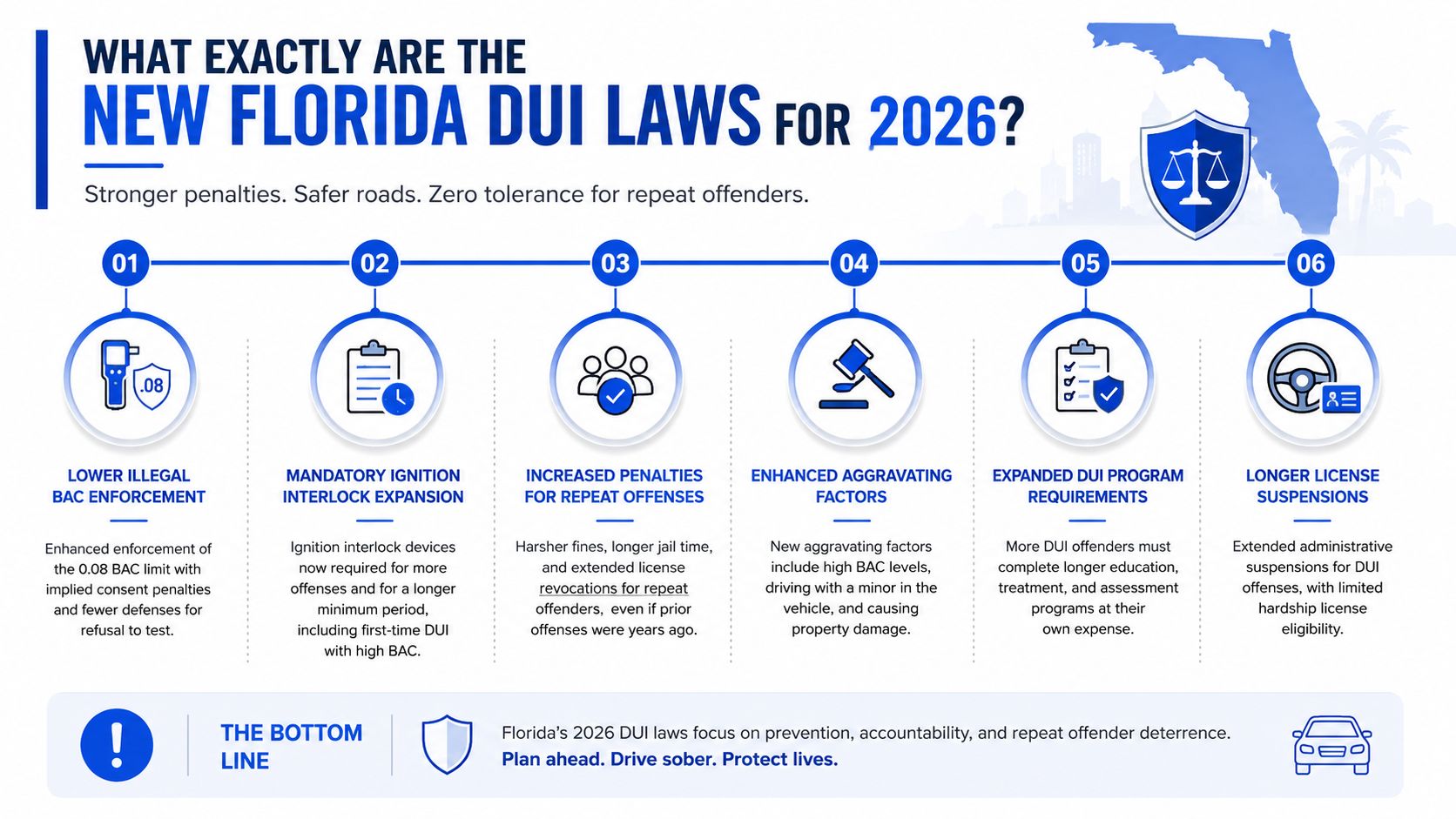
The heading says 2026 because that is when many people are now dealing with charges under rules that took effect on October 1, 2025. The effective date matters. So does the arrest date. If the alleged refusal happened before that date, the State does not get to apply the newer refusal crime retroactively.
The Impact of Trenton's Law
Florida made two major changes under House Bill 687, commonly called Trenton's Law.
One change affects the most serious fatality cases. A second conviction for DUI manslaughter or vehicular manslaughter now carries significantly greater felony exposure than before.
The other change reaches ordinary DUI arrests much more often. Florida added criminal penalties for certain chemical test refusals. That is the part people charged with DUI need to understand immediately, because it changes early case strategy in a very practical way.
Before this change, refusal was usually discussed as a license problem and an evidentiary issue. Now it can also be charged as its own crime. That means a defense lawyer may need to handle two separate questions at once: whether the DUI case itself can be beaten, and whether the refusal allegation was lawfully obtained and can be proven.
What changed in refusal cases
For arrests tied to the newer law, a refusal allegation can bring criminal exposure in addition to the administrative suspension.
Refusal allegation | Criminal level | Exposure | License effect |
|---|---|---|---|
First refusal | Second-degree misdemeanor | Up to 60 days in jail and a $500 fine | One-year license suspension |
Second refusal | First-degree misdemeanor | Up to one year in jail and a $1,000 fine | 18-month suspension |
That chart only tells part of the story.
In practice, refusal cases often turn on details officers and prosecutors gloss over. What warning was given. What test was requested. Whether the request matched Florida's implied consent rules. Whether the stop itself was lawful in the first place. A person may need to defend against the refusal charge while also filing motions to suppress because the officer lacked reasonable suspicion, prolonged the stop, or made an arrest without probable cause.
That is the strategic gap many articles miss. New criminal penalties for refusal do not eliminate old suppression issues. They make those issues more important. If you are dealing with a Florida refusal to submit to a breath test charge, the smart approach is to separate the tracks early instead of treating the refusal as automatic proof of DUI.
Two points matter right away.
The date of the alleged refusal matters because the newer criminal consequences apply only after the law took effect.
The type of chemical test matters because breath, blood, and urine requests can raise different statutory and constitutional issues.
From a defense standpoint, that means the question is not just what penalty was added. The central question is whether the State can keep the stop, the arrest, the refusal procedure, and any statements intact after close review.
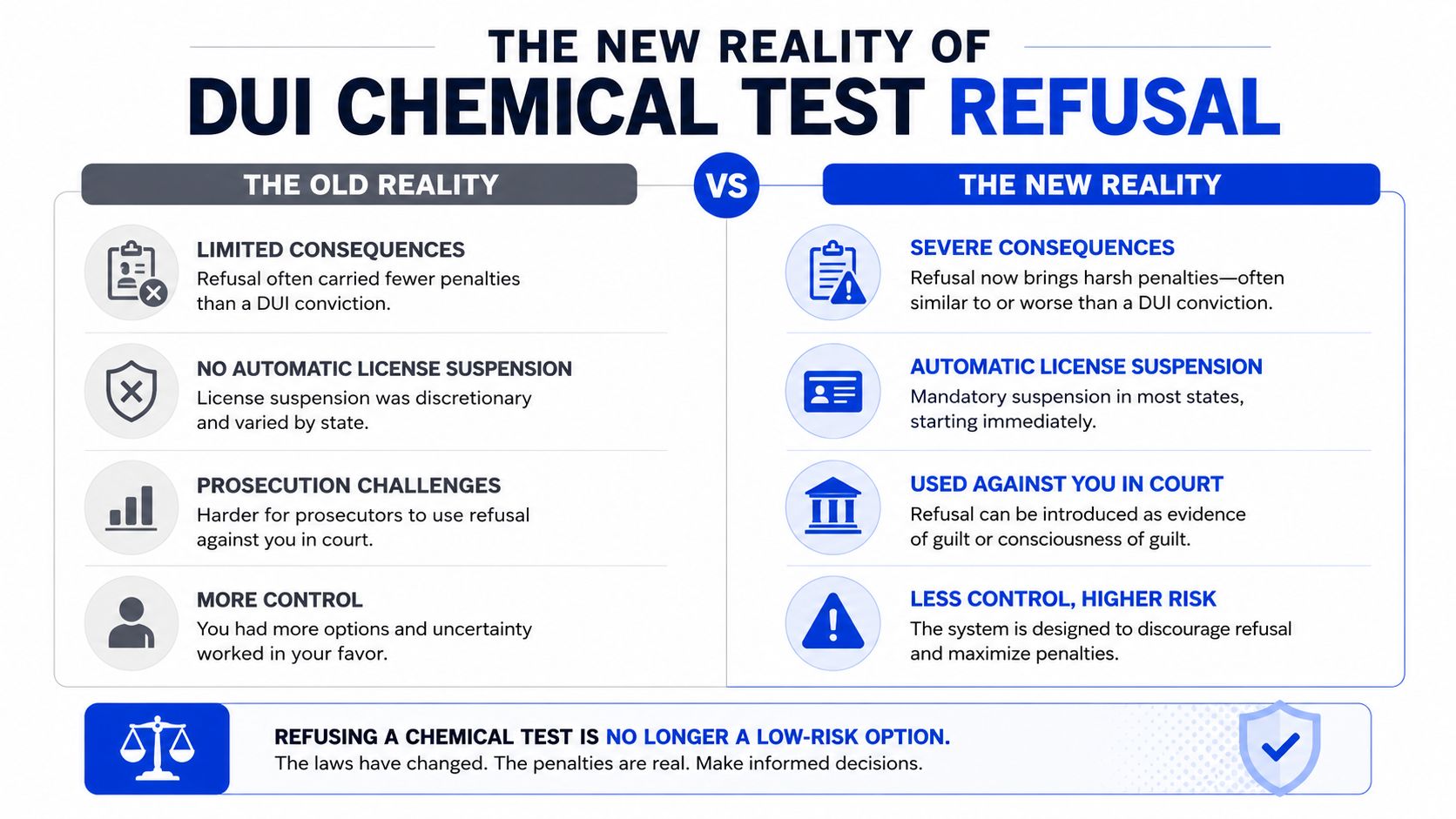
The New Reality of DUI Chemical Test Refusal
The biggest misunderstanding in current DUI defense is this: people assume a refusal charge answers the entire case. It doesn't. It creates another fight.
One refusal can now create three separate problems
Under the current framework, a refusal can trigger three distinct issues.
The DUI prosecution itself
The administrative license consequences
A separate criminal refusal allegation
That separation is the most important thing many people miss. A person can be fighting all three at once, but the defense arguments are not identical in each arena.
A useful way to think about it is this:
Issue | Main question |
|---|---|
DUI case | Can the State prove impairment or otherwise prove the charge? |
License suspension | What happens to your driving privilege right now? |
Refusal charge | Was the refusal legally obtained and can the State prove that separate offense? |
The strategic gap matters because, as noted in this analysis of Florida's 2025 DUI refusal law, the new law can make a first refusal a second-degree misdemeanor with up to 60 days in jail and a $500 fine, but that doesn't automatically mean the refusal can be used against you without challenge.
A refusal charge is not the same as winning the DUI case
In court, a defense attorney still looks closely at the foundation of the entire encounter.
Key questions include:
Was the stop lawful based on actual facts rather than a vague hunch?
Was the arrest supported by enough evidence?
Was the implied-consent process handled properly before the officer demanded the test?
Can the State use the refusal at trial to argue consciousness of guilt?
Was the requested test the type covered on these facts and under the timing of the statute?
That's why a refusal case often requires technical motion practice, not just damage control.
Someone facing this issue should also understand the specific legal terrain involved in Florida refusal to submit to a breath test cases. The practical defense work isn't just arguing “my client said no.” It's examining how the request was made, what warnings were given, what record exists, and whether the State can legally use the refusal the way it wants to.
A refusal can be a charge. It can also be contested evidence. Those are not the same thing.
In Broward, Miami-Dade, and Palm Beach County courts, that distinction can shape plea bargaining strength, pretrial motions, and the overall direction of the case.
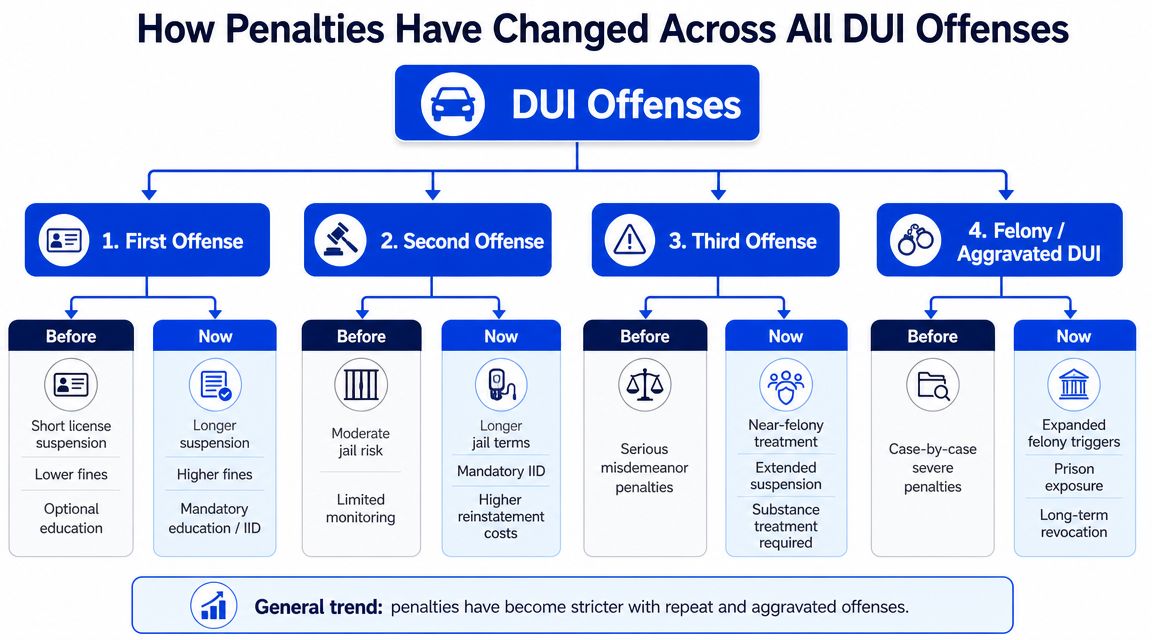
How Penalties Have Changed Across All DUI Offenses
A DUI arrest can start as a straightforward traffic case and turn into a sentencing problem fast. The prosecution may be arguing about jail exposure, mandatory minimums, and enhancement windows at the same time the defense is still litigating whether the stop, arrest, breath result, or refusal evidence should come in at all.
Where the penalty grid gets harsher
As noted in this summary of Florida DUI penalties, a first DUI can carry up to 6 months in jail. That can rise to 9 months if the State alleges a 0.15 or higher breath alcohol level or that a minor was in the vehicle.
The same penalty structure imposes a 10-day mandatory minimum for a second conviction within 5 years and a 30-day mandatory minimum for a third conviction within 10 years.
Here is the practical comparison:
DUI situation | Exposure highlighted in the law |
|---|---|
First DUI | Up to 6 months in jail |
First DUI with BAC 0.15+ or minor present | Up to 9 months in jail |
Second conviction within 5 years | 10-day mandatory minimum |
Third conviction within 10 years | 30-day mandatory minimum |
Those numbers matter, but they do not answer the first strategic question in a real case. The first question is what the State can prove and what evidence can be kept out.
Penalties and defense strategy do not rise at the same pace
A higher statutory maximum does not automatically produce a stronger prosecution. I have seen cases with harsh-looking exposure and weak proof, and cases with modest exposure where the evidence was difficult to beat. Good defense work starts by separating sentencing risk from evidentiary risk.
If the State is claiming high BAC, the defense usually examines the breath test from the ground up. That includes the observation period, machine records, operator compliance, maintenance history, and whether the result is admissible in the first place. If the high-BAC evidence gets limited or excluded, the penalty picture can change with it.
If a minor was allegedly in the vehicle, the issue is narrower but still important. The defense may need to challenge who was present, whether the allegation is supported by admissible evidence, and whether the charging document matches what the State can prove in court.
Repeat allegations require even closer work. In a case involving a second DUI offense in Florida, the dates matter as much as the prior itself. Lawyers often pull certified copies, compare offense dates to conviction dates, and test whether the State is applying the enhancement window correctly. A prior case outside the statutory window can change plea posture, mandatory sentencing exposure, and trial strategy.
The real gap most people miss
The new refusal penalties have drawn attention, but the older DUI enhancement rules still drive much of the danger in court. That creates a two-front defense problem. One front is criminal exposure. The other is suppression and admissibility.
A person can be facing a refusal count, a DUI charge with aggravators, and a repeat-offender enhancement claim all at once. Yet the defense may still have valid arguments that the traffic stop was unlawful, the arrest lacked probable cause, the breath testing process was flawed, or the State cannot properly prove the prior offense the way it claims. Those are separate fights. They should be handled as separate fights.
That is why broad advice about "what a DUI usually brings" often misses the mark. In practice, one qualifying prior, one disputed breath result, or one successful motion to suppress can change the value of the case more than the charging language on page one.
Your License Insurance and Criminal Record The Practical Impact
You get out of jail, call for a ride, and wake up the next morning to a problem that has nothing to do with guilt or innocence. You still need to get to work, pick up your kids, and keep your insurance in place while the criminal case is only beginning.
That is the practical shock in a Florida DUI case. The criminal charge is one fight. Your license, insurance, and record create separate pressure points right away.
What changes first is usually your ability to drive
For many people, the first real penalty is not in the courtroom. It is the loss of driving privileges. That can happen long before a judge decides whether the State can prove DUI or whether the stop, arrest, or chemical test should be thrown out.
Statewide DUI enforcement statistics show tens of thousands of DUI citations and convictions each year in Florida. The point is not the exact percentage. The point is that these cases move through the system every day, and the license consequences start fast.
A suspended license changes everything quickly. It affects work, family obligations, medical appointments, and even your ability to comply with court requirements. If your driving status is already in question, review how to reinstate a suspended Florida license early, because the administrative side does not wait for the criminal case to catch up.
This is also where the strategic gap matters. A person may have a strong suppression issue in the DUI case and still lose valuable time on the license side if nothing is done promptly. Winning a motion months later does not always fix the immediate disruption you are dealing with now.
Insurance usually gets worse before the case is over
Insurance companies do not need to wait for trial strategy to play out. A DUI arrest, a suspension, or a conviction can lead to higher premiums, policy changes, or added filing requirements before the criminal case is resolved.
Clients often focus on fines first. In real life, insurance cost is often the expense that lasts longer.
That is one reason a defense lawyer has to work both tracks at once. One track is reducing or defeating the criminal charge. The other is limiting the collateral damage that keeps growing while the case is pending.
Your record can outlast the sentence
A DUI record can affect hiring, professional licensing, school discipline, housing applications, and background checks. In South Florida, I have seen the main problem become the future paper trail, not just the court date.
Even here, the criminal case and the practical fallout do not always move together. A reduced charge, a dismissed count, or a successful challenge to key evidence can change what ultimately appears on your record. But if the case is handled passively from the start, the damage is harder to contain later.
Three consequences usually matter most:
Driving impact: A license suspension can interfere with work, child care, treatment, and court compliance.
Financial impact: The cost usually extends beyond fines to insurance increases, classes, filing requirements, and missed work.
Record impact: The long-term problem is often what employers, licensing boards, and landlords see after the case ends.
The right question is not just what penalty Florida added to the statute. The right question is how to protect your ability to drive, control the insurance fallout, and keep a bad arrest from becoming a permanent record problem while the defense attacks the stop, the arrest, and the State's proof in court.
What If My DUI Involves Drugs or Prescriptions
A lot of people search the new FL DUI laws after an arrest and assume the issue is alcohol. That's often wrong.
Florida DUI law is not limited to alcohol
Florida's DUI framework includes impairment by drugs, not just alcohol. As discussed in this Florida DUI drug impairment update, the legal BAC thresholds remain 0.08 for most drivers, 0.04 for commercial drivers, and 0.02 for underage drivers, but there is no equivalent per se limit for drugs.
That difference changes everything.
In an alcohol case, the State often wants a clean number. In a drug-related DUI, the State usually has to prove impairment through observations, statements, driving pattern evidence, officer training, and the surrounding circumstances. That can open real defense issues.
Why drug DUI cases are often more technical
Prescription medication cases are a good example. A person may have taken medicine exactly as prescribed and still be accused of DUI if the officer claims the person's normal faculties were impaired. Marijuana cases also create confusion because odor, admissions, appearance, and test requests may all raise separate legal questions.
Important pressure points in these cases often include:
Probable cause for the stop or arrest
Whether the officer confused fatigue, anxiety, or medical conditions with impairment
How the State intends to prove actual impairment
Whether the requested chemical test and advisement fit the facts of the stop
If your case involves pills, cannabis, or a mix of substances, it may also overlap with broader issues handled in Florida drug crime defense matters. The DUI label doesn't erase the need to analyze possession issues, search issues, or statements made during the stop.
Drug DUI cases often look strong on paper because the report uses confident language. That's not the same as reliable proof of impairment.
That's especially true in South Florida cases where roadside observations are doing more work than scientific certainty.
What to Do Now Your First Steps After a South Florida DUI Arrest
At 2 a.m., a South Florida DUI arrest can feel like one problem. By morning, it is usually three. There is the DUI case, there may be a separate refusal allegation with its own consequences under the new law, and there is the license suspension track that starts running before many people understand what was handed to them.
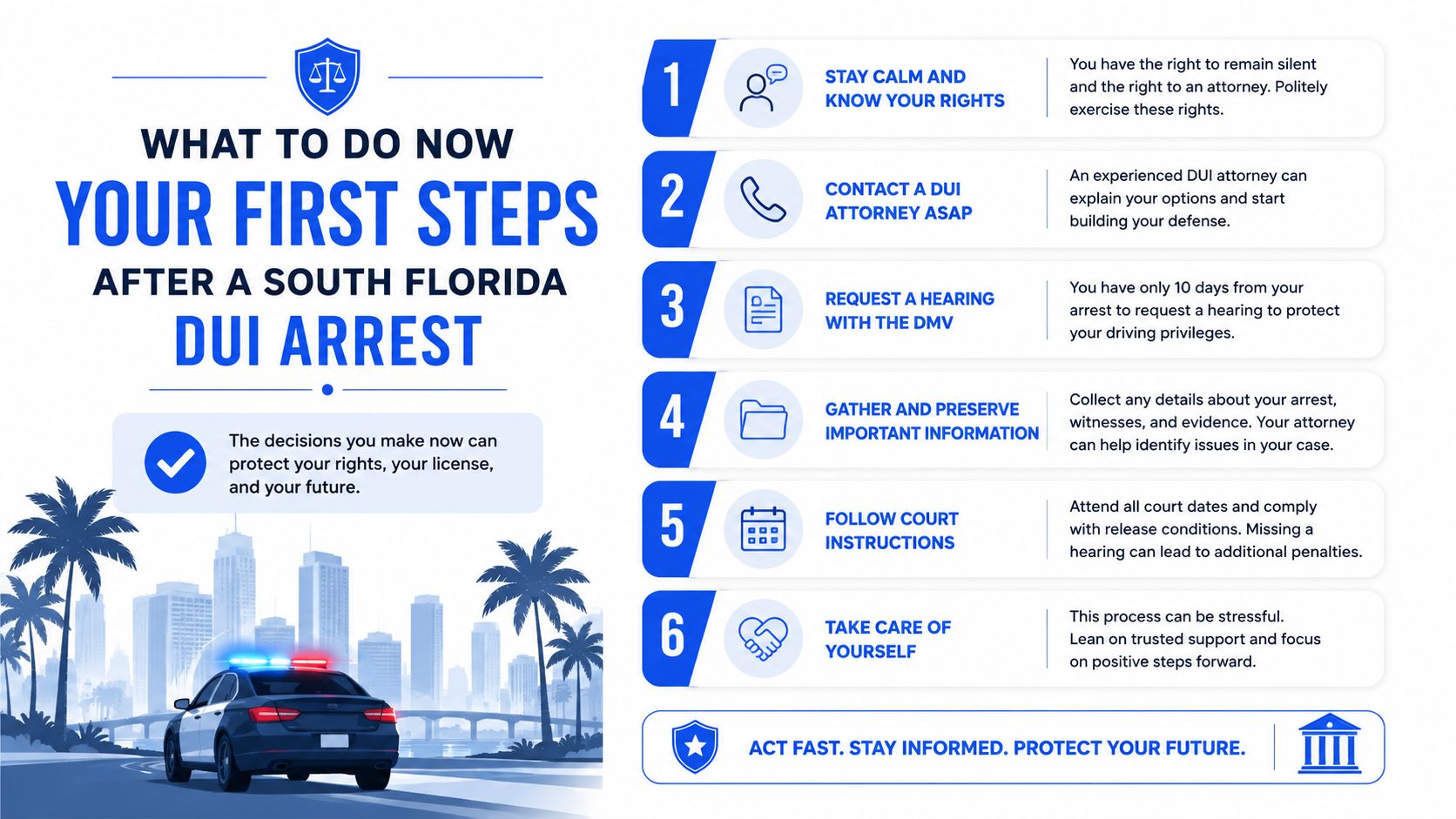
Your immediate checklist
The first steps should serve both fronts of the defense. You are not just collecting paperwork. You are preserving facts that may help fight the DUI itself and, separately, test whether the refusal charge or refusal consequences can be challenged.
Act on the license paperwork immediately. The administrative suspension has its own deadline. Missing that window can limit your options before the criminal case even gets going.
Write down the stop while your memory is fresh. Focus on sequence and wording. What reason did the officer give for the stop? When were you told you were under arrest? What exactly was said before any breath, urine, or blood request? In refusal cases, the warning language and timing matter.
Record the details of any refusal exchange. Note whether you were asked more than once, whether the request changed from breath to urine or blood, whether you asked questions, and whether the officer treated confusion, silence, or hesitation as a refusal. Those facts can matter apart from whether the State can prove DUI.
Preserve timeline evidence. Keep receipts, rideshare records, parking records, text messages, call logs, and phone location data if they help place you before the stop or contradict part of the report.
Identify medical and practical explanations early. Asthma, dental work, reflux, anxiety, injuries, fatigue, and prescribed medication can affect roadside observations and test issues. Get those facts and records in one place now.
Get every document together. The citation, notice of suspension, temporary permit, bond papers, towing paperwork, property receipt, and court date notice all matter. Small inconsistencies between them can matter too.
Do not talk about the case online or by text. Prosecutors and officers do not need your help. Casual messages about drinking, medication, or why you refused can become evidence.
Why early action changes DUI cases
From a defense standpoint, the first question is not just whether you were charged with DUI. The first question is how many separate fights now exist.
A refusal allegation often pushes people into a narrow frame of mind. They start defending the refusal and forget the underlying DUI stop, the basis for the detention, the arrest decision, and the officer's compliance with testing procedures. That is a mistake. A strong defense often works on both tracks at the same time.
One track looks at suppression and proof issues. Was there a valid reason for the stop? Did the officer have legal grounds to extend the encounter? Was there probable cause for arrest? Are the field observations weak, inconsistent, or explained by something other than impairment?
The other track examines the refusal issue on its own facts. What warning was given? Was it complete and understandable? Was the requested test authorized under the circumstances? Did the officer document an actual refusal, or just a delayed or confused response? New criminal exposure for refusal does not erase the need to challenge those details directly.
That gap matters in real cases. I have seen cases where the State talked aggressively about refusal while the stop itself had serious problems. I have also seen the opposite. The stop held up, but the advisement and refusal sequence deserved close examination. Good early defense work does both.
A Florida criminal defense firm such as Ticket Shield, PLLC can review the arrest report, video, testing request, and license paperwork together instead of treating them as unrelated problems. That early review can shape motions, hearing strategy, and how the case is approached from the start.
If you were arrested in Fort Lauderdale, Broward County, Miami-Dade, Palm Beach, or nearby, do not wait for the first court date to get organized. In these new-law cases, delay gives the State a head start on both the DUI prosecution and the refusal narrative.
Florida's DUI laws have changed for 2026. This guide covers the new penalties, license consequences, and what South Florida drivers should do now.