
Suspended License and Insurance in Florida What to Do
Jason Goldsmith, Esq
You open a Florida suspension notice after work and immediately start calculating how you'll get to your job, take your children to school, or make it to court. Then another question appears: If I can't legally drive, do I still need auto insurance?
For most Florida drivers, dropping coverage is not a safe solution. Florida treats insurance as proof of financial responsibility connected to both driving privileges and vehicle registration. When an insurer reports cancellation or nonrenewal, the state can begin a suspension process even if you've stopped driving.
That creates the hidden insurance trap. A suspended license may limit your ability to drive, but it doesn't necessarily eliminate the need for continuous coverage. A lapse can create a separate compliance problem, complicate reinstatement, and require additional proof of insurance.
This issue affects drivers throughout Fort Lauderdale, Broward County, Miami-Dade, Palm Beach, and South Florida. The suspension might arise from uninsured driving, a DUI, an unpaid judgment, an administrative issue, or another traffic-related matter. The cause matters because Florida's reinstatement requirements and insurance consequences aren't identical in every case.
If you're already dealing with a notice, begin by reviewing the Florida driver's license suspension process and identifying the exact reason, effective date, and conditions attached to your suspension.
Table of Contents
How Florida Connects Insurance Compliance and License Status
Why a Suspended License Does Not End Your Insurance Obligation
FR-44 and SR-22 Requirements and How Suspension Causes Change Insurance Impact
Penalties Costs and Legal Options When Facing Suspension in South Florida
Introduction to Suspended License and Insurance in Florida
A suspended license and insurance problem often arrive together, but they're legally distinct issues. Your license concerns your privilege to operate a motor vehicle. Your insurance policy concerns financial protection and, in many situations, the state's requirement that you maintain proof of financial responsibility.
Consider a driver in Broward County who receives a suspension notice after an insurance lapse. The driver parks the car and assumes the problem is over because the vehicle won't be used. Later, the insurer reports the cancellation or nonrenewal, and Florida treats the lapse as a separate compliance event. The driver may now face difficulty proving continuous coverage when seeking reinstatement.
Florida's system connects insurance records to licensing and registration records. The Florida Department of Highway Safety and Motor Vehicles says that failing to maintain required insurance can result in suspension of a driver license or registration, along with a reinstatement fee ranging from $150 to $500. That information appears in the Florida financial-responsibility program report.
The practical point is simple: not driving and not maintaining insurance are different decisions. Even while a vehicle sits in a driveway, coverage may protect against theft or damage. Depending on the vehicle, the insurer, and the reason for suspension, you may also need continuous insurance documentation for reinstatement.
Practical rule: Before canceling a policy, confirm the consequences with your insurer and the Florida DHSMV. A policy change that seems financially sensible can create a second licensing problem.
This guide explains how Florida links insurance and license status, why coverage can still matter during suspension, how FR-44 and SR-22 filings differ, and what documents may help you restore driving privileges. It also addresses the criminal-defense side of the problem, including what to do if the suspension is connected to DUI, uninsured driving, probation, or another charge.
How Florida Connects Insurance Compliance and License Status
Florida's system treats insurance as continuing proof that a driver and vehicle can satisfy financial-responsibility obligations. The policy itself is a private contract with an insurer, but the state also relies on coverage information when deciding whether a person may keep a license or registration.
The process generally works through electronic reporting. An insurer reports cancellation, nonrenewal, or another coverage change. The state then compares that information with the vehicle and driver records. If Florida doesn't receive acceptable proof of replacement coverage, the Department may begin a suspension process.
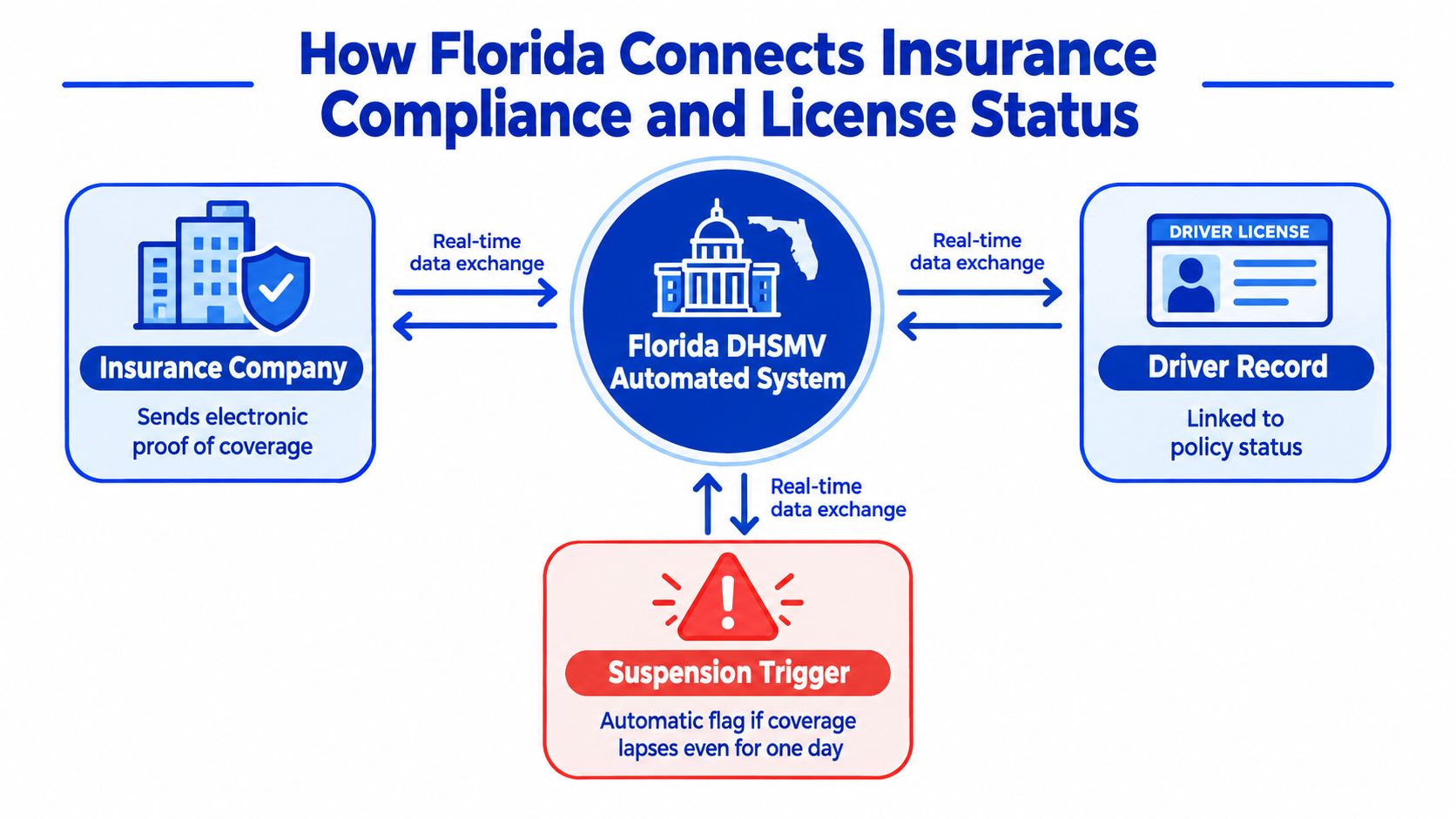
The connection between your policy and your records
A coverage lapse can affect more than the right to drive. Florida may also suspend the vehicle's registration or plate because registration depends on maintaining required insurance. The state's uninsured-motorist program says licenses and registrations can be automatically suspended after notice when the driver doesn't comply within 30 days. That rule is described in the Florida uninsured-motorist program materials.
The insurer's notice date and the actual cancellation date can become important. Florida-focused legal guidance explains that the suspension process may be triggered by the insurer's notice to the state, rather than by the driver's personal decision to stop using the vehicle. That means a driver shouldn't assume that parking the car prevents administrative consequences.
A driver who wants a plain-language explanation of the administrative side can review what an administrative license suspension means in Florida.
Why the state treats a lapse separately
The original violation and the later lapse may involve separate questions. For example, an uninsured-driving allegation might create one legal issue, while a subsequent cancellation can create another insurance-compliance issue. Resolving one doesn't automatically erase the other.
That's why paperwork matters. Keep the suspension notice, policy declarations, cancellation letters, payment records, reinstatement correspondence, and any proof submitted to the DHSMV. If the insurer reported the wrong date or Florida's record doesn't reflect replacement coverage, those documents may help identify the error.
Why a Suspended License Does Not End Your Insurance Obligation
A suspended license limits driving. It doesn't automatically eliminate every risk associated with owning or keeping a vehicle. A parked car can still be stolen, vandalized, damaged by weather, or involved in a loss while someone else operates it with permission.
Coverage also protects against a gap in your insurance history. Some insurers may decline to renew a policy during a suspension, while others may keep coverage active or offer a different product. The right approach depends on the policy language, the vehicle's status, the suspension reason, and Florida's reinstatement requirements.
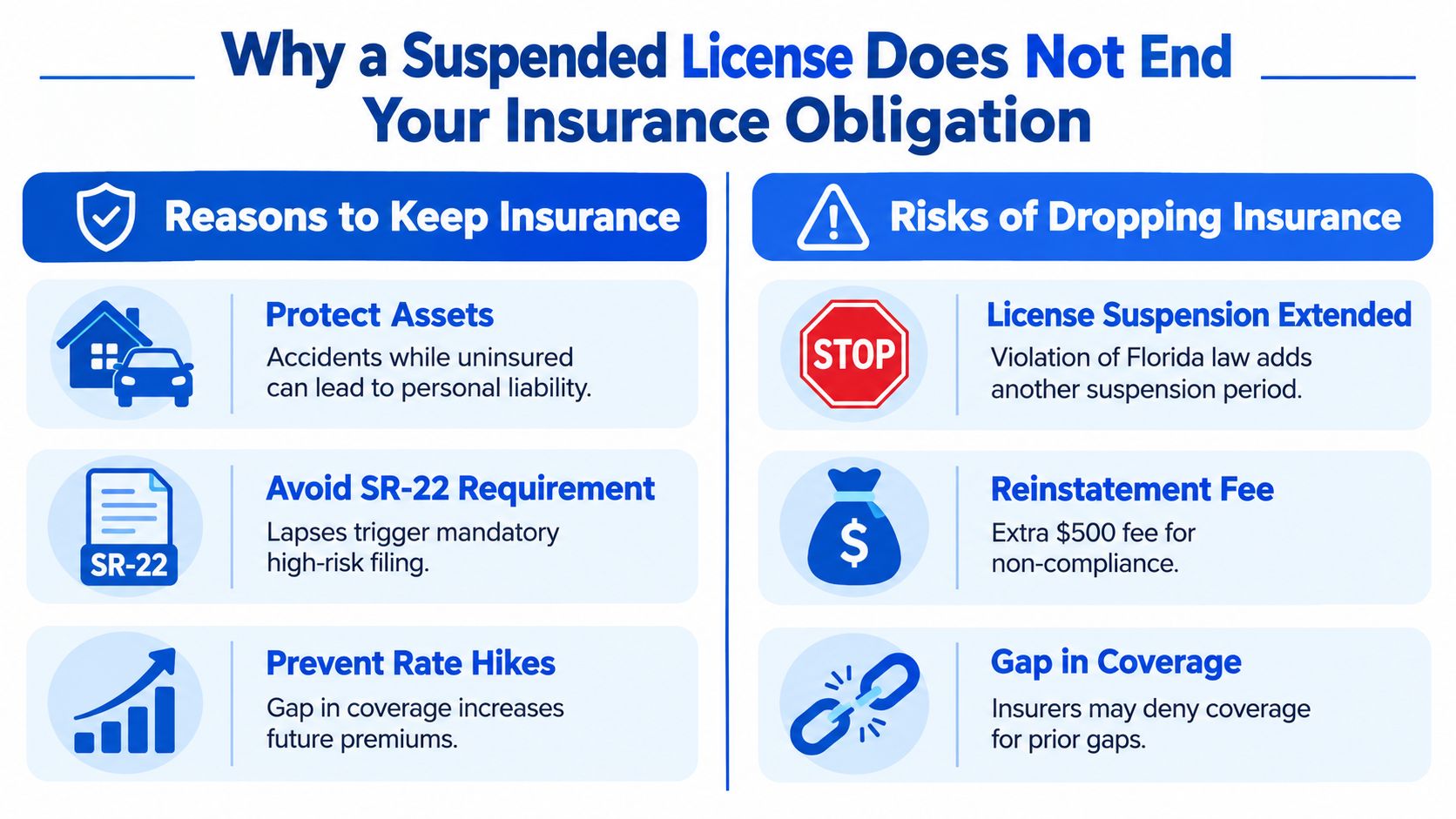
The risks of canceling too quickly
Canceling coverage may appear to save money while you're unable to drive. But that decision can cause several problems:
A second compliance issue: Florida may treat the lapse as a new event affecting your license or registration.
Reinstatement complications: You may need updated proof of liability coverage before the state restores driving privileges.
Loss of parked-vehicle protection: An all-perils policy may cover theft or damage even when the vehicle isn't being driven.
Insurance access problems: A future insurer may ask why coverage ended and whether a continuous filing is required.
Additional financial exposure: If someone drives the vehicle or it causes damage, the absence of coverage can leave you personally responsible.
The Florida-focused explanation of insurance during a suspended license highlights a point many drivers miss. Suspension doesn't necessarily reduce insurance risk. Instead, it can shift risk from ordinary driving exposure to policy-lapse exposure.
A non-owner policy may be relevant for someone who doesn't own a vehicle but needs liability coverage for occasional driving after reinstatement. A parked-vehicle arrangement may be more appropriate for a vehicle that won't be operated. Neither option should be assumed to satisfy Florida's requirements without confirmation from the insurer and DHSMV.
The safest immediate move is to call the carrier, explain the suspension, ask whether the policy can remain active, and request written confirmation of any changes. If an FR-44 or another filing applies, ask the insurer how cancellation, nonrenewal, or a vehicle change could affect that filing.
FR-44 and SR-22 Requirements and How Suspension Causes Change Insurance Impact
Drivers often use “SR-22” as a general term for any high-risk insurance filing. Florida doesn't use that label for many DUI-related reinstatements. Florida commonly requires an FR-44 for those cases, and the filing carries substantially higher liability limits than ordinary minimum coverage.
For many Florida DUI-related reinstatements, the required FR-44 limits are $100,000 for bodily injury per person, $300,000 per accident, and $50,000 for property damage. The filing period is commonly three years, beginning when reinstatement is approved, not when the arrest, conviction, or suspension occurred. These requirements are described in this Florida FR-44 reinstatement guide.
The comparison depends on the cause
Filing or Suspension Type | When Required in Florida | Coverage Limits and Duration | Insurance Impact |
|---|---|---|---|
FR-44 | Often used for DUI-related reinstatement matters | 100/300/50 liability limits, commonly for three years from reinstatement approval | Higher required coverage can make maintaining the policy more expensive and a lapse more consequential |
SR-22 | May apply to certain financial-responsibility or uninsured-driving matters, depending on the jurisdiction and violation | Requirements vary by state; South Carolina requires SR-22 coverage for three years after some uninsured-driving convictions | Continuous proof may be required, and cancellation can delay reinstatement |
Uninsured-driving suspension | Triggered by failure to maintain required coverage or an uninsured-driving conviction | Florida requirements depend on the underlying event and record | The lapse may affect both registration and driving privileges |
Administrative suspension | May follow a licensing or compliance event without the same facts as a DUI conviction | Filing and coverage requirements depend on the order and jurisdiction | Underwriting may treat it differently from a criminal conviction |
Provisional or restricted-license issue | May involve conditions on when or why a person may drive | The driver must follow the specific restrictions | Driving outside the restrictions can create another legal and insurance problem |
The cause matters because insurers and regulators don't treat every suspension alike. DUI, uninsured driving, an administrative error, and a provisional-license violation may appear differently on a driving record and may lead to different filing requirements. Ontario guidance, for example, distinguishes administrative suspensions from suspensions involving criminal convictions, while some U.S. jurisdictions impose their own continuous-coverage rules.
Florida drivers should avoid relying on a generic online answer. Review the order, ask the DHSMV what filing is required, and ask the insurer whether it can file the document electronically and keep it active throughout the required period. For DUI-related cases, a Florida license reinstatement guide after DUI can help identify the separate administrative and criminal issues that may need attention.
Immediate Steps to Take After Your License Is Suspended
A suspension notice should trigger organization, not panic. The first objective is to determine exactly what Florida says happened, when the suspension began, and what must be completed before you drive again.
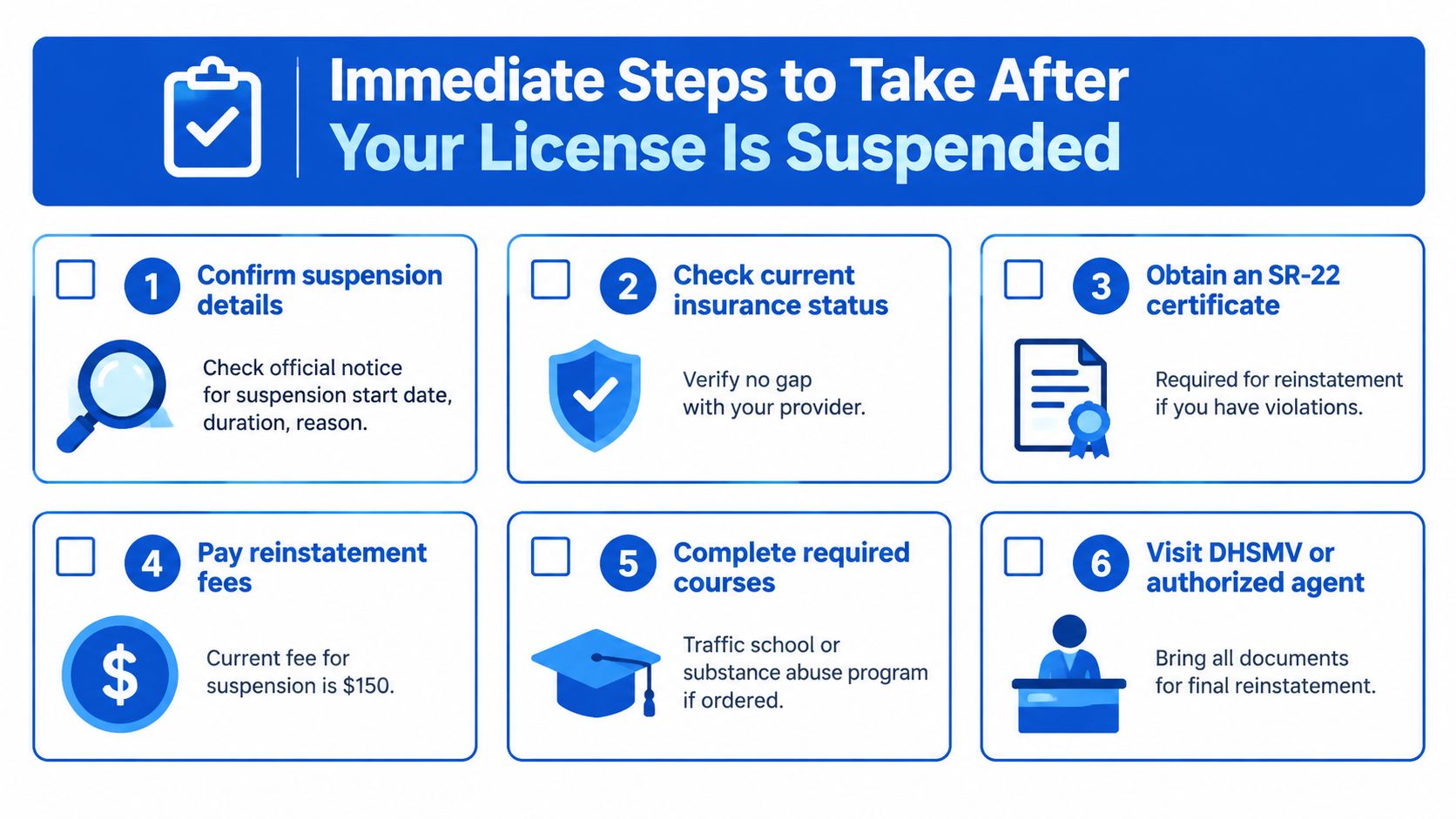
Start with the official record
Use the suspension notice and your DHSMV record as the starting point. Write down the stated reason, effective date, duration, affected license or registration, and any listed reinstatement conditions.
Then collect the documents that can confirm or challenge the record:
Notice and order: Save every page, envelope, attachment, and later correspondence.
Insurance history: Request declarations pages, payment confirmations, cancellation notices, and replacement-policy information.
Court paperwork: Gather citations, charging documents, judgments, probation paperwork, and proof of completed obligations.
Driving record: Obtain the current record so you can compare the state's information with your documents.
Filing information: Ask whether Florida requires an FR-44, SR-22, or another certified proof of financial responsibility.
Don't drive while the suspension is active
Driving before reinstatement can create a new charge and may undermine an argument that you didn't know about the suspension. If you're stopped, don't guess about your status and don't make statements that could be used to establish knowledge. Provide required identification, remain calm, and contact counsel before discussing the underlying facts in detail.
Call your insurer promptly. Ask whether coverage can remain active, whether the vehicle should be removed from ordinary-use status, and whether any filing must stay in place. Get the answers in writing.
If the suspension relates to DUI, uninsured driving, a traffic crime, probation, or another criminal matter, consult a defense attorney early. A Fort Lauderdale or Broward County lawyer can review the stop, notice, service, record accuracy, and any constitutional issues before deadlines pass.
How to Reinstate Your License and Insurance in Florida
Reinstatement is usually a sequence of connected tasks rather than one payment at a counter. The precise requirements depend on the suspension reason, but the process commonly begins with identifying the order and ends only when Florida's records show that the privilege has been restored.
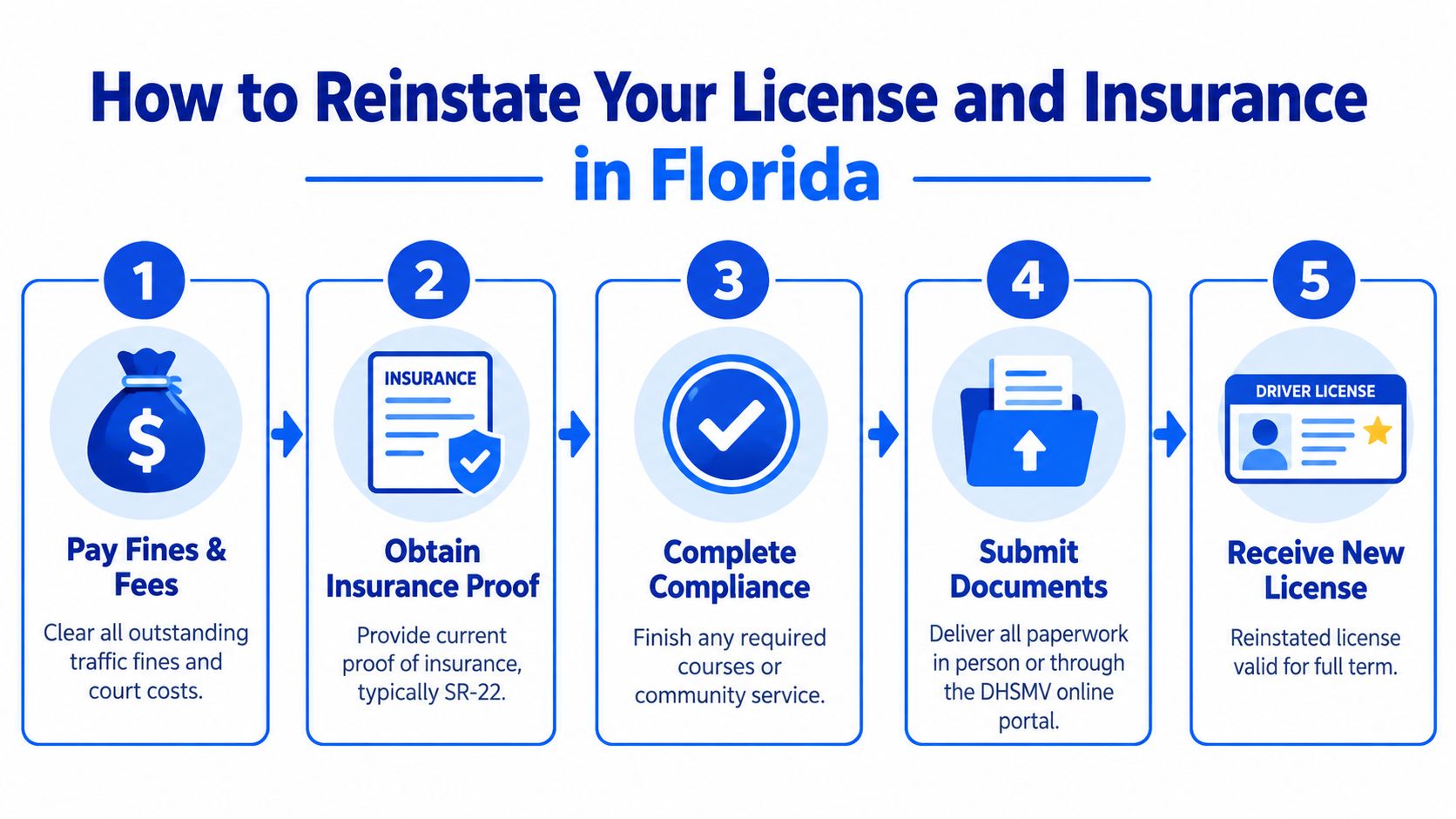
Follow the requirements in the right order
First, maintain or obtain the coverage Florida requires. If the suspension involves a DUI-related FR-44, the insurer must file the correct form and maintain the required limits. A filing isn't the same as ordinary proof of insurance. It's a formal confirmation sent to the state.
Second, resolve the underlying obligation. That may involve a court case, an unpaid judgment, a traffic citation, a required course, or documentation from an insurer. In an uninsured-accident matter, Florida sources report that a license and registration suspension can last up to three years, depending on prior offenses and unpaid judgments. The Florida uninsured-accident explanation discusses why these cases can continue until financial and administrative requirements are satisfied.
Third, pay the applicable reinstatement fee and submit proof through the DHSMV or an authorized service channel. Florida's fee can range from $150 to $500, depending on the circumstance, as described in the Florida financial-responsibility report. Confirm the exact amount for your record instead of assuming that one fee applies to every suspension.
Protect the filing period after approval
An FR-44 period commonly starts when Florida approves reinstatement. That timing matters because a driver might mistakenly count from the arrest or court date. If the policy later cancels or lapses, the insurer may report the change, and Florida can treat the lapse as a new compliance problem.
Keep a reinstatement folder with:
The DHSMV order and current driving record.
Proof of active insurance.
The FR-44 or SR-22 filing confirmation, if required.
Court receipts and satisfaction documents.
Course-completion records.
Payment confirmations and reinstatement correspondence.
The Florida suspended-license reinstatement process can help organize these administrative steps. Don't drive until the state record confirms that your privilege is active, even if you've paid a fee or received a document from an insurer.
Penalties Costs and Legal Options When Facing Suspension in South Florida
The cost of a suspension isn't limited to a ticket. In the United States, a 2026 compilation found that 48 of 51 jurisdictions automatically suspend a driver's license after a first conviction for driving without insurance. Mississippi, Tennessee, and New Hampshire generally reserve suspension for a second offense or court order. The same compilation reports first-offense fine floors from $10 in Wisconsin and $50 in Arkansas and North Carolina, with maximum first-offense penalties reaching $5,000 in Massachusetts and West Virginia. Those figures come from the state-by-state uninsured-driving penalty compilation.
Insurance consequences can continue after the suspension. A 2023 analysis cited by the Fines and Fees Justice Center reported that premiums rise by about $78 per year on average after a license suspension, while a citation for driving on a suspended license can raise premiums by 67% for at least three years. It also found that 75% of licenses suspended in 2016 remained suspended two years later. Those findings appear in the Fines and Fees Justice Center report.
The legal response depends on the underlying facts. Counsel may examine whether the stop was lawful, whether the notice was properly issued, whether the state's record is accurate, whether the driver knew about the suspension, and whether a DUI, drug, theft, domestic-violence, weapons, probation, or other charge requires a broader defense strategy. Depending on eligibility and the facts, counsel may also discuss charge reductions, dismissal arguments, or the cost and considerations involved in suspended-license defense.
If you're facing a suspension in Fort Lauderdale, Broward County, Miami-Dade, Palm Beach, or elsewhere in Florida, Ticket Shield, PLLC offers confidential case evaluation, license-reinstatement guidance, and defense representation focused on protecting your rights and addressing the specific cause of the suspension.
Ticket Shield, PLLC can review your Florida suspension notice, insurance timeline, stop, and reinstatement requirements so you understand what must happen before you drive again. Visit Ticket Shield, PLLC for a confidential consultation and 24/7 guidance throughout Broward County, South Florida, and statewide Florida.