
Habitual Traffic Offender Florida: Fight Your Revocation
Jason Goldsmith, Esq
You open the mailbox or check your email and see a notice from the Florida Department of Highway Safety and Motor Vehicles. It says your license is being revoked, or you're about to be labeled a habitual traffic offender. A common reaction for residents in Broward County, Fort Lauderdale, Miami-Dade, Palm Beach, and across South Florida is the same: panic, confusion, and one immediate question. Can this be fixed?
Sometimes yes. But you need to move fast.
A Habitual Traffic Offender in Florida case is not a routine ticket problem. It can take your license for years and expose you to a felony if you keep driving. I've seen people make the mistake of treating this like a normal suspension. It isn't. The right response depends on where you are in the process, what convictions are on your record, and whether one of those convictions can still be challenged.
Table of Contents
That Letter from the DMV What to Do Now
If DHSMV sent you a notice, don't ignore it and don't assume you can explain it away later in court. By the time that letter arrives, the state usually believes your record already qualifies for revocation or is about to. Waiting makes everything harder.
Start with three steps.
Get your driving record immediately: You need to know exactly which convictions DHSMV is counting.
Stop guessing about your status: A suspended license, revoked license, and HTO designation are not the same problem.
Talk to a lawyer who handles traffic crime consequences: If you also have a pending citation or missed court date, read this guide on a Florida traffic ticket court appearance.
Practical rule: Treat an HTO notice like a criminal emergency, even though the designation itself is administrative.
That's because the notice is often the last warning before your ability to drive legally disappears. If you live in Fort Lauderdale or anywhere in South Florida, that can affect work, child care, probation compliance, and basic daily life almost immediately.
You still may have options. Some people can stop the designation before it becomes final. Others can attack one of the underlying convictions. Others need to focus on lawful reinstatement. The worst move is doing nothing.
What Is a Habitual Traffic Offender in Florida
Florida law creates two separate ways to become a habitual traffic offender. This is not just about racking up one kind of bad ticket. It's a record-based designation imposed through DHSMV.
In Florida, a person is designated a Habitual Traffic Offender if their Department of Highway Safety and Motor Vehicles record shows three or more convictions for specific serious offenses arising from separate acts within a five-year period, including DUI, vehicular manslaughter, driving while license suspended or revoked, or failing to render aid after an accident involving death or injury, as stated in Florida Statute § 322.264.

Two paths to the designation
The first path is the serious-offense route. If your record shows enough qualifying convictions from separate acts within the statutory period, DHSMV can classify you as an HTO.
The second path is the moving-violation route. A driver doesn't need a DUI or a felony to end up here. A long record of point-countable traffic convictions can create the same result.
Why this catches people off guard
Most drivers don't realize HTO is an administrative status, not a new criminal charge by itself. That distinction matters. You won't necessarily be arrested just because DHSMV designates you. But your license can still be revoked, and the next decision you make after that can turn into a felony problem.
A lot of people in Broward County find out only after multiple older cases finally collide on one driving record. They thought each ticket or DWLS case was isolated. It wasn't.
DHSMV looks at your record as a whole. Judges and clerks may have handled each case separately, but the state licensing system adds them together.
If you're researching habitual traffic offender Florida issues because you already have old DUI, DWLS, or traffic cases, assume the record needs a careful review. Small details matter. Separate acts matter. Dates matter. The exact wording of the final disposition matters.
Qualifying Offenses That Lead to an HTO Designation
The biggest mistake I see is people assuming they need three DUIs or three identical charges to become a habitual traffic offender. That's wrong. Florida can use a combination of qualifying convictions.
Under Florida law, a driver becomes an HTO either through qualifying serious convictions or through a high volume of moving violations with assessable points. The law does not require the serious convictions to match. One DUI, one DWLS, and one qualifying motor-vehicle-related felony can be enough if they fall within the statutory window, as explained by The Traffic Stop's discussion of Florida HTO law.
The three conviction path
Here is the cleanest way to think about the serious-offense route.
Offense Category | Florida Statute Reference |
|---|---|
Voluntary or involuntary manslaughter involving a motor vehicle | § 322.264 |
DUI violation | § 316.193 / § 322.264 |
Any felony in which a motor vehicle is used | § 322.264 |
Driving while license suspended or revoked | § 322.264 |
Failing to stop and render aid at an accident involving death or injury | § 322.264 |
Driving a disqualified commercial vehicle | § 322.264 |
A few practical points matter here:
Separate acts are required: Multiple counts from one incident don't automatically function like separate events.
Mixed offenses count: The state can combine different offense types.
Old pleas still matter: Many people forget how a prior plea was entered until DHSMV uses it years later.
If one of those convictions is DUI-related, this overview of penalties for DUI in Florida helps explain why one traffic case can create much larger consequences.
The fifteen moving violation path
This route surprises careful people who don't see themselves as criminals. You can become an HTO through fifteen convictions for moving traffic offenses where points are assessed within the same five-year period.
That means the state is not only targeting dramatic offenses. It is also targeting repeated moving violations that show a sustained pattern on the record.
A habitual traffic offender case often starts as a paperwork problem. Then it turns into a mobility problem. Then, if ignored, it becomes a felony exposure problem.
If you've had years of speeding, careless driving, failure-to-yield, or similar traffic cases, don't assume they're harmless because none of them seemed major alone. DHSMV doesn't view them one by one. It totals them.
The Severe Consequences of an HTO Revocation
Many people underestimate the danger. An HTO revocation has two layers. First, you lose your driving privilege. Then, if you drive anyway, you can face a serious criminal charge.
The administrative penalty
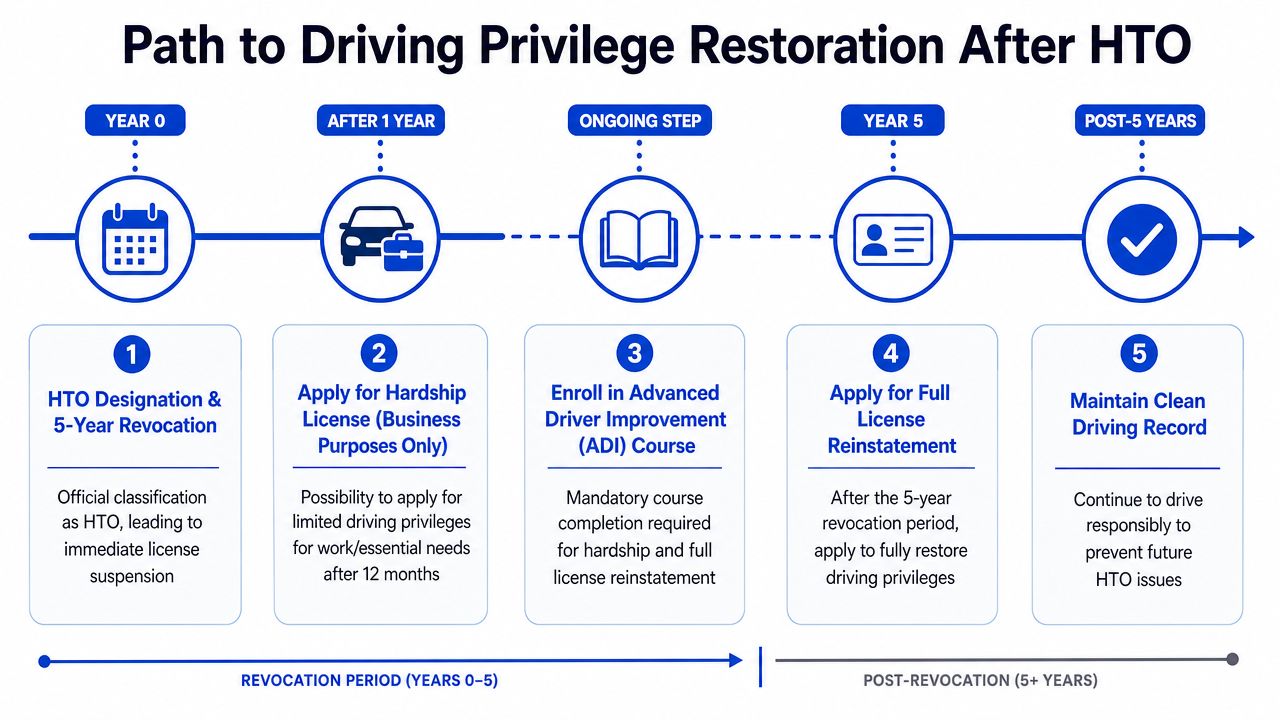
Florida imposes a mandatory five-year revocation once DHSMV validates the designation. The revocation begins immediately, and it is not treated like the ordinary suspension issues many drivers have seen before.
A lot of online advice blurs together suspension, revocation, hardship relief, and reinstatement. That confusion hurts people. An HTO revocation is stricter, and you need to assume the state will enforce it as written.
For many South Florida residents, this has real consequences long before any courtroom appearance. Commuting to work in Fort Lauderdale, taking a child to school in Broward County, or attending required appointments in Miami-Dade becomes a legal risk if you don't have valid driving privileges.
The felony risk if you keep driving
The second layer is worse. If you drive after the HTO revocation, the case can move from an administrative licensing issue into felony territory.
Driving with a revoked license after HTO designation is a third-degree felony under § 322.34(5), punishable by up to five years in prison and $5,000 in fines, as described in this discussion of Florida HTO felony exposure.
That means a routine stop for driving to work can end with handcuffs, formal charges, bond conditions, court appearances, and a permanent criminal record risk.
The old cases don't disappear: The state still uses the record that triggered the HTO.
A new arrest changes the stakes: What used to be traffic-related can become a felony defense case.
Judges take notice: A person driving after revocation often looks like someone ignoring court and DHSMV orders, even when the background is more complicated.
If police have already cited or arrested you for driving while revoked as an HTO, stop driving and get legal advice immediately. At that point, you are defending more than your license. You are defending your freedom, record, and future employment.
Proactive Defenses to Avoid an HTO Status
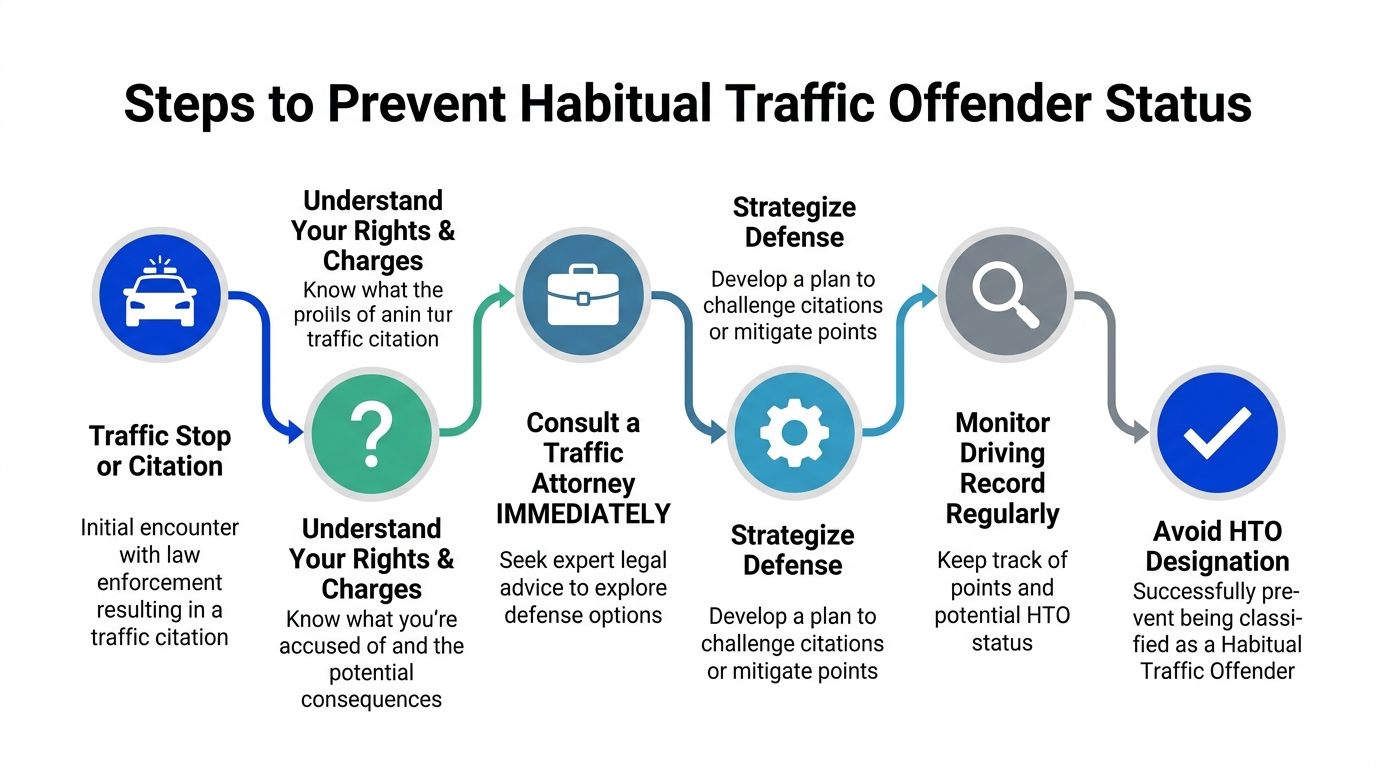
You do not beat an HTO case by waiting for the revocation to start and hoping to fix it later. The best chance to stop this problem is before DHSMV finalizes the designation, while there is still room to challenge the record it is using against you.
For many drivers, the fight is not with the HTO letter itself. It is with the underlying conviction that gave DHSMV the last case it needed.
Why the thirty day period matters
A driver pleads to what looks like a routine traffic case, pays the fine, and moves on. A few weeks later, DHSMV treats that conviction as the final trigger for HTO status. By then, the deadline to attack the case may already be closing.
That is the mistake I see too often.
If your last qualifying conviction is recent, the first 30 days matter more than anything else. That is often the window to file the right challenge, correct the record, or stop a bad conviction from becoming the foundation of a five-year revocation. Many articles skip this and jump straight to life after revocation. That advice misses the best opportunity to avoid the designation in the first place.
The practical rule is simple: do not stare at the HTO notice alone. Examine the conviction that completed the count.
What a defense lawyer should examine right away
A serious HTO review starts with the driver record, the court files, and the timeline. You need to know exactly what DHSMV is counting, whether those cases qualify, and whether one of them can still be attacked before the designation hardens into place.
Common defense angles include:
Challenging the final conviction: If the last qualifying case is withdrawn, vacated, or amended to a non-qualifying offense, the HTO basis can collapse.
Reviewing the plea and notice process: A plea entered without proper advisements or with another legal defect may be open to attack.
Checking for DHSMV errors: Duplicate entries, wrong dispositions, and misclassified offenses happen more than they should.
Testing whether the offense qualifies: DHSMV does not get to label every traffic case as HTO-countable. The statute controls.
Comparing dates carefully: Timing matters. A conviction outside the statutory period may not count the way the agency claims.
This is detailed work. Small record errors can decide the entire case.
If your license is already suspended for another reason while you are trying to stop an HTO designation, review the steps for reinstating a suspended Florida license so you do not miss a separate problem that keeps you off the road even if the HTO issue is fixed.
Act before the agency finishes the job
Once DHSMV locks in the HTO revocation, your options shrink and the process gets harder. You may still have ways to challenge the designation or seek limited relief later, but preventing the status is better than trying to undo it after the fact.
Get the driving record. Pull the court files. Have a lawyer review the last qualifying case immediately.
Waiting to see what happens is how a traffic problem turns into years without lawful driving.
Restoring Your Driving Privileges After an HTO
A lot of people believe an HTO means no relief of any kind for five full years. That isn't accurate. Florida law may allow some drivers to petition for limited reinstatement before the full revocation period ends.
That doesn't mean approval is automatic. It means hopelessness is the wrong assumption.
You may have an option after twelve months
Florida Statute 322.271(1)(b) allows petitioning DHSMV for reinstatement after twelve months, and over 45% of eligible HTO petitions filed after 12 months are approved, while only 12% of drivers attempt the process due to misinformation.
That matters because many people are told to sit and wait for the entire revocation period. In practice, some drivers can seek a business-purpose-only license after serving the required time.
Here's the video explanation many drivers find helpful before they start the process:
Practical steps before you file
A petition is not just a form with your name on it. Prepare it like it matters, because it does.
Confirm eligibility first: Make sure the twelve-month period has run and identify any holds, unpaid obligations, or disqualifying issues.
Complete required courses: Advanced Driver Improvement is commonly part of the path toward relief.
Build a clean record during revocation: New driving cases can ruin your chances.
Document your need to drive: Work obligations, treatment, school, and family responsibilities can all matter in showing why relief should be granted.
If you're already trying to figure out the broader process, this guide on how to reinstate a suspended license in Florida is a useful starting point for understanding the state's licensing procedures.
Bottom line: Don't assume five years means five years with no lawful driving option. In some HTO cases, the real question is whether you qualify to petition after one year and whether the petition is prepared correctly.
How Our Former Prosecutor Fights HTO Allegations
An HTO case can turn on one bad plea from years ago, one clerical error on your record, or one notice you did not act on fast enough. That is why these cases demand a lawyer who knows how the state built the file and how to take it apart.

Jason S. Goldsmith reviews HTO allegations the way a former prosecutor should. He starts with the paper trail. He checks the driving record, the qualifying offenses, the dates, the plea documents, and the court dispositions to see whether DHSMV counted the case correctly and whether one of the underlying convictions can still be challenged.
That timing matters. In many cases, the best chance to stop an HTO designation is before it hardens into a five-year revocation. The often-missed issue is the short window to attack an underlying conviction before the administrative consequences are fully locked in. Waiting usually makes everything harder.
If the case has already turned into a charge for driving while license revoked as a habitual offender, the defense has to work on two tracks at once. One track is the current criminal case. The other is the foundation beneath it. If the stop was unlawful or the evidence was obtained improperly, a motion to suppress evidence in Florida criminal cases may be part of the strategy. If the underlying HTO record is flawed, that issue needs immediate attention too.
This is not a paperwork exercise. It is a record attack, a timing problem, and sometimes a courtroom fight all at once.
For clients in Fort Lauderdale, Broward County, Palm Beach, Miami-Dade, and throughout Florida, that approach gives you a real path forward. First, find out whether the designation can still be prevented. Second, if it is already in place, find out whether the state can prove the new charge and whether you may qualify for relief far sooner than five years.
Frequently Asked Questions About Florida HTO Laws
Can an out of state conviction make me an HTO in Florida
It can, depending on how the conviction appears on your Florida driving record and whether it is treated as a qualifying offense or countable moving violation. The answer usually turns on record classification and documentation. Never assume an out-of-state case is irrelevant just because it happened elsewhere.
What happens to my CDL if I am designated an HTO
Commercial drivers usually face harsher practical fallout because the job itself depends on lawful driving privileges. An HTO problem can affect your ability to maintain or use a commercial license, and any motor-vehicle-related criminal exposure can make that worse. If you hold a CDL, get your record reviewed immediately before making any employment or licensing assumptions.
Can the five year revocation be reduced
Not in the way many people hope. The revocation itself is mandatory once the HTO designation is in place. The better questions are whether the designation can be prevented in the first place, whether one of the underlying convictions can be removed, or whether you qualify to petition for limited driving privileges after the required waiting period.
Is an HTO designation the same as a criminal conviction
No. The designation itself is an administrative status based on your record. But it can lead directly to criminal charges if you drive after revocation. That distinction confuses a lot of people, and it's one reason HTO cases are so dangerous. They start in the licensing system and can end in criminal court.
Can I still fight an old conviction that is being used against me
Sometimes, yes. That depends on the type of conviction, how the plea was entered, what the court record shows, and whether a valid legal basis exists to reopen or challenge it. These are technical fights. Generic internet advice won't help much here. You need the actual dockets, dispositions, and transcript history reviewed.
Is an HTO case related only to traffic law
No. It often overlaps with broader criminal defense issues. DUI, probation concerns, prior plea consequences, and search and seizure problems can all matter. That's why many firms that handle Florida domestic violence defense, theft crime penalties in Florida, Florida gun charge defense, record sealing in Florida, and probation violations also handle serious traffic crime matters. The legal skill set is the same where it counts. Protect the record, challenge the state's proof, and prevent a manageable problem from turning into a felony.
If you received an HTO notice or you've been charged with driving while revoked as a habitual traffic offender, contact Ticket Shield, PLLC for a confidential consultation. The firm serves Broward County, Fort Lauderdale, Miami-Dade, Palm Beach, and clients statewide across Florida. Early action matters in these cases, especially when a prior conviction may still be challenged or limited reinstatement may be available.
A habitual traffic offender designation brings a five-year revocation. Learn how to fight HTO status and restore your Florida license.