Marchman Act Florida: A Family Guide to Involuntary
Jason Goldsmith, Esq
Your loved one has stopped answering texts, the house feels tense, and every conversation turns into a fight about rehab, bills, or what happened last night. You're trying to help, but you also need to know what Florida law can do, what it can't do, and whether a court order will really lead to treatment or just more delay.
That's where the Marchman Act comes in. In Florida, it gives families a civil court path to seek involuntary assessment, stabilization, and treatment for a person whose substance use has made them unable to make safe decisions for themselves. It's not a criminal charge, and it doesn't create a criminal record, but it is a serious legal process with deadlines, evidence rules, and practical limits that families should understand before they file.
Table of Contents
What the Marchman Act Is and Why Florida Families Use It
A Florida family usually reaches for the Marchman Act after the same painful pattern repeats. The person refuses help, promises to stop, then keeps using in ways that put work, housing, relationships, or physical safety at risk. At that point, a family often needs more than encouragement, they need a legal framework that lets a court intervene when addiction has taken away the person's ability to choose safely.
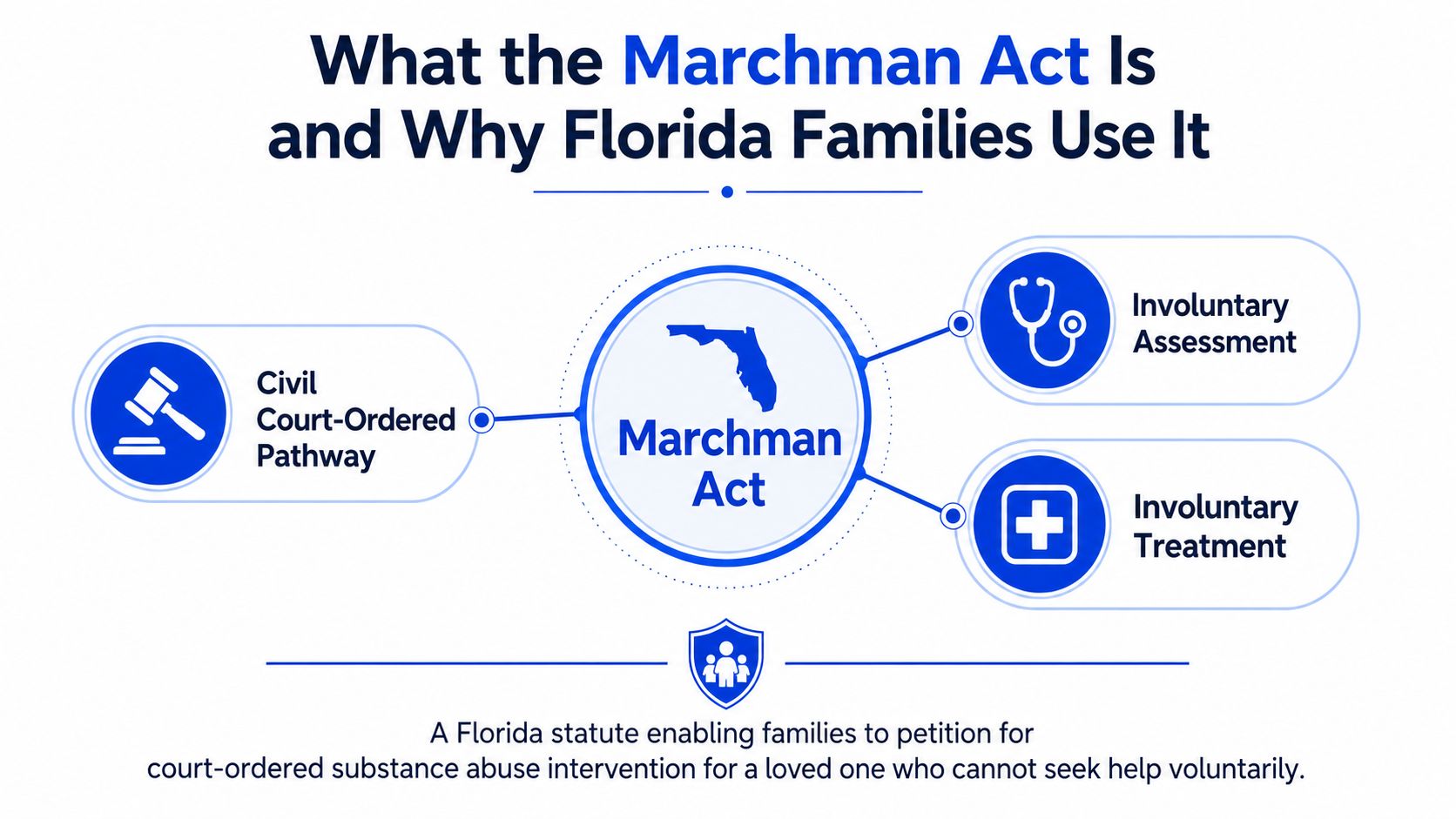
The Hal S. Marchman Alcohol and Other Drug Services Act of 1993 is Florida's civil commitment law for substance use disorders, codified in Chapter 397 of the Florida Statutes. It authorizes involuntary or voluntary assessment, stabilization, and treatment for people impaired by substance use. The law is a court process, not a punishment, and it sits beside Florida's voluntary treatment system rather than replacing it.
Civil intervention, not a criminal case
That distinction matters. A Marchman Act filing doesn't accuse someone of a crime, and it doesn't put them in the criminal justice system just because a petition was filed. Families often confuse it with arrest because law enforcement can be involved in carrying out an emergency order, but the legal purpose is treatment, not prosecution.
Practical rule: If the issue is addiction and the person can't reliably make safe decisions because of substance use, the Marchman Act may fit. If the issue is a criminal arrest, DUI, drug possession, or another charge, that's a different legal problem that needs a criminal defense response.
Florida families use this statute when voluntary help has failed or when the person is so impaired that voluntary help isn't realistic anymore. The core question is whether the person can recognize the need for care and act on it safely. If the answer is no, the Marchman Act may provide the structure a family needs to move from chaos to evaluation and treatment.
The Legal Criteria a Petitioner Must Prove
Florida courts don't grant a Marchman Act petition just because a family is worried. The petitioner has to present good-faith evidence that the person meets the legal standard, and Florida DCF materials make clear that mere refusal of treatment alone is not enough. The court is looking for a stronger link between substance impairment and real-world inability to make safe decisions.
The three-part showing Florida expects
The petition has to show three things in substance, even if the facts are written in plain language. First, the person must be substance-abuse impaired. Second, the person must have lost self-control over substance use. Third, because of that impairment, the person must be unable to appreciate the need for services or be likely to suffer neglect or substantial harm without intervention.
Here's a simple way to think about it. Saying “my son drinks too much” is not the same as proving legal impairment. Showing repeated intoxication, failed attempts to stop, and unsafe behavior that follows from use gives the court a much clearer picture.
What makes a petition stronger
Family members usually strengthen a filing with concrete observations rather than broad fears. Helpful materials often include:
Incident logs that show dates, behavior, and what happened after substance use.
Medical records that reflect overdose, intoxication, withdrawal, or substance-related injury.
Texts, voicemails, or emails that document repeated promises, relapses, or denial.
Witness accounts from people who personally saw the impairment and its effects.
A bare allegation that someone “needs rehab” usually won't carry much weight. A timeline showing lost consciousness, missed work, unsafe driving, or inability to care for themselves creates a much stronger factual basis. Courts want to see why the person can't safely choose treatment on their own, not just why the family is frustrated.
The filing should read like evidence, not emotion. Emotion is why a family reaches this point, but evidence is what gets a judge's attention.
Who Can File a Petition and How the Process Starts
Florida doesn't limit Marchman Act petitions to doctors or police. The law allows specific qualifying petitioners, including a spouse, relative, guardian, licensed practitioner, or service-provider representative, and in some descriptions three adults with personal knowledge of the person's substance use. For minors, Florida court materials also recognize parents, legal guardians, custodians, and certain providers as eligible petitioners.
That broad standing is one reason the statute is used by families, not just professionals. If you live in Broward County, Fort Lauderdale, Miami-Dade, Palm Beach, or another South Florida county, the first practical step is usually to determine the correct county clerk, then follow that county's filing instructions and packet requirements. Local court procedures matter because Marchman Act filings are handled through the courts, and each clerk's workflow can affect how quickly the petition gets in front of a judge.
What to gather before filing
A petition is stronger when it includes more than a story about addiction. Families should try to organize:
A short chronology of recent incidents.
Names of witnesses who saw the behavior firsthand.
Any treatment history showing prior attempts that failed.
Records of relapse, overdose, or dangerous conduct tied to substance use.
The goal is to give the court a clean factual record. Judges don't need a perfect case, but they do need enough detail to see the legal criteria in the petition, not just a plea for help.
If the person is a minor, the filing posture can be different, and the family should be careful not to assume adult rules automatically apply. If the person is an adult, the petitioner still needs personal knowledge, a factual basis, and a clear explanation of why less formal options haven't worked. That's the part many people miss. A petition is not just a form, it's a sworn request for court intervention.
The Step-by-Step Timeline From Petition to Treatment
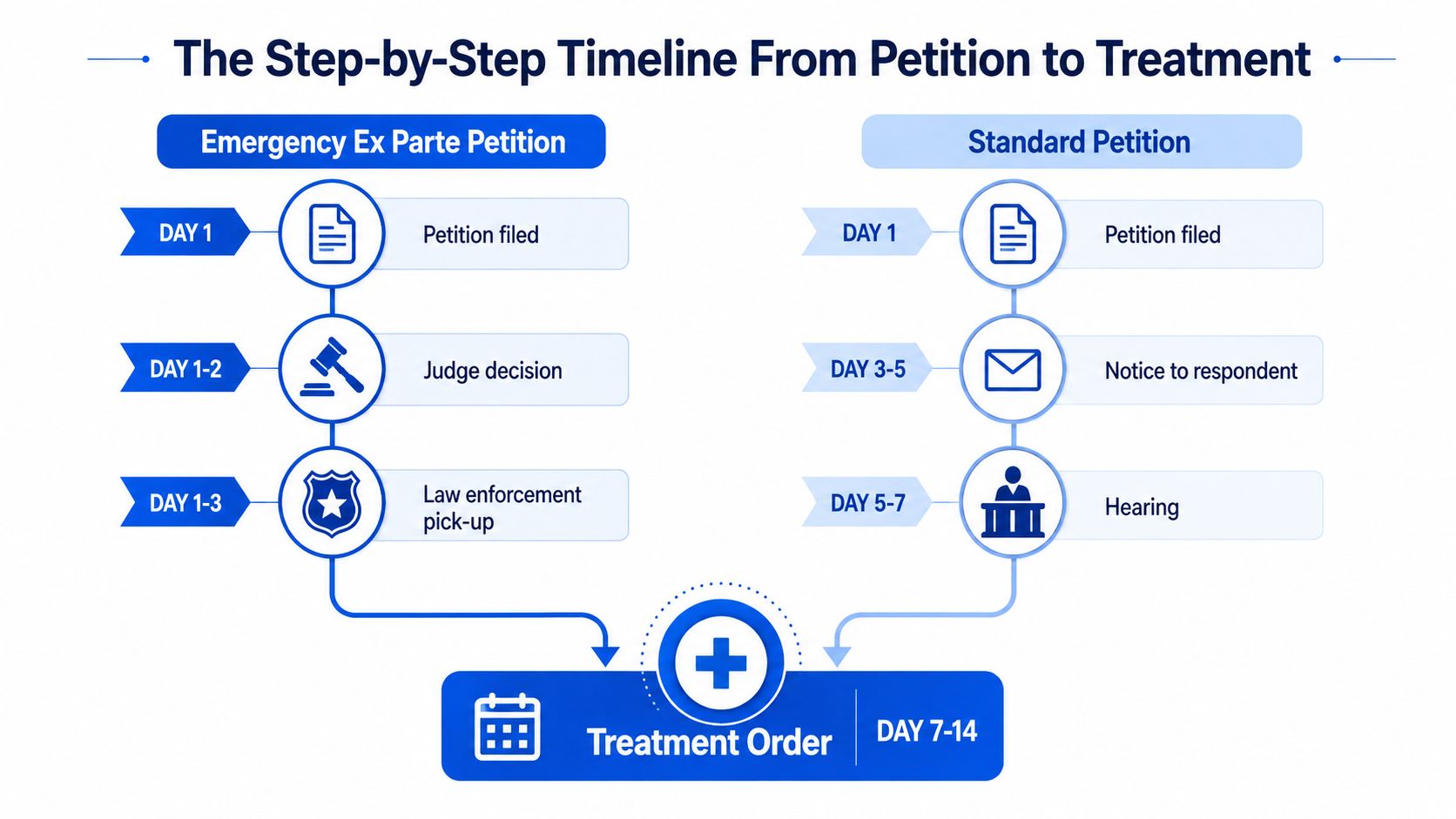
The Marchman Act moves on two tracks, emergency and non-emergency. That difference shapes everything about timing, law enforcement involvement, and how quickly a family might see a person brought to a licensed facility.
Emergency ex parte cases
If a judge finds emergency circumstances, an ex parte order can authorize law enforcement to take the respondent to a licensed facility for assessment and stabilization for up to 72 hours. That short window is meant to address immediate risk, not long-term recovery. The point is to interrupt a dangerous situation quickly enough to get an evaluation and stabilize the person.
Standard petitions
If the case is not an emergency, the petition must be set for hearing within 10 days. That hearing gives the court a chance to review the evidence, hear from the petitioner, and decide whether the legal standard is met. If the judge grants involuntary treatment, the resulting order may run up to 90 days.
Florida drug court procedures and related treatment pathways often get discussed alongside addiction cases, but the Marchman Act is its own process with its own deadlines and proof requirements.
Why the timeline matters
The Act separates short-term stabilization from longer treatment authority. That means a family may get an emergency order quickly, but that doesn't automatically mean the person is staying in treatment for months. It also means the hearing date and facility coordination are not small details, they're the center of the case.
A family should plan for two questions at once, how fast can the court act, and what happens after the person is taken into custody? The answer to the first question can be very fast in an emergency case. The answer to the second depends on what the facility can do.
Marchman Act vs Baker Act and What Each Law Covers
Families often search both laws on the same night, and the confusion is understandable. The Marchman Act is for substance use impairment. The Baker Act is for a mental health crisis. They can overlap in real life, but they are not interchangeable.
The basic difference
The Marchman Act focuses on whether a person's substance use has taken away the ability to make safe, rational choices about care. The Baker Act focuses on mental illness and the immediate need for psychiatric intervention. If someone is intoxicated, withdrawing, or trapped in addiction without a primary psychiatric emergency, the Marchman Act is usually the more direct fit.
Florida mental health court procedures become relevant when the concern is psychiatric illness rather than substance use, which is why families should separate the two issues before choosing a petition path.
When the two can overlap
Some people have both addiction and a serious mental health condition. In those cases, professionals and courts look at what is driving the immediate risk. If the person is suicidal, psychotic, or presenting a psychiatric danger, the Baker Act may come first. If the addiction itself is the main reason the person can't function safely, the Marchman Act may be the better tool.
Florida's materials and court guidance make this distinction operational, not theoretical. A family can waste valuable time if it picks the wrong statute and starts over later. The better approach is to identify the main problem, then use the law that matches that problem.
Short version: substance use crisis points to Marchman. Mental health crisis points to Baker. When both exist, the facts decide which one controls first.
Why a Signed Order Is Not the Same as Treatment
This is the part most guides skip. A judge can sign a Marchman Act order, and the family can still hit a wall the next day. Treatment depends on licensed facility capacity, and some guidance even tells petitioners to contact a facility first to confirm bed availability before filing, which tells you something important. The court order is one step in the path, not a guarantee that a bed is waiting.
That's why the system can feel frustrating even when the family does everything right. Florida court and agency materials show that the process depends on local filing steps, hearing scheduling, and treatment-facility coordination. If one part breaks down, the order doesn't magically solve the logistics.
Why early review matters
The USF annual report estimated 10,226 Marchman Act court cases statewide for FY 2023 to 2024, up from 6,092 estimated cases in FY 2022 to 2023, a year-over-year increase of about 67.9% in the report's estimates. In that same report, 4,780 cases were dismissed before hearing, which was 46.74% of the total. Those numbers show that courts are sorting weak cases early and that filing quality matters before anyone gets to the treatment stage. USF's annual Marchman Act report
Families in Miami-Dade and Broward see especially heavy use of the statute. The report identified 1,102 cases filed in Miami-Dade County and 1,047 in Broward County, together more than 2,100 filings, or about 21% of the statewide estimated total. That concentration is a reminder that this isn't a rare emergency tool tucked away in the statute books, it's a process that gets used often in Florida's biggest markets. Florida Marchman Act statewide reporting
The practical lesson is simple. A signed order is important, but it's not the same thing as a staffed bed, a clinician ready to accept the person, or an admission. Families who understand that reality make fewer assumptions and are less likely to feel blindsided when logistics slow the process down.
Defending Against a Petition and When to Call an Attorney
A Marchman Act petition still gives the respondent rights. They can have counsel, they can get a hearing, and they can challenge whether the evidence meets the statute. That matters because some petitions are strong and some are thin, rushed, or filed in the middle of a family conflict instead of a true treatment crisis.
Signs the petition may be weak
Certain warning signs show up often in contested cases:
The petition relies on rumors instead of first-hand observations.
The facts describe dislike or conflict but not substance-induced impairment.
The filing ignores timing and doesn't show current risk.
The petitioner can't explain why voluntary options failed.
If the petition is weak, the respondent may be able to argue that the court shouldn't enter an involuntary order. A family may still want help, but the legal threshold has to be met with evidence, not resentment.
When a criminal defense lawyer should get involved
The moment there are concurrent criminal charges, the stakes rise. Statements made in a Marchman Act case can create problems elsewhere if someone is also facing DUI, drug possession, probation violations, or related criminal exposure. A person who is worried about jail, license suspension, or a pending case needs advice that looks at the whole picture, not just the addiction petition.
Drug crime defense in Florida can become relevant very quickly if the same facts are being used in both a civil intervention case and a criminal matter. That's when an attorney's job is to protect rights, examine the evidence, and make sure one process isn't creating avoidable damage in another.
The key point is this. Marchman Act cases are civil, but they don't happen in a vacuum. If there's a chance the petition is retaliatory, procedurally flawed, or connected to criminal exposure, legal help is no longer optional.
Practical Next Steps and How Ticket Shield Can Help
Start with the facts you already have. Pull together incident notes, texts, discharge paperwork, and any records showing how substance use has affected safety or decision-making. Then call a treatment facility to ask whether a bed may be available, check the correct county filing process, and decide whether your situation calls for an emergency ex parte request or a standard hearing within the 10-day window.
If you're in Fort Lauderdale, Broward County, Miami-Dade, Palm Beach, or elsewhere in South Florida, don't wait until the situation escalates to sort out the legal pieces. The Marchman Act is a civil tool with real limits, and getting the filing right the first time can make the difference between a usable order and a stalled case. If you're also dealing with criminal exposure, probation, or a pending arrest, the strategy needs to account for that immediately.
You can use this secure case submission form to start the conversation and get help deciding what makes sense for your family.
If you're facing a Marchman Act issue alongside a DUI, drug charge, or other Florida criminal matter, Ticket Shield, PLLC can help you sort out the legal risks before they get bigger. Visit Ticket Shield, PLLC for a confidential consultation, and get clear guidance from a Florida defense team that knows how to protect your rights when the situation is urgent.