
Drug Field Test Kit Reliability in Florida Defense
Jason Goldsmith, Esq
You're in a bad spot, and you already know it. A bag, a pill, a residue, or a white powder got tested on the side of the road, at booking, or in a jail hallway, and an officer told you it "came back positive." In Florida, that kind of result can drive a charge fast, but a positive field test is not proof of what the substance was. It is a screening result, and if the State wants a conviction, that's where the fight starts.
Table of Contents
What a Field Drug Test Actually Does
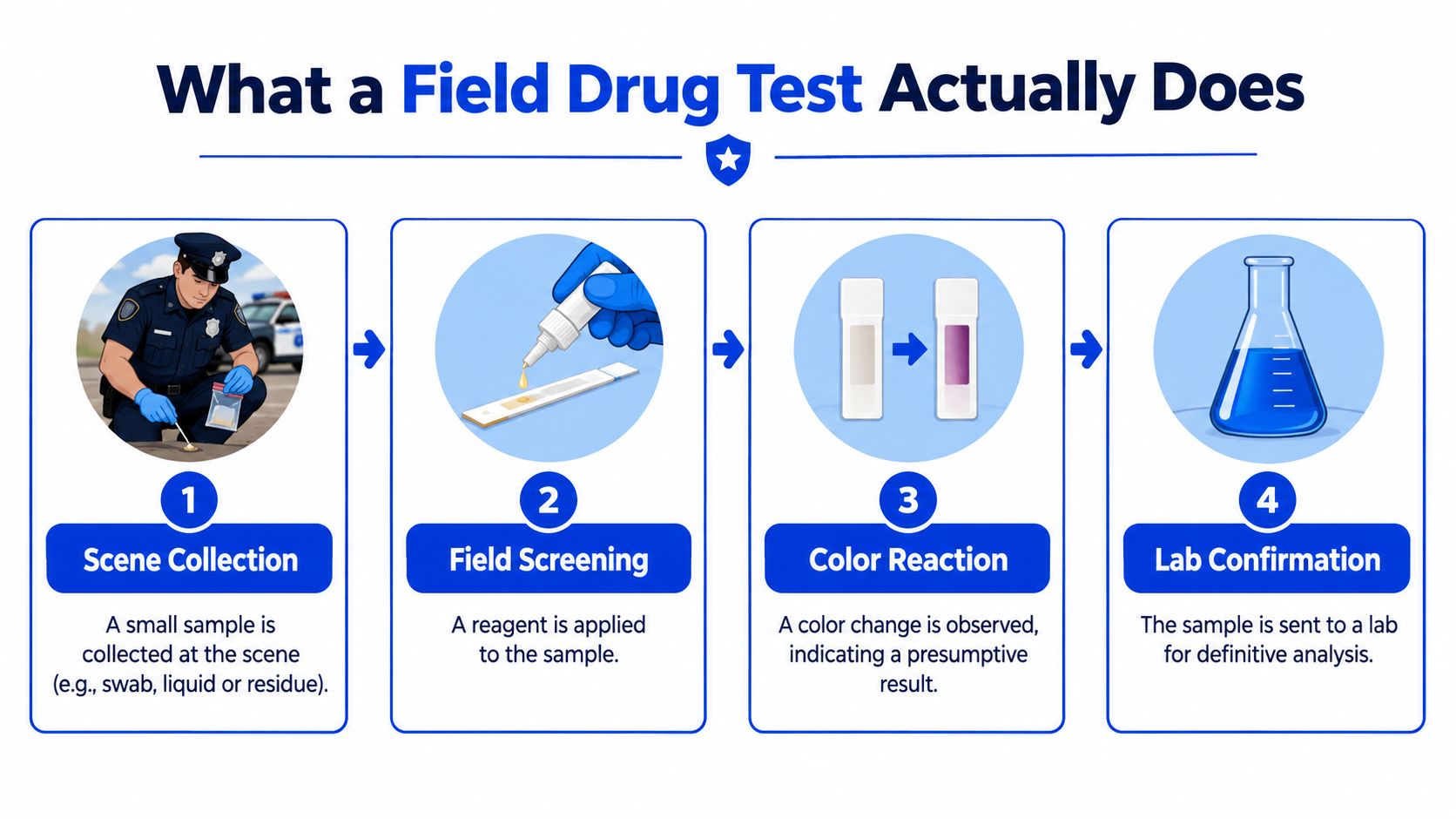
A South Florida stop can turn serious in a minute. An officer finds a small amount of powder, a tablet, or residue, pulls out a pouch or strip, adds a reagent, watches for a color change, and compares it to a chart or card. That scene feels scientific, but what's really happening is much narrower: the officer is looking for a presumptive reaction, not a final identification.
Screening is not identification
Colorimetric kits are built to react to broad chemical characteristics. They can tell an officer that a material might be a controlled substance, but they don't map the full molecular structure the way a lab method does. That's why a positive result can also come from legal household products, medicines, or newer synthetic drugs that share similar features.
Practical rule: If the result came from a pouch, strip, or swab at the scene, treat it as a reason to investigate further, not as proof.
These kits were designed to help officers decide whether to seize material and send it to a laboratory. They were not designed to answer the courtroom question, “What exactly was this substance?” That difference matters because the legal system demands more than a color match when someone's freedom is on the line.
The right mental model is simple. A field test is a screening decision tool, not a chemical identity card. Once you understand that, the rest of the reliability problem becomes much easier to see.
Why Presumptive Results Are Not Chemical Fingerprints
The cleanest way to think about a field test is this. It looks for a shared chemical feature, while a confirmatory lab test looks for a unique molecular fingerprint. A key that fits many locks is not the same thing as a fingerprint that belongs to one person.

What confirmation actually means
Methods such as gas chromatography–mass spectrometry and liquid chromatography–mass spectrometry are used because they can separate and identify compounds with much greater specificity. They do what a field kit can't do, they tie the result to a chemically validated identity rather than a color change. That is the standard that matters when the question is whether the State can prove possession of a controlled substance.
The history here is not new. A 1974 National Bureau of Standards study warned that field kits should not be the sole evidence for identifying a narcotic or drug of abuse, and in 1978 the U.S. Department of Justice reached the same basic conclusion about evidential use. That long-standing warning lines up with the modern rule of thumb, a presumptive result should lead to confirmation, not replace it. Florida drug possession charges and defense strategy
Why the color can mislead
A color reaction is only useful if the substance, lighting, reagents, sequence, and operator judgment all line up. If any of those pieces are off, the result can point in the wrong direction. That is why defense work focuses less on whether the officer saw a color and more on whether that color was reliable enough to stand up in court.
NIST's basic definition tracks the same point. A positive presumptive result only indicates the possible presence of a target material, and it is generally sensitive but not specific. In plain English, the test can be willing to say "maybe," but it can't say "definitely."
Error Rates Behind the “Accurate” Label
A positive field test can put a drug label into the police report before anyone has established what the substance is. That label is not the same as courtroom reliability. The relevant question is whether the kit performed accurately with this sample, under these conditions, and with this operator.
False positives can change the entire case
A ProPublica review of Florida laboratory records found that 21% of evidence police identified as methamphetamine was not methamphetamine. Half of those false positives contained no illegal drug at all. That finding matters because an officer's field-test conclusion can shape the arrest, charging decision, and later plea discussions before confirmatory testing occurs.

The University of Pennsylvania's Quattrone Center reported that more than 750,000 people are arrested each year in the United States for possession based on presumptive colorimetric field tests. Its model estimated about 30,000 false arrests annually from inaccurate kit results and found that Black Americans were falsely arrested at roughly three times the rate of white Americans (Quattrone Center). Those figures show why defense counsel should treat the kit as evidence requiring examination, not as a final identification.
What the numbers mean for a defense challenge
A manufacturer's accuracy claim usually reflects controlled testing. It does not establish that the officer used the right amount of reagent, preserved the sample, followed the instructions, or interpreted the color correctly. Cross-reactivity and sample condition can also produce a result that looks persuasive while pointing to the wrong substance.
The defense should request the kit's instructions, lot information, expiration date, officer training records, photographs, notes, and all laboratory results. Compare the reported procedure with the manufacturer's requirements. A missing control, unexplained color, contaminated container, or delayed confirmation can weaken the State's interpretation.
A National Institute of Justice report on a dual-method portable prototype described a blinded experiment with no false positives and a 0.17% false-negative rate. A separate Las Vegas Metropolitan Police Department evaluation of portable Raman testing reported consistent results in approximately 87% of random retests (NIST). Those findings do not make every alternative test conclusive, but they show why the State should explain its chosen method and prove its limits.
Fentanyl Strips and the New False-Positive Problem
The fentanyl problem is where field testing gets especially dangerous. A positive strip can look decisive, yet the result may be built on cross-reactivity, mixed samples, or a test never meant for the substance present.
What the NYC review showed
A 2024 New York City Department of Investigation review found that only about 15% of items that field-tested positive for fentanyl in correctional-facility testing were positive in laboratory testing, with reported false-positive rates around 91% for NARK II and 79% for MobileDetect (NYC DOI report). That is a serious warning for defense counsel. A strip or kit result can point in the wrong direction when the setting, the sample, or the procedure does not match the test's limits.
The report tied the failures to conflicting instructions, procedural deviations, and reactions with common substances. That matters in a criminal case because the State often talks about the result as if it were a clean identification, while ignoring whether the process was controlled.
Novel adulterants expose the gap
A 2025 study of xylazine detection, published in the Journal of Analytical Toxicology (Journal of Analytical Toxicology), reported cross-reactivity and false positives across several commercial and on-site screening tools. That is exactly the problem defense lawyers should press on. Modern drug cases often involve mixtures, cutting agents, trace amounts, and substances the original kit was never designed to sort out.
Two weak screens do not become one strong identification because they agree. A field positive for fentanyl, or for a newer adulterant, still needs laboratory confirmation before anyone treats it as proof.
Procedural and Human Failure Modes That Compromise Accuracy
A positive roadside result can still fall apart in practice. These kits are used fast, under pressure, and in bad conditions. That is where accuracy breaks down.
The common failure points
Expired reagents and poor storage can distort a reaction. Bad lighting makes a faint color shift easy to misread. Officers can use the wrong sequence, contaminate the sample, or read the result too quickly. NIST warns that lateral-flow devices can also produce false negatives when the sample matrix interferes and false positives when antibodies cross-react (NIST glossary).
These are ordinary field conditions, not rare exceptions.
Expired reagents: Old or damaged kits can produce unreliable colors.
Incorrect sequence: Changing the steps can change the reaction.
Poor lighting: A dim patrol car or jail intake area can distort what the officer sees.
Contamination: A dirty baggie, table, glove, or tool can affect the sample.
Training gaps: An officer who does not know the kit well may misread the result.
The forensic literature shows how easily close reactions can mislead. In a cocaine color-test study, fentanyl produced color patterns interpreted as cocaine, and a 3-mg cocaine sample produced the same color sequence as fentanyl under the tested conditions (Wiley forensic study). That is the problem with mixtures and trace amounts.
Chain of custody also matters. If the State cannot show what was tested, who handled it, and whether the sample stayed tied to the item taken from you, the screen loses force (chain of custody issues and why they matter).
How Florida Law Treats Field Tests in a Possession Case
Florida law does not let an officer's roadside opinion do all the work. That's the part people miss. The statute punishes possession of a controlled substance, but the State still has to prove the item was a controlled substance covered by Florida law.
What the statutes require
Florida Statute 893.13(6)(a) prohibits actual or constructive possession unless the substance was lawfully obtained or otherwise authorized. Florida Statute 893.02(4) defines a controlled substance by reference to Florida's Schedules I through V. That means the prosecution has to connect the seized item to a scheduled substance, not just point to a color change on scene. Florida controlled substance statute
A field test may support seizure. It does not, by itself, prove the substance's identity.
Florida also draws a sharp distinction in the driver-testing context. Under sections 316.1932 and 316.1934, test results used to detect controlled substances in a driver are expressly not admissible in a criminal prosecution for possession of a controlled substance (Florida statutes). That distinction matters because a roadside or bodily-fluid result is not the same thing as proof that the physical material allegedly possessed was illegal.
Why reliability details become courtroom issues
There's also a reported judicial finding that an NIK color test for heroin did not meet a recognized forensic scientific standard after it produced a presumptive positive from chocolate (Prison Legal News summary). That example makes the point plain. If a harmless substance can trigger the same kind of result, then the defense is right to ask about the kit, the officer, the storage conditions, and the lab follow-up.
If the State is building a possession case on a field result alone, that's a vulnerability. Florida law cares about the identity of the seized item, not the convenience of a patrol-room screen.
Building the Defense Challenge Step by Step
The defense job is to make the State prove the substance, not just describe it. That starts with documents. If you don't ask for the right records, you're letting the prosecution hide behind a color chart.
What to demand right away
Ask for the kit's manufacturer instructions, lot and expiration information, officer training records, photographs of the reaction, the reagent sequence, the sample quantity, environmental conditions, and the confirmatory laboratory report. Those items tell you whether the test was even used the way the maker intended. They also show whether the reaction can be trusted in the first place.
Manufacturer instructions: Confirms the correct procedure and step order.
Lot and expiration data: Shows whether the kit was current and usable.
Training records: Reveals whether the officer was qualified to run it.
Reaction photos: Helps verify what color was seen.
Environmental conditions: Lighting, temperature, and location can matter.
Confirmatory lab report: Shows whether a chemically specific test was done.
Where the challenge often lands
The key questions are straightforward. Was the screening result confirmed? Did the lab use a validated chemically specific method? Was the sample tested the same item seized from your client? Do the chain-of-custody records and analyst notes support the identification? If any answer is shaky, the defense has room to move.
In practice, these requests can uncover missing controls, an expired kit, a reagent sequence error, or a sample that never matched what the officer claimed to seize. That's not a technicality. It's a proof problem. Motion to suppress guidance
Ticket Shield, PLLC handles review of field test administration, officer documentation, contamination risk, and compliance with testing procedures, which is exactly where many possession cases break down. I'd rather see that work happen early than after the State has already turned a bad screen into a plea offer.
Why a Positive Field Test Is the Start, Not the End
A presumptive result starts the investigation, it doesn't finish it. Florida law, modern error data, and fentanyl-specific reviews all point the same way, identity has to be established through validated confirmation with clean documentation. That's the part the State still has to prove.
What clients should do next
Challenge the screening result. Demand the lab report. Scrutinize the kit's history, the officer's notes, and the chain of custody. If the only thing standing between you and a drug conviction is a color change, push back hard and fast.
That's especially true in cases involving probation or repeat exposure, where a weak drug test can trigger bigger consequences than people expect. Probation drug test issues often turn on the same reliability problems, and the same habits help there too, ask for the paperwork and force the State to prove what happened.
A positive field test does not mean the case is over. It means the prosecution has a starting point, and your defense gets to test everything after that.
Ticket Shield, PLLC reviews field test results, lab confirmation, and chain-of-custody problems in Florida drug cases. If you're facing a possession charge after a positive field test, visit Ticket Shield, PLLC and get a defense team that knows how to challenge weak evidence before it turns into a conviction.