Florida Statute 893.13 Explained for the Accused
Jason Goldsmith, Esq
You're in a South Florida apartment when someone knocks. The officers announce themselves and say they want to come inside after receiving information from a confidential informant. A roommate is in the next room. A bag may be in a shared vehicle, a bedroom, or somewhere you've never seen. You're trying to decide whether saying nothing, signing a consent form, or answering one question will protect you.
That moment can shape the entire case. Florida Statute 893.13 is the central possession, sale, delivery, manufacturing, and possession-with-intent provision in Chapter 893. The State may use statements, consent, text messages, packaging, weight, and the location of the substance to decide whether to pursue simple possession or a more serious charge. Related trafficking allegations can bring mandatory minimum exposure under Section 893.135.
If you've been arrested or contacted by investigators, don't try to explain the facts before a lawyer examines the search, the evidence, and the exact charge. The statute's language matters from the first police contact through motions, plea negotiations, and trial.
Table of Contents
A Knock at the Door in South Florida
The officers may sound calm. That doesn't make the situation routine. In a Broward or Miami-Dade apartment, a knock connected to a confidential informant tip can quickly become a search, an arrest, or both. Police may ask who lives there, who owns a particular room, or whether they can “take a quick look.” A frightened resident may answer casually, point toward a bedroom, or sign a consent form without understanding the consequences.
Those details become important because possession under Florida Statute 893.13 isn't limited to drugs found in someone's hand or pocket. The State may argue that a person knew the substance was present and exercised control over it. A shared apartment, borrowed car, or common area can create competing explanations, but the prosecution will often rely on proximity, access, statements, and surrounding circumstances.
Practical rule: Don't consent to a search or discuss ownership simply because officers ask politely. State that you want to remain silent and want a lawyer.
The first seventy-two hours deserve careful attention. Police reports, body-camera footage, call recordings, text messages, consent forms, and jail communications can all affect how prosecutors view the case. A statement intended to explain that a bag belonged to someone else may instead be presented as evidence that you knew where it was. A text about money or a meeting may be interpreted as evidence of sale or delivery, even when you believe it had an innocent meaning.
The immediate questions are practical:
Who controlled the location? A prosecutor may distinguish a private bedroom from a common living space.
How did officers enter? Consent, a warrant, exigent circumstances, and probable cause raise different legal issues.
What did police seize? The substance's identity, packaging, weight, and location affect the charging decision.
What did everyone say? Roommate statements and your own words may become central evidence.
Understanding the statute early doesn't guarantee a particular result. It does help identify whether the case should be fought through suppression, challenged on possession, negotiated toward a lesser resolution, or taken to trial.
What Florida Statute 893.13 Actually Prohibits
Section 893.13 makes it unlawful to sell, manufacture, deliver, or possess with intent to sell, manufacture, or deliver a controlled substance. It also prohibits knowing possession of a controlled substance. The statute works with Florida's controlled-substance schedules, so the substance's legal classification affects both the charge and the potential punishment. The Florida drug crimes resource provides additional context about Chapter 893 offenses.
The statute separates conduct that prosecutors often describe in broad terms:
Simple possession means the State claims you knowingly possessed the substance.
Possession with intent means the State claims you knowingly possessed it for the purpose of selling, manufacturing, or delivering it.
Delivery concerns transferring or attempting to transfer the substance.
Sale involves an alleged exchange or agreement involving the controlled substance.
Manufacturing concerns producing, preparing, processing, or creating the substance.
A prescription or another statutory authorization may change the legal analysis. Section 893.13 also contains exceptions involving valid prescriptions and authorized research or other lawful activity. The details matter, including whether the prescription belonged to the person possessing the medication and whether the substance and conduct fall within the authorization.
Section 893.13 is the broad possession and distribution statute. Section 893.135 is the trafficking statute, and trafficking is driven by specified drug types and weights rather than proof of a completed sale. A possession case can therefore become a trafficking case even when the defense position is that the substance was intended only for personal use.
Section 893.13 offense categories at a glance
Offense Type | Subsection | Prohibited Conduct | Typical Classification |
|---|---|---|---|
Simple possession | Section 893.13(6) | Knowing possession of a controlled substance | Misdemeanor or felony, depending on substance and amount |
Possession with intent | Section 893.13(1) | Possession with intent to sell, manufacture, or deliver | Felony exposure |
Sale or delivery | Section 893.13(1) | Selling or delivering a controlled substance | Felony exposure |
Manufacturing | Section 893.13(1) | Manufacturing a controlled substance | Felony exposure |
Trafficking | Section 893.135 | Possession, sale, manufacture, delivery, or transport at statutory thresholds | Felony trafficking with mandatory minimum exposure |
The charge label doesn't tell the whole story. The alleged substance, amount, location, statements, packaging, and police conduct determine what the State can prove.
Elements the State Must Prove at Trial
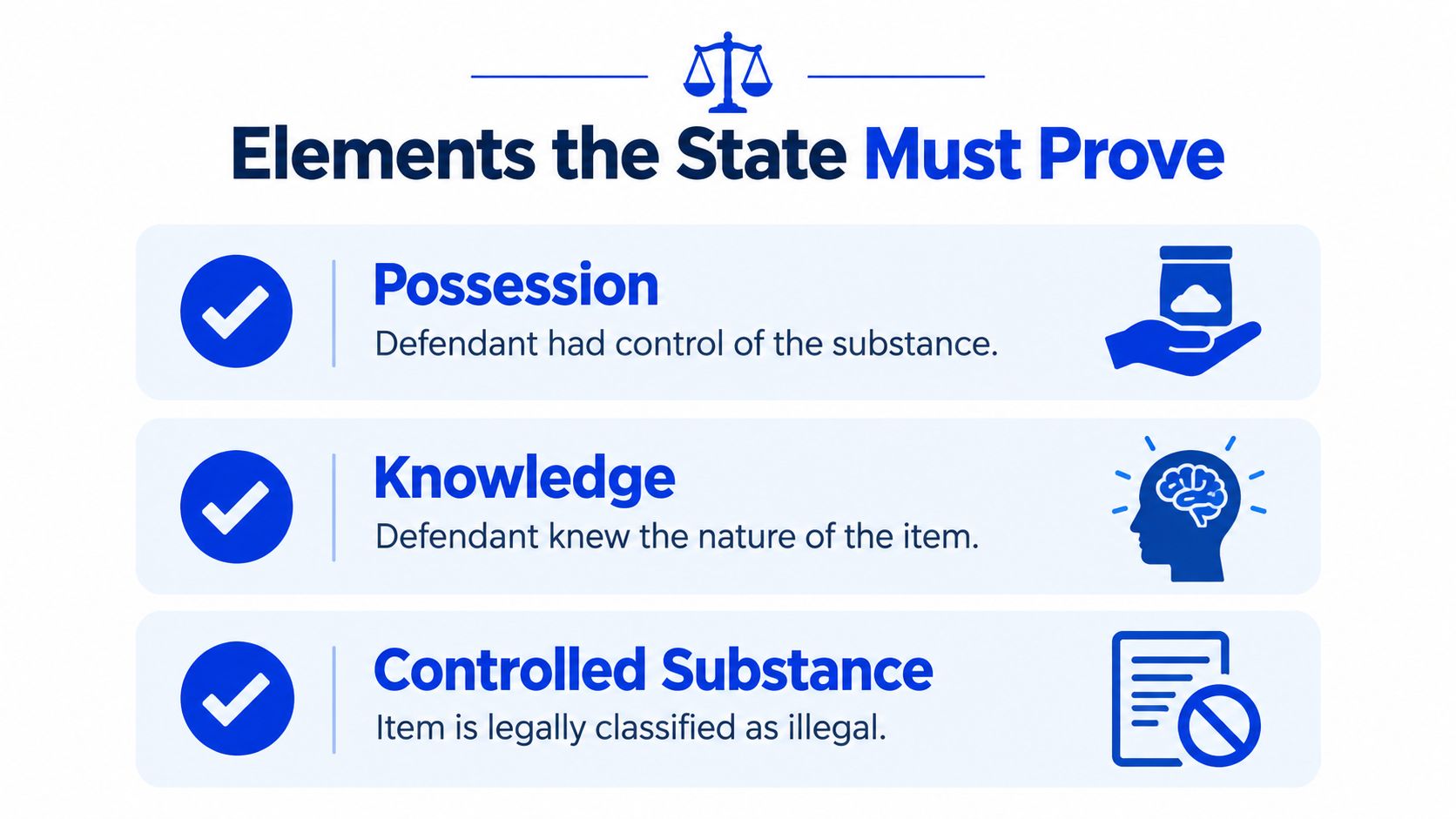
At trial, the State must prove the charged conduct beyond a reasonable doubt. For a possession allegation, that generally requires proof that the defendant knowingly possessed the item, that the defendant exercised control over it, and that the item was a controlled substance under Florida law.
Possession can be actual or constructive. Actual possession usually involves an item found on the person or within immediate physical control. Constructive possession is more contested. It can arise when the State claims the defendant knew the substance was present and had dominion and control over the place or item where police found it.
Shared occupancy creates a recurring problem. If officers find drugs in a bedroom occupied by several people, or in a car with multiple passengers, proximity alone may not establish exclusive control. Prosecutors may point to fingerprints, admissions, keys, personal documents, text messages, packaging, or conduct suggesting control. The defense should test each inference rather than accept the location of the seizure as the conclusion.
Knowledge has two separate meanings
The State must prove knowing possession or knowing sale or delivery. But Florida law treats knowledge of the substance's illicit nature differently. Under the statutory design described in Section 893.101 and incorporated into Section 893.13, lack of knowledge that the substance was illicit is an affirmative defense, rather than an element the State must prove in its initial case.
When a defendant raises that affirmative defense, the statute permits a presumption that the possessor knew the illicit nature of the substance. The defense must therefore be developed with evidence, not merely asserted. Relevant facts may include how the item was obtained, who packaged it, whether the defendant had access to the location, and what the defendant was told about it.
This differs from the question of whether the defendant knowingly possessed the item at all. A person may argue that the State failed to prove control, while separately arguing that the person lacked knowledge of the substance's illicit nature. The distinction is technical but consequential.
For a practical explanation of shared-space allegations, review constructive possession in Florida drug cases. The defense should examine the physical evidence, witness accounts, laboratory documentation, and every step between seizure and courtroom presentation.
From Misdemeanor to Felony to Trafficking
Florida's penalty structure depends heavily on the substance and quantity. A small cannabis possession allegation can be treated differently from possession of a Schedule I or II substance. The charge can change again when prosecutors allege intent to sell or when the weight reaches a trafficking threshold.
The statutory framework includes misdemeanor exposure for certain lower-level possession conduct, including 20 grams or less of cannabis, while larger amounts and many other controlled substances can create felony exposure. The classification also depends on the specific subsection and facts alleged. Before discussing a plea, counsel should confirm the substance, laboratory result, weight, applicable schedule, and exact charging language.
The felony consequences are substantial. For certain third-degree felony possession offenses, Florida law provides for up to five years in prison and a $5,000 fine, as reflected in the statutory framework for Chapter 893 offenses. Florida Statute 893.13 identifies the prohibited conduct and felony treatment for many violations.
Penalty escalation under Florida Statutes 893.13 and 893.135
Offense Level | Drug Type / Quantity | Max Prison | Max Fine |
|---|---|---|---|
Second-degree misdemeanor | Cannabis at or below the applicable low-quantity threshold | Up to 60 days | Statutory misdemeanor fine |
First-degree misdemeanor | Certain lower-level possession conduct | Up to 1 year | Statutory misdemeanor fine |
Third-degree felony | Certain Schedule I or II substances, or cannabis above the misdemeanor threshold | Up to 5 years | $5,000 |
Trafficking | Substance and weight meeting Section 893.135 thresholds | Mandatory minimum and felony maximums vary | Statutory fine varies by threshold |
Trafficking is not the same as having “a lot of drugs” in a conversational sense. Section 893.135 assigns specific thresholds and penalties. For example, cannabis above 25 pounds but below 2,000 pounds carries a 3-year mandatory minimum and a $25,000 fine. For certain opioids, including oxycodone or hydrocodone, 4 grams or more but less than 14 grams carries a 3-year mandatory minimum and a $50,000 fine. These figures come directly from Florida's trafficking statute.
The practical lesson is to separate personal-use intent from trafficking classification. A defense lawyer must investigate weight methodology, mixture calculations, lab testing, possession, and whether the State can connect the defendant to the entire alleged quantity. The phrase “it was mine for personal use” may not defeat a trafficking charge if the statutory threshold is met.
For cannabis-specific charging questions, see when marijuana possession becomes a felony in Florida. The answer depends on the statutory amount and the evidence supporting possession.
How Florida's Mens Rea Rule Reshapes Defense Strategy
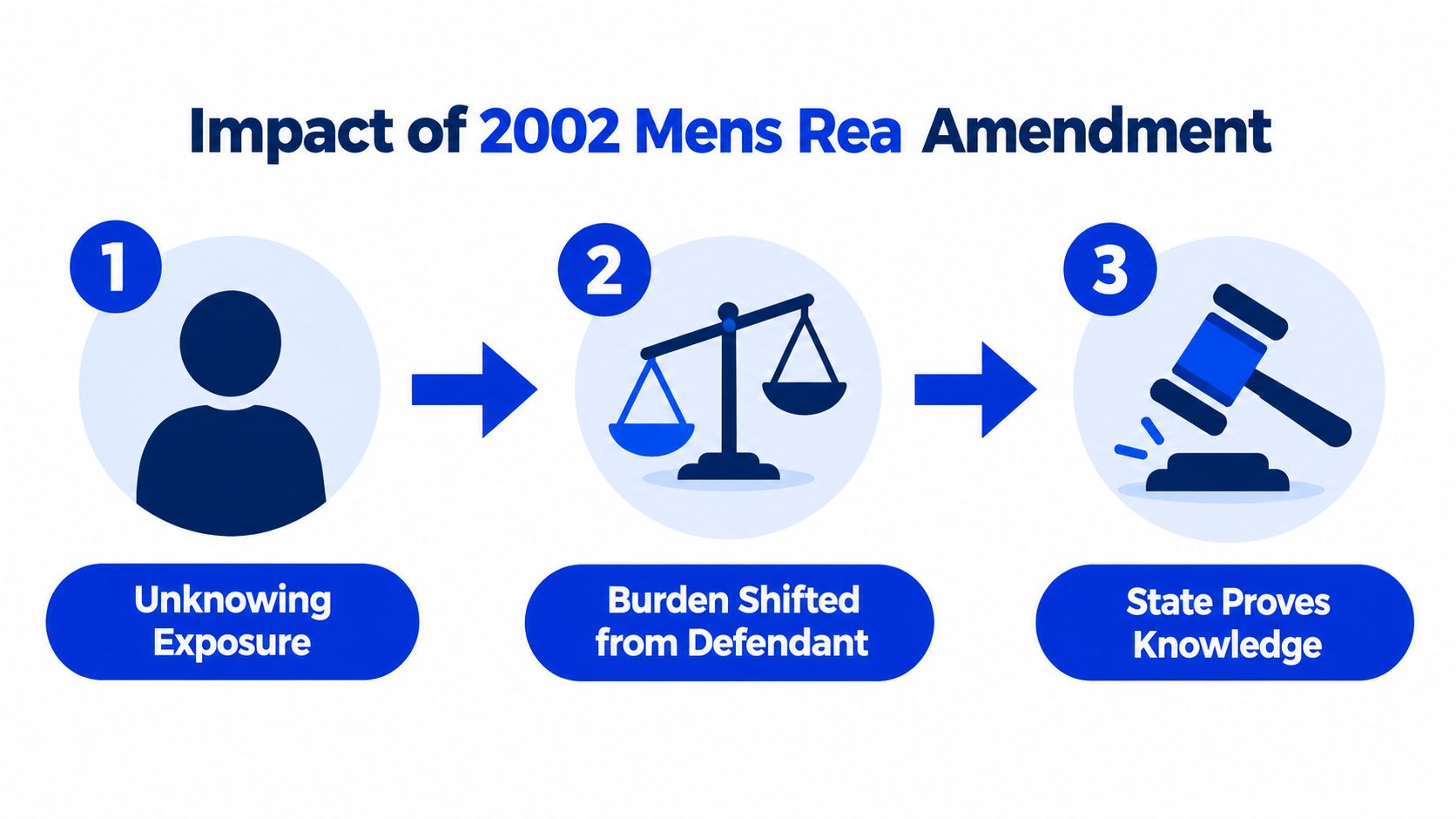
The 2002 amendment changed the way Florida drug prosecutions address knowledge. Before that shift, the State faced a burden involving whether the accused knew the illicit nature of the substance. The amended framework removed that prosecution burden on the illicit nature question and made lack of such knowledge an affirmative defense. The Florida Supreme Court later upheld the constitutionality of that design in a 2012 decision by a 5-2 vote, as reflected in the legislative and statutory history materials for Section 893.13.
The statute still requires proof of knowing possession or knowing sale and delivery. The difficult distinction is that “knowing” does not require the State to prove the defendant understood that an item was illegal. When contraband appears in a shared apartment, borrowed car, workplace locker, or package, the defense must separate three issues: who possessed the item, who controlled the location, and whether the defendant knew its illicit nature.
Why suppression often matters more than explanation
A traditional knowledge defense can become a credibility contest. The jury may hear that the defendant didn't know what was in a bag, while the State presents photographs, messages, access evidence, and statements that suggest otherwise. If police obtained the evidence through an unlawful stop, an invalid consent search, or an unsupported warrantless entry, a suppression motion attacks the foundation of the case instead of asking jurors to choose between competing stories.
That is why defense counsel should begin with the how-we-found-it question. Review the confidential informant information, surveillance, warrant affidavit, consent language, body-camera footage, K-9 deployment, traffic-stop basis, and chain of custody. A weakness in the search may eliminate the physical evidence that strengthens the prosecution's case.
The Eleventh Circuit has recognized the unusual mens rea structure of Section 893.13 in federal contexts, including recidivist and immigration analysis. A prior Florida drug conviction can therefore create consequences beyond the Florida sentence, particularly when federal authorities classify the offense differently from comparable offenses elsewhere. The Eleventh Circuit decision interpreting Section 893.13 illustrates why the plea decision must account for more than the immediate offer.
Arrest, Search, Bond, and Plea Pathways
After a drug arrest in Broward, Miami-Dade, or Palm Beach County, the case moves through several decisions that affect bargaining position. Officers may arrest without a warrant when they claim probable cause exists at the scene. Booking follows, and a felony defendant generally faces a first-appearance proceeding within 24 hours under Florida's procedural framework. The judge may address release, conditions, and probable cause.
Bond conditions can include drug testing, no-contact provisions, travel or geographic restrictions, and court appearances. Violating a condition can create a separate problem, even when the underlying drug charge remains unresolved. Read what happens after an arrest in Florida before making assumptions about the next court date or release requirements.
The search is often the first serious battleground
A lawyer should examine more than whether officers had a warrant. The review may include:
Traffic-stop justification: Did police have a lawful reason to stop the vehicle, and did the encounter last longer than that reason permitted?
Consent: Did the person understand the request, have authority to consent, and voluntarily agree?
K-9 activity: Did officers use the dog during a lawful detention, or did the sniff prolong the stop?
Inventory procedures: Did officers follow a standardized process, or was “inventory” used as a pretext to search?
Apartment entry: Did officers have valid consent, a warrant, or circumstances recognized by law?
The defense may seek suppression under the Fourth Amendment and Article I, Section 12 of the Florida Constitution. Whether suppression succeeds depends on the precise facts, not on the label police place on the search.
Resolution options require a full consequence review
Eligible nonviolent defendants may be considered for pretrial intervention, treatment-based drug court, or county-specific programs. Prosecutors may also offer reduced charges, a withhold of adjudication, or a sentence involving county jail rather than state prison. These options can be meaningful, but they aren't automatically safe for every defendant.
A withhold of adjudication may still be treated as a conviction for immigration purposes. A plea that appears minor on the offer sheet can affect professional licensing, employment screening, housing, financial aid, or future sentencing. A defense lawyer should evaluate those consequences before recommending acceptance.
Collateral Consequences Beyond the Courtroom
A Section 893.13 case doesn't end when a defendant leaves court. The disposition may affect driving privileges, employment, housing, education, licensing, and immigration status. Those consequences often influence whether the defense should seek dismissal, diversion, a carefully structured plea, or trial.
Florida law can impose a six-month driver's license suspension for a first-time drug offense, with longer suspensions or permanent revocation in repeat situations, according to the statutory framework described in the research materials. Affected drivers may need to address hardship-license issues through the Florida Department of Highway Safety and Motor Vehicles. The suspension can interfere with work, school, medical appointments, and family responsibilities even when no jail sentence is imposed.
Where the record can follow you
Category | First Offense | Felony or Repeat |
|---|---|---|
Driving privileges | Suspension may disrupt employment and transportation | Longer suspension or permanent revocation may become an issue |
Employment | Background checks may reveal the case or disposition | Felony records can create broader screening and licensing problems |
Professional licensing | Boards may review the conduct and outcome | Nurses, teachers, contractors, and other licensed workers may face discipline |
Education and aid | Federal financial-aid eligibility may be affected | A felony disposition can complicate continued education and funding |
Housing | Landlords and public-housing agencies may consider drug records | Felony or repeat conduct may increase denial or termination risks |
Immigration | Non-citizens may face federal consequences from a drug disposition | Trafficking-related outcomes can create especially severe classification issues |
Employers and licensing boards don't always treat a withhold as though nothing happened. Background-check databases may show the arrest, charge, disposition, or later court activity. Public-housing rules and federal financial-aid rules operate independently from the judge's sentencing decision.
Immigration requires separate analysis. Federal law can treat a Florida controlled-substance conviction as a basis for removability or inadmissibility under INA 212(a)(2). A trafficking disposition may also be treated as an aggravated felony in circumstances recognized by federal law. The unusual mens rea structure of Section 893.13 can matter in that analysis, which is why non-citizens should obtain immigration advice before entering a plea.
For post-case options, including whether a disposition may qualify for sealing, review Florida record sealing requirements. Sealing doesn't erase every federal, licensing, or immigration consequence, so eligibility and limitations must be assessed carefully.
Why Early Legal Help Changes the Outcome
The first seventy-two hours after an arrest, search, or target letter are often the most useful time for defense preservation. Video may be overwritten, witnesses may become difficult to locate, and electronic records may disappear under ordinary retention practices. Early counsel can send preservation requests, identify independent witnesses, secure 911 audio, obtain surveillance footage, and document the client's account before memories change.
Early intervention can also prevent a case from escalating. A lawyer may challenge the basis for a traffic stop, examine whether police had probable cause to arrest, contest buccal-swab consent, or address an investigation before prosecutors file formal charges. In some circumstances, counsel can explore pre-filing options such as Miami-Dade Drug Court, Broward Behavioral Health Court, or Palm Beach pretrial intervention, subject to eligibility and prosecutor approval.
The strategic connection
Suppression and mens rea analysis work together. If a court excludes physical evidence because police violated the Florida Constitution or the Fourth Amendment, the State may lose the most persuasive proof of possession, control, identity, or intent. The remaining case may depend on statements or circumstantial evidence, and that can change plea bargaining power.
The opposite is also true. If the evidence remains admissible, the defense must address the statutory knowledge framework directly. That may involve showing shared access, challenging constructive possession, disputing laboratory identification or weight, developing the affirmative defense concerning illicit nature, or presenting an alternative explanation supported by admissible evidence.
The most useful preparation is concrete:
Preserve the timeline: Write down where officers were, what they said, who consented, and when items were located.
Protect communications: Don't delete texts or ask others to change their accounts.
Avoid new statements: Don't discuss the facts with police, codefendants, or potential witnesses without legal advice.
Identify collateral risks: Tell counsel about immigration status, licenses, employment, housing, school, and prior cases.
Review every offer carefully: A reduced charge or withhold may still carry consequences outside Florida criminal court.
Ticket Shield, PLLC handles Florida drug investigations and prosecutions, including challenges to searches, possession theories, and charge reductions, with direct attorney communication and early case evaluation. Contacting a criminal defense attorney before the first arraignment date is the single highest-value step an accused person can take because it preserves options before evidence, negotiation position, and collateral protections narrow.
If you're facing a Florida Statute 893.13 investigation, arrest, or court date, Ticket Shield, PLLC can review the search, possession evidence, charging decision, and potential immigration or licensing consequences. Visit Ticket Shield, PLLC to request a confidential consultation and discuss a defense plan for your South Florida case.