
Animal Abuse a Felony in Florida: Laws and Penalties
Jason Goldsmith, Esq
You're standing in the kitchen in Broward or Miami-Dade, staring at a notice, a deputy card, or a call from animal control, and the question hits fast, is animal abuse a felony or are you looking at a misdemeanor that can still wreck your record? In Florida, the answer turns on facts, not panic. The line between a county-jail case and a prison-level case depends on what the State can prove, and that's where a defense gets built, or lost.
If the accusation is serious, move like it's serious. Don't explain yourself to investigators, don't guess at the law, and don't assume the label in the report is the final word. A felony charge is a legal conclusion, not a verdict, and early legal advice often decides whether the case stays in misdemeanor territory or escalates into a permanent criminal record. For a plain definition of what counts as a felony charge in Florida, see this overview of felony charges.
Table of Contents
When Animal Abuse Becomes a Felony in Florida
A lot of people hear “animal cruelty” and assume every case is the same. It isn't. Florida treats some conduct as a misdemeanor and other conduct as a felony, and the difference usually comes down to intent, custody, and the severity of the animal's suffering.
A South Florida pet owner can go from worried to booked in a matter of hours. A complaint comes in, an investigator sees the animal, and before the owner has even had a chance to gather records, the case starts moving toward charging. That is why the first move matters so much, because once statements are made and photographs are circulated, the defense is working uphill.
Practical rule: If animal control or law enforcement wants your side of the story, speak only after counsel has reviewed the file.
Quick Comparison of Florida Animal-Cruelty Charge Levels
Offense Level | Statute | Maximum Prison | Maximum Fine |
|---|---|---|---|
Ordinary animal cruelty | Florida Statute 828.12(1) | Up to 1 year in jail | Up to $5,000 |
Aggravated animal cruelty | Florida Statute 828.12(2) | Up to 5 years in prison | Up to $10,000 |
The charging decision matters because the criminal process moves fast. Booking, first appearance, bond conditions, and no-contact restrictions can all happen before the defense has a full picture. That's why the right question isn't just whether the allegation sounds bad, it's whether the State can prove the felony elements and survive a challenge to the evidence.
For a defendant, that distinction affects more than the punishment range. It affects plea options, negotiation position, and whether a record can ever be sealed. When the case starts as a felony, the pressure from day one is different, and that's exactly when defense counsel should start narrowing the charge.
The Two Tiers of Florida Animal Cruelty Law
Florida's cruelty statute has two tiers, and the legislature drew the line on purpose. Ordinary cruelty under section 828.12(1) is typically a first-degree misdemeanor, while aggravated cruelty under section 828.12(2) is a third-degree felony. The State has to match the facts to the correct tier, not just pick the harsher label because the case drew attention.

Ordinary Cruelty Under Section 828.12(1)
Ordinary cruelty covers conduct like unnecessarily tormenting, overdriving, overloading, mutilating, or killing an animal, or depriving it of necessary sustenance or shelter. The key word is unnecessarily. That word does a lot of work in these cases, because it forces prosecutors to prove that the conduct wasn't justified by the circumstances.
A misdemeanor charge is still serious. It can bring jail exposure, probation, and collateral consequences that follow people into work, housing, and family disputes. But it is not the same thing as a felony, and defense counsel should push back when the charging paper stretches the facts beyond what the statute supports.
Aggravated Cruelty Under Section 828.12(2)
Aggravated cruelty is different because Florida treats it as conduct that causes cruel death or excessive or repeated unnecessary pain or suffering. The State can also proceed when the accused owned or had custody or control of the animal and failed to act. That's the move prosecutors use in neglect cases when the facts show long-term deprivation rather than a one-time incident.
Florida also added a separate third-degree felony for abandoning a dog restrained outside during a natural disaster, effective October 1, 2025, under section 828.13(4). That tells you the category is expanding, not shrinking. If the facts fit aggravated cruelty, the State will charge it that way, but if the facts fit neglect, abandonment, or ordinary cruelty, the defense should demand the lower classification.
What Prosecutors Must Prove to Make It a Felony
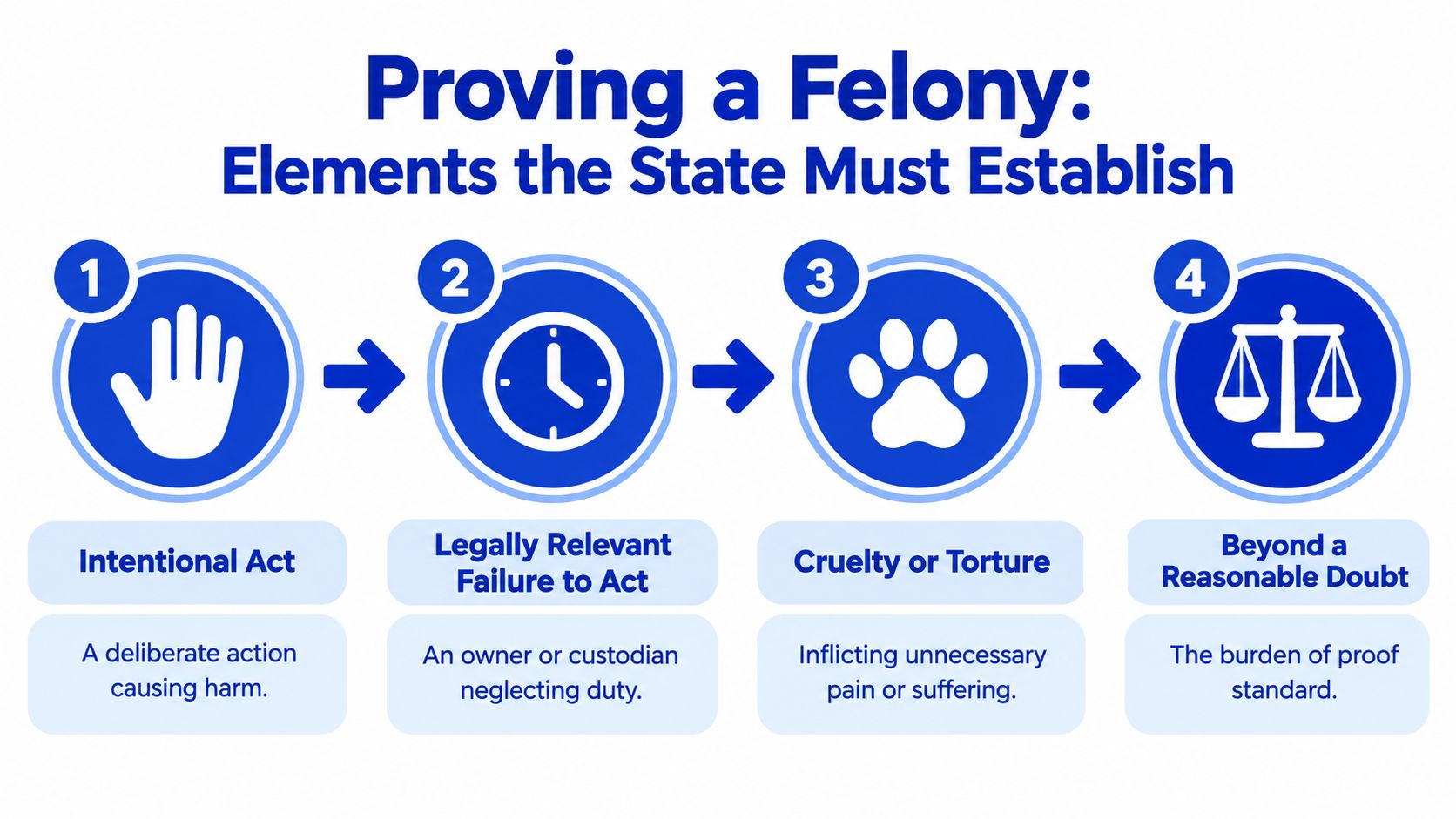
A felony cruelty case doesn't rise or fall on the emotion of the allegation. It rises or falls on proof. The State has to establish the statutory elements beyond a reasonable doubt, and each element gives the defense a place to fight.
The State Has to Connect Conduct to Harm
The first issue is whether the accused intentionally committed the act, or, in a failure-to-act case, whether the person had custody or control and legally relevant responsibility for the animal. Prosecutors try to turn bad conditions into felony intent, but bad conditions alone are not enough. The charging language has to fit the statute, and the evidence has to support it.
The second issue is causation. The State must connect the act or omission to the animal's cruel death or qualifying suffering. If the defense can show a different cause, such as disease, age, accidental trauma, or a prior injury, the felony theory weakens fast. That's why the exact timing of symptoms, treatment, and intervention matters so much.
“Unnecessary” Is a Real Legal Standard
Florida doesn't punish every harsh result. It punishes unnecessary pain, suffering, or deprivation. That means a defense lawyer should immediately ask whether the conduct was unjustified, whether there was a lawful purpose, or whether the facts are being stretched after the fact.
The State may be loud at the arrest stage. It still has to prove each statutory element in court.
The FBI's NIBRS rollout helps illustrate how the offense is treated at the federal reporting level, but it does not change the need for proof in a Florida courtroom. Animal cruelty is classified by the FBI as a crime against society, and NIBRS data began being reported by participating agencies in 2016, with 1,126 animal-cruelty cases in the FBI's first published release containing the category for 2016. The takeaway is simple, raw allegations are not convictions, and raw counts are not the same as proven felony conduct. FBI NIBRS data release
Penalties, Sentencing Points, and What They Mean in Practice
A third-degree felony sounds abstract until you see how Florida scores it. Under Florida's Criminal Punishment Code, aggravated animal cruelty under section 828.12(2) is scored as a Level 5 offense, and Florida law adds a 1.25 multiplier when the primary offense involved knowing and intentional torture or torment that injured, mutilated, or killed the animal. That multiplier can push the case into a worse guideline position before anyone starts talking about plea offers.
The Real Exposure
The statutory maximum for aggravated animal cruelty is up to 5 years in prison and up to a $10,000 fine. Florida's legislative analysis also states that a third-degree felony generally carries up to 5 years' imprisonment and a fine up to $5,000, while the referenced felony-penalty provision can authorize a fine of up to $10,000. In practice, the exact sentencing result depends on the scoresheet, the plea posture, and the judge's lawful options.
What matters in the courtroom is not only the label, but the mechanics. A case can start as a felony and still resolve with a reduced charge, a withhold, counseling, restitution, or a negotiated disposition that keeps a prison score off the table. Those outcomes are case-specific, not automatic.
Why Sentencing Math Changes the Defense
Florida's sentencing system is mechanical. That means the defense has to check the math early, especially when there's more than one count, more than one animal, or aggravating facts the State wants to use to multiply exposure. A client who thinks the case is “just one bad incident” may be facing multiple counts if prosecutors allege separate acts or separate animals.
Bottom line: The scoresheet can matter as much as the statute title.
For a broader explanation of Florida jail exposure in criminal cases, review how much time in jail a felony case can carry. In animal cruelty prosecutions, the defense goal is often to avoid the felony score altogether, or at least keep the case from landing in a sentencing cell that makes prison the default pressure point.
How Veterinary Evidence Can Make or Break the Case
Animal-cruelty cases are usually won with medical proof, not speeches. The State leans on veterinary reports, photographs, and scene documentation to argue that the injuries were intentional, prolonged, or impossible to explain away. The defense has to test all of it, line by line.
What the Defense Looks For
Veterinary-forensic evidence often comes down to four questions, injury mechanism, timing, alternative causes, and reliability. If the records show preexisting disease, chronic illness, or another explanation for the animal's condition, the felony theory may be overstated. If the timeline is thin, or the photos don't match the report, the State's story can fall apart.
A survey of 200 prosecuting attorneys found that detailed veterinary medical reports, crime-scene documentation, and high-quality photographs were the evidence sources most commonly relied upon, and that forensic necropsies and detailed medical records were important in charging and case outcomes. The same survey also noted that DNA, computer forensics, forensic accounting, blood, and trace evidence were used less often, and that additional veterinary-forensics training was identified as a limitation. Veterinary-forensic survey
Chain of Custody Still Matters
Photographs with metadata, treatment notes, and necropsy records can be powerful, but only if they're preserved and authenticated properly. If there's a gap between the alleged incident and the exam, the defense should ask whether the injury could have progressed, changed, or been misread. If the animal had known medical issues, that history needs to be front and center, not buried in a file.
For cross-examination strategy in this type of case, see how to cross-examine witnesses effectively. The best defense starts with the records, then uses the testimony to show where the State is guessing instead of proving.
Defense Strategies That Actually Work in Florida
The first defense move is simple: read the charging language like it's evidence, because it is. If the State alleges aggravated cruelty, the question is whether the facts support intentional conduct, custody or control, and the specific kind of suffering the statute requires. If one of those pieces is weak, the felony charge is vulnerable.
Attack the Weakest Element First
Intent is usually the first pressure point. Prosecutors often rely on what the owner said, what a neighbor thought they saw, or how bad the animal looked when officers arrived. That can be enough to start a case, but it's not enough to win every case, especially when the defense can show accidental harm, a sudden medical crisis, or a different cause entirely.
The next target is causation. A defense lawyer should compare every statement with the vet records, the dates, and the timeline. If the State can't prove that the accused caused the qualifying harm, the felony theory loses force.
Use the Right Motions Early
A constitutional defense is not optional. If officers entered without a valid basis, or if a statement was taken after the client was effectively in custody without proper safeguards, the defense should move to suppress it. That can shrink the case before trial and sometimes change the charging posture altogether.
Challenge the Search: If law enforcement or animal control entered unlawfully, fight to exclude photos, statements, and anything found after the entry.
Test Custody and Control: In shared households, the State still has to prove who owned, controlled, or was legally responsible for the animal.
Push Mitigation Early: Medical bills, treatment history, financial hardship, and responsible rehoming efforts can all matter in negotiations.
Retain Experts Fast: An independent veterinarian can review the State's theory before the file hardens into a felony information.
Negotiate for the Right Result
Not every case should go to trial, and not every case should be plead straight up. Sometimes the right outcome is a misdemeanor reduction, a withhold of adjudication, or a disposition that keeps the felony off the record. Sometimes the right move is aggressive trial preparation because the State's proof is too thin to survive.
For a broader overview of defense options in criminal cases, see common criminal defense strategies. In animal cases, the defense that wins is usually the one that starts early, stays technical, and refuses to let the accusation outrun the evidence.
New Consequences Most Articles Miss
Florida has made animal-cruelty cases more public and more punitive in ways many people still don't realize. Beginning January 1, 2026, Florida law requires the Florida Department of Law Enforcement to publish a searchable website listing people convicted of, or who entered a guilty or nolo contendere plea to, specified animal-cruelty violations, regardless of adjudication. That means a plea can create public exposure even when the court withholds adjudication.
Florida also enacted a third-degree felony for abandoning a dog restrained outside during a natural disaster, effective October 1, 2025. That matters in South Florida, where storm-related evacuations are a reality, not a hypothetical. A case that might once have looked like a misdemeanor abandonment allegation can now carry felony consequences if the facts fit the statute.
These changes affect more than sentencing. They affect jobs, housing, custody disputes, and plea bargaining power, because the public consequences don't disappear just because someone avoids a prison sentence. The defense has to account for that reality from the start, not after the plea is already on the table.
The key point is simple, felony now means more than jail time. It can mean public listing, special sentencing math, and a record that follows the client well beyond the courtroom.
What to Do Right Now If You Are Facing Charges
If you're under investigation or already charged, treat the next 24 to 72 hours like they matter, because they do. Preserve veterinary records, receipts, photos, text messages, adoption papers, and anything showing the animal's condition over time. Don't post about the case, don't text friends about “what really happened,” and don't give a recorded statement without a lawyer in the room.
Request the court dates immediately and make sure you know when the bond hearing and arraignment are set. If the animal has been seized, act fast on the custody issue, because the civil hearing can move before the criminal case even gets traction. For a practical checklist after an arrest, review what to do when arrested in Florida.
A defense lawyer should read the charging affidavit, compare it to the statute, line up an independent veterinary review, and decide whether the case is best attacked through a motion, a negotiated reduction, or trial. The sooner that happens, the more room there is to keep a felony from becoming the permanent story. Being charged is not the same as being convicted, and early strategy usually decides how much damage the State can do.
Ticket Shield, PLLC defends people facing Florida animal-cruelty charges with the same hard-edged approach we use in other criminal cases, challenge the State's proof, protect your rights, and push for the best lawful result. If you're dealing with a misdemeanor or felony accusation tied to animal abuse in South Florida, visit Ticket Shield, PLLC to get help from a Florida criminal defense team that knows how these cases are built and how to fight them.