Controlled Substance Charges in Florida: A Practical Guide
Jason Goldsmith, Esq
You got stopped in Fort Lauderdale, the officer asked a few questions, and suddenly a small bag, a pill bottle, or something in the glove box is the center of your life. That's how controlled substance charges start for a lot of people in South Florida, not with a dramatic bust, but with a routine stop that turns into a search, an arrest, and a criminal case with real consequences. The smartest move is to understand how Florida treats these cases, where they escalate, and what gives a defense lawyer room to push back.
Table of Contents
What Happens When You Are Stopped With a Controlled Substance in Florida
A stop on I-95, on Broward Boulevard, or after a minor traffic issue can turn into a controlled substance case fast. An officer sees something in plain view, asks for consent to search, and now your car, your bag, or your pockets are part of a criminal investigation. If the item is a prescription bottle with the wrong label, a small amount of pills, or a substance the officer thinks is illegal, the stop can move from traffic enforcement to arrest in minutes.
The first decision that matters
What happens next usually depends on one thing, whether the police had a lawful reason to stop you and then a lawful reason to search you. If they didn't, the case can fall apart. If they did, the State will try to build the case around what was found, who controlled it, and what the substance was, and that's where the defense starts attacking the facts.
Practical rule: don't talk your way out of a controlled substance arrest. People almost always say more than they should, and prosecutors use those statements later.
That's why the first hours matter so much. In South Florida, police and prosecutors often focus on whether they can turn a simple possession stop into something more serious by pointing to pills, packaging, cash, or the way the substance was found. If you want the search-and-seizure side of that issue explained in plain English, this guide on reasonable suspicion versus probable cause is the right place to start.
What a defense lawyer looks for immediately
A former prosecutor looks at the case differently than most clients do. The question isn't just “Was there a drug?” The questions are, who found it, where was it found, who had control over it, was the search legal, and can the State prove knowledge and possession beyond a reasonable doubt.
If the stop happened in Fort Lauderdale, Miami-Dade, or Palm Beach County, the local context matters too. Task-force work, shared vehicles, and highway stops often create sloppy police reports. Those are the cases where a careful defense can expose weak assumptions before they harden into felony charges.
How Florida Classifies Controlled Substances
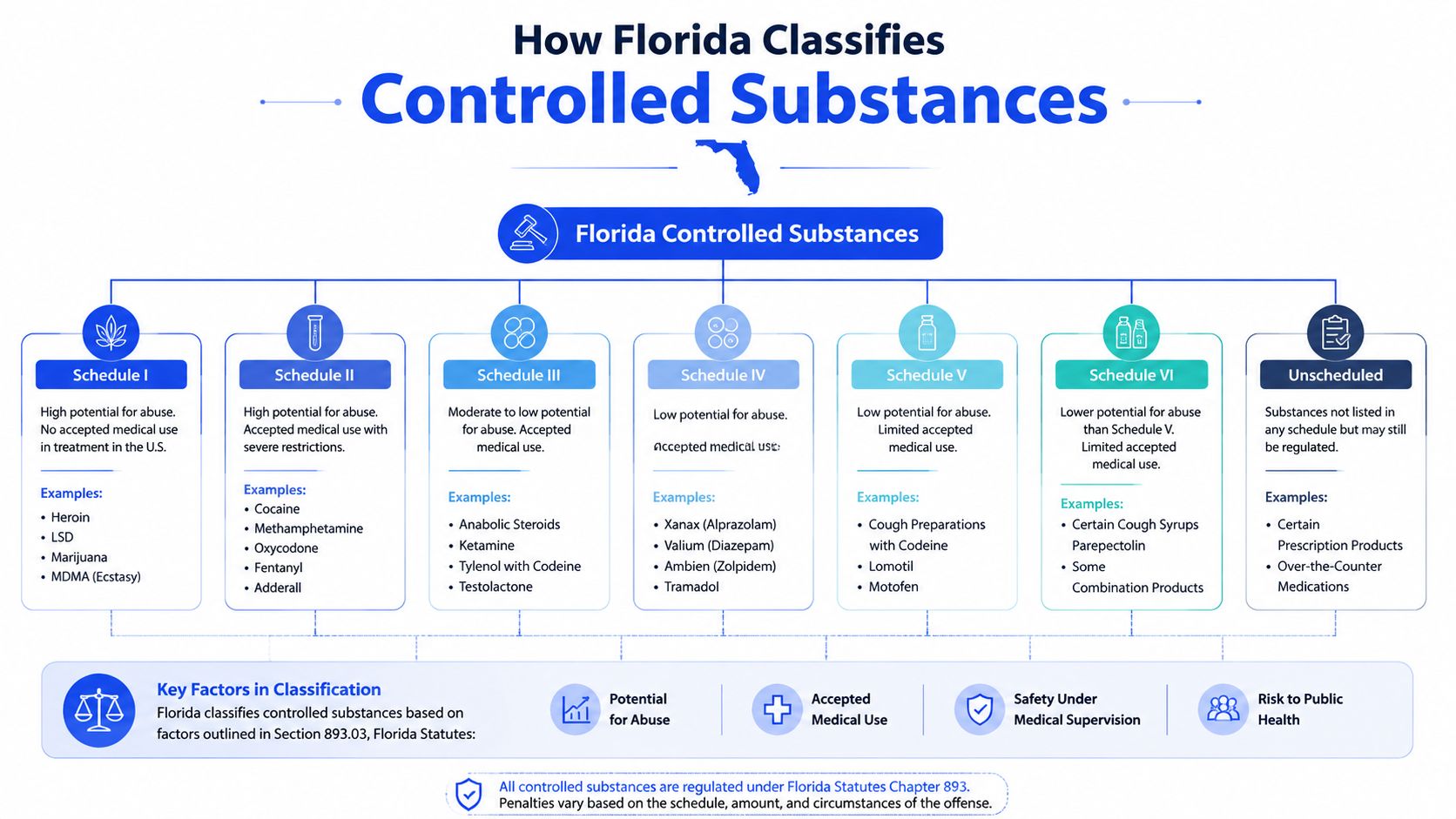
Florida uses a schedule system that tracks the federal model, and that schedule matters more than people usually realize. The drug's classification shapes how prosecutors charge the case, how judges view risk, and how much pressure the State brings to the table. Federal law organizes controlled substances into five schedules, with Schedule I reserved for drugs with a high potential for abuse and no currently accepted medical use, while later schedules reflect lower abuse potential and more accepted medical use, as explained in the federal overview from Congress's research service on the Controlled Substances Act R45948.
Why the schedule changes the whole case
A charge involving Schedule I or Schedule II drugs usually gets treated as more serious than a case involving a lower schedule. Heroin and fentanyl are common examples of Schedule I drugs, while oxycodone and cocaine are commonly treated as Schedule II substances. Ketamine and testosterone appear in lower schedules than heroin or fentanyl, benzodiazepines like alprazolam are commonly treated as Schedule IV medications, and small codeine preparations may fall into Schedule V.
Prosecutors use that label fast. A Palm Beach County arrest for a Schedule I substance can draw a harder charging decision than a prescription medication case in the same courthouse, even before the lawyer argues about possession, knowledge, or the legality of the stop. The schedule does not decide guilt, but it tells the State how aggressively to start.
The schedule is only one part of the analysis
Federal scheduling decisions consider eight statutory factors, including abuse potential, pharmacological effect, scientific knowledge, abuse patterns, public-health risk, and dependence liability, as reflected in the federal summary R45948. That matters because clients often think “drug charge” is a single category. It isn't.
In Florida, the substance, the quantity, and the conduct all work together. Possession of a small amount of one drug can be handled very differently from possession of a prescription medication without authorization, and both are different again from a case involving delivery, manufacturing, or trafficking allegations. A case that starts with a possession arrest can move toward a sale or delivery theory if officers find packaging, cash, messages, or other facts prosecutors use to argue distribution, which is why Florida sale or delivery controlled substance defense matters so much in a case review. If you do not know the schedule, you do not really know what kind of fight you are in.
From Possession to Trafficking How Charges Escalate
A lot of people get blindsided. A case that starts as “the officer found something in the car” can move upward because of quantity, packaging, or where the item was located. Prosecutors do not need a dramatic drug ring to charge harder. They usually need a substance, some circumstantial evidence, and a theory that the facts show more than personal use.
The ladder prosecutors climb
Common Florida Controlled Substance Charge Tiers | Typical Conduct | Key Trigger |
|---|---|---|
Simple possession | Holding a controlled substance without authorization | Knowledge and control over the item |
Possession with intent to sell or deliver | Carrying drugs plus facts suggesting distribution | Packaging, scales, cash, repeated short-term traffic |
Trafficking | Possessing an amount prosecutors say crosses a threshold | Weight, mixture, or purity level |
Manufacturing or cultivation | Producing, preparing, or growing a controlled substance | Equipment, process, or growing operation |
A passenger in a car, a roommate in a shared home, or a person staying in a friend's apartment can get dragged into a case through constructive possession. That means the State will argue the person controlled the item even if it wasn't in their hand. Actual possession is direct physical custody. Constructive possession is the theory prosecutors reach for when the drugs were nearby but not in someone's pocket, and that distinction often decides whether the case is strong or flimsy. A Florida defense overview that discusses sale or delivery theories is here.
The hidden clues prosecutors use
Officers and prosecutors look for the kind of details that suggest distribution rather than personal use. Those details can include baggies, bindles, scales, large amounts of small bills, or frequent short-term traffic at a location. Quantity matters too, because a weight that looks small to a client can still be enough to push the charge higher once the substance is measured the way the law allows.
A lot of clients lose the case mentally before the lawyer even gets involved. They assume the amount automatically proves guilt. That's exactly where the defense starts, by challenging possession, intent, and the way the substance was weighed or found.
The smart move is to focus on the actual facts, not the label on the charging document. In Broward or Miami-Dade, that often means fighting the State on who had control, what the police really saw, and whether the facts support simple possession or something more serious.
Penalties You Could Be Facing in Florida
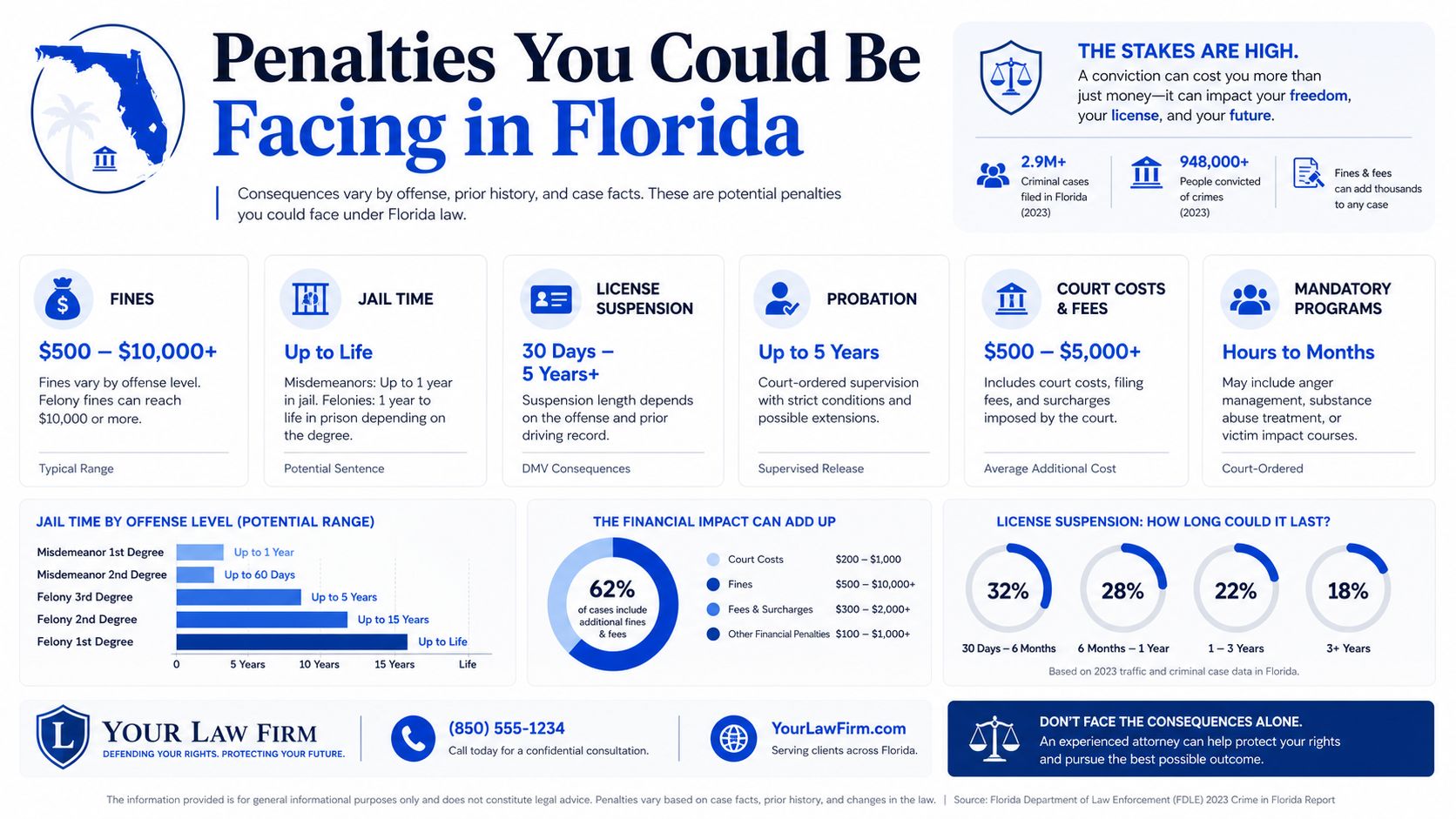
The penalty range in a controlled substance case can swing wildly depending on how the State charges it. Federal drug-penalty materials say federal law can range from less than one year to life imprisonment, with fines from $1,000 up to $4 million for first offenses, depending on the substance and charge federal drug penalties overview. In South Florida, that matters because some cases stay in state court, while others get pulled into a federal system that treats quantity and prior record far more harshly.
What the State can really do
A possession case may be charged as a misdemeanor or a felony depending on the substance and the facts. Once the case is framed as trafficking or a serious federal offense, the exposure gets much worse, and sentencing can follow a completely different track. Federal data on opioid cases shows how severe that system can be, with opioid-related sentencing dominated by trafficking and prison terms that are measured in years, not weekends, in the federal court material BJS federal opioid offenses report.
Consequences clients often miss
The criminal penalty is only part of the damage. A drug conviction can affect your driver's license, immigration status, firearm rights, employment, and housing. If the case crosses county lines, involves interstate conduct, or becomes part of a task-force investigation, the chance of federal involvement rises, and that can change the entire posture of the case.
Florida clients also need to understand that the schedule and quantity issue can trigger much worse exposure than they expected. Federal sentencing materials specifically note threshold amounts for substances such as fentanyl and other controlled drugs, and the same substance can be treated very differently once the amount crosses a line USSC drugs primer.
The bottom line on punishment
The question is not just whether you were arrested. It's whether the charge is built as a low-level possession case or a major felony. That distinction controls the fight over bond, negotiation strategy, and whether a record can later be cleared at all.
Myths That Can Wreck Your Defense
A lot of people make their case worse because they believe something that sounds logical but isn't true in court. One of the biggest mistakes is thinking a small amount automatically means a small problem. Another is thinking a prescription bottle ends the discussion. It doesn't.
The myths I hear most often
“It was only personal use.” That's not a defense by itself. Prosecutors can still pursue possession, and if there are baggies, cash, scales, or quantity issues, they may try to argue intent to sell or deliver.
“It was my prescription.” A valid prescription helps only if the medication and the facts line up. If the bottle isn't yours, the prescription is expired, or the amount doesn't match the lawful authorization, the State can still press the case.
“I threw it away, so there's nothing to prove.” Discarding evidence does not erase the arrest. Officers may still testify about what they saw, and prosecutors may rely on body-cam, witness statements, or physical recovery.
“This is my first arrest, so they'll go easy on me.” First arrest does not equal automatic leniency. Judges and prosecutors still care about substance, quantity, and any aggravating facts.
“If I just explain myself, they'll clear it up.” Talking usually gives the State more to use, not less.
What the law actually cares about
Prosecutors focus on proof, not explanations. They want to show the substance was controlled, the accused knew it was there and knew what it was, possession was unlawful, and the amount was usable rather than residue. A Florida defense summary that discusses these elements and the common circumstantial indicators prosecutors use is here.
Plain truth: the first story you tell police is often the worst story in the file. Once it's recorded, it can be very hard to undo.
The defense job is to replace assumptions with facts. That means challenging what police claim happened, testing whether the substance was what they say it was, and refusing to let a convenient myth become the backbone of the case.
Defense Strategies That Actually Work in South Florida
Strong drug defenses are rarely one magic trick. They're usually a stack of targeted attacks on the State's proof. If one piece fails, the whole case gets weaker. That's especially true in Broward, Fort Lauderdale, Miami-Dade, and Palm Beach cases, where a stop, a search, and a field claim often come before the lab report ever does.
The search is often the first battleground
If police lacked a valid reason to stop you, or if they exceeded the scope of a search, the evidence can be attacked. That's why suppression motions matter so much in controlled substance cases. A detailed explanation of that process is covered in what a motion to suppress evidence does.
Shared spaces create real doubt
Constructive possession cases are often weak because multiple people had access to the same car, bedroom, or apartment. If the drugs weren't in your actual possession, the State has to prove more than proximity. It has to prove control, knowledge, and unlawful possession, and shared spaces often make that a harder sell than prosecutors expect.
Prescription and intent cases need a sharper lens
Doctors, patients, and pharmacy-adjacent cases raise a different issue, the mental state requirement. After the Supreme Court's 2022 decision in Ruan, prosecutors must prove a doctor knowingly or intentionally acted outside authorized practice when a valid-prescription defense is raised. That mens rea issue matters because controlled substance allegations aren't all the same, and intent can be the difference between a mistake and a crime.
The defense toolbox in South Florida also includes diversion, negotiated reductions, and pretrial resolutions that can prevent a permanent conviction in the right case. Those options don't appear by accident. They show up when the lawyer spots a weakness the State can't comfortably explain to a judge or jury.
What separates a weak defense from a real one
A real defense doesn't just say “the client didn't do it.” It proves where the State's theory breaks. That can mean bad search work, bad identification, shaky lab evidence, or a lawful explanation the police ignored. Once those facts are in the case, the prosecutor has to deal with them.
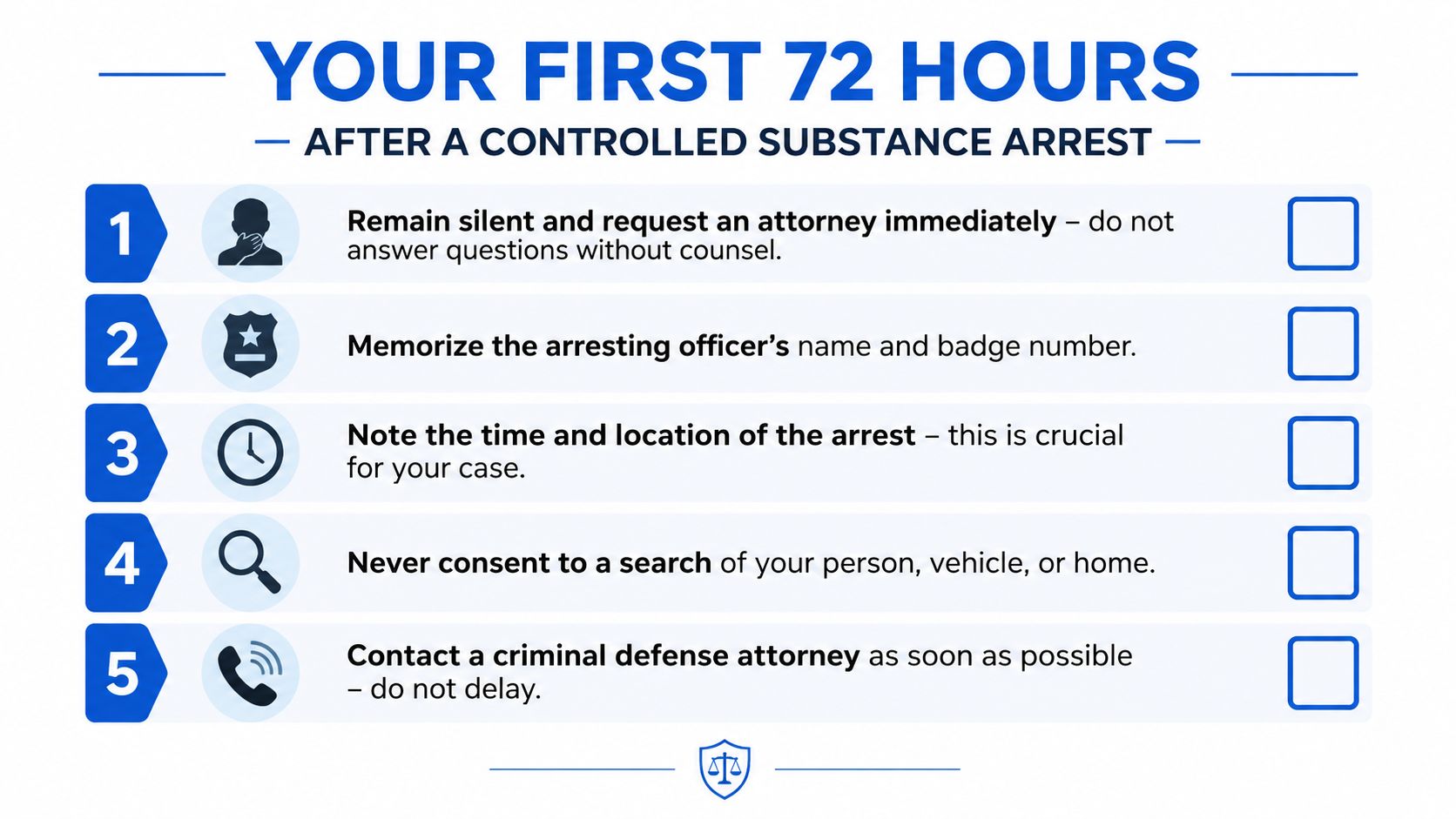
Your First 72 Hours After a Controlled Substance Arrest
The first three days after an arrest are not the time to improvise. Keep your mouth shut, keep your phone use tight, and start preserving anything that supports your version of events. That includes prescription records, pharmacy information, text messages, location data, and names of witnesses who can confirm where you were or what you were doing.
What to do immediately
Stay silent. Ask for a lawyer and stop answering questions.
Write down the arrest details. Officer name, badge number, time, location, and who was with you.
Do not consent to searches. That includes your car, your home, your phone, and your bags.
Avoid social media posts. Even casual comments can come back in discovery.
Collect documents fast. Prescription bottles, appointment records, and pharmacy history can matter quickly.
A short explanation of your rights is in this guide on Miranda rights, and it's worth reading before you talk to anyone about the arrest.
What not to do
Don't call the arresting officer to “clear things up.” Don't message friends about what happened. Don't delete anything from your phone. That kind of cleanup can look worse than the original charge, and it can create new problems the defense didn't need.
Best move: get a defense lawyer involved before the State finalizes the case theory. Early intervention can change what gets filed, what gets reduced, and what evidence gets challenged.
If you're in Broward, Miami-Dade, or Palm Beach County, the sooner the defense starts investigating, the better the odds of catching mistakes before they harden into a formal charging decision.
How a Defense Attorney Changes the Outcome
A defense lawyer changes a controlled substance case by getting in front of the facts early. That starts with reviewing the stop, the search, the police reports, the body-cam, the lab process, and every detail that might let the State overstate the evidence. In many South Florida cases, the State files fast and assumes the client will plead. That's exactly when a lawyer with prosecutorial experience can spot weak charging decisions and push back before the case gets locked in.
What the lawyer actually does
The work usually starts with the search issue, then moves to possession, quantity, and intent. If the evidence is weak, the lawyer can seek suppression, challenge constructive possession, negotiate for a reduction, or press for diversion or another outcome that avoids the worst consequences. If the case is serious, trial preparation has to begin early, because controlled substance cases often turn on details the State assumes nobody will fight.
A former prosecutor knows how charging decisions get made in Broward, Fort Lauderdale, and Miami-Dade. That matters because prosecutors do not treat every case the same way. They look at quantity, history, and aggravation, and a lawyer who understands that mindset can often identify the pressure point that changes the offer.
Quick answers people search after an arrest
Can a controlled substance felony be sealed or expunged in Florida? It depends on the final result and the charge. A withhold of adjudication can matter, but a conviction usually blocks record clearing for many offenses, so the end result has to be protected from day one.
When does a South Florida drug case become federal? Cases can move federal when they involve larger quantities, interstate conduct, or task-force investigations. That matters because federal penalties can be much harsher than state-level exposure.
What about prescription drug charges? A prescription can help, but only if the facts match lawful possession and authorized use. Prescription and medical cases also raise intent issues, especially when prosecutors try to say someone knowingly acted outside their authority.
How long does a drug case take? Misdemeanor cases usually move faster than felonies, but the actual timeline depends on the court, the evidence, and whether the defense is pushing motions or negotiations.
If you're facing controlled substance charges in South Florida, don't wait for the State to define your case for you. Call Ticket Shield, PLLC now for a confidential consultation, get a defense team that knows how prosecutors build these cases, and put someone in your corner who can challenge the stop, the search, and the charge before the damage gets worse. Visit Ticket Shield, PLLC to take the next step today.