What Is Constructive Possession? a Florida Defense Guide
Jason Goldsmith, Esq
A lot of people search what is constructive possession after a bad night turns into a criminal case. A traffic stop in Fort Lauderdale. A car with friends. A backpack under a seat. A firearm in the console. Drugs in an apartment where more than one person lives. Then the officer says you're under arrest, even though the item wasn't in your hand, pocket, or bag.
That feels backward because it is counterintuitive. But it's also a common way prosecutors file charges in Broward County, Miami-Dade, Palm Beach, and across South Florida. They use a theory called constructive possession to argue that you legally possessed something without physically holding it.
That charge is serious, but it is not automatic. In Florida courts, the State still has to prove specific things. In shared cars, shared homes, hotel rooms, and other joint-occupancy situations, that's often where the case becomes vulnerable.
Table of Contents
Arrested for Something That Wasnt Even Yours
A common South Florida scenario goes like this. Police stop a car in Broward County. There are several people inside. Officers search the vehicle and find narcotics in the center console or a gun under a seat. Nobody claims it. Yet one person, or sometimes more than one person, ends up charged.
That's where constructive possession comes in. The doctrine functions as a legal fiction that equates non-physical control with actual possession, enabling charges for possession crimes even when the item is never found on the person. It comes up often in drug and weapons cases because people rarely keep incriminating items openly in their hands. That basic framework is reflected in this overview of constructive possession.
For the person in handcuffs, the thought is usually the same. It wasn't mine. How can they charge me with it?
The short answer is that police can charge first and leave the hard proof for later. The better question is whether prosecutors can prove the case in court.
Practical rule: Being near contraband is not the same as legally possessing it.
That distinction matters in Fort Lauderdale criminal courts and throughout South Florida. Shared access changes the analysis. If the item was found in a place that several people could reach, the State doesn't get to skip over the problem of who knew about it and who controlled it.
The early stage of the case also matters more than is generally understood. Bond conditions, court dates, and release terms can affect work, driving, and family life within days, which is why it helps to understand how pretrial release works in Florida criminal cases as soon as possible.
If you're facing this charge, don't assume the arrest means the evidence is strong. In many joint occupancy cases, the State starts with suspicion and tries to build certainty later. That gap is where a defense is often found.
Actual Possession vs Constructive Possession
In practice, the difference is straightforward. The fight over proof usually is not.
Actual possession means the item was on you or being carried by you. A baggie in a pocket, a firearm in a waistband, or pills inside a purse are common examples.
Constructive possession means prosecutors are saying something different. They are claiming you knew the item was there and had the present ability to control it, even though it was found somewhere else. Florida courts recognize that theory, but they do not let the State prove it by proximity alone. A useful summary of that rule appears in the Florida Bar Journal's discussion of constructive possession law.

A courtroom example shows why this matters. If officers find cocaine in your hand, the State is working with direct physical possession. If the same cocaine is found in a center console of a car with three occupants, the case changes. Now prosecutors need to tie that console, and the drugs inside it, to a specific person through real evidence instead of assumption.
That is where joint occupancy cases in Broward and Miami-Dade often start to weaken. Shared cars, shared apartments, and shared bedrooms create a proof problem for the State. Police may arrest everyone in reach of the item, but prosecutors still need evidence that points to one person's knowledge and control. A key, a statement, fingerprints, texts, exclusive access to a locked space, or personal items mixed with the contraband can matter. The absence of those details can matter just as much.
If your case involves drugs, our page on Florida possession of a controlled substance charges explains the broader charge and penalties.
A quick Florida comparison
Aspect | Actual Possession | Constructive Possession |
|---|---|---|
Location of item | On the person or being carried | In a car, room, safe, console, bag, or other place not physically on the person |
Type of proof | Direct physical custody | Knowledge plus the ability and intent to control |
Typical dispute | Whether the item was actually found on the accused | Whether the accused knew about it and had dominion over it |
Joint access issue | Usually less central | Often the key issue in shared cars, homes, and hotel rooms |
Defense focus | Search legality, identification, testing | Knowledge, control, access by others, and lack of independent proof |
Constructive possession cases are often won or lost on the missing link. In a shared apartment, who used the closet? In a borrowed car, who owned the backpack? In a hotel room, who had the key card and whose property was near the item? Those are the questions that decide whether the State has a theory or actual proof.
That distinction matters more than the label. Actual possession cases often turn on what was found and where. Constructive possession cases, especially in joint occupancy settings, turn on whether prosecutors can prove the connection they are asking a jury to infer.
What Florida Prosecutors Must Prove for a Conviction
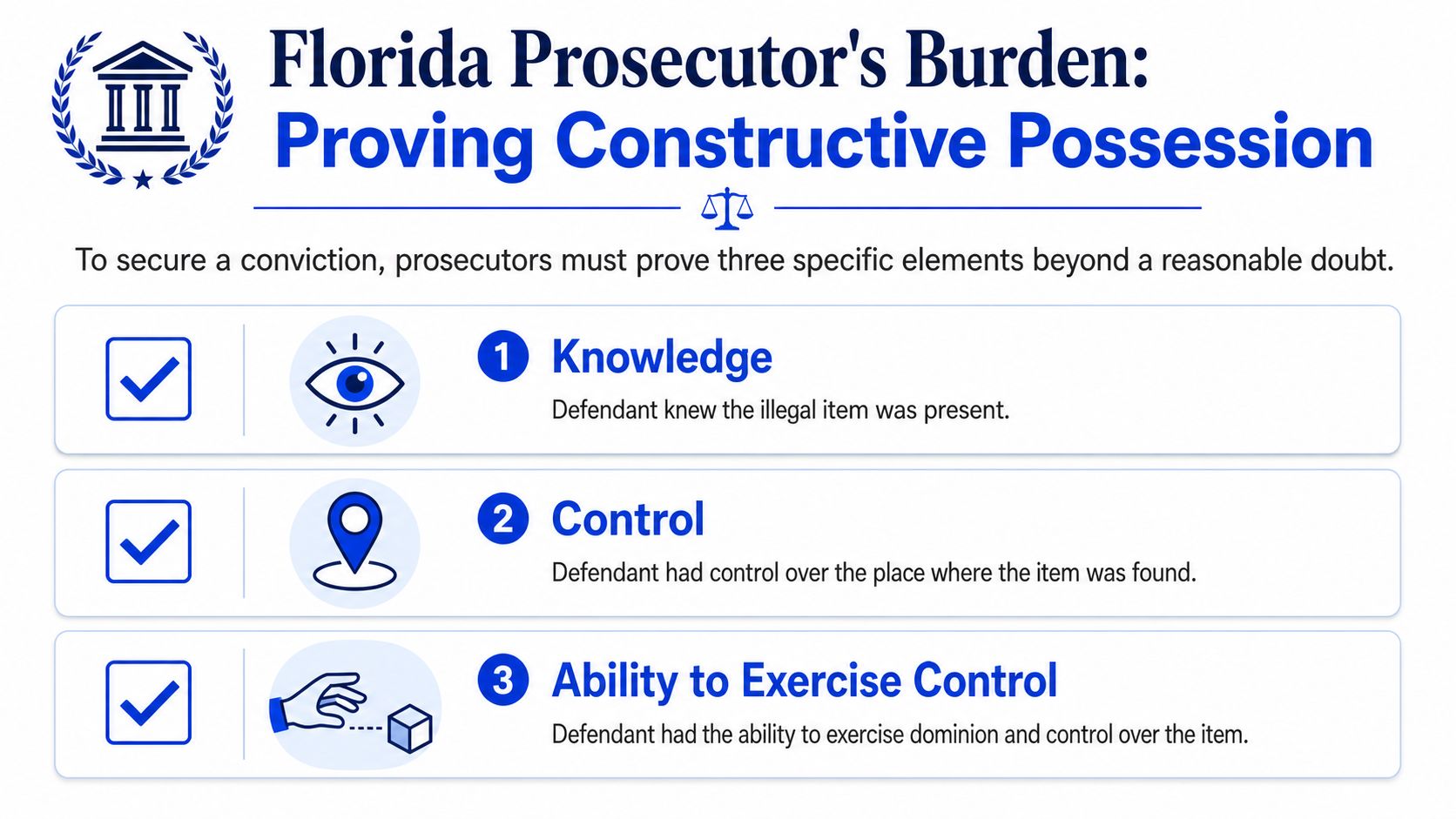
In Florida, the State must prove three specific elements beyond a reasonable doubt to convict someone of constructive possession: (1) knowledge of the presence of the substance, (2) knowledge of the illicit nature of the substance, and (3) dominion and control over the substance or the location where it was found, as explained in this Florida constructive possession summary.
If prosecutors miss even one of those elements, the case has a serious problem.
Knowledge of the item's presence
The State must show you knew the item was there. That sounds obvious until you apply it to real facts. A passenger may not know what is under another person's seat. A roommate may not know what is inside a cabinet, closet, or shoebox in a common area.
This is one reason search issues matter so much. The legality of the stop, the search, and the seizure can affect whether the evidence comes in at all, which is why defenses often begin with a close look at illegal search and seizure issues in Florida cases.
Knowledge of the item's illicit nature
The prosecution must also prove you knew the item was illegal in character. In drug cases, that means the State must prove more than your presence in the room. In weapons cases, context can matter just as much.
A container, bag, or console can hold many lawful things. If the State can't bridge the gap between access and awareness, it may not be able to prove this element beyond a reasonable doubt.
Dominion and control
This is usually where constructive possession cases are won or lost. Dominion and control means more than being close to the item. It asks whether you had the power to exercise control over it or over the place where it was found.
Courts do not convict based on mere proximity alone. In practice, prosecutors look for facts they can argue show control, such as:
Exclusive access: Only one person used the room, car, locker, or container.
Possession of keys: A key to a trunk, glove compartment, or safe may become part of the State's theory.
Statements or conduct: Admissions, gestures, evasive behavior, or attempts to hide something often appear in police reports.
Connection to the location: Lease documents, rent payments, or ownership records may be used to tie a person to the area.
A constructive possession case often rises or falls on whether the State can connect the person to the item, not just the person to the scene.
In Fort Lauderdale, Miami, and other Florida courts, juries are asked to decide whether those facts prove possession or whether they only create suspicion. Suspicion isn't enough.
Real-Life Examples of Constructive Possession Charges
These cases are easier to understand through the situations that bring people into court.
Drugs in a shared car
A driver and two passengers are stopped in Miami-Dade. Police search the car and find pills in the center console. Everyone is within reach of the console, but that doesn't mean everyone possessed the pills.
Florida law draws an important distinction when only one person is in the vehicle. Under Gibson v. State, being the sole occupant of a vehicle when drugs are found in plain view within the defendant's ready reach creates a prima facie case of constructive possession, which can allow a jury to find guilt without additional evidence, as discussed in this analysis of the Gibson vehicle rule.
That does not mean the same shortcut applies in a multi-passenger car. In a shared vehicle, the prosecution usually needs more to tie one person to the item.
A center-console case might raise questions like these:
Who used the car regularly
Who was driving
Whether the item was visible
Whether anyone made statements
Whether the console also held one person's property
Those details often matter far more than the arrest report's conclusion.
Contraband in a shared apartment
This is one of the most common Broward and Palm Beach scenarios. Police execute a search warrant at an apartment or house. They find drugs in a kitchen drawer, living room cabinet, or bedroom nightstand. More than one adult lives there, stays there, or comes and goes regularly.
That fact pattern often sounds stronger on paper than it is in court. A lease proves residence. It does not automatically prove knowledge of a specific item in a specific place. Shared housing creates built-in reasonable doubt when the State cannot show who exercised control.
In joint occupancy cases, prosecutors need facts that point to a person, not just an address.
If the item was found in a common area, the defense will want to know who else had access, who kept belongings nearby, whether the item was hidden, and whether the police found any direct evidence tying the accused to it.
This video gives a helpful general overview of how constructive possession gets argued in criminal cases:
Weapons in a locked safe
Locked containers create another common dispute. Suppose officers find a firearm in a safe inside a bedroom closet. The State may argue constructive possession if you had access to the room, knew the firearm was inside, and had the ability to control the safe or its contents.
But access is not the same thing as proof. In real cases, lawyers look closely at who owned the safe, who knew the code, who used the room, where the key was kept, and whether the room itself was shared.
That's why constructive possession charges often look strongest at arrest and less certain after careful review. Shared cars, shared apartments, and shared storage spaces all force the State to prove a personal connection, not just a nearby object.
How a Defense Attorney Fights These Charges in Court
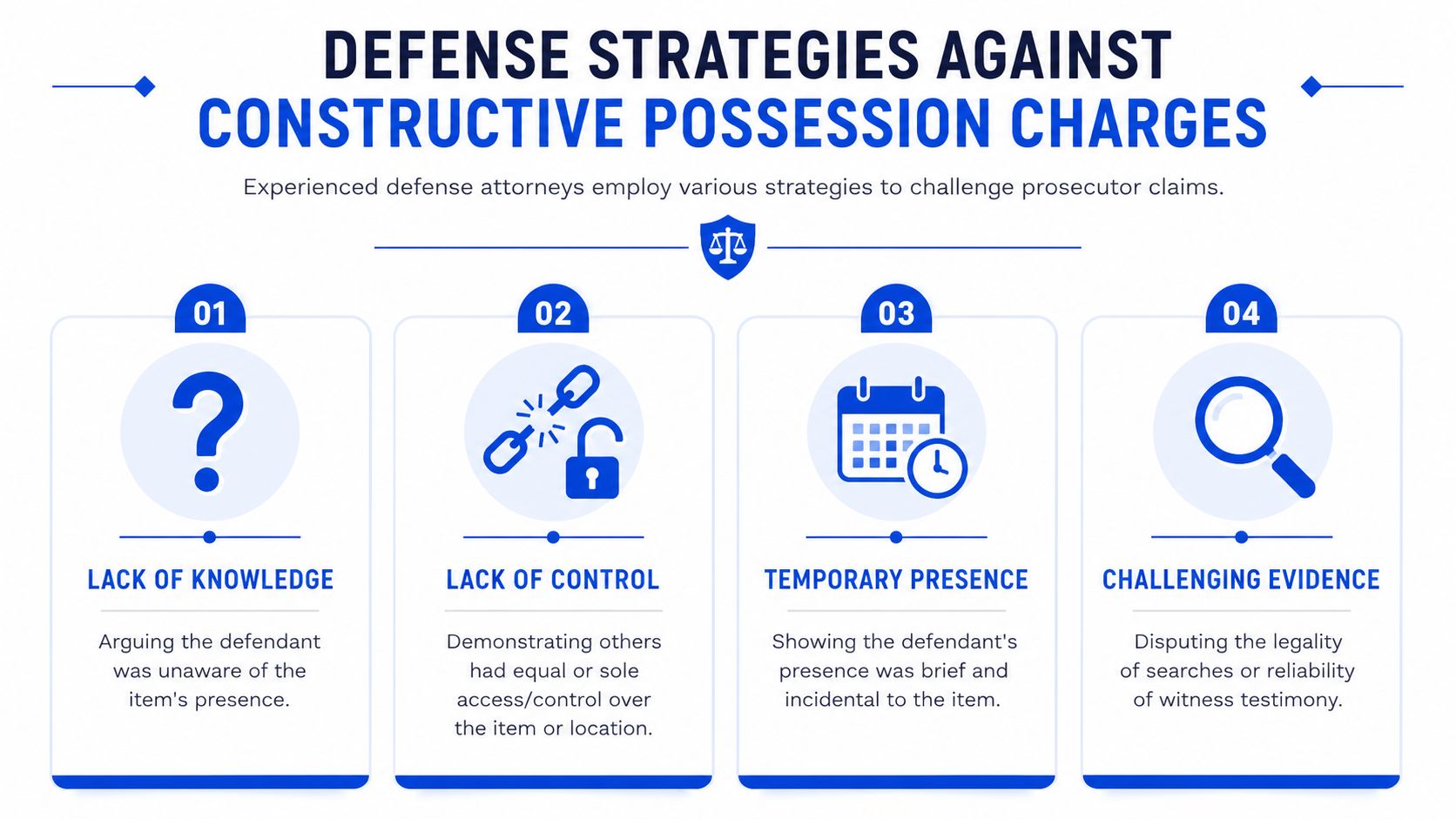
The most effective defense is usually direct and disciplined. Instead of arguing about everything, a strong lawyer attacks the exact gaps in the State's proof.
In shared spaces such as cars or living rooms where multiple people have access, Florida courts require additional independent evidence to tie the defendant personally to the narcotics, such as fingerprints, admissions, or proof of exclusive access, as noted in this discussion of constructive possession in shared spaces.
Attacking the knowledge element
A defense attorney starts by asking a basic question. What shows the client knew the item existed?
Sometimes the answer is weak. The item was hidden. It was under a seat, inside a closed bag, buried in a drawer, or mixed in someone else's belongings. In those cases, the State may rely on assumptions that don't hold up once the facts are tested.
That testing often includes:
Reviewing body camera footage: Officers sometimes describe visibility or access differently on video than in a report.
Comparing statements carefully: One witness says the item was obvious. Another says it was concealed.
Examining location details: A hidden item in a common area is different from an item sitting in plain view on a single person's desk.
Disputing dominion and control
This is often the strongest defense path in Broward and Miami-Dade courts. The more people with equal access, the harder it becomes for the prosecution to prove one person exercised control.
Useful defense themes may include:
Shared access to the area
Multiple roommates, passengers, guests, or family members had the same opportunity to place, move, or hide the item.No exclusive authority
The client didn't own the container, didn't control the room alone, and didn't have the only key.No signs of use or handling
The State may have a theory of control, but no practical evidence that the client ever retrieved, moved, used, or disposed of the item.
Defense focus: Joint occupancy is not a loophole. It is a real evidentiary problem for the prosecution when it cannot single out one person with reliable proof.
Arguing lack of proof in joint-occupancy cases
A lawyer also challenges the quality of the investigation itself. Police sometimes arrest the easiest person to charge, not the person they can prove possessed the item.
That is where cross-examination becomes critical. Officers must explain why they tied the item to one person and not another, why no additional testing was done, and why obvious alternate explanations were ignored. The mechanics of that process matter, especially when preparing to cross-examine witnesses effectively in a criminal case.
What usually doesn't work is an unstructured explanation from the accused trying to talk police out of the arrest at the scene. What often does work is forcing the State to confront missing evidence, inconsistent reports, and assumptions dressed up as proof.
Penalties for Conviction are Just as Severe
A constructive possession charge can expose you to the same punishment as any other possession case. Florida does not reduce the penalty because the item was found under a seat, in a shared bedroom, or inside a console instead of in your hand.
What drives sentencing is the underlying accusation. If prosecutors file a simple possession case, the penalties follow that offense. If they file possession with intent, trafficking, or a firearm-related possession charge, the exposure rises with that charge. The label "constructive" changes how the State tries to prove the case. It does not make the case minor.
That matters because people charged in Broward or Miami-Dade often underestimate the risk in shared-space cases. They assume the case will fall apart because the drugs or gun were not found on them. Sometimes it does. Sometimes it does not. If the State gets past the proof problems, the court can still impose serious consequences.
A conviction may lead to jail or prison, probation, a lasting criminal record, license consequences in some drug cases, immigration problems for non-citizens, and trouble with jobs, housing, or professional licenses.
Why timing affects the outcome
Early defense work can change the value of the case long before trial. I look first at the charging decision, the lab status if drugs are involved, the body camera footage, who lived in or used the space, and whether the reports overstate "control" without facts to back it up. In joint occupancy cases, those details often shape plea negotiations as much as they shape trial strategy.
Prosecutors are more likely to hold firm when the file looks clean and unanswered. They are more likely to reassess when the defense quickly points out missing fingerprints, inconsistent statements, unclear ownership of the area, or other residents and passengers the police barely investigated.
That is the practical trade-off. Waiting gives the State time to settle into its theory. Acting early gives the defense time to challenge the charge before that theory hardens into the version repeated in court.
Protect Your Rights and Contact Our Firm Today
If police charged you for something that wasn't in your hand, pocket, or bag, don't assume the case is hopeless. Constructive possession charges are common in South Florida, especially in shared cars, apartments, and other joint-access situations. They are also defendable when the State can't prove knowledge, illicit nature, and control with reliable evidence.
Don't try to explain your way out of it with law enforcement after the arrest. Don't guess about what matters. And don't assume that being near an item makes you legally responsible for it.
Use your right to remain silent. Ask for a lawyer. Get the facts reviewed quickly by someone who knows how Broward County, Fort Lauderdale, Miami-Dade, Palm Beach, and surrounding Florida courts evaluate these cases.
Ticket Shield, PLLC represents people charged with drug crimes, gun and weapons charges, probation violations, DUI, theft offenses, domestic violence allegations, federal crimes, juvenile cases, search and seizure issues, and other criminal matters throughout Florida. The firm is available 24/7, and Attorney Jason S. Goldsmith brings the perspective of a former prosecutor to case analysis and defense strategy.
If you need help now, contact Ticket Shield, PLLC for a free, confidential consultation. You can speak directly with a Florida criminal defense attorney about constructive possession, drug charges, weapons allegations, DUI, record sealing, probation violations, and other criminal cases in Broward County, Fort Lauderdale, Miami-Dade, Palm Beach, and across South Florida.
Florida can charge you for contraband found near you, not just on you. Learn how constructive possession works and how to defend against it.